Can a Cane-Using Traveler See the Nasrid Palaces and Generalife in One Granada Visit?

Updated
The myth: a cane either makes the full Alhambra impossible or changes almost nothing
Neither assumption is useful. A cane-using traveler may be able to see the Nasrid Palaces and the Generalife in one Granada visit, but the answer does not come from the cane itself. It comes from how that traveler manages sustained standing, repeated gradients, uneven transitions, an out-and-back palace route if the reduced-mobility itinerary is used, and the outdoor distance between the palace zone and the Generalife. Two people who both use a cane can have entirely different days: one may walk a kilometer comfortably but need a seat after ten minutes of standing; another may stand through a long explanation yet find cobbles, descending ramps or a second uphill segment destabilizing.
The most realistic verdict is therefore conditional. Combining both headline areas is credible when the traveler can tolerate a multi-hour heritage visit with deliberately placed pauses, when the group treats the Nasrid Palaces time as fixed, and when everyone accepts that the Generalife may need to be shortened to its lower, more practicable portions. It becomes a poor plan when the traveler requires reliably available seating at short intervals, cannot repeat slopes after fatigue has accumulated, or would be distressed by a route change, split exit or missed reunion.
This is also why an Alhambra plan should not be reduced to “three hours” or “about a kilometer.” The official FAQ says a general visit takes around three hours, but that is a site-wide estimate rather than an accessibility promise. The same FAQ also says the Alcazaba, Nasrid Palaces, Partal and Generalife can each be entered only once, even though visitors may leave and re-enter the wider complex. Those rules make pacing decisions consequential: once a controlled zone has been left, a later recovery does not restore that entry. See the official Alhambra FAQ for the current wording.
For the wider context of shaping the day rather than merely collecting monuments, this comfort-first Alhambra planning guide explains why the rest of Granada should be built around the visit’s physical load rather than added automatically.
What “one visit” should mean for a cane-using traveler
There are three different ambitions hidden inside the phrase “see the Nasrid Palaces and Generalife.” The most demanding is a continuous circuit that includes the standard palace progression, Partal, the full walk east, the Generalife’s lower and upper garden sequence, and perhaps the Alcazaba as well. A more realistic combined visit shares the Nasrid Palaces and a selected Generalife route while omitting the Alcazaba and treating the upper gardens as optional. A third version keeps both headline names on the same date but divides them into two blocks, using the official ability to leave and re-enter the larger complex while respecting the single-entry rule for each controlled area.
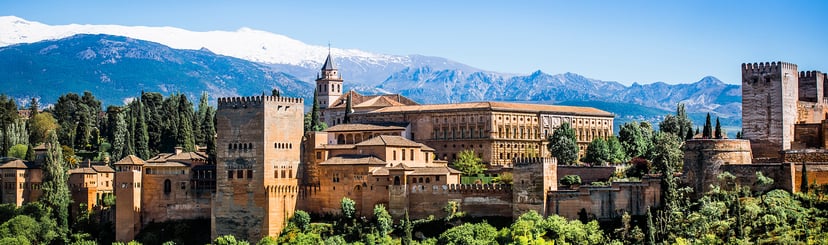
Those versions are not semantic refinements. They produce different physical demands. The Alhambra and Generalife form an elongated complex, not a single palace with a garden immediately outside its final room. The Nasrid Palaces sit in the central-western monumental zone near the Palace of Charles V and Puerta del Vino. The Partal landscape extends eastward from the palace sequence. The Generalife occupies a separate garden zone farther east, reached through outdoor circulation that may include surface and gradient changes. A traveler who feels successful on level palace paving can still find the connecting walk or the return from the Generalife to the main access area to be the part that changes the day.
The Alhambra interactive map gives useful scale indicators. Its predefined-route table displays the Generalife at 497 metres and eight minutes, the Nasrid Palaces at 894 metres and fifteen minutes, the Alcazaba at 832 metres and thirteen minutes, and the Palace of the Partal at 605 metres and ten minutes. These figures should not be added as though they were a complete itinerary, and the displayed times are not cane-user pacing estimates. They are best read as evidence that each named area contains meaningful movement of its own. They do not include the time spent looking, waiting, standing while a group compresses at a doorway, pausing for interpretation, finding a service point or moving between zones. The figures can be checked on the Alhambra interactive map.
Route judgment: for this article, a “full combined visit” means both the Nasrid Palaces and a substantive Generalife experience, not every publicly visitable corner of the complex. Adding the Alcazaba to the same plan is a separate escalation. Its towers, steps and defensive geometry are physically different from the palace and garden demands, and the municipal wheelchair guidance identifies the Alcazaba as inaccessible. A cane user who can manage some steps may still choose it, but it should not be smuggled into the plan as a minor add-on.
Distance is only one part of the physical load
The official accessibility map is unusually helpful because it does not present the Alhambra as a single smooth path. It distinguishes gradients of 1–3%, 3–6%, 6–9% and 9–12%, and it separates regular pavement from uneven pavement and cobblestones. It also marks practicable segments for people with disabilities, rest areas, toilets, visitor services and wheelchair-support points. The point is not that every cane-using visitor will follow every marked segment. The point is that the site itself recognizes several kinds of friction that a simple distance figure conceals. The source is the official Alhambra accessibility map.
For a cane user, four loads need to be considered separately. The first is moving distance: the total accumulation of corridors, courtyards, exterior paths and the connection to the Generalife. The second is standing time: a traveler may cover the route but struggle when a group pauses upright for several minutes in a room without a usable seat. The third is surface work: cobbles and uneven paving demand more attention, shorten stride and can make the cane placement less predictable. The fourth is gradient repetition: a slope that is manageable when fresh may feel very different after palace circulation, especially if an out-and-back arrangement makes the same transition occur twice.
These loads do not rise together. A traveler with arthritis may find prolonged stillness more painful than slow walking. Someone with balance impairment may prefer a gentle continuous slope to a succession of thresholds. A traveler recovering from surgery may have adequate balance but a strict endurance limit. A person with neurological fatigue may look strong at the beginning and then decline quickly once concentration and sensory load accumulate. None of these profiles can be inferred from age, appearance or the style of cane.
A useful pre-visit conversation therefore asks concrete questions rather than “Can you walk?” How long can the traveler stand without leaning or sitting? Is downhill more difficult than uphill? Can the traveler manage a short uneven section when people are close on both sides? Does a five-minute pause restore capacity, or does pain continue to build despite stopping? Is the cane mainly for confidence, for weight-bearing, or for unpredictable weakness? Does the traveler need a handrail on steps, and if so, does the cane occupy the hand that would otherwise use it? The answers shape the route more reliably than a generic mobility label.
Editorial interpretation: the combined visit is often limited by the sequence of loads rather than by the single hardest segment. Palace standing followed by the Partal-to-Generalife walk can be harder than either component alone. Likewise, a garden route that feels pleasant at the start can leave too little reserve for the return to the access pavilion. The planner should track cumulative effort and the location of the next dependable exit, not just the next beautiful space.
The Nasrid Palaces are a controlled circulation problem, not merely an indoor walk
The Nasrid Palaces have a fixed admission time. The official FAQ states that visitors must be at the palace entrance at the time printed on the admission, and missing that time means losing access. That rule changes accessibility planning because a rest cannot simply expand indefinitely before the palace. The party needs to arrive with a margin that is generous for the traveler’s pace but not so early that the traveler spends the reserve standing near the entrance. For a detailed day-level sequence, this guide to building Granada around the Nasrid Palaces time helps separate what must be fixed from what should remain conditional.
Inside, the challenge is not necessarily a long uninterrupted distance. It is the combination of narrow historic spaces, thresholds, changes in direction, slow group movement and limited freedom to retreat. The official accessibility material acknowledges narrow rooms, steps and uneven areas across the monument, while also describing adapted itineraries for reduced mobility. A cane user who follows the standard public route may be able to access more than a wheelchair user, but that does not make the standard route automatically preferable. Extra rooms can mean extra thresholds and a longer one-way progression before a comfortable exit.
The separate Nasrid Palaces accessibility plan is especially important. It states that the accessible route enters and exits through Puerta del Príncipe and is an out-and-back itinerary. It also says that, at the time of that plan, the Hall of the Abencerrajes and the Hall of the Two Sisters were not accessible to people with reduced mobility. The plan’s arrows show prescribed circulation through selected palace spaces rather than unrestricted wandering. Current arrangements should be confirmed because access measures and temporary works can change. The exact source is the official Nasrid Palaces accessibility plan.
The out-and-back design has two consequences that are easy to miss. First, a transition encountered on the way in may have to be encountered again when the traveler is more tired. Second, the accessible traveler may return to the palace-side entrance area rather than emerge with visitors following the ordinary continuation toward Partal. A companion party must know whether it will remain together on the adapted route, whether only part of the group is permitted to accompany the traveler, and where everyone will reunite if circulation separates them. This is an operational question for staff on the day, not something to guess from a diagram.
Standing tolerance matters here as much as walking tolerance. The Court of the Myrtles, the Court of the Lions and the decorated rooms invite close looking, but a slow interpretive stop can become a physical burden when no seat is available exactly where the narrative naturally belongs. A private guide or family member can adapt by moving essential context to a rest point before entry, keeping in-room explanations concise and returning to detail later. That preserves the cultural experience without asking the cane user to prove endurance through prolonged stillness.
The Partal-to-Generalife relationship is where many combined plans become unrealistic
Visitors often imagine that the Generalife simply follows the Nasrid Palaces. In narrative terms, the transition is elegant: royal residence gives way to gardens, cultivation, water and views. In physical terms, the relationship is less seamless. The Partal and the routes east create a substantial outdoor middle between palace concentration and the Generalife garden sequence. That middle may involve exposure, variable paving, gradients and the absence of a guaranteed seat at the exact point fatigue appears.
The official accessibility map shows a practicable network and identifies the Lower Gardens of the Generalife, but the municipal tourism guidance offers an important caution. It describes approximately half of the Alhambra route as wheelchair-transitable, says staff open a secondary entrance for the Nasrid Palaces, and identifies the palace interior and Lower Gardens of the Generalife as transitable. It also says the Partal and Upper Garden of the Generalife are not wheelchair-accessible. This is wheelchair guidance, not a judgment that a cane user cannot enter those areas. Its value is diagnostic: it tells a planner where major barriers or route discontinuities are significant enough to exclude wheelchair circulation. See the Granada municipal accessibility guidance.
A cane user may be able to walk through Partal and reach upper garden areas, but the group should not treat that as the only meaningful Generalife experience. The Lower Gardens can provide a genuine garden encounter, with long planted axes, water, changing perspectives and the approach to the palace-garden complex. Depending on current access, the traveler may share this lower portion and stop before the more demanding upper sequence. That is a substantive visit, not merely waiting at the entrance while others see the “real” garden.
The sequence after the Nasrid Palaces should therefore include a decision pause before the party commits eastward. That pause is not just for sitting. It is the moment to check gait quality, pain, confidence on uneven surfaces, weather exposure, the distance to the agreed bailout point and whether the traveler can still enjoy rather than merely endure the garden. A cane user who is already shortening stride, leaning more heavily on the cane or becoming quiet from concentration may have reached the point where cultural value falls sharply even if another segment is technically possible.
When the Nasrid Palaces admission is early, “palaces first, Generalife conditional” is usually the cleanest way to protect the non-negotiable element. When the palace admission is later, the Generalife can come first, but only with a firm turn-back plan. The party must not use the interactive map’s eight-minute Generalife figure as a return buffer. That number is a displayed route estimate, not the time required for a cane user to finish a garden segment, exit, find the correct palace approach, use a toilet and arrive calmly for controlled admission.
For travelers whose principal interest is garden design, water and landscape, it may be reasonable to reverse the cultural priority: share the Lower Gardens and the most practicable Generalife sequence while fresh, then use the adapted palace route later. The fixed palace time still governs the day, but the route can acknowledge that the garden is not secondary for every visitor. What matters is that the group chooses its priority before fatigue makes the decision for them.
Rest points are useful only when they are placed before the traveler needs rescuing
The official complex map marks rest areas and several service nodes, while the FAQ identifies toilets at the Entrance Pavilion, in the Nasrid Palaces area and in the Generalife. The accessibility page is more specific about disabled toilets at the Entrance Pavilion and the service pavilion near Puerta del Vino, and it lists toilets in the Lower Gardens of the Generalife. These are valuable anchors, but a toilet symbol should not be mistaken for a guaranteed seat, and a formal rest-area symbol should not be assumed to mean immediate availability in a busy monument.
A robust plan uses two kinds of pause. A micro-pause is brief: the traveler stops, changes stance, leans safely or sits if an appropriate place is available, and the group does not launch into a long explanation. A recovery pause is longer and located at a service or rest node where the traveler can use facilities, drink water, reassess and decide whether to continue. The combined Nasrid–Generalife visit needs both. Micro-pauses manage the route; recovery pauses determine whether the next zone should be attempted.
The timing of pauses matters. Waiting until visible distress appears can make the next safe exit feel much farther away. A planned pause before the palace time, another immediately after the controlled palace route, and a third before entering or ascending farther into the Generalife creates decision points. The traveler should not need to argue for stopping. The group can agree in advance that each decision point is mandatory, even if everyone feels well.
Seating strategy should also distinguish between “a place where one might perch” and a place suitable for the traveler’s actual needs. Some people need a seat with a back; others need arm support to rise; some can use a low stone edge, while others cannot safely lower themselves. Historic courtyards and garden walls should never be presumed usable, both for conservation and personal safety. When reliable seating is essential at short intervals, the group should contact the monument before the visit and ask where formal rest areas are currently available along the intended route.
A support wheelchair can be a contingency for some travelers, but it should not be introduced casually. The official FAQ says wheelchairs may be available at the Entrance Pavilion, subject to availability and identification procedures. Availability is not guaranteed, and switching mobility modes may change which itinerary staff direct the party to use. A traveler who might use a wheelchair as a fallback should discuss that possibility in advance and confirm whether a companion can push, whether the chair can be retained for the necessary period, and how it affects the palace and Generalife routes.
A full shared visit: when it is credible and how to shape it
A shared Nasrid Palaces and Generalife visit is credible when the traveler can manage mixed surfaces, can stand through short controlled intervals, recovers meaningfully after planned pauses and is comfortable with a route that may not include every room or every upper garden section. The group should also have enough time around the palace admission to move at the traveler’s pace without turning every delay into a crisis.
A workable full-route plan begins by removing unnecessary effort outside the monument. Walking up from Plaza Nueva by Cuesta de Gomérez, from Realejo by Cuesta del Realejo, or from Paseo de los Tristes by Cuesta del Rey Chico may be atmospheric, but the official FAQ lists these as uphill pedestrian approaches. For a cane user attempting both principal zones, the climb should not be treated as a warm-up. Arrive by an appropriate authorized bus, taxi or prearranged vehicle plan, and confirm the current drop-off and collection rules. Transport can preserve energy before and after the visit; it cannot remove the internal gradients or controlled circulation.
If the palace time is in the morning, the party can make the Nasrid Palaces the shared cultural core. Arrive at the relevant access area with enough time for facilities and staff questions, but avoid a long standing wait. Confirm whether the traveler will use the standard route or the reduced-mobility route through Puerta del Príncipe. Keep interpretation concentrated on the palace’s spatial logic rather than trying to speak at length in every room. On exit, take a recovery pause near the palace-side service area and decide whether the Generalife target is the Lower Gardens only or a longer garden sequence.
If the traveler remains steady, continue east at a deliberately slow pace. The group should treat the Partal-to-Generalife connection as a segment in its own right, not as dead time between attractions. Use it for light interpretation, visual orientation and short stops rather than pressing forward to “save time.” On reaching the Generalife, prioritize the lower, practicable experience first. Only then decide whether upper areas are appropriate. This order ensures that the traveler receives a meaningful garden visit before any optional ascent or more difficult transition.
If the palace time is later, begin with the Generalife only when the schedule contains a substantial reserve. Visit the Lower Gardens first and set a departure time that is based on the traveler’s slower return pace, not on the map’s nominal minutes. The palace admission is not flexible, so any uncertainty should be resolved by leaving the garden earlier. A late rush across variable surfaces is exactly the kind of situation in which a cane becomes less effective as a balance aid.
A shorter shared visit: preserving both names without pretending all routes are equal
The shortened version is often the best answer for a traveler whose ability is real but variable. It keeps the Nasrid Palaces and Generalife in one date while explicitly reducing either the inter-zone walk, the garden depth or the time spent standing. The success of this approach depends on choosing what will be shortened before the group reaches the decision point.
Keep the Nasrid Palaces complete enough, then use the Lower Gardens as the Generalife experience
This version prioritizes the adapted or most manageable palace route and then enters the Generalife only as far as the traveler can comfortably share the lower sequence. It is suitable for a first-time visitor whose main reason for coming is Nasrid architecture but who would regret seeing no Generalife at all. The planner should avoid language such as “just the lower gardens,” because the phrase can make the traveler feel that the visit is a consolation. The lower approach has its own spatial character and can carry a concise interpretation of water distribution, cultivation, framed views and the relationship between residence and productive landscape.
See the Generalife while fresh, then accept a reduced palace itinerary
This can fit a garden-focused traveler with a later palace admission, provided the return margin is generous. The party visits the most practicable Generalife areas early, rests, and then asks staff about the current reduced-mobility palace route. The tradeoff is that the out-and-back palace itinerary may omit rooms named on the official plan. The cultural compensation is careful interpretation: explain absent rooms with plans or verbal context rather than forcing the traveler onto a route that feels unsafe.
Use two same-day blocks rather than one continuous circuit
The official FAQ allows visitors to leave and re-enter the larger complex while each controlled area remains single-entry. A party with a large gap around the Nasrid Palaces time can therefore visit one zone, leave for a genuine seated recovery period, and return for the other. This is not automatically easier. Exiting, reaching transport, returning through access controls and covering approach distances can consume more energy than staying within the complex. It works only when the break location, transport and re-entry path are known, and when the time gap is wide enough to absorb a slow return without threatening the palace admission.
For a broader one-date structure, this split Alhambra day plan develops the logic of separating palace and garden effort rather than forcing one continuous march.
Route judgment: shortening is successful when it removes the physically expensive part while preserving the intellectual relationship between palace and garden. It fails when the party simply moves faster through the same route. Speed reduces the traveler’s ability to place the cane carefully, increases pressure at thresholds and eliminates the pauses that make the combined visit possible.
A split-party visit: how to preserve group cohesion without making one traveler the limit
Some companion parties contain very different mobility levels. The cane user may want the shared palace experience but not the full Generalife extension; children or stronger walkers may want the upper gardens; one family member may need to stay close to the traveler while others prefer a faster circuit. A split can respect all of those needs, but only when it is designed around named reunion points and the monument’s single-entry rules.
The safest split usually occurs after a shared core, not before it. Everyone enters the Nasrid Palaces together at the fixed time, follows the route authorized for the traveler, and leaves with the main cultural experience in common. At the first recovery point outside the controlled circulation, the party decides whether to continue together. If the cane user stops, at least one agreed companion remains unless the traveler has clearly chosen otherwise and is comfortable navigating the service area independently.
The group should not use “meet somewhere near the Partal” as a plan. Historic garden spaces contain several paths, landmarks can look different from opposite approaches, and the adapted palace route may return to Puerta del Príncipe rather than follow the ordinary exit. Better reunion points are functional and named: the visitor information point at the Entrance Pavilion, the service pavilion near Puerta del Vino, or another currently staffed node confirmed on arrival. A reunion point must be outside any zone that one party may have already exited and cannot re-enter.
A practical split after the palace can work like this. The cane user and companion remain in the central service area for a seated recovery and facilities. The stronger subgroup continues through the Partal and toward the Generalife. Everyone agrees on a final reunion at the Entrance Pavilion or at the prearranged legal collection point, with a fallback time and a phone plan. This sacrifices a shared Generalife experience, but it prevents the cane user from being hurried through the hardest cumulative segment.
Another split keeps the Generalife shared. The entire party travels to the Lower Gardens, pauses at the agreed service area, and then only the stronger subgroup continues to upper garden sections if current access makes that appropriate. The cane user and companion remain in the lower area or begin the return. The reunion should be at a staffed entrance or service node rather than at a fountain, patio or decorative feature inside the gardens. The municipal wheelchair guidance’s distinction between lower and upper areas makes this a logical place to separate the route, even though a cane user’s actual ability may differ from wheelchair criteria.
Ticket and identification handling matters when the group divides. The official FAQ describes Alhambra admission as personal and non-transferable and says visitors should carry their own ticket and identification. Do not leave all documents, medicines, water or phones in the bag of the subgroup that walks away. Each person should have what is needed to exit, rejoin and communicate independently.
For multigenerational parties, this Granada plan with older parents adds useful context on preserving shared experiences without treating the least mobile traveler as an itinerary problem. The same principle applies to younger cane users: mobility needs should shape the plan without defining the person.
Bailout points should be selected before admission, not discovered under pressure
A bailout is not a failure. It is a planned transition from the intended route to a safe, comprehensible finish. At the Alhambra, the best bailout point depends on which single-entry zone has already been used, where the traveler exits, and where authorized transport or services can be reached without adding another difficult segment.
Before the Nasrid Palaces
If the traveler is already struggling before the fixed palace time, the first decision is whether a short recovery can restore enough capacity for the adapted palace route. Because the admission is time-specific, the party should speak to staff immediately rather than waiting until the printed time has passed. The Entrance Pavilion and the service area near Puerta del Vino are practical anchors because the official maps place visitor services and toilets there. The exact procedure for a secondary or adapted entrance must be confirmed on the day.
Immediately after the palace route
This is the most valuable bailout point in a combined visit. The traveler has completed the non-repeatable cultural core and can stop before committing to the long eastward relationship with Partal and Generalife. If the adapted route returns to Puerta del Príncipe, the party should regroup there or at a nearby named service landmark agreed with staff. The next step can be a central rest, a direct return to the Entrance Pavilion, or a split in which others continue.
At the threshold of the Generalife
Reaching the Generalife does not require completing every garden level. The Lower Gardens can be the endpoint. Use the toilets and service markers shown on the official map as orientation, then decide whether the traveler remains, turns back with a companion or continues. The key is to preserve enough capacity for the exit. A garden’s beauty can make distance feel less obvious on the outward leg, while the return still has to be made.
Full withdrawal from the complex
The Entrance Pavilion is the clearest full-exit anchor because it is associated with information, toilets, parking, bus and taxi symbols on the official map. A private driver or prearranged vehicle can be valuable here only if the legal meeting point and timing have been confirmed; vehicles cannot erase the walk from an interior bailout point to the collection area. The transport plan should include what happens if the traveler exits forty-five minutes earlier than expected, not only the ideal collection time.
A group should record the bailout plan in one sentence before entering: “If the palace is enough, we regroup at the Puerta del Vino service area; if the Generalife becomes too much, we finish at the Lower Gardens and meet at the Entrance Pavilion.” The exact landmarks can change with works or access controls, but the discipline of naming them prevents a tired traveler from having to negotiate logistics in the moment.
How a private guide and coordinated transport materially change the answer
Private service is relevant here when it changes pacing and group coordination, not because it turns a historic monument into a frictionless environment. A guide cannot create step-free access, guarantee a bench, reopen a single-entry zone or alter the Nasrid Palaces time. What a well-prepared guide can do is front-load essential interpretation before controlled rooms, shorten explanations when standing becomes costly, ask staff about the current adapted route, keep the companion party together through a nonstandard exit and shift the cultural narrative to the spaces the traveler can actually experience.
Coordinated transport has a narrower but still material role. It can avoid the steep pedestrian approaches from the lower city, reduce uncertainty at the start, and provide a known exit plan if the visit ends early. Its value depends on legal access and collection points; it does not substitute for internal walking. A driver who knows only the scheduled finish is less useful than a transport plan with an early-bailout protocol and a reachable coordinator.
The most important service outcome is that the traveler does not have to manage physical uncertainty and family communication at the same time. One person should hold the route logic: the palace time, the staff questions, the next rest node, the split decision and the reunion location. That coordination lets the cane user attend to balance and the monument rather than repeatedly defending the need to pause.
Decide by functional profile, not by age or the presence of a cane
The traveler walks steadily but cannot stand for long
The Nasrid Palaces may be more difficult than the outdoor connection because slow-moving rooms and interpretive pauses create static load. Keep explanations brief inside, identify formal rest opportunities before entry, and favor a continuous gentle walking rhythm where permitted. A full Generalife may still be possible if the traveler can keep moving and if lower garden pauses are available, but do not assume a garden automatically provides more seats.
The traveler manages level ground but struggles on gradients or uneven paving
The palace’s adapted route and the Lower Gardens deserve priority. The Partal-to-Generalife connection and any upper garden extension become the critical decisions. Ask staff which practicable route is active and where surface changes occur. A split after the palace may provide a better shared day than asking the traveler to cross the outdoor middle and then turn back depleted.
The traveler has good early capacity but fatigue accumulates rapidly
Place the non-negotiable area first. For most first-time cultural visitors, that will be the Nasrid Palaces; for a garden specialist, it may be the Generalife. Use a mandatory recovery pause immediately afterward and make the second area conditional. A late fixed palace time can be risky for this profile if the traveler spends too much energy elsewhere beforehand.
The traveler is comfortable walking but anxious about separation or route uncertainty
Keep the group together on the adapted route and avoid a split unless the reunion point is staffed, named and easy to explain. Ask exactly where the accessible palace route exits. Carry a printed or saved map. The emotional cost of fearing that companions are waiting elsewhere can be more exhausting than an extra few minutes of walking.
The traveler sometimes needs a wheelchair after a certain distance
Treat this as a mixed-mode access plan, not an improvised emergency. Confirm wheelchair availability, the procedure at the Entrance Pavilion, who can assist, and how switching modes affects access to Partal, the palace and the Generalife. The municipal guidance suggests that the wheelchair-transitable route is substantially more limited than the full visitor route, so the party may need to choose the accessible palace circuit and Lower Gardens rather than expecting a chair to preserve every original plan.
What to recheck shortly before the visit
The sources used here are official or institutional, but several operational details can change through conservation work, temporary closures, crowd management or revised access procedures. The article’s underlying route logic is durable; the exact doorway, room availability and staff process should be reconfirmed close to the visit.
- Confirm the Nasrid Palaces admission time and the approach point the traveler must use.
- Ask whether the Puerta del Príncipe out-and-back accessible route is operating and which companions may follow it.
- Ask whether the Hall of the Abencerrajes and Hall of the Two Sisters remain excluded from the reduced-mobility route, and whether any additional rooms are affected.
- Confirm the current practicable connection between the palace side, Partal and the Lower Gardens of the Generalife.
- Identify formal rest areas and accessible toilets on the route actually planned, not only on the general map.
- Confirm whether support wheelchairs are available, how they are issued and where they must be returned.
- Verify the legal taxi, bus or private-vehicle collection point and the procedure for an early exit.
- Choose one primary reunion point and one fallback point outside any single-entry area.
Also re-evaluate the traveler, not just the monument. A route chosen months earlier may no longer fit after a flare, medication change, fall or improvement in strength. The most respectful question on the morning of the visit is not “Are you still able to do everything?” It is “Which experience matters most today, and what sign tells us to shorten?”
The practical handoff for a companion party
Before leaving the hotel or lower city, write down five items: the Nasrid Palaces time; whether the palace or Generalife is the cultural priority; the traveler’s realistic standing interval; the first recovery point; and the final reunion or collection point. Carry the official accessibility map, keep each person’s admission and identification with them, and tell the whole party that the Generalife extension will be decided after the palace rather than assumed.
On arrival, ask staff to confirm the adapted palace route, current room exclusions, the practicable route toward the Lower Gardens and the nearest formal rest area. After the Nasrid Palaces, stop long enough to make a genuine decision. Continue together only when the traveler still has capacity for the outdoor connection and the return. Otherwise, shorten to a lower-garden experience, divide the party with a companion and named reunion, or finish with the palace as the successful shared core.
A companion party benefits from private mobility pacing when interpretation, stopping, shortening and reunion all need to work together. Orange Donut Tours can shape that coordination through private Alhambra and Generalife planning while keeping the monument’s access rules and the traveler’s real limits at the center. Inquire now
If you’re interested in any private tours of Granada, please reach out to us.



 So if you are looking for the absolute best in Granada & surroundings with authentic local fully-licensed native guides whose English you can actually understand and with an exclusive and amazingly fun itinerary













