When the Córdoba Alcázar Belongs in a White-Glove Private Day: Gardens, Roman Bridge and Riverside Context After the Mezquita
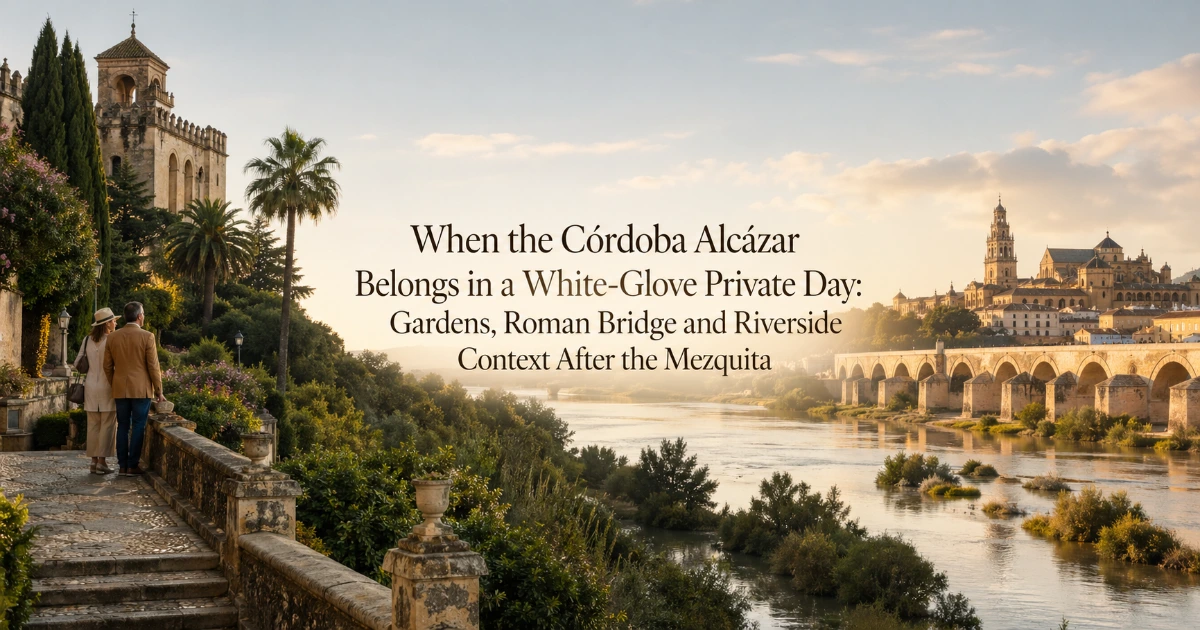
Updated
The Córdoba Alcázar belongs after the Mezquita-Catedral when your private day needs a garden-led change of texture, a short royal-and-riverside layer, and enough remaining attention for another narrated site. It works because the Mezquita exit to Alcázar gate handoff is physically natural: you can leave the dense forest of columns, cross the old-city edge near the Judería, and reach the Alcázar without a transfer reset. The clearest exception is a hot, tight rail-stop day or a traveler who came for one exceptional sight only; then the Alcázar should become a brief context stop or be cut.
In Córdoba, the Alcázar is valuable not because it outranks the Mezquita, but because it can translate the city’s power from sacred interior to garden, wall, river and bridge in one compact post-Mezquita arc. That is the useful threshold. The Alcázar is not automatically the right post-Mezquita choice, and the fact that it sits close to the Mezquita-Catedral is the beginning of the decision, not the end of it.
The common planning mistake is assuming that closeness equals ease. Córdoba’s historic center is compact, but a compact center can still become tiring when a morning inside the Mezquita-Catedral is followed by garden glare, stone paving, the Roman Bridge, and a late lunch that keeps sliding later. For private touring, the best value is not adding every nearby monument; it is deciding whether the second layer will make the day feel more complete or simply more crowded. Travelers who want the Mezquita-Catedral as the day’s emotional summit should consider a focused route through a Mezquita-Catedral private tour and then use the river or Judería as lighter context.
Because the Mezquita-Catedral is the anchor that determines everything after it, confirm any current visitor details through the official Mosque-Cathedral site (https://mezquita-catedraldecordoba.es/en/) before treating the rest of the day as fixed. The operational point is not to load the morning with fragile assumptions. It is to protect the monument that carries the highest emotional and historical weight, then decide how much Alcázar, bridge and riverside context the group can absorb after that anchor has been given proper space.
When is the Córdoba Alcázar worth adding after the Mezquita-Catedral?
The Alcázar of the Christian Monarchs is worth adding when the group still wants interpretation after the Mezquita-Catedral, but needs air, gardens and a different kind of historical frame. It is a strong second act for couples, families with patient older children, small groups, celebration travelers who want photographs without turning the day into a photo shoot, and first-time visitors who prefer a compact story of Córdoba rather than a single-site morning. It is weaker for travelers who know they have one deep-visit slot and would rather end on the Mezquita’s interior silence than keep narrating the city.
The most reliable way to think about the choice is a ranked ladder, not a monument checklist. Each step adds a different consequence to the day: depth, exposure, distance, or a shift in mood. The ladder below is not a universal ranking of Córdoba’s sites. It is a post-Mezquita priority order for a white-glove private day when the question is whether the Alcázar, the Roman Bridge and riverside context belong after the city’s defining monument.
- 1. Alcázar of the Christian Monarchs. Best when you want a compact second chapter that moves from sacred architecture to royal, military and garden context without leaving the old-city orbit.
- 2. Roman Bridge and Calahorra Tower riverside context. Best when you want the day to breathe, but only if heat, glare and exposed walking will not flatten the group’s energy.
- 3. Palacio de Viana. Best when patios, domestic scale and a more residential Córdoba matter more than staying beside the Mezquita; it is usually a different style of day, not a casual add-on after the Alcázar.
- 4. Medina Azahara. Best when you have a dedicated time block, vehicle logic and appetite for a larger historical argument; it should not be treated as another quick stop in the same post-Mezquita lane.
The corrective point is simple: the Alcázar often wins as the closest meaningful add-on, but closeness can make it overvalued. A weaker private day is not one that skips the Alcázar; it is one that adds the Alcázar, a full bridge crossing, the Calahorra Tower, extra Judería wandering, and a late lunch because nobody wanted to admit that the Mezquita-Catedral had already done the essential work.
Use three filters before committing. First, ask whether the group wants another interpreted site or whether it wants the city to soften after the Mezquita-Catedral. Second, ask whether the day has weather and timing margin for gardens and river exposure. Third, ask whether the next stop will clarify Córdoba or merely prove that it is close. The Alcázar wins when it passes all three filters. It becomes expendable when it fails even one of them and the group is already carrying heat, rail pressure or low attention.
What the Alcázar adds after the Mezquita, and what it does not
The Alcázar adds a useful change of medium after the Mezquita-Catedral: outdoor rhythm, political context, garden axes, water, walls and a more legible sense of how Córdoba’s rulers used the river-facing edge of the city. After the Mezquita’s interior complexity, this matters. Many travelers do not need another masterpiece; they need the city to become readable again. The Alcázar can do that because it shifts the conversation from religious layering and architectural transformation to governance, military presence, dynastic memory and controlled landscape.
That does not make it equal in emotional force. The Mezquita-Catedral is usually the reason discerning travelers came to Córdoba in the first place. Its interior asks for concentration, and the best guides know when to leave silence around the columns instead of filling every minute. The Alcázar is more useful as a second lens than as a rival. If a group expects the same level of astonishment, it may feel like a letdown. If the group understands that the Alcázar is a context builder, the gardens and walls can feel generous rather than anticlimactic.
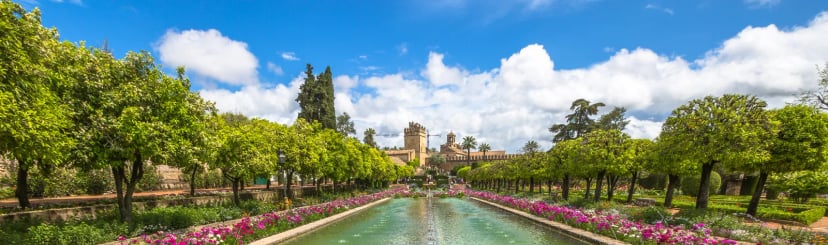
The gardens are the most persuasive reason to include it in a private day. They let the pacing loosen without losing cultural content. A guide can point out how sightlines, water, enclosure and procession change the feeling of power after the mosque-cathedral, and the group can absorb that without standing in another dense interior. This is why an Alcázar of the Christian Monarchs Private Tour works best when it is calibrated as a compact second chapter, not as a forced full-depth palace visit squeezed into a schedule that is already too ambitious.
What the Alcázar does not add is a solution to every kind of fatigue. It does not erase heat. It does not turn a rail stop into a calm overnight. It does not automatically suit a traveler who has limited mobility, little interest in royal history, or a low tolerance for more explanations after a substantial Mezquita-Catedral visit. It also does not need to be explored at maximum depth to be worthwhile. In many white-glove private days, a selective Alcázar visit is stronger than a complete one because it leaves room for the river, lunch, hotel return, or a quieter old-town transition.
It also does not replace Córdoba’s patio language. The Alcázar gardens are formal, symbolic and tied to power; they do not give the same domestic, lived-in register as private patios and neighborhood courtyards. That distinction matters for travelers who arrive imagining flowers, shade and intimate Córdoba. If the garden desire is really a patio desire, the Alcázar may satisfy the eye but not the mood. In that case, the better decision may be to keep the Alcázar brief or reserve patio-focused touring for a separate moment.
The strongest Alcázar visit after the Mezquita-Catedral is therefore selective by design. It should identify the garden and wall elements that extend the morning’s story, then leave before the site becomes a second lesson in endurance. This is especially true for travelers who have a lunch reservation, a train return, or an evening plan that should not feel like recovery from the tour. The private-day success metric is not how much of the Alcázar was covered; it is whether the group leaves understanding why that particular layer belonged.
The Mezquita exit to Alcázar gate handoff is the route hinge
The Mezquita exit to Alcázar gate handoff is the reason the Alcázar is tempting, and it is also where a guide should decide whether to deepen or cut. On a map, the handoff looks almost effortless. You are still in the historic core, close to the Judería, close to the river, and within the same mental world of stone walls, courtyards and old-city lanes. That compactness is Córdoba’s advantage over bigger Andalusian cities, and it is why the Alcázar can feel like the natural post-Mezquita move.
But the handoff has a hidden cost: the group has just left the city’s densest interpretive experience. The Mezquita-Catedral requires visual concentration, spatial orientation and historical layering. A guide may have moved from Roman foundations to Islamic Córdoba, Christian transformation and later cathedral insertions. Even when the walk to the Alcázar is short, the attention reset is not automatic. This is the moment when a private guide earns trust by reading faces, not only by reading the plan.
For comfort-first visitors, the practical question is not “Can we walk there?” It is “Will arriving there make the next ninety minutes better?” If the answer is yes, the guide should keep the route clean: exit the Mezquita-Catedral, avoid unnecessary loops through lanes that look charming but add no decision value, and use the Alcázar as a purposeful change of texture. If the answer is no, a short exterior explanation around the old-city edge may do more for the day than another ticketed interior.
The handoff is also where private touring differs from mass sightseeing. A group tour often moves because the itinerary says so. A tailored route can pause and choose. For a couple traveling for an anniversary, the gardens may be exactly the softening note that turns the day from scholarly to memorable. For a family managing heat and lunch timing, the same move may become a slow drain. For a small group coming by train, the Alcázar can be excellent if it replaces wandering, not if it is added after every other old-town stop.
The non-obvious routing point is that the cleanest handoff may feel less picturesque than a looser wander through the Judería, but it often creates a better day. The lanes around the old Jewish Quarter are atmospheric; they are also the kind of place where five additional minutes become twenty because each turn seems harmless. After the Mezquita-Catedral, those charming detours should earn their place. If they do not lead to shade, a clearer story, a rest point or the Alcázar gate, they are the easiest steps to remove.
This is also the moment to decide whether the Alcázar is a destination or a threshold. As a destination, it deserves enough time for the gardens and historical frame to make sense. As a threshold, it can be used more lightly, connecting the Mezquita-Catedral to the river edge and the Roman Bridge. Both choices are valid. What does not work is pretending it is a destination while allowing only threshold-level energy.
Roman Bridge and riverside context: how the route changes mood and body feel
The Roman Bridge belongs after the Alcázar when the day needs release, perspective and a visible connection between the old city and the river, not when the group is already overheated. This is the most misunderstood part of the post-Mezquita route. The bridge can make Córdoba feel larger, calmer and more complete, especially when the view back toward the Mezquita-Catedral helps the morning’s interior story settle into a cityscape. It can also expose the group to glare and make a polished day feel suddenly effortful.
The bridge is not just a scenic add-on. It changes the body feel of the itinerary. After the enclosed Mezquita-Catedral and the structured Alcázar gardens, the Roman Bridge opens the route to sky, river light and distance. That openness can feel welcome in mild weather or at the right time of day. In stronger sun, the same openness becomes the cost. There is less shade, more reflection from pale paving and water, and a different walking rhythm than the narrow streets near the Judería. That is why a Roman Bridge and Calahorra Tower Private Tour should be placed as a deliberate riverside chapter, not as a reflexive “while we are nearby” extension.
Córdoba does a specific thing to the body on this route: it compresses major history into a small area, then makes the final pieces feel deceptively easy because the distances are not dramatic. The fatigue is cumulative rather than obvious. Stone paving, standing interpretation, midday warmth, the exposed river crossing, and the mental work of absorbing the Mezquita-Catedral can leave even capable travelers feeling that the day became heavy without any single difficult segment. The best private plan notices the accumulation before the group starts negotiating every bench, café and shaded corner.
The mood consequence is just as important. A well-placed riverside moment makes the day feel shorter and calmer because it stops the itinerary from being only interiors and commentary. The Roman Bridge can give travelers a postcard-clear view, a sense of how the old city sits above the Guadalquivir, and a natural close before lunch or a return to the hotel. A poorly placed bridge crossing does the opposite. It turns the afternoon into a glare-heavy march and makes the Alcázar feel like one more obligation instead of the graceful middle note it could have been.
A useful middle setting is the area around the Puerta del Puente, where the group can register the river threshold without committing to the longest possible riverside move. That small adjustment changes the day. It lets the guide explain why the bridge matters, lets travelers see the Mezquita-Catedral in its wider urban frame, and still leaves enough energy for lunch or a shaded return through the old town.
The Calahorra Tower sharpens the decision. Naming it on the route does not mean every traveler should go inside or linger. For some groups, the tower is valuable as a visual anchor across the river, enough to explain the city’s defensive and crossing logic. For others, especially travelers who want a fuller river story, it can be part of the route. The private-day question is whether crossing toward the tower adds clarity or simply increases exposure. When heat is rising, the best answer may be to use the bridge edge and view, not insist on the full crossing.
The riverside also changes the social rhythm of a private group. Inside the Mezquita-Catedral, people tend to listen. In the Alcázar gardens, they begin to compare impressions, ask shorter questions and look for photographs. On the Roman Bridge, conversation often loosens or stops entirely because the view is doing more of the work. A guide should not fight that shift. The riverside is most elegant when it is allowed to become less verbal, especially after a morning built around dense interpretation.
The cut-first rule for heat, rail stops and limited attention
When Córdoba is hot, the first thing to cut is not the Mezquita-Catedral; it is the depth of everything after it. This is the rule that saves the day. The Alcázar can stay, but it may need to become a focused garden-and-context visit rather than a full exploration. The Roman Bridge can stay, but perhaps as a shaded approach to the river view rather than a complete out-and-back. Extra old-town wandering should usually go before the core monuments, because it often adds steps without adding a distinct planning payoff.
For rail-stop travelers, the station-to-old-town transfer matters even though it does not sound dramatic. Arrival logistics, luggage handling, a transfer into the historic core, the Mezquita-Catedral, the Alcázar, lunch and the return transfer can all fit on paper. The problem is the lack of emotional margin. If the train day is designed around a once-in-Córdoba visit, then a private guide should protect the Mezquita-Catedral and choose one secondary texture only. That may be the Alcázar gardens, or it may be a lighter river view, but it should not become a museum-by-proximity crawl.
Paying for a private guide does not make an overheated, too-long post-Mezquita add-on feel worthwhile if the traveler mainly wants one exceptional sight. Premium spend helps when it buys judgment: better sequencing, fewer unnecessary lanes, a cleaner handoff from monument to garden, and the confidence to stop before the day dulls. It does not help when it is used to justify a longer list. The most expensive mistake in Córdoba is not missing a secondary stop; it is exhausting the group after the Mezquita-Catedral and making the city feel smaller because every remaining choice was forced.
Families and multigenerational groups should be especially strict. Children may handle the Mezquita-Catedral beautifully and then fade in the Alcázar gardens because the second site asks for patience in a different way. Older parents may find the compact center reassuring, then struggle when the route adds the bridge under bright light. Celebration travelers may want photographs at the Alcázar and river, but photographs do not require the longest possible interpretation. For these groups, the better private plan is often a precise Alcázar visit, a short riverside mood shift, and then a meal or rest before the day turns performative.
The cut-first rule is not anti-Alcázar. It is pro-Córdoba. The city rewards visitors who let one great sight stay great, then choose the next layer with restraint. In cooler weather, with a rested group and an overnight hotel nearby, the Alcázar plus the Roman Bridge can be a satisfying arc. Under heat, tight trains or low attention, the Alcázar should either be selective or skipped. The best private day is the one that still feels elegant at the end, not the one with the most nearby monuments checked off.
Limited attention is different from limited time, and it should be treated just as seriously. A couple may have the whole afternoon free but little appetite for more guided explanation after the Mezquita-Catedral. A family may have time before lunch but no patience for another slow interpretive stop. A group celebrating a milestone may want the day to feel curated, not studied. In each case, the Alcázar decision should respond to the group’s energy, not the empty space on the calendar.
The most useful private-guide move is to name the tradeoff before the group feels it. A guide might say, in effect: we can deepen the Alcázar and keep the bridge short, or we can keep the Alcázar selective and give you the river view as a gentler close. That framing gives travelers permission to choose quality over coverage. It also prevents the awkward mid-route moment when everyone is tired but nobody wants to be the person who cancels the next stop.
Alcázar, Palacio de Viana or Medina Azahara: a same-day priority ladder, not a second-day repeat
Choose the Alcázar when you want the strongest in-city continuation after the Mezquita-Catedral; choose Palacio de Viana when patios and domestic Córdoba matter more than staying in the monument core; choose Medina Azahara only when the day has room for a separate historical and logistical commitment. This comparison is not about which site is “better.” It is about what kind of private day each one creates after the Mezquita.
The Alcázar wins the immediate post-Mezquita slot because it keeps the route coherent. It stays near the old city, connects naturally to the river, and gives the guide a clear way to shift from spiritual and architectural layering to power, gardens and urban edge. It is the right choice for travelers who want a compact Córdoba story and do not mind a second interpreted site. It is not the right choice for travelers who want to preserve the Mezquita-Catedral as the day’s final high point and then drift toward lunch.
Palacio de Viana changes the day’s register. It moves the emphasis toward patios, domestic space and the city’s quieter residential rhythm. That can be superb for travelers staying overnight, for garden lovers who want a more intimate patio sequence, or for visitors who have already done the Alcázar on a previous trip. But it is less natural as a quick post-Mezquita extension because it pulls the day away from the riverside logic that makes the Alcázar and Roman Bridge pairing work. When Viana is the better choice, it deserves its own pacing rather than being treated as the third or fourth item after the Mezquita. For that style of day, a Palacio de Viana Private Tour is a better anchor than a rushed Alcázar-plus-everything route.
Medina Azahara is the wrong comparison if the question is only “What should we add after the Mezquita?” Its value lies in a broader historical argument and a different logistical shape. It can be excellent, but it changes the day from an in-city sequence into a larger commitment. For travelers deciding between a city-core day and a more ambitious plan, the existing heat-aware framework in this curated Córdoba day guide is the better next read. For the present decision, the point is narrower: Medina Azahara should not be squeezed in just because the Alcázar, bridge and old city made the morning feel efficient.
The firm editorial call is this: after the Mezquita-Catedral, the Alcázar is the best second stop when you want continuity; Palacio de Viana is the better alternative when you want a different mood; Medina Azahara is a separate commitment, not a casual upgrade. If the trip is getting overpacked, stop forcing the third layer. Pick one post-Mezquita idea and let it breathe.
The traveler-fit difference is practical. The Alcázar suits a first-time visitor who wants Córdoba’s old city to feel connected in one walk. Viana suits someone staying long enough to care about the city’s interiors, patios and domestic grace. Medina Azahara suits a traveler who wants the larger political and archaeological horizon and is willing to spend the time and movement that horizon requires. Treating them as interchangeable “things to add” is how a private day loses its editorial shape.
How to shape a white-glove private day around the Alcázar without overloading it
A white-glove Córdoba day should shape the Alcázar around the group’s remaining attention, not around a fixed monument quota. The most elegant version starts with the Mezquita-Catedral at a time that allows concentration, exits cleanly toward the Alcázar, uses the gardens as a change of rhythm, then decides whether the Roman Bridge will be a full riverside chapter or a shorter context view. The route should feel like a sequence of decisions, not a checklist with nicer logistics.
There are three workable shapes. The first is Mezquita plus focused Alcázar, which suits travelers who want two interpreted sites and then a meal or rest. The second is Mezquita plus Alcázar gardens plus bridge view, which suits couples, photographers and first-timers who want the city’s interior and river context without a long afternoon. The third is Mezquita plus river only, which suits very hot days, rail stops, or travelers who want one exceptional monument and a lighter close. All three can be premium. The least premium shape is trying to do all three versions at once.
The private guide earns the spend by choosing the right post-Mezquita depth, not by adding every nearby monument. That may mean shortening the Alcázar, skipping the full bridge crossing, choosing a better lunch handoff, or keeping the route inside the historic core so the group never feels stranded between ambitions. If your Córdoba day needs that kind of decision-making rather than a fixed monument stack, Inquire now.
If you are staying overnight, the same logic becomes even more useful. The Alcázar does not need to carry every remaining Córdoba memory before departure. A private route can leave the bridge for softer light, place a food-and-wine evening after a rest, or let the Judería become a shorter connector rather than another narrated district. The result is not a slower day for its own sake; it is a day with fewer forced transitions and a better chance that the Mezquita-Catedral, Alcázar gardens and river each keep their own shape.
For travelers who want the old city to stay coherent beyond the Mezquita and Alcázar, Historic Center of Córdoba Private Tours can be a better organizing frame than a single-site mindset. The useful question is whether the Alcázar is the centerpiece of the second act or one part of a broader historic-core reading. Once that is decided, the rest of the day becomes easier: fewer redundant explanations, fewer exposed detours, and a route that can contract gracefully if heat or attention changes.
A white-glove plan should also decide where the guide becomes quieter. Not every premium moment needs more commentary. The Mezquita-Catedral often needs deep interpretation; the Alcázar may need selective explanation; the river may need space. A guide who can modulate that arc will make the day feel more considered than a guide who keeps the same level of narration from the first column to the last bridge view.
For food-and-wine travelers, the post-Mezquita decision should protect lunch rather than compete with it. Córdoba’s monuments can absorb the best hours of the day, and a late, overheated meal is rarely the elegant result travelers imagined. If lunch is part of the celebration or comfort plan, the Alcázar and bridge should be shaped backward from that handoff. A shorter Alcázar visit before a calm meal may feel more premium than a complete visit that leaves the table doing the recovery work.
How long should the Alcázar, gardens and riverside take in a private day?
The Alcázar and riverside should take only as long as they continue improving the post-Mezquita story. In practical planning terms, think in layers rather than minutes. A short layer gives you exterior context, garden mood and the reason the site belongs after the Mezquita-Catedral. A medium layer adds more interpretation and a more deliberate garden rhythm. A longer layer only makes sense when the group has real appetite for the Alcázar itself and is not treating it as a bridge to lunch.
This matters because Córdoba can make a short plan feel long when each “nearby” element adds a little standing, a little sun and a little interpretive load. The Alcázar, Roman Bridge and Calahorra Tower are close enough to tempt overuse, but not so effortless that they are consequence-free. A private day should be able to contract. If the group exits the Mezquita-Catedral energized, deepen the Alcázar. If the group exits quiet and saturated, use the Alcázar as a lighter outdoor chapter or move toward the river only. If the group exits tired, skip the ticketed add-on and let lunch do the recovery work.
The most polished days also respect what comes after. Córdoba is not only a morning of monuments; it may be part of a larger Andalusia route, a rail movement, a celebration dinner, or an overnight designed around a gentler evening. A post-Mezquita plan that consumes every ounce of attention can damage the next part of the trip. A slightly shorter Alcázar visit, followed by a measured bridge view and a well-timed meal, often leaves travelers with a fuller memory of Córdoba than a maximal route they are relieved to finish.
As a planning rule, do not let the Alcázar become the place where every earlier delay gets hidden. If the Mezquita-Catedral runs long because the group is engaged, that is usually a good sign; respond by trimming the Alcázar or the bridge rather than pushing lunch and return logistics. If the group wants extra time in the Alcázar gardens, make the bridge shorter. If the river view becomes the emotional close, do not keep adding old-town lanes afterward. The day should have one clear second act, not several endings.
FAQ
Is the Alcázar of the Christian Monarchs worth visiting after the Mezquita-Catedral?
Yes, it is worth visiting when you want a compact second chapter with gardens, royal context and a natural route toward the river. It is not essential for every traveler, especially if the Mezquita-Catedral is meant to be the single deep focus of the day.
Should I visit the Alcázar or the Roman Bridge after the Mezquita?
Choose the Alcázar if you want another interpreted site with gardens and historical depth. Choose the Roman Bridge if you want a lighter close, a city view and riverside context with less interior focus, while remembering that the bridge can be exposed in strong sun.
Can I do the Mezquita-Catedral, Alcázar and Roman Bridge in one private day?
Yes, the sequence can work well because the sites sit in a compact old-city and riverside area. It works best when the Alcázar visit is selective and the bridge is treated as a deliberate mood shift, not as an automatic extra after a full monument morning.
When should I skip the Córdoba Alcázar?
Skip it when the day is very hot, the rail schedule is tight, mobility is limited, or the traveler mainly wants one exceptional sight. In those cases, a lighter riverside view or a calm lunch after the Mezquita-Catedral can be the better private-day choice.
Is Palacio de Viana a better choice than the Alcázar?
Palacio de Viana is better when patios, domestic architecture and a quieter residential mood are the priority. The Alcázar is usually better immediately after the Mezquita-Catedral because it keeps the route near the monument core and river context.
Should Medina Azahara be added after the Mezquita and Alcázar?
Usually no. Medina Azahara deserves a separate time block and a different logistical plan. It can be excellent, but it should not be squeezed into a post-Mezquita sequence simply because Córdoba’s center makes the first part of the day feel efficient.
Does a private guide make the Alcázar more worthwhile?
A private guide makes the Alcázar more worthwhile when the guide calibrates depth, heat exposure and route order to the group. The value comes from choosing the right amount of Alcázar, bridge and riverside context, not from adding every possible stop.
What is the best post-Mezquita route for comfort-first travelers?
The best route is usually Mezquita-Catedral, a focused Alcázar visit if the group still wants depth, then either a short Roman Bridge view or a meal. In stronger heat or on a rail-stop day, reduce the Alcázar or bridge before compromising the Mezquita-Catedral.
If you’re interested in any private tours of Cordoba, please reach out to us.



 So if you are looking for the absolute best in Cordoba & surroundings with authentic local fully-licensed native guides whose English you can actually understand and with an exclusive and amazingly fun itinerary













