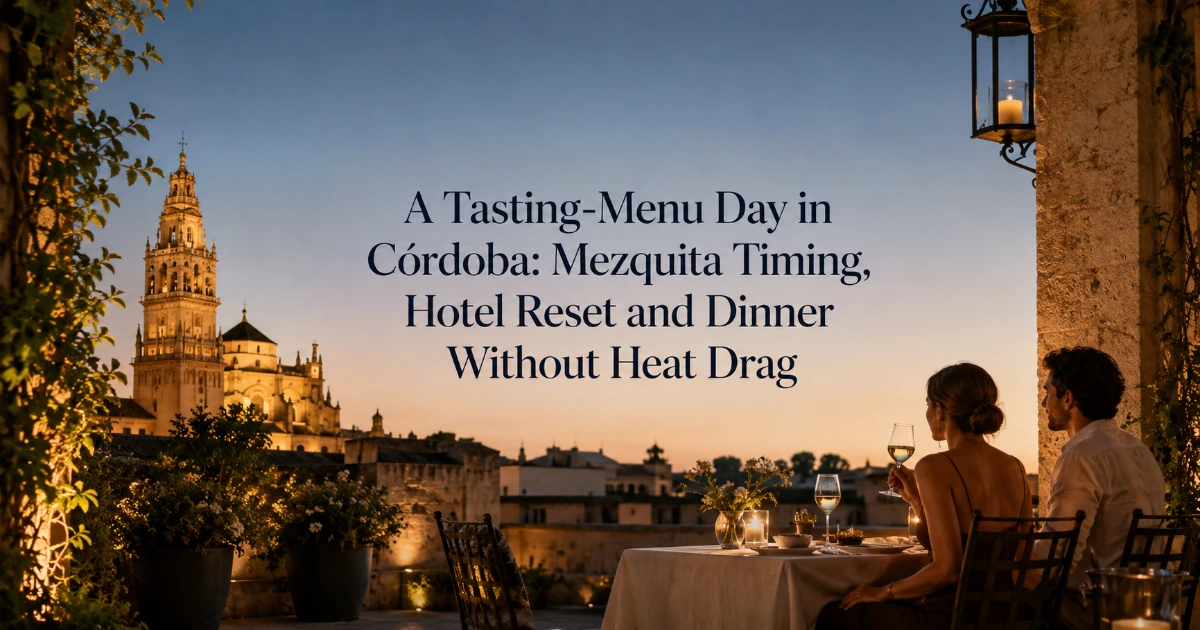
A Tasting-Menu Day in Córdoba: Mezquita Timing, Hotel Reset and Dinner Without Heat Drag
Updated
The best tasting-menu day in Córdoba is a morning Mezquita, one short old-town arc, a real hotel pause, and a clean transfer to dinner. It works because the route hinge is tiny but consequential: once you are on the Mezquita side of the Roman Bridge, one more crossing, one more Judería loop, or one more patio can turn a composed evening into a heat-sapped one. The clearest exception is a fixed late Mezquita ticket or a destination lunch rather than dinner; then the plan should become a protected half-day, not a full sightseeing build. The thesis is simple: in Córdoba, the serious meal should set the day’s ceiling, not become the prize after you have already spent your body.
This is not a restaurant ranking and it is not a generic first-day guide. It is a sequencing problem for travelers who care about dinner enough to protect appetite, mood, and timing. Córdoba’s old center is compact, which tempts visitors into overconfidence, but compact does not mean effortless. The final pedestrian lanes around the Judería, the sunlit stretch by the Guadalquivir, the Patio de los Naranjos queue rhythm, and the transfer back to a hotel all create a different kind of fatigue from a longer city. A map may show ten minutes between two pins while the lived transition includes uneven stone, a wrong turn near Calleja de las Flores, a pause in Plaza del Triunfo, and a pickup point that is not where a vehicle can actually wait.
If your day is being arranged privately, the value is not only in explanation inside the monument. It is in deciding where the guide should stop, where the car should appear, which lane is a pleasant coda rather than a detour, and what should be left out. For a tailor-made version of this exact pacing problem, Orange Donut Tours can fold the Mezquita, old-town context, hotel geography, and dinner handoff into private Córdoba planning. The aim is not to make the day look sparse. It is to make the morning feel complete and the evening feel newly begun.
The ranked ladder for a tasting-menu day in Córdoba
The winning sequence is the one that spends your best attention at the Mezquita and saves your best temperament for dinner. The day should be ranked by energy preservation, not by how many famous stops it contains. This is the ladder we would use for couples, food-and-wine travelers, and comfort-first visitors who are treating dinner as a major part of the Córdoba stay.
- 1. Morning Mezquita, one restrained old-town hinge, hotel pause, chauffeur or taxi to dinner. This is the best base plan. It gives the Mosque-Cathedral the attention it deserves, keeps the Judería from becoming a maze-for-the-sake-of-it, and leaves enough time to return to the room before a long-format meal. It suits first-time visitors, celebration travelers, and anyone who wants the dinner table to feel like the day’s second act rather than the rescue after a hard march. The ideal hinge is modest: perhaps the Patio de los Naranjos, a short thread through Deanes or Judíos, or a view from Plaza del Triunfo toward the river. The day is already culturally substantial; the coda only needs to release you from the monument, not compete with it.
- 2. Morning Mezquita, light lunch, hotel pause, dinner. This works when travelers need a real midday meal but still want dinner to land. The lunch should be simple, local, and deliberately not a second culinary event. A single tavern stop with a controlled order is different from a grazing route, a wine-led lunch, or several dishes chosen because “we may not be back.” The mistake is trying to make lunch special in the same way dinner will be special; by evening, palate and patience both flatten. The right lunch solves hunger and provides shade without creating another reservation that owns the clock.
- 3. Late-afternoon Mezquita, direct dinner transfer. This can work in cooler months or with a very nearby hotel, but it is more fragile than it sounds. The Mezquita may feel atmospheric late, yet the timing compresses the one thing a tasting-menu day needs most: unglamorous recovery time. A delay at entry, a guide running ten minutes long, or a slow pedestrian exit onto Cardenal Herrero can erase the margin. It is viable only when dinner timing is forgiving, clothes and essentials are already organized, and the transfer has been thought through before the visit begins.
- 4. Mezquita plus Medina Azahara plus tasting-menu dinner. This is the impressive-on-paper version that often disappoints in real use. Medina Azahara belongs in many Córdoba stays, but on a serious dinner day it turns the schedule into archaeology, road time, heat management, and another substantial interpretive arc before the evening has even begun. A premium vehicle can smooth the road but cannot make two major Umayyad sites feel light. This version is for travelers who explicitly rank historical depth above the meal, not for people hoping to do everything at luxury pace.
- 5. Continuous old-town touring until dinner. This is the false economy. You avoid paying for a transfer or a pause, but you spend the evening with warm shoulders, dusty shoes, and a diminished appetite. The final hours often become an accidental chain: the Alcázar because it is nearby, San Basilio because the patios are famous, the bridge because the light is good, then a walk back because the hotel still looks close. It is the plan most likely to make a premium dinner feel oddly hard work.
The counterintuitive correction is that the popular “late Mezquita, then dinner” instinct is often overvalued. It sounds elegant because it avoids midday heat and feels cinematic, but the timing can trap you between a monument visit and a formal meal without the hotel reset that makes the evening feel polished. For this specific day, morning is usually the more luxurious choice because it gives you margin later. Luxury here is not a later alarm or a denser itinerary; it is the ability to stop before the city has dictated your energy.
The best Mezquita window when dinner is the point
The best Mezquita window for a tasting-menu dinner day is early enough that the visit does not steal the afternoon reset. In practice, that usually means placing the Mezquita in the first serious touring block of the day and confirming current access, ticket categories, and visit conditions on the official Mosque-Cathedral site (https://mezquita-catedraldecordoba.es/en/) before finalizing the sequence. Do not build the day around remembered hours, old screenshots, or a hotel concierge’s generic “go later” advice. The monument is the immovable piece, dinner is the emotional endpoint, and everything between them should remain adjustable.
The reason is not only crowd management. Inside the Mezquita-Catedral, attention works best when you have not already spent it on small lanes, shopping decisions, and lunch negotiations. The building asks for context: the forest of columns, the mihrab, the Christian cathedral inserted into the earlier mosque, and the changed axes of power and worship. A private guide earns their keep here by controlling depth. Too little explanation and the visit becomes visual awe without orientation; too much and the rest of the day becomes a lecture you carry into dinner. A focused private visit through a Mezquita-Catedral private tour should leave you sharper, not overloaded.
For travelers comparing opening with late afternoon, the decision changes when a tasting menu is involved. Late afternoon can be beautiful on a lighter evening, especially if the stay is not food-led. But if dinner is the reservation you most care about, a late monument window creates three practical problems. You either dress too early or return too late, you lose the chance to shower and change without haste, and you may arrive at dinner carrying the mental residue of a major site. The deeper timing comparison is covered in the opening versus late-afternoon Mezquita guide, but the dinner-day answer is firmer: put the Mezquita before the heat and before the evening clock starts tightening.
The best pre-entry routine is deliberately plain. Meet close enough that the guide is not using your freshest half-hour for a broad city orientation. Avoid beginning with a long Roman Bridge crossing from Campo de la Verdad unless that walk is itself a priority and the weather supports it. Do not add a coffee stop with uncertain service between the meeting point and timed entry. The Mezquita should begin the day’s serious attention, not arrive after a sequence of small delays. Once inside, a well-shaped visit can move from the architecture’s basic logic to the mihrab and later Christian interventions without trying to turn every chapel into an equal stop.
The best post-Mezquita movement is equally short and intentional. Leave through the old-town side, take the Roman Bridge view only if it is a clean hinge rather than a full riverside wander, and resist the urge to “just see” every lane near Calleja de las Flores. The Mezquita side of the Roman Bridge is useful because it gives you a visual release after the monument without committing you to the far bank, the Calahorra Tower, and a return crossing. You can pause near the Puerta del Puente, register the river and the bridge, then turn toward lunch, pickup, or the hotel. That small routing choice can save the legs and the mood.
The old-town stop to cut: the Alcázar before the hotel pause
The old-town stop to cut first is the Alcázar, not the hotel reset. That does not mean the Alcázar is unworthy; it means its value is badly timed on a tasting-menu day. After the Mezquita, the Alcázar looks temptingly close on the map. In real conditions, it adds standing time, exposed garden movement, ticket friction, and another interpretive layer just when the day should be narrowing toward lunch, shade, and recovery. The proximity around Torrijos, Caballerizas Reales, and the river edge makes the addition look almost free. It is not free in the body.
Editorial no: skip the Alcázar on this particular day after the Mezquita if dinner is the reservation you are trying to protect. Stop forcing it simply because “we are already nearby.” Nearby is not the same as well-sequenced. The Alcázar’s gardens, walls, and river-adjacent setting can be a pleasant recovery stop on a different day, but after a full Mezquita visit they often push travelers past the point where the afternoon still feels optional. Dinner then has to repair the day rather than crown it.
If you need a short old-town coda, make it one of three things: a controlled Judería thread ending near your pickup point, a shaded café pause near the Mezquita, or a quick visual release toward the Roman Bridge without crossing and returning. A guide can choose a lane sequence that gives you one or two useful details without turning the Judería into an inventory. Deanes, Judíos, the edge of the Synagogue area, or Plaza Maimónides can provide context, but the route should have a declared end. “We will wander until lunch” is precisely how a 25-minute coda becomes a 75-minute detour.
Do not add a full San Basilio patio route, a Viana detour, or a craft-shopping loop unless you are willing to downgrade dinner from centerpiece to simply “where we eat later.” Those are good Córdoba experiences, but they belong to a different day shape. Viana pulls you north into another part of the city; San Basilio invites slow courtyard attention; meaningful craft buying creates comparison and decision time. None is an efficient little extra. The editorial discipline is to let another day hold them properly rather than flattening them into a rushed checklist.
Body consequence: the extra post-Mezquita monument usually shows up later as heat held in the shoulders, foot tenderness on stone, low-grade dehydration, and less willingness to sit through a long sequence of courses. Córdoba’s effort accumulates through standing, shade gaps, and small pedestrian transitions rather than dramatic climbs. Because the strain feels modest moment by moment, travelers often notice it only after returning to the room too late to recover fully.
Mood consequence: once the morning becomes an endurance test, the couple or group starts bargaining over every remaining choice. One person wants the hotel; another wants the bridge; someone worries that cutting the Alcázar means “missing Córdoba.” That negotiation follows you into the taxi and sometimes into dinner. The mood-preserving decision is to stop while the morning still feels successful. Ending on a high is not under-touring; it is what allows the evening to feel generous rather than compensatory.
How long the hotel reset really needs before a Córdoba tasting menu
A real hotel reset needs at least two hours door to door, and closer to three hours when heat, dressing, or a transfer is involved. The reset is not just a shower. It is the time it takes to leave the old center, reach the hotel, cool down, change, stop discussing logistics, and re-enter the evening without feeling managed. Couples especially underestimate this because the walking distances look modest and the dinner hour feels far away in the morning. By mid-afternoon, the same distance feels longer, a room may not cool instantly, and two people do not always move through showers and dressing at the same speed.
“Door to door” matters because a two-hour block on paper can become barely an hour in the room. The walk from the final old-town stop to a vehicle-friendly edge takes time. A pickup near the Mezquita may require meeting on a street where the car can pause rather than directly outside the monument. The drive may be short but not frictionless. On the return, dinner transport needs its own buffer. Count from the moment touring ends to the moment you need to leave again, not from the moment the hotel door closes.
If your hotel is inside or right beside the Judería, the reset can be shorter, but it can also be noisier and more pedestrian-dependent. A room near the Mezquita can make the return feel effortless, yet luggage access, taxi approach, and the final lane may still need thought. If your hotel is riverside, near the station axis, around Plaza de las Tendillas, or outside the tightest old-town lanes, you may gain a calmer arrival and easier pickup at the cost of a longer return after touring. Neither is automatically better. The right hotel geography depends on whether you value old-town atmosphere, vehicle access, or a calmer pre-dinner room break. For the stay-planning version of that choice, see the Córdoba hotel geography guide.
Córdoba does something specific to the body: it compresses effort into small transitions. You are not climbing like Granada or crossing a city like Madrid, but you are moving through stone lanes, sun pockets, narrow pavements, and pedestrian edges where a car cannot always rescue the last few minutes. In warm months, the heat load builds quietly. By the time you notice it, you are already making worse decisions: one more alcoholic drink instead of water, one more shop instead of the room, one more view instead of a clean return. The reset interrupts that chain before fatigue becomes the day’s organizing force.
Córdoba also does something specific to the trip mood. A day without a pause begins to feel shorter in the wrong way, as if every good thing is being squeezed before the dinner booking. A day with a proper reset feels longer and calmer because the morning and evening become two separate experiences. That distinction matters for celebration travel. You do not want to arrive at a tasting menu still negotiating whether the walk back was worth it, whether someone should have worn different shoes, or whether the lunch order was a mistake.
The reset should be protected from small tasks. Do not use it for souvenir decisions, route debates, or “quick” work calls. Do not schedule a spa treatment that creates another clock unless the hotel is handling it seamlessly and the treatment itself is the reset. Do not turn the room break into a wardrobe crisis by returning too late. Put dinner clothes out before the morning if the reservation matters. Confirm the pickup point before you lie down. Chill water, lower the room temperature, and let the body stop moving. A tasting menu rewards appetite, attention, and conversational ease; the reset is where those are rebuilt.
Lunch should bridge the day, not compete with dinner
Lunch is the most common hidden saboteur of a tasting-menu day because Córdoba makes a tavern stop feel like an essential cultural obligation. It can be one, but not every food experience needs to peak on the same date. A tasting-menu dinner day calls for a lunch that solves hunger, adds shade, and returns control of the clock. It should not become a second reservation with multiple courses, a broad tapas crawl, or an impromptu Montilla-Moriles tasting just because the morning has gone well.
The right lunch is lighter in ambition than in quality. Choose one place, order with restraint, and stop before the table becomes the afternoon. A cold soup, a shared vegetable dish, a modest portion of something distinctly Cordoban, or a simple plate can provide a sense of place without blunting dinner. The exact choice should respond to appetite and weather rather than a checklist of specialties. The premium decision is not to deny yourself local food; it is to avoid asking lunch and dinner to deliver the same emotional crescendo.
Geography matters more than fame. A lunch that requires a cross-town detour, uncertain taxi pickup, or a long walk deeper into the Judería can cost more energy than the menu suggests. The best lunch location is often on the line between the Mezquita finish and the hotel return. Near the old-town edge, you can eat, step into a planned vehicle, and end the first half of the day cleanly. A supposedly superior table that pulls you away from that line may be the worse choice for this particular day.
Wine needs the same discipline. A glass with lunch may suit some travelers; a comparative tasting or several generous pours usually belongs elsewhere. Pairings at dinner, warm-weather dehydration, and the sedative effect of a long midday meal can combine badly. If Montilla-Moriles is a central interest, give it its own afternoon or build the entire day as a wine-led experience with a lighter evening. Do not bolt it onto the Mezquita-plus-tasting-menu sequence and assume a hotel shower will erase the cumulative effect.
Where the guide should end and the transfer should take over
The private guide should usually end before the hotel reset, while the transfer should protect the movement into dinner. That division sounds simple, but it is the place where many premium days either become graceful or strangely over-managed. A guide is most valuable inside the Mezquita, in the Judería context, and in deciding which old-town thread is enough. A driver or arranged pickup is most valuable when the day needs to stop being educational and start being calm.
The cleanest handoff is not always at the restaurant. Often it is at the hotel or at a vehicle-friendly edge after the old-town walk. The guide closes the story while attention is still high; the room closes the heat and walking chapter; the transfer opens the evening. This is especially useful when dinner is not immediately beside the Mezquita. For a destination table, the pre-dinner transfer should not be improvised while dressed for the evening in a pedestrian lane.
The dinner transfer deserves the opposite treatment: little interpretation and no improvisation. Confirm which entrance or meeting point is practical, how much margin the restaurant expects, and whether the return is prearranged or can be handled simply later. The value is not theatrical chauffeur service. It is removing the small uncertainty that becomes disproportionately irritating when you are dressed, hungry, and trying to arrive composed. For a restaurant beyond the old-town core, this is where paid logistics can materially improve the experience.
Where premium spend does not help: paying for a chauffeur to remain on standby while you stack another ticketed old-town monument after the Mezquita looks impressive on paper, but it does not materially improve the day. Premium spend does not help when it is used to add the Alcázar, a distant patio route, or Medina Azahara simply because a vehicle is available. It buys a more expensive and more impressive-looking itinerary, not a better dinner day. A chauffeur cannot make the Judería lanes wider, turn a rushed shower into a reset, or restore appetite after an overbuilt afternoon.
Premium spend helps when it removes decision points: timed-entry guidance, a private interpretive arc, a sensible end point, restaurant communication, and a pickup that does not require you to negotiate the last mile in dress shoes. It also helps when it protects one traveler whose mobility, heat tolerance, or energy differs from the rest of the group. The distinction is important. Spending should compress friction, not expand the list of obligations.
This is the natural planning handoff: let the guided day finish before it starts competing with the evening, then let logistics carry the dinner rather than asking dinner to compensate for logistics. Inquire now if you want Orange Donut Tours to build the Mezquita visit, short old-town finish, hotel pause, and dinner transfer as one paced day rather than separate bookings.
How to handle Noor, ReComiendo or another serious table without turning the day into a restaurant ranking
Choose the dinner first, then design the day around the kind of evening it demands. Noor, ReComiendo, Terra Olea, and other serious Córdoba tables should not be treated as interchangeable pins after sightseeing. The relevant question is not “which restaurant is best?” but “what does this reservation do to the day?” A destination tasting menu, a playful long-format dinner, and a refined but somewhat more flexible meal each place different pressure on your afternoon. This article does not rank them because the planning decision is about consequence, not prestige.
For Noor, the useful planning clue is that it should be treated as a destination dinner, not as a spontaneous old-town add-on. Confirm current details through the MICHELIN Guide entry for Noor (https://guide.michelin.com/gb/en/andalucia/cordoba/restaurant/noor) and the restaurant’s own booking communications before locking the rest of the day. Do not assume that an old article’s service days, menu length, pairing format, or arrival advice still applies. Once the booking is confirmed, work backward from the arrival time and protect a full hotel reset plus a clean vehicle transfer.
For ReComiendo, use the restaurant’s official site (https://www.recomiendopower.com/) for current menus, booking information, and any dietary or pairing details. Treat the reservation as the evening’s main event even if the restaurant’s geography makes the transfer look straightforward. Proximity on a map is not permission to tour until the last possible minute. The better sequence remains Mezquita, restrained coda, light lunch, hotel, and a deliberate departure.
For Terra Olea, check the restaurant’s official site (https://terraolearestaurante.com/) rather than relying on an older roundup or a screenshot of a menu. The same planning rule applies: verify the current shape of the meal, communicate dietary needs directly, and decide whether the reservation calls for a driver or a simple taxi from the hotel. The restaurant selection may change, but the day logic does not. The longer and more destination-like the dinner, the less sightseeing belongs after lunch.
If you still need to choose the room, use a separate restaurant shortlist and then return to the pacing logic here. The Córdoba fine-dining shortlist is the better place to compare dining options, while recognizing that any dated guide should be checked against current primary sources. This article is narrower: once a long dinner matters, the Mezquita and the hotel reset should be arranged to protect it.
The practical consequence is dinner geography. If the restaurant is away from the old-town core, do not romanticize walking there after a full day. If it is closer to the center, do not use that closeness as permission to skip the reset. If the restaurant offers pairings, do not add a heavy wine-country afternoon before it unless the entire day has been built as a culinary arc. A tasting-menu dinner is not only about flavor; it is about arriving with enough attention to notice progression, enough appetite to enjoy it, and enough ease that conversation is not dominated by logistics.
Fine-dining day timing in Córdoba without heat drag
The best fine-dining day timing in Córdoba leaves the afternoon deliberately underwritten. A strong day does not need to look empty; it needs to leave enough unclaimed time that dinner can expand without everyone watching the clock. Think in blocks rather than a minute-by-minute script. The exact access window, restaurant booking, and season will move the blocks, but the order should remain stable.
- Morning: Put the Mezquita-Catedral first, with a private guide if you want the building’s layers to land without overexplaining every chapel. Keep the pre-entry walking minimal. This is not the morning for a broad old-town orientation before the main site. Meet near the monument, enter with the current access conditions confirmed, and use the freshest attention on the architecture that justifies the trip.
- Late morning: Choose one short transition after the monument. Use the Patio de los Naranjos, the edge of the Judería, Plaza del Triunfo, or the Mezquita side of the Roman Bridge as a release valve. Do not let this become a second tour. The purpose is to move from interior intensity to open air, register the city’s setting, and reach lunch or transport without another substantial queue.
- Lunch: Eat lightly enough that dinner remains appealing. Córdoba’s taverns can be excellent, but a tasting-menu day is not the day for a maximal lunch route. One controlled table is better than several stops. Keep alcohol modest, especially in warm weather or when dinner may include pairings. If you want a tavern-led afternoon instead, that is a different food plan and should be allowed to become the day’s centerpiece.
- Early afternoon: End touring. This is the decision point most itineraries blur. Do not fill a spare 45 minutes with the Alcázar, shopping, or a bridge crossing. Use the margin for the transition to the hotel. A schedule that reaches the room early is working; it is not failing to maximize Córdoba.
- Mid-afternoon: Protect the hotel reset. Cool down, shower, change, hydrate, and stop making decisions. The room break is the part that looks least exciting in an itinerary and feels most valuable in the evening. When the hotel is outside the Judería or the restaurant is a destination transfer, this block should be closer to three hours door to door than two.
- Pre-dinner: Transfer cleanly. The best pre-dinner movement is boring in the right way: no route debate, no overheated walk, no last-minute taxi search from a lane where vehicles cannot comfortably stop. Leave enough margin that a small delay does not turn arrival into a sprint, but not so much that you are standing outside the restaurant with nowhere to settle.
- Dinner: Let the meal own the evening. Do not add a post-dinner obligation unless it is a very short return or a riverside air break that does not require another logistical decision. The tasting menu is already the night’s program. A compulsory bridge walk, bar reservation, or late train converts pleasure back into scheduling.
In warmer periods, move even more decisively toward the morning-first version. The old town’s shade is real but discontinuous, and the open river edge can feel exposed. The best response is not simply “take a car everywhere,” because the Mezquita and Judería still involve pedestrian movement. The response is to reduce the number of transitions, shorten the old-town coda, and reach the hotel before the accumulated heat has become fatigue. A driver protects the edges of the day; editing protects the center of it.
For a hotel in the Judería, the day can feel almost frictionless if you resist using that convenience to add stops. Walk back after lunch, close the door, and treat the evening departure as a new beginning. For a riverside hotel, coordinate the pickup edge so the bridge or Ribera does not become an accidental extra loop. For a hotel closer to the station or modern center, accept the transfer as the price of a calmer room break and easier vehicle access. There is no universally perfect base; there is only the base whose inconvenience you have planned rather than discovered.
If the evening is still open and you are deciding between fine dining, Arab baths, patios, or a river walk, the broader overnight decision lives in the comfort-first Córdoba evening guide. For this article, the answer remains narrower: when dinner is the serious reservation, the day should become smaller, not more ambitious.
When this plan breaks down
This plan breaks down when the dinner is not actually the priority. If your group cares more about monuments than the meal, then Medina Azahara, Viana, the Alcázar, or a fuller Judería route may deserve the time. There is no virtue in protecting a dinner that nobody is excited about. In that case, book a simpler evening and let the day be cultural rather than culinary. The mistake would be keeping the tasting menu for status while resenting the edits required to enjoy it.
It also breaks down when the Mezquita ticket is fixed late and cannot be moved. Then you should not pretend the day can still carry a full morning route, a major lunch, a proper reset, the monument, and a tasting menu. Cut the morning down to a gentle hotel-adjacent walk, a quiet café, or a single shaded stop. Reset before the monument if necessary, organize clothes and transport early, and make the late Mezquita the day’s main cultural act. Dinner should then be close, chauffeured, or deliberately less formal.
A destination lunch creates a different exception. If the long-format meal is midday, invert the energy logic: keep the morning controlled, eat, then allow the afternoon to dissolve into a hotel pause, a very gentle riverside walk, or nothing at all. Do not try to use dinner-day advice mechanically by adding a full evening program. The central principle is that the serious meal sets the ceiling. Whether that meal is lunch or dinner, the rest of the day should respect its physical and emotional weight.
The final exception is a no-overnight Córdoba stop. A tasting-menu dinner and a same-day departure can work only under unusually clean conditions, and even then the evening loses much of what makes it worthwhile. The whole point of a serious Córdoba dinner is that the city quiets after the day-trip rhythm fades. If you are watching a train clock, carrying luggage anxiety, or calculating the drive to another Andalusian city, choose lunch or a shorter food route instead. A premium meal cannot create calm around a departure you never stopped monitoring.
FAQ
What is the best Mezquita timing before a tasting-menu dinner in Córdoba?
The best timing is usually a morning Mezquita visit, followed by one short old-town transition and a protected hotel reset. Late afternoon can be atmospheric, but it often compresses the recovery time that makes a serious dinner feel enjoyable. Confirm current visitor information on the official source before fixing the rest of the day.
How long should the hotel reset be before dinner?
Plan at least two hours door to door, and closer to three hours in warm weather, with dressier dinner plans, or when the hotel is not immediately beside the old-town core. Count the return from touring and the departure to dinner inside that block. The reset should include cooling down, changing, hydrating, and stopping logistics talk.
What old-town stop should I cut on a tasting-menu day?
Cut the Alcázar first if the Mezquita and dinner are the anchors. It is close on the map, but it adds standing time, exposed garden movement, and another ticketed layer when the day should be narrowing toward recovery. Save it for a day when its gardens can be the point rather than an obligation between two larger experiences.
Can I do the Mezquita, Medina Azahara and a tasting-menu dinner in one day?
You can, but it is usually the wrong shape for comfort-first travelers. Medina Azahara adds road time, heat exposure, and historical density; it deserves a different day unless the dinner is deliberately lighter or the group explicitly values archaeology more than evening energy. A premium car smooths the route but does not remove the cumulative load.
Should I walk to dinner from the old town?
Only if the restaurant is genuinely close, the weather is mild, the route is simple, and you have already reset at the hotel. For a destination dinner or dressier evening, a clean pickup is often more valuable than another scenic walk. Do not make the final approach your first attempt to solve a pedestrian-lane pickup problem.
Is a private guide worth it for this kind of day?
Yes, when the guide sharpens the Mezquita visit, controls the old-town scope, and ends before the day becomes tiring. The guide should improve judgment and pacing, not encourage more stops just because there is time on paper. The most valuable guidance may be the decision to stop at the river view rather than cross the bridge.
Is premium transport always worth it in Córdoba?
No. Transport is worth it when it protects the hotel reset, handles a difficult pickup edge, or improves the dinner arrival. It is not worth it as a substitute for cutting an overbuilt route, because vehicles cannot solve every pedestrian lane, heat pocket, or rushed afternoon. Spend on friction removal, not on making the itinerary look fuller.
Can this plan work for couples celebrating something special?
Yes, and it is especially well suited to couples because it protects the mood of the evening. The key is to stop touring before the day feels depleted, return to the room early enough, and let dinner feel like a second beginning. The best celebration-day luxury in Córdoba is not one more sight; it is arriving at the table without needing the meal to rescue you.
If you’re interested in any private tours of Cordoba, please reach out to us.



 So if you are looking for the absolute best in Cordoba & surroundings with authentic local fully-licensed native guides whose English you can actually understand and with an exclusive and amazingly fun itinerary













