Córdoba Before Granada: Reading Umayyad and Nasrid Art in the Right Order
Updated
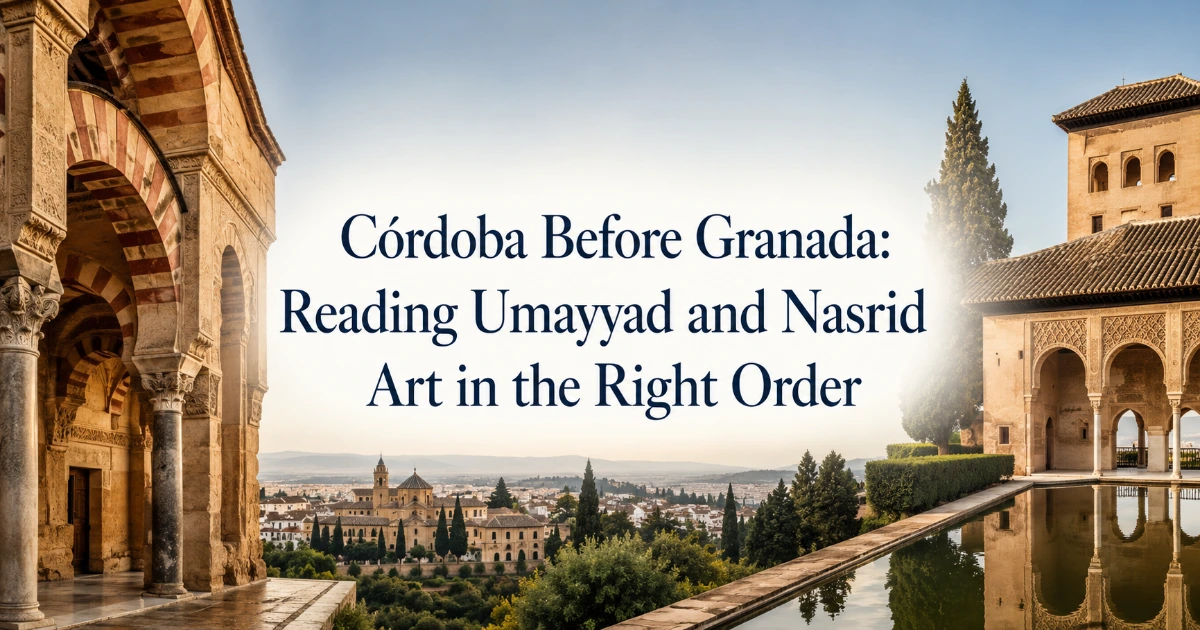
See Córdoba before Granada. Begin with the Mezquita-Catedral and let Granada’s Alhambra come later. This order works in real city conditions because Córdoba’s essential lesson can be built in one compact, carefully paced visit: from the Mezquita side of the Roman Bridge, the river, bridge, former mosque, cathedral insertions and old-town lanes sit in one legible arc, without Granada’s hill approach or a second transfer reset. The clearest exception is a fixed Alhambra booking or transport plan that would force awkward backtracking; never damage the whole itinerary merely to preserve an art-history ideal.
Córdoba teaches the grammar of Andalusi space; Granada rewards you by turning that grammar into a private language of palace, water, inscription and view. The sequence is chronological, but more importantly it is perceptual: first learn to read rhythm, reused materials, hierarchy and sacred focus in an Umayyad monument, then notice how the Nasrid palaces orchestrate movement, surface and intimacy centuries later.
This is not a claim that Nasrid art is simply “later Umayyad art,” nor that one dynasty hands a finished style directly to the next. The two cities are separated by centuries, political ruptures and other Andalusi traditions. The value of Córdoba first is that it gives the eye a baseline. Without that baseline, the Alhambra can become a rush of beautiful surfaces; without Granada later, Córdoba’s spatial discipline can feel complete when it is actually the opening chapter of a much longer architectural conversation.
Travelers arranging private tours in Córdoba should therefore brief the day around interpretation rather than coverage. The goal is not to collect every monument with an Islamic or Mudéjar label. It is to leave Córdoba able to answer four questions: how power is expressed through space, how repetition creates order, how a sacred focus interrupts that order, and how later users reshape an inherited building.
Córdoba or Granada first for Islamic art?
Córdoba is the better interpretive base; Granada is the stronger reveal. The order matters because the Mezquita-Catedral asks you to read a vast spatial system before it asks you to admire individual details, while the Nasrid palaces ask you to move through a tightly controlled sequence of rooms, courts, thresholds, water and views. Beginning with the larger grammar makes the later refinement easier to understand without flattening either city into a decorative style.
The ranked sequence that makes both cities clearer
- 1. Mezquita-Catedral, Córdoba: establish rhythm, scale, reuse, sacred hierarchy and the building’s later Christian layers.
- 2. Medina Azahara only when time and interest justify it: add courtly power and ceremonial urbanism, but do not treat the excursion as compulsory.
- 3. A low-information interval: use the transfer, an overnight or a quiet meal as a pause rather than adding another palace, museum or dense heritage walk.
- 4. Alhambra and Generalife, Granada: let Nasrid surface, water, movement and framed landscape become the culmination rather than the opening shock.
The ranking is deliberately unequal. The Mezquita-Catedral is essential to the argument. Medina Azahara is an upgrade for travelers with time, stamina and a real appetite for political history. The pause is not wasted time; it is what allows the eye to recover. Granada then becomes the point at which earlier ideas are transformed, not merely repeated.
The overvalued default most readers should reconsider is adding Medina Azahara to a same-day Córdoba stop simply because it appears to be the perfect bridge to palace architecture. It can be exactly that for a serious history traveler, but the excursion also introduces a road transfer, exposed walking and a second major interpretive system. When it compresses the Mezquita-Catedral, lunch and the old-town route, it weakens the very sequence it was meant to improve. A focused city visit followed by Granada is often more intelligent than a heroic checklist.
Travelers who decide that the extra courtly context is worth the energy can use Caliphal Córdoba beyond the Mezquita to shape the added block. Everyone else should keep the ranked sequence at steps one, three and four.
There is also a clear condition that flips the recommendation. When the Alhambra time slot is fixed or tied to a non-negotiable hotel and transport plan, Granada should keep its place. Visit it first, but ask the guide to distinguish palace space from congregational mosque space and to flag which visual habits will be useful later in Córdoba. The order can be reversed; the interpretation should not become accidental.
What Córdoba should establish before Granada
Córdoba should establish the rules of looking, not exhaust the history of al-Andalus. The most productive visit is one in which the guide keeps returning to a small number of visual and spatial ideas. This restraint is especially valuable for couples, families and small groups whose interests vary: everyone can understand rhythm, hierarchy and adaptation even when not everyone wants dynastic detail.
Read the hall before chasing the famous details
The first task inside the Mezquita-Catedral is orientation. The forest of columns is not background scenery on the way to the mihrab; it is the central spatial experience. The transition from the Patio de los Naranjos into the darker interior helps the eye register that change before the details begin. Repetition makes the hall feel extensive and non-axial, while the double-tiered arches lift the roofline and allow a relatively low field of columns to support a much larger volume. A guide should let the group stand, turn and compare before moving. Rushing straight to the most ornamented zone deprives the later details of their contrast.
This changes the traveler experience in a practical way. A group that pauses early can move more selectively afterward because each bay no longer feels like a separate item to catalogue. A group that begins with dates, rulers and terminology often keeps stopping for explanations without understanding the whole. The difference is not academic; it determines whether the interior feels legible or exhausting.
A private Mezquita-Catedral tour earns its cost when the guide controls that tempo, places the group where sightlines are useful and edits the commentary to the travelers in front of them. It does not earn its cost by delivering the longest possible lecture. The ideal first block is generous enough to let the spatial system register, but disciplined enough that the mihrab, cathedral nave and later chapels still arrive with energy.
Notice how continuity and variation work together
The next lesson is that repetition is never purely mechanical. The building grew through successive Umayyad enlargements, and the visitor should learn to notice continuity across those campaigns as well as changes in proportion, material, light and emphasis. Reused columns and capitals also matter: authority is being assembled from inherited material, adapted into a new visual order rather than created in a vacuum.
This is an important correction before Granada. Travelers often assume that later, more delicate ornament is automatically more sophisticated. Córdoba shows that sophistication can lie in scale, modular logic and the disciplined management of difference. The hall’s power comes partly from how little any single element needs to announce itself. When the eye later meets Nasrid stucco, tile, timber and epigraphy, it can appreciate that abundance as a different strategy rather than a simple improvement.
Treat the mihrab and maqsura as a deliberate interruption
The richly articulated zone around the mihrab and maqsura should feel different because it is different in function and status. Here, intersecting arches, inscriptions, mosaic surfaces and a more concentrated decorative language interrupt the broader rhythm of the hall. The visual hierarchy becomes explicit. That is the point to ask how a building directs attention after spending so long appearing to diffuse it.
This prepares the eye for Granada more effectively than memorizing ornamental vocabulary. The Nasrid palaces repeatedly use thresholds, changes of scale, surface density and framed openings to signal that one space is more charged than another. Córdoba provides the first lesson in how emphasis is manufactured. Granada later shows how that emphasis can be made mobile, unfolding room by room rather than concentrating around a sacred focal zone.
The practical consequence is that the mihrab should not be treated as a photo stop at the end of a long trudge. It needs enough remaining attention for the group to compare what changes there. If queue drag, heat before entry or an overfilled morning has already depleted the group, the most important contrast becomes merely “the ornate part.” Good pacing protects interpretation.
Use the cathedral insertions to understand time, not to stage a verdict
The Christian fabric inside the former mosque is essential to reading Córdoba, but it should not become a simplistic contest in which one civilization is asked to defeat another aesthetically. The cathedral nave, chapels and other later interventions show that the building remained active, contested and repeatedly redefined. They also change how the earlier structure is perceived: sightlines close, axes appear and the visitor moves between competing spatial logics.
This is where an experienced guide can prevent two common errors. The first is sentimentalizing the building as uncomplicated proof of harmony. The second is treating every later intervention as mere damage. Both positions flatten history. The more useful question is what each phase asks the building to become and how those demands remain visible together.
That habit is valuable in Granada, where later Christian layers also coexist with Nasrid fabric. It encourages the traveler to look for transformation without making every room an argument about loss. The result is a more mature reading of both cities and a calmer visit: the guide does not need to resolve centuries of political history into one slogan.
Make Medina Azahara earn the extra half-day
Medina Azahara is the strongest optional bridge between the Mezquita-Catedral and the Alhambra because it introduces the court, ceremonial reception and the relationship between architecture, landscape and political display. It expands Córdoba from a sacred urban monument into the world of the caliphal palace-city. For travelers deeply interested in Islamic art, archaeology or rulership, that shift can make Granada’s palace sequence more resonant.
Yet the decision is logistical as well as intellectual. Medina Azahara lies outside the compact historic center, so the excursion adds vehicle time, a new arrival process and more exposed walking. In midday heat, the body registers that exposure before the mind reaches the interpretive payoff. If Córdoba is only a rail stop, the station-to-old-town transfer, luggage handling and return to onward transport already create enough resets. Adding Medina Azahara can turn a coherent day into three separate operations.
Our editorial judgment is firm: keep Medina Azahara when Córdoba has an overnight, the group is genuinely curious and the Mezquita-Catedral will not be shortened to make room. Cut it when the city is a compressed transfer stop, when older travelers are already managing heat or uneven paving, or when Granada’s Alhambra visit follows immediately the next morning. The more detailed Córdoba plan for Islamic-art lovers is useful only after that first decision has been made.
For current visitor information, ticketing guidance and any operational details that may change, use the official Mosque-Cathedral site (https://mezquita-catedraldecordoba.es/en/) as the final source rather than relying on a generic itinerary. Confirm the practical details close to the visit, then preserve enough unallocated time around entry for current procedures, orientation and a calm start.
What Granada should reveal later
Granada should reveal how a later courtly culture turns inherited Andalusi ideas into a tightly choreographed palace experience. The Alhambra is not the “more beautiful sequel” to the Mezquita-Catedral. It is a different building type, created in a different political world, with different relationships among ruler, court, garden, inscription and view.
Expect compression rather than vastness
Córdoba’s great hall teaches the eye to understand a field: repeated supports extend space and make the individual body feel small within a larger order. The Nasrid palaces work by compression and release. Narrower passages lead to courts; low or restrained thresholds open onto more charged spaces; intimate rooms frame water, sky or distant landscape. The visitor’s movement becomes part of the architecture.
Because of that difference, a useful Granada guide should not spend the first hour hunting for formal similarities. Horseshoe or lobed arches, inscriptions and geometric pattern matter, but the more revealing comparison is behavioral. What does the building make you do? Where does it slow you, turn you, conceal the next space or suddenly open a view? The Alhambra becomes clearer when the traveler has already experienced Córdoba’s more expansive spatial order.
This also affects pacing. The Alhambra is not one interior that can be understood from a few central positions. It requires sustained movement across a complex site, and the intellectual load rises when every threshold receives a full explanation. The guide should choose a handful of moments that pick up threads from Córdoba rather than restarting the history of Islamic Spain from the beginning.
Read surface as a way of organizing attention
Nasrid plasterwork, tile, timber, epigraphy and muqarnas are not a detachable decorative skin. They control scale, dissolve weight, distinguish zones and keep the eye moving between text, pattern and architecture. A wall can seem both richly occupied and surprisingly light. A ceiling can turn structure into an image of depth. A band of inscription can mark status, praise, memory or the presence of power.
Córdoba prepares the traveler to notice where density increases and why. The contrast is especially productive: after the structural clarity and repeated arches of the Mezquita-Catedral, Granada’s surfaces feel less like ornamental excess and more like another system of order. The traveler begins to ask which elements are carrying weight, which are masking it and which are shaping perception.
The common mistake is to photograph the densest surface and move on. A better reading pairs detail with distance. Step close enough to see the layered craft, then step back to see how that surface changes the room. That alternation keeps the visit from becoming a catalogue of motifs and gives photographers, designers and non-specialists a shared way to engage.
Let water, light and framed landscape complete the architecture
Water in the Nasrid palaces is not merely atmospheric. It extends axes, reflects facades, modifies sound and changes how a court is perceived. Openings toward gardens, hills and the city also make landscape part of the palace. Córdoba’s most important spatial lesson is largely interior and urban; Granada’s later revelation is that architecture can choreograph the world beyond its walls.
The contrast between the Court of the Myrtles and the Court of the Lions makes the point concrete. The long pool in the Court of the Myrtles strengthens an axial, reflective reading toward the Comares complex; the fountain and water channels in the Court of the Lions organize a more intricate field of movement and attention. They are not interchangeable “beautiful courtyards.” Each uses water to give the court a different social and visual character.
This is why an overfilled Alhambra day underperforms. When the group is rushing to meet the next reservation or saving energy for an ambitious Albayzín climb, the pauses needed for reflection and framed views are the first things lost. The site is still impressive, but the experience becomes a sequence of crowded surfaces rather than a sequence of spatial decisions.
Keep the Alhambra as the principal act of the day. A lower-city walk, a measured Realejo return or a quiet evening can follow, but the palace should not compete with a second hill-heavy program. Travelers who treat Granada as a single monumental performance will remember more than those who try to prove how much of the city can be attached to one timed entry.
Do not reduce Umayyad and Nasrid art to a dynasty ladder
The comparison is useful only when its limits remain visible. Córdoba’s Umayyad monument and Granada’s Nasrid palaces are separated by several centuries and by the artistic worlds of the taifa kingdoms, Almoravids, Almohads and Christian-ruled Mudéjar production. Nasrid builders inherited a broad Andalusi vocabulary, not a sealed Umayyad template. Later does not mean decadent, and resemblance does not prove direct continuity.
The best question is therefore not “Which dynasty made the better art?” It is “How did different rulers use architecture to solve different problems of authority, ritual, court life and memory?” Córdoba answers through scale, sacred concentration and the remaking of inherited material. Granada answers through controlled access, epigraphic presence, sensory refinement and the fusion of palace with garden and view.
That distinction is what turns the trip into a cumulative narrative. The cities stop competing for the title of most beautiful monument and begin explaining one another. A well-briefed guide in private tours in Granada can pick up the exact concepts established in Córdoba, allowing the Alhambra visit to deepen rather than duplicate the first tour.
The cut-first rule: stop before Córdoba becomes a survey course
When the itinerary becomes crowded, cut the extra Córdoba interior before cutting time inside the Mezquita-Catedral. The narrow planning question is not whether the Alcázar, synagogue, patios, Archaeological Museum, Mudéjar chapel or Viana are worthwhile. It is whether any of them improves the Umayyad-to-Nasrid sequence enough to justify the attention it consumes.
Our explicit editorial no is this: do not force the Alcázar, a patio house, the synagogue, the Archaeological Museum and Medina Azahara around the Mezquita-Catedral in one day. That plan looks rich on paper and feels fragmented in the body. Each stop introduces a new historical frame, a new entrance rhythm and another set of details. By the time the group reaches lunch, the distinctions that matter have blurred into “old stone, arches and courtyards.”
For a first cross-city reading, keep three Córdoba components. First, give the Mezquita-Catedral the best concentration of the day. Second, use a short old-town and river orientation to place the building in the city rather than treating it as an isolated interior. Third, leave one deliberate pause for lunch, shade or hotel return. That is enough to establish the visual grammar without making Granada feel like the second half of a marathon.
If one addition is desired, choose it by the question it answers. Medina Azahara is for court and caliphal power. The Archaeological Museum is for urban layers and objects. A Mudéjar chapel is for the afterlife of Andalusi forms under Christian rule. A patio route is for domestic scale and living tradition. Do not add two or three simply because they are nearby. The best extra stop is the one that resolves a specific curiosity already raised inside the Mezquita-Catedral.
The overnight changes the equation because it separates the learning blocks. An evening on the Ribera or a short walk toward the Roman Bridge lets the city settle without adding another interior. The next morning can then hold Medina Azahara or a focused secondary site. This is not an argument for a generic multi-day stay; it is a way to prevent one interpretive arc from being crushed into a transfer window. For the broader logistics choice, see how Córdoba fits between Seville and Granada.
How to avoid monument fatigue between Córdoba and Granada
Avoid fatigue by separating the two masterworks with a low-information interval, not by making either visit shorter than it deserves. The pause can be an overnight in Córdoba, a transfer morning with no cultural stop, an unhurried lunch or a quiet Granada arrival. What matters is that the mind is not asked to absorb a second dense historical system immediately.
Account for what the route does to the body
Córdoba’s historic core is compact, but compact does not mean effortless. The station sits outside the old-town lanes, vehicles can only solve part of the approach and the remaining route includes paving, standing and heat exposure. Crossing the Roman Bridge to the Calahorra side before the Mezquita-Catedral adds an out-and-back river crossing that is pleasant in a relaxed stay but wasteful before a timed entry. Use the Mezquita side as the hinge, then decide later whether the full crossing still suits the group.
Granada imposes a different load. The Alhambra sits on a hill, the complex requires substantial internal walking and the temptation to add Albayzín or Sacromonte creates another climb or vehicle transfer. A traveler who handled Córdoba easily can still feel the cumulative effect in Granada because the effort is distributed across more elevation, longer site movement and stricter timing.
Families, older parents and travelers with limited stamina should therefore reduce transitions rather than merely reducing commentary. A shorter lecture does not compensate for an extra bridge crossing, a hot wait, an unnecessary hotel change or a late uphill return. The route itself must be edited.
Protect the trip’s mood from becoming dutiful
The emotional risk is not only tiredness; it is the feeling that the trip has become a syllabus. Córdoba should leave curiosity, not a sense of having completed a required unit before the Alhambra. A quiet river walk, a shaded lunch or an early evening in the hotel gives the first city an ending of its own. That closure makes Granada feel anticipated rather than imposed.
The same principle applies on arrival in Granada. Do not use the night before the Alhambra for the most ambitious hill walk, longest dinner and latest return simply because the city feels exciting. A tired group becomes impatient with explanation and starts treating palace rooms as obstacles between photographs. A calmer arrival preserves the sense of discovery that the sequence was designed to create.
Food-and-wine travelers can still make dinner part of the narrative, but place the most demanding meal after the most demanding monument. The MICHELIN Guide entry for Noor (https://guide.michelin.com/gb/en/andalucia/cordoba/restaurant/noor) can help with independent restaurant context, while the official site (https://www.recomiendopower.com/) for ReComiendo should be used for its current operational details and confirmation when booking. The editorial point is not which dinner wins. It is that a long tasting menu belongs after the Alhambra or on a night without an early palace start, not before it.
Use one strong comparison, then stop comparing
During the Alhambra visit, ask the guide to return to Córdoba at only a few decisive moments: a threshold where movement is controlled, an inscription band that changes the wall’s status, a water axis that reorganizes a court, or a later intervention that changes the original spatial logic. Constant comparison becomes another form of fatigue. The aim is recognition, not a running exam.
After those moments, let Granada remain Granada. The Alhambra should be experienced as a Nasrid palace complex with its own political and sensory logic, not as an appendix to the Mezquita-Catedral. The sequence succeeds when Córdoba sharpens perception and then recedes enough for Granada to speak in its own register.
Where private planning earns its cost
Private planning earns its cost through continuity, editing and logistics, not through adding more privileged-looking components. The most valuable upgrade is a shared interpretive brief across the two cities. The Córdoba guide should know that Granada follows; the Granada guide should know what the group already understood, where attention faded and which ideas created genuine interest.
Pay for a coordinated intellectual handoff
A strong handoff is specific. The Córdoba guide can record that the group responded to spatial rhythm but not dynastic chronology, that one traveler is interested in inscriptions, that the children understood reuse through the columns, or that the cathedral insertions raised questions about later adaptation. The Granada guide can then begin from those observations instead of repeating a standard introduction.
This is especially useful for mixed-interest groups. One traveler may care about architecture, another about political history, another about photography and another about comfort. A private guide can choose comparison points that serve several interests at once. Water, for example, can be read as engineering, sensory design, courtly display and photographic composition without turning the visit into four separate lectures.
Pay for transport where it removes a genuine reset
A driver is valuable for Medina Azahara, for luggage movement between Córdoba and Granada, for older travelers who need controlled drop-offs and for a Granada return that would otherwise require an additional climb. A driver is less valuable inside Córdoba’s compact historic core, where walking is part of the spatial logic and access is naturally limited.
Premium spend does not help inside the pedestrian core of Córdoba when it merely buys a larger vehicle waiting outside. It also does not shorten the Alhambra’s internal walking or replace the need for a well-paced visit. Spend on the transition that removes a genuine logistical burden, not on a theatrical layer that leaves the same physical and cognitive load in place.
The same judgment applies to dining and hotel choices. A costly lunch does not improve the sequence if it is too long, too far from the next movement or heavy enough to flatten the afternoon. A well-located hotel can be more valuable than a more ornate property if it allows a midday return, a luggage handoff and an easier departure. Comfort is created by geography and timing before it is created by amenities.
Keep the expert time concentrated
Not every hour needs a guide. The highest-value arrangement often places expert interpretation around the Mezquita-Catedral and Alhambra, then leaves meals, transfers and a simple evening unprogrammed. This preserves attention and gives the group room to absorb what it has heard. It also prevents the guides from becoming narrators of every street rather than interpreters of the decisive spaces.
In Córdoba, a short contextual walk from the river edge through the mosque-cathedral precinct and into selected Judería lanes is enough after the monument. In Granada, the palace visit can stand on its own, followed by a straightforward return. The restraint is part of the premium service: someone has made the cuts before the traveler has to feel why they were necessary.
Build one narrative, not two isolated tours
The strongest two-city plan gives each guide a different assignment and one shared thesis. Córdoba should explain how Umayyad power, sacred space, inherited material and later Christian use coexist in one monumental field. Granada should explain how the Nasrid court turns architecture into a sequence of access, inscription, reflection, garden and view. The shared thesis is that Andalusi art is not one look; it is a set of evolving strategies for organizing authority, attention and memory.
The brief to give both guides
- In Córdoba: prioritize spatial rhythm, the transition toward the mihrab, reused material, successive enlargement and the effect of later cathedral fabric.
- Between cities: leave one low-information interval and avoid adding a major palace or museum merely because the transfer day looks empty.
- In Granada: return selectively to hierarchy, thresholds and later interventions, then focus on Nasrid surface, water, court movement and framed landscape.
- For the group: adapt depth to stamina, age, specialist interests and the emotional tone of the trip rather than forcing a fixed lecture.
Once those assignments are fixed, the planning handoff becomes useful rather than promotional. Orange Donut Tours can coordinate the Córdoba and Granada days so the second guide receives the first guide’s interpretive brief, the transfers support the sequence and the optional stops are judged by the travelers’ actual energy rather than by a template. Inquire now to shape one cumulative art-history narrative instead of booking two unrelated monument visits.
The sequence should end where it began: Córdoba first whenever logistics allow, and Córdoba kept selective. The Mezquita-Catedral is the foundation; Medina Azahara is the earned extension; the pause is part of the design; the Alhambra is the later revelation. When that order is respected, both monuments become easier to read and harder to reduce to a single photograph.
FAQ
Should I visit Córdoba before Granada?
Yes, when the route and Alhambra booking allow it. Córdoba first gives you a clearer foundation for reading Andalusi architecture: the Mezquita-Catedral establishes repetition, scale, sacred hierarchy, reused material and later Christian transformation. Granada then reveals a later Nasrid palace language based on controlled movement, dense surface, water, gardens and framed views. Reverse the order only when a fixed Alhambra slot, transport schedule or hotel plan would create awkward backtracking.
Is one day in Córdoba enough before Granada?
One focused day is enough for the interpretive sequence if the Mezquita-Catedral receives the best attention, the old-town and river context stays concise and the day includes a real pause. One day is not enough for the Mezquita-Catedral, Medina Azahara, the Alcázar, patios, the synagogue and museums without sacrificing clarity. Add an overnight when Medina Azahara or a second specialist site is important, not merely to accumulate more stops.
Do I need to visit Medina Azahara before the Alhambra?
No. Medina Azahara is a valuable bridge for travelers interested in caliphal court culture, ceremonial architecture and the relationship between palace, city and landscape, but it is optional. Skip it when Córdoba is a compressed rail or road stop, when heat and walking load are concerns or when the Alhambra follows immediately the next morning. A complete Mezquita-Catedral visit is more useful than a shortened mosque visit plus a rushed excursion.
What should I look for inside the Mezquita-Catedral?
Look first at the spatial field rather than isolated decoration: the repeated columns, double-tiered arches and the way successive enlargements maintain and adjust the system. Then notice how the mihrab and maqsura create concentrated hierarchy within that repetition. Finally, compare the later cathedral nave and chapels with the earlier mosque fabric. Those three readings—rhythm, emphasis and transformation—prepare you best for Granada.
How much time should separate the Mezquita-Catedral and the Alhambra?
A full quiet evening or a low-information transfer interval is usually enough. The goal is not a fixed number of hours but a change in cognitive load. Avoid placing another major palace, archaeological museum or dense heritage tour between the two. Travelers arriving in Granada should have enough energy for the hill, internal walking and sustained attention required by the Alhambra rather than beginning the visit already saturated.
Can Córdoba and Granada both work as day trips?
They can work separately as day trips under some transport plans, but the cumulative art sequence becomes weaker when both are treated as high-speed excursions. Repeated station transfers, luggage decisions, road margins and same-day returns consume the pauses that help the monuments register. When comfort, depth and memory matter, keep at least one city as an overnight or use a private transfer that removes luggage and timing resets without adding another sightseeing stop.
How do private guides improve the Córdoba-to-Granada sequence?
Private guides improve the sequence by sharing an interpretive brief, adapting depth to the group and choosing only the comparisons that matter. The Córdoba guide can establish the concepts and note what engaged or tired the travelers; the Granada guide can then continue from that point rather than repeating a generic introduction. The value is continuity and editing, not simply more commentary or a longer list of monuments.
What if my itinerary has Granada before Córdoba?
The trip can still work. Ask the Granada guide to frame the Alhambra as a later Nasrid palace system rather than as a summary of all Islamic art in Spain, and note the roles of thresholds, inscription, water and landscape. In Córdoba, look backward from that experience toward the more expansive Umayyad spatial grammar of the Mezquita-Catedral. The historical order will be reversed, but the comparison can remain disciplined and accurate.
If you’re interested in any private tours of Cordoba, please reach out to us.



 So if you are looking for the absolute best in Cordoba & surroundings with authentic local fully-licensed native guides whose English you can actually understand and with an exclusive and amazingly fun itinerary













