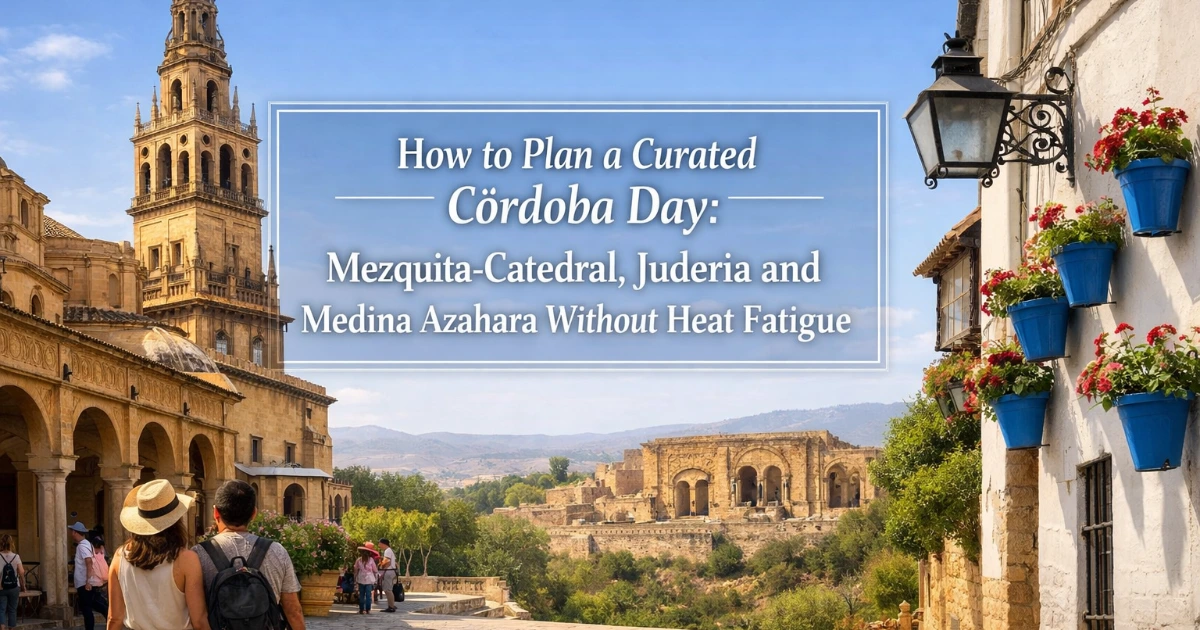
How to Plan a Curated Córdoba Day: Mezquita-Catedral, Judería and Medina Azahara Without Heat Fatigue
Updated
The best one-day Córdoba plan is city first, ruins second: start with the Mezquita-Catedral, carry that momentum through the Judería while the old core is still readable, then decide whether Medina Azahara deserves your afternoon. That shape wins because the most delicate part of the day is not the drive west to the caliphal site; it is the short ribbon from Puerta del Puente toward the Judería, where the old core either feels like a living city or like leftovers after a transfer. The honest exception is real: if severe heat, a ruins-first traveler, or seasonal timing makes Medina Azahara the priority, you can flip the order, but you must accept that central Córdoba will feel tighter and more transactional.
In Córdoba, the real luxury is not adding another monument. It is preserving the point at which the Mezquita-Catedral still has room to register emotionally, the Roman Bridge remains a glance rather than a chore, and the Judería is explored before your body starts negotiating sun, stone, and crowd drag. That is why a curated day here works best when it is designed around sacrifice, not ambition. If you are already considering tailor-made private touring in Cordoba, this is exactly the decision that makes the difference between a polished day and one that feels oddly rushed despite spending well.
The first counterintuitive correction is this: a Medina Azahara-first start is not the sophisticated default. It is the specialist version. For many first-timers, it buys cooler ruins at the cost of flattening the old center, which is where Córdoba most often wins people over. Use the official Mosque-Cathedral site (https://mezquita-catedraldecordoba.es/en/) for live entry planning, and use the official Medina Azahara site (https://www.museosdeandalucia.es/web/conjuntoarqueologicomadinatalzahra) for current access and seasonal arrangements before you lock the sequence.
A ranked ladder for fitting Córdoba’s essentials into one day
The clearest way to plan this day is to rank route shapes, not attractions. Córdoba is compact enough to tempt people into a “we can probably add one more thing” mindset, but the city punishes that optimism because one excursion out to Medina Azahara breaks the center into two different sightseeing moods.
Here is the ladder that usually holds up best for a comfort-minded one-day visit.
- 1. Best balance: Mezquita-Catedral first, Judería next, an unhurried lunch or hotel pause, then Medina Azahara as the second chapter of the day.
- 2. Heat-first exception: Medina Azahara at the opening edge of the day, return for the Mezquita-Catedral, then a shortened Judería walk and a lighter evening.
- 3. Plan to avoid: Mezquita-Catedral, Judería, Medina Azahara, Alcázar, Roman Bridge, patios, and a formal dinner all in one Córdoba day.
The first option is the editorial winner because it lets the Mezquita-Catedral land while your attention is still fresh, keeps the Puerta del Puente to Judería transition intact, and places the most transfer-heavy piece later, when the day can afford a reset. The second works only when your real priority is heat avoidance or archaeology. The third is where good intentions become fatigue, and where even expensive logistics start delivering a smaller return.
The ladder also clarifies a common psychological trap. Travelers often assume option three is merely option one plus enthusiasm. It is not. Once you attach Alcázar timing, patio ambitions, or a full Roman Bridge crossing to a day already committed to Medina Azahara, you have changed the route from elegant compression to competitive scheduling. The difference is not subtle by mid-afternoon.
Does Medina Azahara belong in a one-day Córdoba visit?
Yes, Medina Azahara belongs in a one-day Córdoba plan only when you treat it as one of the day’s three pillars rather than as a fourth headline. The ruin is worth the time, but it changes the day’s geometry more than travelers expect because it is not simply “another sight on the way.” It creates a transfer chapter, a different exposure profile, and a second mental start.
That second start matters. Inside the old core, Córdoba feels continuous: the Mezquita-Catedral, the lanes of the Judería, and the river edge near Puerta del Puente belong to the same walking story. Medina Azahara does not. Once you leave for it, you have ended one version of your Córdoba day and begun another. That is why the visit is rewarding only if you leave enough space around it.
The mistake is not choosing Medina Azahara. The mistake is keeping every other instinct unchanged after choosing it. If the ruins stay in, something else has to become brief, optional, or gone. In practice, that usually means no second major monument after the Mezquita-Catedral, no serious museum detour, and no fantasy of covering every photogenic corner of the center with equal depth.
Who suits this fuller version best? Couples comfortable with one substantial cultural day do well, as do small groups with aligned interests and travelers who enjoy moving between very different environments within a single day. Who enjoys it least? People who prefer one atmosphere per day, anyone with significant heat sensitivity, and travelers who become irritated by transfer admin. Those visitors often end up admiring Medina Azahara in theory while resenting its place in the schedule.
Mezquita-Catedral first or Medina Azahara first?
For a first Córdoba day, start with the Mezquita-Catedral unless heat or a very specific traveler priority flips the logic. That remains the stronger recommendation because the building deserves your clearest attention, the old core is easiest to read before the middle of the day, and the sequence into the Judería feels organic rather than patched together.
Starting at the Mezquita-Catedral also keeps the city’s most meaningful interior in the coolest emotional slot of the day, not just the coolest physical one. When you go in early, the visit still feels like an arrival, not a recovery from a drive. From there, the Judería makes sense as a continuation of the same story. If you want dedicated planning help around this anchor, the most relevant next step is a Mezquita-Catedral private tour built around your actual day shape rather than a generic monument stop.
Medina Azahara first becomes defensible in narrower conditions: very hot periods, travelers who care more about the caliphal site than the old center, photographers chasing softer exterior light, or repeat visitors who have already had their full Mezquita-Catedral moment. The official Medina Azahara access page (https://www.museosdeandalucia.es/web/conjuntoarqueologicomadinatalzahra/acceso) is a useful reality check because it makes plain that the site sits outside the old-core walk and carries its own arrival pattern, which is exactly why it consumes more energy than the map suggests.
The deeper reason not to default to Medina Azahara first is that the Mezquita-Catedral is not just a box to tick before lunch. It is the interpretive key that makes much of Córdoba feel legible afterward. When travelers postpone it until after the excursion, they often discover that the city center now has to be “managed” rather than absorbed. That is a poor bargain unless the ruins themselves are the main emotional objective of the day.
Why Puerta del Puente is the hinge of the day
The most useful micro-location in this whole decision is Puerta del Puente. It is where river-edge Córdoba and old-core Córdoba meet, and it quietly tells you whether your route is still coherent. If you can move from the Mezquita-Catedral toward Puerta del Puente, take a measured look at the Roman Bridge, and then fold back into the Judería without rushing, your day still has shape. If that zone happens only after the excursion out to Medina Azahara, it often feels like a scenic errand instead of part of the city’s main narrative.
This is why the Roman Bridge should stay in its place. It is a framing device, not the day’s fourth star. Step onto it for perspective, use it to understand the river setting, and move on while your energy is intact. The bridge earns its space when it sharpens the approach to the old city; it loses value when it becomes a sun-heavy add-on squeezed between bigger obligations.
The Judería works the same way. Its narrow lanes, patio glimpses, and small route choices are most rewarding when they follow directly from the Mezquita-Catedral. They are less satisfying after a transport reset, when everyone is thinking about how much day remains. If that walk matters to you, keep it close to the monument or explore it more deliberately through a Judería walking tour rather than leaving it as the tired endpiece.
How the old core spends your energy by noon
Córdoba’s center is compact, but compact does not mean physically trivial. The effort here comes less from distance than from accumulation: stone underfoot, stop-start walking, pockets of shade followed by sudden glare, queue drag near headline sites, and the mental wear of slow navigation through narrow lanes. Add one river-edge detour and one transfer out to Medina Azahara, and people start feeling tired earlier than the map would predict.
The city also distributes effort unevenly. The Mezquita-Catedral itself offers interior relief, but the approach, waiting, and post-visit decision-making all happen outside. The Judería is atmospheric precisely because it is intricate, and intricacy asks more from you than a straight boulevard does. Medina Azahara then changes the body again: there is more open exposure, more spatial scale, and less of the tucked-away shade that softens walking in the old center.
That is why “we are good walkers” is not enough of a planning principle here. Many strong walkers still dislike how this day feels when it is overpacked, because what wears them down is not mileage alone. It is the repeated switching between close urban lanes, queue conditions, sun, and the psychological reset of leaving town for archaeology and coming back again.
One more subtle factor is decision fatigue. In the old core, every turn looks potentially interesting, which is delightful when you have room for curiosity and draining when the clock is already arguing with you. The more aggressively the day is packed, the more each small choice starts to feel expensive. That is another reason a curated route outperforms a “we will just follow our instincts” approach once Medina Azahara enters the picture.
What the day does to the trip mood
The better route protects mood as much as stamina. A well-shaped Córdoba day feels composed: one deep morning, one genuine pause, one second chapter, then an evening that still belongs to you. A badly shaped day feels chopped into tasks. You may still see the headline places, but the city never gets the chance to feel elegant or calm.
This is where a lot of one-day plans quietly fail. Travelers think they are solving for inclusion, when they should be solving for emotional continuity. The Mezquita-Catedral has an interior stillness that deserves a little space before and after it. The Judería is most charming when you are willing to notice small corners. Medina Azahara asks for a different register again: scale, distance, and exposure. Jam them together without a pause and each one starts stealing from the next.
If you care about dinner, wine, or simply enjoying the evening rather than surviving it, the midday break is not laziness. It is the moment that keeps the day from becoming all extraction and no pleasure. That is especially true for couples, celebration travelers, and multi-generational groups, who often remember the rhythm of the day longer than they remember the exact order of monuments.
What to cut first so the Mezquita-Catedral still lands properly
If Medina Azahara stays in the day, cut the Alcázar first. That is the cleanest sacrifice because it removes another major-ticket monument without damaging the coherence of the old-core walk. The Mezquita-Catedral and Judería already form a complete morning narrative; the Alcázar creates a second monument block that often competes with them rather than enhancing them.
The next cuts are usually patio-hunting beyond a passing glimpse, Palacio de Viana, and any “quick museum” that looks harmless on paper. None of those places is poor. They are simply the wrong additions to a day already trying to hold the Mezquita-Catedral, the Judería, and Medina Azahara with enough dignity. This is one of those cities where the first extra is rarely the problem and the second extra is where the plan breaks.
The Roman Bridge should also be scaled correctly. Keep it as a brief perspective stop near Puerta del Puente, not as a full extra chapter with separate expectations. And do not let photo stops in pretty lanes dictate timing. Córdoba rewards wandering only after you have protected the major sequence. Wandering first is how people use up the best hour and then start stealing time from the monument that mattered most.
If refusing those cuts feels painful, that is usually your signal that Córdoba wants an overnight rather than a heroic day. The city is small enough to look easy and rich enough to punish under-allocation.
Lunch, shade, and the smartest break in the day
The most effective pause comes after the Mezquita-Catedral and Judería, not after Medina Azahara. By then you have completed the center’s most nuanced section, and you have done it before the day’s heaviest heat or crowd fatigue sets in. A long lunch in or near the old core, or a return to the hotel for a proper reset, creates a visible line between the city chapter and the ruins chapter.
This break is the least glamorous part of the plan and often the most important. It keeps Medina Azahara from feeling like a forced epilogue and gives everyone a chance to rehydrate, sit down, and decide honestly whether the second half still has enough appetite. Without that pause, travelers tend to drag themselves to the ruins because it is “already booked,” which is exactly how good sites get blamed for bad sequencing.
There is a strong comfort logic here for food-and-wine travelers as well. Córdoba is much more pleasurable when lunch is treated as a real anchor rather than as a tactical snack consumed while walking. A seated meal in shade restores attention, protects tempers inside a group, and makes the afternoon visit feel chosen rather than endured. Travelers who skip this step often assume they are saving time; in reality they are borrowing energy from the back half of the day at punishing interest.
If you are staying in Córdoba, this is also the section of the day where the city starts repaying the overnight decision. A hotel pause near the center changes the feel of everything that follows. If you are not staying over, build in the break anyway. The time is not wasted; it is what keeps the afternoon from inheriting the strain of the morning.
Where a guide changes the day and where more spend does not
A guide materially improves this Córdoba puzzle when Medina Azahara turns from a maybe into a sequencing problem. That is the point where good planning stops being about knowing what the attractions are and starts being about controlling when transfers happen, where explanations are most useful, how long each chapter really needs, and when to abandon the fantasy of “just one more stop.” If you want help with precisely that part, a Medina Azahara private tour or a custom day built around the old core and the ruins is where private planning earns its keep, not in adding luxury language to the same overcrowded route.
Premium spend does not help once the day is overpacked; a nicer car cannot give the Mezquita-Catedral back the attention lost to a rushed Medina Azahara run and a hot midday queue. That sentence matters because Córdoba tempts people into thinking transport comfort can solve what is really a design error. It cannot. What extra spend can do is reduce handoff friction, protect a late-afternoon site visit, and spare you the mental admin of stitching separate pieces together.
If your question has shifted from “Should we see Medina Azahara?” to “How do we fit it without flattening the city?” you are already at the right handoff point for expert trip design. That is the moment to make the day custom rather than crowded. Inquire now
This is especially true for celebration travelers, three-generation families, and food-and-wine travelers with dinner ambitions. Those visitors are not trying to maximize monument count; they are trying to keep the whole day gracious. In Córdoba, that usually means tightening the route, making one firm cut earlier than feels emotionally comfortable, and refusing to let a transfer-heavy ruin visit cannibalize the evening you were hoping to enjoy.
A curated Córdoba day that actually fits
The calmest full version of this day begins with the Mezquita-Catedral, moves immediately into the Judería, pauses before the afternoon hardens, and only then heads to Medina Azahara. This is the route that best preserves both the city’s emotional arc and your physical energy.
Early morning
Enter the Mezquita-Catedral as your first serious stop. Give it enough time that the forest of columns, the spatial shifts, and the Christian insertions do not blur into “we saw it.” A rushed entry here is expensive in the wrong way: you have paid with your best concentration and received only proof of attendance.
Late morning
Walk outward through the old center while that first visit is still resonating. Let Puerta del Puente and a short Roman Bridge look frame the city, then re-enter the Judería instead of drifting aimlessly. This keeps the morning legible. The goal is not to empty the quarter of every lane; the goal is to walk it while it still feels connected to the monument you just experienced.
Midday
Stop. Eat well, sit down properly, or return to your hotel if you have one nearby. This is the moment many travelers try to “save” by skipping, and it is exactly the moment that saves the afternoon. If you need a second coffee, cooler clothes, or ten minutes with no cultural ambition at all, take them.
Afternoon
Go to Medina Azahara as a deliberate second act. Keep expectations clean: this is not a tiny detour but a substantial archaeological chapter with a different pace and exposure level. Because the city core is already done, the visit can now be expansive instead of stressful. If live access details, seasonal hours, or entry patterns affect your timing, confirm them on the official pages before the day.
Evening
Return without trying to reopen the sightseeing list. Save the evening for a drink, a thoughtful dinner, or a gentle river-edge walk if you still want one. When the plan works, the evening feels like continuation rather than compensation.
When to flip the day and start at Medina Azahara
Start at Medina Azahara first when heat management clearly outranks atmosphere in the old core. That is most often true for travelers highly sensitive to sun, families traveling in a punishing warm spell, or returning visitors who already know central Córdoba and would rather spend their freshest energy at the archaeological site.
There is also a traveler-type argument for flipping the sequence. Some people simply care more about palatial urbanism, excavation scale, and the logic of the caliphal site than they do about wandering the Judería at leisure. For them, putting Medina Azahara first is not a compromise; it is honesty. The cost is that the Mezquita-Catedral and the Judería become the controlled second half of the day rather than the day’s opening crescendo.
What you should not do is flip the plan casually. If you begin at Medina Azahara, commit to a shorter city-center afternoon. Do not come back and pretend you still have the same appetite for every lane, bridge, and garden. The official Medina Azahara pages make clear that access and seasonal opening patterns are operationally distinct from the center, which is why this option should be chosen deliberately, not because the map looked small.
If you are arriving by train, changing hotels, or traveling with children
Same-day arrivals make the full version harder. The problem is not that Córdoba is difficult to reach; the problem is that arrival procedures steal the very slice of the day that this route relies on most. If your train lands late enough to compress the morning, the old-core-first plan becomes less elegant and the Medina Azahara add-on becomes easier to resent.
Hotel changes create the same distortion. Luggage handoffs, check-in windows, and “we will just freshen up quickly” promises can quietly consume the cool, focused portion of the day. In those cases, the smartest response is not heroic efficiency. It is cutting Medina Azahara, shortening the Judería, or turning the city day into a center-only plan with a stronger lunch and evening.
With children, the issue is not only heat. It is the number of transitions. Kids often handle the Mezquita-Catedral well when it comes early and the story is clear. They handle the Judería well when it feels exploratory. What they handle poorly is the adult habit of stacking one transport reset too many and then asking for patient attention at the next site. Families do better with a shorter list and a more forgiving rhythm.
The same logic applies to same-day departures. If you must be back at the station with luggage by late afternoon or early evening, do not pretend you still own a full Córdoba day. Protect the Mezquita-Catedral and the Judería, enjoy lunch, and leave Medina Azahara for another trip or for the version of Andalucía that includes an overnight here.
Should you stay overnight instead of forcing the full day?
If you feel resistant to cutting anything, staying overnight is usually the stronger answer. One extra night in Córdoba does not just create more sightseeing hours; it changes the order in which you can use the city. Suddenly the Roman Bridge can be an evening stroll, the Mezquita-Catedral can keep its own morning, and Medina Azahara no longer has to fight the rest of the center for oxygen.
This is especially true for travelers who care about both culture and dining, or for anyone treating Andalusia as a polished sequence rather than a monument sprint. Córdoba is one of the places where one night often delivers more emotional value than one more sight squeezed into a day. If that is the decision you are really making, this guide to choosing a Córdoba overnight is the more useful next read.
The important point is not that a day in Córdoba fails. It can be excellent. The point is that a day with Medina Azahara succeeds only when you stop asking it to mimic an overnight.
An overnight also changes the psychological tone of arrival. Instead of treating Córdoba as a puzzle to solve before the train leaves, you get to use the river edge, dinner, and the quieter parts of the Judería at the time of day that flatters them most. That is why travelers who value comfort often find the overnight decision more luxurious than any in-day upgrade they could buy.
It also lets you separate kinds of attention. The Mezquita-Catedral can keep the quiet authority of a morning visit. Medina Azahara can have the broader, more weather-aware block it needs. The Roman Bridge can return to being a walk you choose for pleasure instead of a viewpoint you squeeze in because the guidebook mentioned it. Once those pieces stop competing for the same daylight, Córdoba feels less like an exercise in compression and more like a city with its own pace.
How to check live details without cluttering an otherwise evergreen plan
The safest way to keep this day evergreen is to separate routing judgment from live operations. The routing judgment is stable: protect the Mezquita-Catedral, keep the Judería close to it, and let Medina Azahara stand as a second chapter rather than an add-on. The live operations are what can shift: entry patterns, seasonal opening windows, and practical access details.
That is why two direct sources matter more than a stack of generic travel posts. Check the official Mosque-Cathedral site (https://mezquita-catedraldecordoba.es/en/) before you book the center around it, and check the official Medina Azahara site (https://www.museosdeandalucia.es/web/conjuntoarqueologicomadinatalzahra) before you finalize the excursion. They are the right places to confirm what is current without changing the underlying advice in this guide.
Everything else in the plan should remain simple. You do not need endless optimization. You need one good morning, one honest cut list, one real pause, and one decision about whether Medina Azahara still belongs after those choices are made.
FAQ
Can you really do the Mezquita-Catedral, Judería, and Medina Azahara in one day?
Yes, but only if those are the day’s main three pillars and you cut most other headliners. The plan stops working when Medina Azahara is treated as an add-on instead of a second chapter.
Is Medina Azahara worth it on a first trip to Córdoba?
Yes, if you are curious about the caliphal story and willing to protect enough time for it. No, if adding it means rushing the Mezquita-Catedral or turning the Judería into a tired afterthought.
Should I visit Medina Azahara before or after the Mezquita-Catedral?
After, in most first-time one-day plans. Visit Medina Azahara first only when heat is the dominant concern or when the archaeological site is your personal priority over the old center’s morning atmosphere.
What should I cut first if I keep Medina Azahara in the plan?
Cut the Alcázar first, then any extra museum or patio-focused detour. Keep the Roman Bridge brief and avoid turning scenic corners into a second sightseeing list.
Is the Roman Bridge worth more than a quick stop on this route?
Usually no. It is valuable as a framing view near Puerta del Puente, but on a day already carrying Medina Azahara it rarely deserves a long dedicated block.
Does private transport solve Córdoba heat fatigue by itself?
No. It helps with transfers and timing, but it cannot rescue a day that is fundamentally overpacked. Better routing beats better upholstery.
Who should avoid the full Mezquita-Catedral, Judería, and Medina Azahara combination?
Anyone arriving late morning, families already juggling naps or low heat tolerance, and travelers who dislike multiple transitions in one day. Those visitors usually enjoy Córdoba more with a center-only day or an overnight.
When does staying overnight become the better call?
It becomes the better call the moment you find yourself resisting every sensible cut. An overnight gives the Mezquita-Catedral and Medina Azahara the space they need without forcing the old core to feel like a checklist.
If you’re interested in any private tours of Cordoba, please reach out to us.



 So if you are looking for the absolute best in Cordoba & surroundings with authentic local fully-licensed native guides whose English you can actually understand and with an exclusive and amazingly fun itinerary













