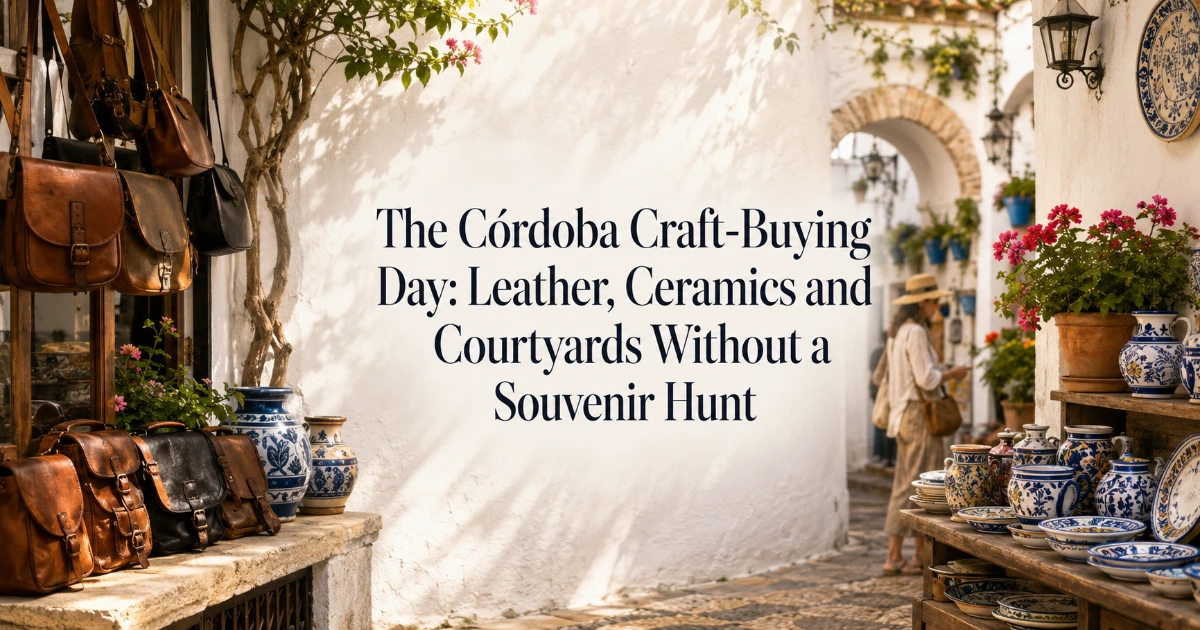
The Córdoba Craft-Buying Day: Leather, Ceramics and Courtyards Without a Souvenir Hunt
Updated
The best Córdoba craft-buying day is not a shop crawl; it is a short cultural route with one leather stop, one ceramics or design stop, and courtyard context before buying. That works because Córdoba’s historic center is compact, intense, and easy to overfill: the same lanes that make the Judería feel intimate also make an unfocused buying day feel repetitive. The clearest exception is a traveler with a collector’s brief, extra luggage capacity, and a full overnight; otherwise, not every craft stop belongs in one day.
Córdoba rewards the traveler who buys after seeing how the city handles shade, water, tile, leather, privacy, and interior life. The article-specific thesis is simple: in Córdoba, craft has more meaning when it follows a patio, a threshold, or a domestic detail, because the city’s finest objects often make sense only after you have seen the architecture of concealment and cooling that shaped them.
That is why a strong route usually begins with the Mosque-Cathedral area or a patio sequence, then narrows into craft. Check the official Mosque-Cathedral site (https://mezquita-catedraldecordoba.es/en/) for current visitor information if the monument is part of the same day, and keep the buying portion deliberately edited. A private version of this plan can be built through Córdoba shopping private tours, but the value is not simply having someone point at shops. It is having someone decide what not to include.
The ranked ladder: what belongs before craft buying in Córdoba
The strongest sequence puts context first, buying second, lunch or a hotel reset third, and optional additional browsing last. Córdoba is small enough that travelers underestimate decision fatigue. It is also layered enough that an object seen too early can feel decorative rather than rooted in place.
1. Courtyard or domestic context before buying: Begin with Córdoba patios, Palacio de Viana, or a focused old-town walk that shows how interior courtyards, tiled thresholds, carved doors, grilles, shade, and planted rooms structure daily life. This makes ceramics and leather feel connected to the city rather than detached from it.
2. One anchored craft category: Choose leather, ceramics, paper goods, or design-led objects as the principal category. Leather and ceramics can both fit, but only if each stop has a different purpose.
3. A controlled second stop: Add one more stop only if it changes the conversation. A second leather stop rarely improves the day unless the traveler is comparing workmanship, scale, or a commission.
4. Lunch, luggage, and decision space: Leave a pause before final purchases. Carrying bags through the Judería or toward the station changes the body of the day quickly.
5. Optional evening refinement: If you stay overnight, a later return can work for a single reconsidered purchase. It should not become a second hunt.
The counterintuitive correction is that the most famous first move is not always the best first move. Starting with the most photographed lanes around the Judería can overheat the day visually and physically before the craft conversation has begun. A quieter approach from the station side into the old town, or a patio-first route around San Lorenzo and Palacio de Viana, often gives a cleaner sense of Córdoba’s domestic vocabulary before the busier lanes near the Mosque-Cathedral pull attention toward crowds and quick purchases.
The same ranking also protects the day from becoming too vendor-led. If the first question is “where can we buy?” the route begins with supply. If the first question is “what has Córdoba taught us to notice?” the route begins with judgment. That difference matters in a city where a carved door, a tiled baseboard, a shaded patio wall, and a small leather object can all belong to the same visual language without needing to be explained as souvenirs.
For travelers planning a broader old-town day, Córdoba historic core private tours can supply the monument and neighborhood framing. For this craft-buying day, however, the historic route has to be pruned. The craft portion should not be the leftover hour after every major sight; it should be the point at which the earlier context starts changing what you notice.
Why courtyards change what you buy
Courtyards give the day context because they show Córdoba’s craft logic in use before you handle an object. A patio is not just a pretty pause. It teaches scale, shade, repetition, surface, water, and restraint. Those are the same qualities that make a piece of ceramics, worked leather, or a small household object feel right rather than merely attractive.
This matters because many travelers arrive in Córdoba with the wrong buying rhythm. They see color, then they buy color. They see pattern, then they buy pattern. After a courtyard, the better questions are more precise: would this tile tone belong against limewashed walls? Does the leather feel like an object made for use, or only display? Is the piece calm enough to live with, or did it only seem compelling because the lane was beautiful?
Palacio de Viana is useful here because its sequence of patios makes the idea of interior Córdoba legible. You do not need to turn the craft day into a palace day, but a measured visit to Palacio de Viana private tour can sharpen the eye before buying. The point is not to imitate the palace at home. It is to understand why Córdoba’s best craft often works through repetition, hand scale, proportion, and quiet surfaces rather than theatrical flourish.
The micro-location choice matters. A patio route around Viana and the old residential north gives a different mood from a buying route that begins in the Judería beside dense visitor movement. The first makes craft feel domestic and rooted; the second can make every object compete with monument-day adrenaline. Neither is wrong, but they produce different buying decisions.
Córdoba patios also slow the hand. In the heat, travelers often buy quickly because they want shade, water, or a seated break. A courtyard-first plan gives that relief before the shop threshold, so the purchase is less likely to become a comfort reaction. This is especially important for families, couples with different shopping tolerance, and celebration travelers who want the day to feel like a shared cultural route rather than one person shopping while the others wait.
There is another benefit: courtyards make smallness feel valid. A traveler who has just seen how Córdoba works through enclosed rooms, narrow thresholds, shaded plants, and controlled views is less likely to feel that the “right” purchase must be large. A small ceramic dish, leather case, paper object, or quiet household piece can carry the day better than a dramatic object that has to be explained, shipped, and defended for the rest of the trip.
Leather, ceramics and the Córdoba buying route without a souvenir hunt
A good Córdoba craft-buying route should feel edited enough that each stop answers a different question. Leather belongs when you care about touch, use, and workmanship; ceramics belong when you want Córdoba’s patios, table culture, and surface detail to travel home more naturally. Trying to exhaust both categories usually makes the day feel less curated, not more complete.
Leather first when the traveler values use
Leather should come first when the traveler wants something practical, tactile, and discreet. In Córdoba, leather has historic resonance, but the traveler consequence is more immediate: leather demands handling, comparison, and time. It is difficult to judge by glancing. A bag, belt, case, or smaller object changes under the hand, and a rushed traveler often confuses finish with quality.
One leather stop is enough for most visitors. Two can work when the pieces are visibly different in function or finish. Three becomes a hunt, and the mood changes. The day starts to revolve around finding the “best” item instead of understanding why one object belongs to the trip. Craft buying should be kept to one or two stops when the traveler has a train later, children in the group, limited luggage, or a first visit that still needs the Mosque-Cathedral and a real lunch.
Ceramics first when the patio is the point
Ceramics should come first when the traveler has just seen courtyard surfaces, table settings, or tile logic and wants a piece that carries that atmosphere without pretending to recreate Córdoba at home. This is where courtyard context before buying becomes practical. After patios, you are less likely to choose the loudest pattern and more likely to notice scale, glaze, weight, and how a piece might sit in your actual house.
The friction is luggage. Ceramics introduce fragility, volume, and shipping questions. Small pieces can be manageable, but anything substantial should be discussed before enthusiasm takes over. A guide or planner can help ask the right practical questions, but no responsible route should promise that every piece can be shipped easily, cheaply, or safely. Confirm packaging, insurance, customs, timing, and delivery responsibility with the seller before you commit.
Design-led objects when you want Córdoba without copying Córdoba
Design-led objects can be the most elegant choice for returning visitors. These are not necessarily the most historically obvious pieces. They may be paper goods, textiles, small home objects, contemporary ceramics, or leather with restrained lines. The advantage is that the piece can nod to Córdoba without becoming a literal travel memory.
This option suits travelers who already saw the Mosque-Cathedral on a previous trip, or who have a house full of things from earlier travels and now buy more selectively. It also suits celebration travelers who want a small piece chosen with care rather than a heavy object that creates logistics. The risk is thin context. Buying more expensive pieces does not make the route feel curated if the craft context is thin.
The body cost of a craft day in Córdoba
Córdoba’s craft day feels easy on a map and heavier on the body when heat, stone, narrow lanes, and carrying begin to accumulate. The city’s compact center is a gift, but it can also trick travelers into stacking too many small stops because each one seems close.
The station-to-old-town transfer is the first reality check. Córdoba’s railway station sits outside the tight historic core, so a traveler arriving by train still needs a reset before the buying day begins. If luggage is involved, the craft route should not start with wandering. It should start with storage, hotel drop-off, or a planned transfer into the old town. The moment a traveler is carrying a tote, a small purchase, and a jacket through uneven lanes near the Judería, the day feels less graceful.
The Roman Bridge is another useful boundary. It is beautiful in the right route, especially when river context matters, but it is not automatically helpful on a craft-buying day. Crossing the Guadalquivir adds exposure and walking time, and it can pull the day toward views rather than objects. If the bridge is included, make it a mood choice, not a buying choice. If the traveler is already managing ceramics, leather, or warm-weather fatigue, cut the river crossing first.
Midday heat changes judgment. In Córdoba, the warmest part of the day can make shoppers impatient, more suggestible, and less willing to compare slowly. The better plan is to use the morning for context and the first buying decision, then lunch or a seated pause before any second stop. Afternoon browsing should be optional, not assumed. That rule is especially important for older parents, children, or travelers coming from Seville or Granada who still have another city day ahead.
Footing matters too. The Judería’s lanes and old-town paving can make repeated backtracking feel more tiring than the distance suggests. A private guide cannot make stone softer or heat vanish, but a good route can reduce needless loops. That is where premium planning earns its cost: not in making the object more expensive, but in making the day shorter, calmer, and more decisive.
The body consequence is not only tired feet. It is poorer taste. Once a traveler is hot, holding bags, and aware of a later train or dinner reservation, the purchase often becomes a way to end the discomfort. That is the wrong kind of decision pressure. A better Córdoba craft day keeps the body light enough that the eye stays patient.
How to sequence a selective Córdoba craft-buying day
The best order is context, first craft stop, lunch, second craft stop only if it adds something, then logistics. This order keeps the day cultural rather than transactional and gives travelers enough space to make a better purchase.
Best half-day version: Begin with a short old-town or patio context walk, choose one leather or ceramics stop, then finish with a seated drink or lunch. This is the right version for day-trippers, families, and travelers who do not want purchases to control the day.
Best full-day version: Add Palacio de Viana or a richer patio sequence in the morning, make the first craft decision before lunch, then reserve the afternoon for one contrasting stop. This works best for returning visitors and overnight guests.
Best celebration version: Keep the craft stops fewer, add a beautiful lunch or evening plan, and treat the purchase as one part of a shared day. A couple celebrating an anniversary rarely benefits from four buying stops.
Best collector version: Use a specialist brief, define categories in advance, and allow time for comparison, packing, and follow-up. This is the exception that can justify more than two stops.
The first cut should be duplicate browsing. If the plan is getting crowded, do not cut the courtyard context first. Cut the third shop, the second version of the same product category, or the extra scenic detour. Without context, the buying becomes generic; without a third stop, the route usually improves.
For travelers who want patios to remain central rather than merely decorative, Córdoba patios private tour is the cleaner companion to a buying day than a broad all-sights itinerary. The craft stops then become a continuation of the patio logic rather than an unrelated shopping layer.
If the Mosque-Cathedral is also part of the day, it should not be treated as a quick preface to shopping. Its scale and visual density can dominate attention. Some travelers do better seeing it separately or placing it early, then using lunch as a mental break before craft. Others, especially returning visitors, may keep the monument out of the route entirely and use patios and neighborhood detail as the day’s cultural base.
The afternoon should have an escape hatch. If the first craft decision felt satisfying, let the day stop there and shift toward a drink, hotel reset, or short walk rather than adding a shop simply because there is time. The most elegant Córdoba craft day often ends earlier than expected. That is not a failure of planning; it is the proof that the route has stayed selective.
Where private help changes the day, and where it does not
Private help changes the day most when it edits the route, manages pacing, and connects objects to place. It does not turn every purchase into a meaningful one, and it should not be used to justify buying more.
The strongest private-tour value is selection. A guide can decide whether this traveler should begin in the Judería, around Viana, near the Mosque-Cathedral, or with a quieter threshold sequence. They can notice when a family is losing patience, when one partner is shopping and the other is merely enduring, or when a celebration day is starting to feel like errands. They can also translate the city’s details into buying judgment: why a ceramic form may feel more Córdoba than a loud pattern, or why a simple leather object may be stronger than something heavily decorated.
Private help also matters with time. A day-tripper from Seville or Granada has a different craft plan from a guest staying overnight near the Judería or the Viana side of town. Rail travelers need a route that respects station transfers and luggage. Hotel-based travelers can use a midday return or a late reconsideration. The same two shops can feel relaxed or rushed depending on whether the day has a clean base.
Where premium spend does not help is in forcing scale. A chauffeur, private guide, or higher object budget will not make a four-shop craft hunt feel elegant if the route lacks context and pauses. Paying more can improve comfort, privacy, interpretation, and decision quality; it cannot replace restraint. For a truly tailor-made version that edits the stops around your interests, group pace, and luggage reality, Inquire now.
Shipping, luggage and the purchase decision
Shipping and luggage should be discussed before the final buying decision, not after the object is wrapped. Córdoba is a better place to buy selectively than impulsively, because the practical cost of carrying can change the value of a piece.
For leather, the question is usually volume and daily carry. Smaller leather goods travel easily, but larger bags or structured pieces can still complicate a multi-city Andalusia itinerary. If you are moving between Córdoba, Seville, Granada, and Madrid, even one additional bag can affect transfers, train boarding, hotel check-ins, and the mood of the next day.
For ceramics, the question is risk. Fragile purchases require careful packing and a clear understanding of who is responsible if something breaks, is delayed, or encounters customs complications. Some sellers may offer packing or shipping options, but travelers should confirm details directly at the point of purchase. Avoid vague assumptions. Ask about packaging, shipment tracking, insurance, delivery time, customs paperwork, and whether the seller or shipper is the point of contact after dispatch.
The most elegant solution is often the least dramatic: buy one piece that fits the trip you are actually taking. If your itinerary includes a rail stop, a hotel change, or a flight with limited baggage tolerance, smaller is not less special. It may be the difference between remembering the purchase with pleasure and resenting it every time you move cities.
This is also where a private planner can be candid. A traveler may be willing to spend on a fine object but not realize that the object will dominate the logistics of the afternoon. A good route keeps the purchase in proportion to the journey. That is especially valuable when Córdoba is one stop in a larger Andalusia arc rather than the trip’s final city.
How this route should feel by the end of the day
A well-built Córdoba craft-buying day should end with clarity, not accumulation. The mood should be calm enough that the purchase feels chosen, the courtyards still feel present, and the evening has not been flattened by errands.
The mood consequence is real. Too many shop thresholds make the day feel shorter in the wrong way: not because it was efficient, but because the memories blur into interiors, decisions, and bags. A patio-first route lengthens the day emotionally. You remember the coolness of a courtyard, the scale of a doorway, the way ceramic color made sense after shade, or the feel of leather after seeing the city’s controlled surfaces. Then the purchase becomes a small conclusion rather than the day’s only proof.
This is also why Noor belongs only as a planning reference, not as an automatic add-on. The MICHELIN Guide entry for Noor (https://guide.michelin.com/gb/en/andalucia/cordoba/restaurant/noor) may be relevant for travelers building a food-and-craft overnight around Córdoba’s refined contemporary identity, but a tasting-menu evening after an overstuffed buying day can be a mistake. If dinner matters, the craft route must be lighter. If craft is the day’s focus, dinner should not require the group to recover from five hours of decisions first.
For travelers weighing whether this should sit inside an overnight rather than a day trip, this craft-and-patios overnight guide offers the adjacent version. The distinction is important: an overnight can support a richer route, but this article’s buying day still works best by staying selective.
Who should keep the route to one or two stops
Most travelers should keep the craft portion to one or two stops unless buying is the main purpose of the trip. This is not a compromise. It is the condition that keeps the day from turning into a search.
Families should usually choose one principal category. Children may enjoy texture, color, and a short decision, but repeated adult comparison drains the day quickly. Older parents may appreciate craftsmanship but not the stop-start rhythm of browsing. Couples often need the route edited because one person’s interest in buying may exceed the other’s patience. Small groups need even more restraint, because every additional stop multiplies opinions and waiting time.
Returning visitors can support a more focused route because they are less likely to feel the pressure to see everything else. First-time visitors should be more careful. If the Mosque-Cathedral, the Judería, lunch, patios, and craft all compete inside one day, craft should be a highlight, not a full sub-itinerary. The better first-time formula is one deep cultural anchor and one buying decision.
Collector-minded travelers are the exception. If you are comparing specific techniques, commissioning a piece, or building a design brief around Córdoba, then more time can be justified. Even then, the day needs pauses and logistics. The route should still avoid duplicate stops that only repeat the same type of object at the same level of quality.
Travelers with later trains should be the strictest. Once the mind starts checking the clock, the buying decision becomes poorer. If the day includes a rail departure, choose the craft category before lunch, make the purchase before the afternoon fades, and leave enough time for packing or returning to the hotel. The most expensive mistake is not overpaying for an object; it is letting the object distort the rest of the itinerary.
A practical Córdoba craft-buying day without turning it into a shop list
The most useful Córdoba craft-buying plan is a route logic, not a vendor list. Specific shops change, stock changes, and the right stop depends on the traveler’s taste, budget, luggage, and time. The durable planning question is what each stop is supposed to do.
- Start with a place lesson: Choose Córdoba patios, Palacio de Viana, or a short old-town context route that makes surfaces, shade, and domestic scale visible.
- Name the buying purpose: Decide whether you want use, beauty, memory, gifting, collecting, or home design. Those are different purchases.
- Choose one main material: Leather for touch and use; ceramics for surface, table, and patio connection; design objects for a subtler Córdoba reference.
- Add one contrast only: If leather is first, ceramics can be the contrast. If ceramics is first, a restrained design object can be the contrast. Do not add a second version of the same stop unless comparison is the point.
- Protect the logistics: Discuss luggage, wrapping, shipping, train timing, and hotel returns before the final purchase.
- Leave one object unbought: If two pieces are competing, the calmer choice is often to leave the less practical one behind. Regret fades faster than baggage friction.
That last point is where expert editing can feel almost anti-commercial, but it is what makes the day more valuable. A guide who helps you not buy the wrong piece has improved the trip. A planner who keeps the route from becoming a vendor checklist has protected the city’s meaning as well as your afternoon.
If you are still deciding whether Córdoba should be a stop, sleep, or pass-through city in a larger Andalusia plan, this guide to Córdoba between Madrid and Seville is the more relevant logistics read. If Córdoba is already secured and craft is the day’s purpose, the route above is the cleaner decision frame.
FAQ
Is Córdoba good for craft buying?
Yes, Córdoba is good for craft buying when the route is selective and tied to local context. Leather, ceramics, patios, and domestic architecture can form a strong cultural day, but the experience weakens when travelers try to turn the old town into a broad shopping crawl.
Should I visit Córdoba patios before buying ceramics?
Yes, visiting Córdoba patios before buying ceramics usually improves the decision. Courtyards help you understand scale, color, shade, surface, and restraint, so the ceramic piece is less likely to be chosen only because it looked attractive in a busy lane.
How many craft stops belong in one Córdoba day?
One or two craft stops are enough for most travelers. Add more only when craft buying is the main purpose of the trip, the group has strong stamina, and luggage or shipping has already been considered.
Should leather or ceramics come first in Córdoba?
Leather should come first if you care most about use, feel, and workmanship. Ceramics should come first if patios, table culture, and surface detail are the emotional center of the day. If both matter, choose one as the main decision and the other as a short contrast.
Can I combine the Mosque-Cathedral with a craft-buying day?
Yes, but the Mosque-Cathedral should be treated as a major cultural anchor, not a quick pre-shopping stop. Use the official Mosque-Cathedral site for current visitor information, then keep the craft portion concise so the day does not become visually and physically overloaded.
Is a private guide useful for shopping in Córdoba?
A private guide is useful when they edit the route, connect craft to place, manage pacing, and help the group avoid unnecessary stops. The value is judgment and flow, not simply access to more shops.
Can ceramics be shipped home from Córdoba?
Sometimes, but do not assume shipping is simple or guaranteed. Confirm packing, insurance, tracking, customs, delivery timing, and responsibility with the seller before purchase, especially for fragile or high-value pieces.
What should I cut first if the Córdoba craft day feels too full?
Cut duplicate browsing first. Keep the courtyard or patio context, keep one meaningful craft stop, and remove the third shop, extra scenic detour, or second version of the same category.
If you’re interested in any private tours of Cordoba, please reach out to us.



 So if you are looking for the absolute best in Cordoba & surroundings with authentic local fully-licensed native guides whose English you can actually understand and with an exclusive and amazingly fun itinerary