A Curated Córdoba Craft-and-Patios Day for a Luxury Overnight: Viana, the Judería and Artisan Stops Beyond the Mezquita
Updated
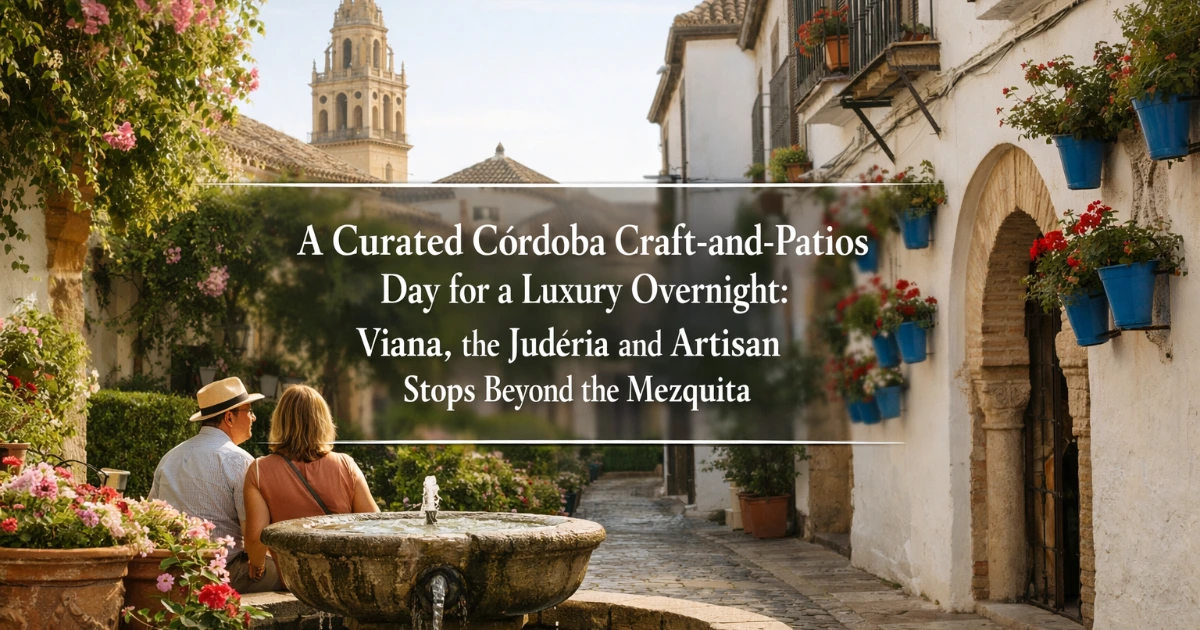
Build this as a slower overnight layer, not as a longer Mezquita-Catedral day. The strongest plan puts Palacio de Viana first, uses the Judería as a detail-rich walking hinge, and adds only artisan stops that explain materials you have already seen in patios, Mudéjar tilework, carved wood, leather, silver or ceramics. This works in real Córdoba because the Judería-to-Viana walking hinge is short enough to connect on foot but long enough to change the body of the day: the tight visitor lanes around the Mezquita-Catedral, Plaza del Cardenal Salazar and San Bartolomé feel different from the plainer residential edges toward Plaza de Don Gome. The clearest exception is a rail stop or a few hours between trains; then this theme becomes too dispersed, and the Mezquita-Catedral plus a trimmed Judería walk is the better use of the city.
Córdoba’s overnight value is not simply “more sights”; it is the shift from monument intensity to house, threshold, patio and handwork. That shift is why a dedicated Viana, Judería and craft day suits discerning travelers who already gave the Mezquita-Catedral its own space, especially couples and returning visitors who would rather remember the texture of the city than add another trophy stop. If the palace is the anchor you most want interpreted in depth, Orange Donut Tours can shape the day around a Palacio de Viana private tour and then build the surrounding craft and patio rhythm around your energy, not around a checklist.
Is a Córdoba craft-and-patios day worth it for a luxury overnight?
Yes, it is worth it when you are staying overnight and want a second layer of Córdoba after the Mezquita-Catedral rather than a second helping of the same old-town intensity. The day works because Palacio de Viana changes the scale of the city: instead of one monumental interior, you move through a lived house, a sequence of patios, garden thresholds and domestic rooms where private life, status, shade and craft are all part of the story. The official Viana site frames the palace around five centuries and 12 patios, but the planning consequence is more important than the number: Viana rewards patience, stops, turns and comparisons, not a fast sweep before a train.
The counterintuitive correction is that the area immediately around the Mezquita-Catedral is not the best place to keep shopping once the main monument is done. It is convenient, photogenic and tempting, but it can turn an otherwise elegant second day into a souvenir loop, especially around the busiest lanes near Calleja de las Flores. For this article’s purpose, the Mezquita surroundings are best used as context, a starting memory, or an evening edge; the day’s deeper value lies in moving from the Judería’s tight historical grain toward Viana’s domestic Córdoba and then choosing craft stops with discipline.
A craft-and-patios day is too niche for a short Córdoba stop. Premium planning cannot make dispersed craft stops worthwhile if the traveler only has a few hours between trains. In that case, spend money on a smoother station transfer, a focused Mezquita-Catedral visit, luggage handling and a calm lunch; do not force Viana, patios and craft into the margins. The theme earns its cost only when you can slow down enough to notice thresholds, courtyards, tile patterns, workshop logic and the way the route itself changes from tourism concentration to lived-in Córdoba.
For current visit formats, seasonal notes or ticketing details, check the official Palacio de Viana site (https://www.palaciodeviana.com/) and the official Mezquita-Catedral site (https://mezquita-catedraldecordoba.es/en/) before final confirmation. The editorial point, however, is evergreen: the Mezquita-Catedral should not be treated as the warm-up to this day. It deserves its own mental space. Viana, patios and artisan detail are what make the overnight feel justified rather than simply longer.
The ranked ladder: what earns space in the day
The best Córdoba craft-and-patios day is a priority ladder, not a collection of equal stops. When everything is treated as equally important, the route starts to feel like errands: one courtyard, one chapel, one shop, one photo lane, one bridge, one more shop. The stronger version ranks the day by what changes your understanding of Córdoba and what preserves the mood of an overnight.
1. Palacio de Viana wins the day. It is the anchor because it gives you patios in sequence, not as isolated glimpses, and because it moves the conversation from public monument to private house. Viana belongs after the Mezquita day, not before it, because the palace asks for a softer eye: garden planning, reception spaces, water, ceramics, ironwork, inherited rooms, shaded turns and family display. If you visit it while still in “major monument” mode, you underread the house.
2. Judería detail comes next. The Judería is not filler between the Mezquita-Catedral and lunch. It is where Córdoba’s smaller-scale craft and religious layers are easiest to read if you slow down: San Bartolomé, the edge of Plaza del Cardenal Salazar, Calle Judíos, Calle Averroes, the Zoco Municipal corridor, Puerta de Almodóvar and the routes that pull you away from the most photographed corners. A Judería private walking tour can turn those small stops into a coherent thread rather than a scatter of pretty alleys.
3. Patio culture beyond Viana should be selective. Córdoba’s patios are not only a May festival topic, and the city’s official patio information makes clear that patio routes and formats vary across the year. Use a dedicated patio layer when it supports the day’s central question: how Córdoba arranges privacy, cooling, status, plants, water and social life around inward-facing spaces. If you want that layer interpreted rather than simply photographed, fold in a Patios of Córdoba private tour rather than chasing a loose list of courtyards.
4. Artisan stops earn their place only when they explain materials. A leather, silver, ceramic or textile pause can deepen the day if it connects to what you have just seen in Mudéjar thresholds, tile bands, domestic rooms or patio hardware. The same stop becomes filler if it is treated as shopping for shopping’s sake. The standard should be simple: does this stop help you see Córdoba better after you leave the shop?
5. The Roman Bridge is not the daytime priority for this theme. The Roman Bridge is beautiful and essential to many first visits, but on a craft-and-patios day it pulls the body and attention toward the river, broad light and exposed walking. That is the opposite rhythm from Viana and the Judería-to-Viana walking hinge. Use the bridge later, as an evening walk if your hotel and dinner plans make it natural, not as a midday add-on that steals your best energy from the patios.
This ranking is intentionally firm. The best choice is Viana as the anchor, Judería detail as the interpretive hinge, patio culture as the slow middle layer, and craft as a curated accent. The overvalued choice is trying to make the Mezquita surroundings do everything: monument, lunch, shopping, patios, craft and evening stroll. That keeps you in the most obvious part of Córdoba and makes the overnight feel surprisingly thin.
How the Judería, Viana area and Mezquita surroundings create different walking rhythms
The route matters because Córdoba’s compactness can trick travelers into planning too much. On a map, the old town looks easy: the Mezquita-Catedral, Judería, San Bartolomé, the Zoco area, Plaza de las Tendillas, Plaza de la Corredera and Viana all sit within a walkable core. In the body, they are not the same. The city changes underfoot as you move from monument lanes to Jewish Quarter turns to the quieter approach toward Plaza de Don Gome.
Around the Mezquita-Catedral, walking is stop-start and attention is constantly interrupted. Doorways, tour groups, restaurant terraces, photo corners and carriage routes compress the experience. That can be thrilling on a first morning, but it is a poor condition for subtle craft judgment. If you leave the Mezquita-Catedral and immediately start browsing, you are likely to buy from fatigue, not discernment. For couples, it is also the easiest way to flatten the mood: one person wants to linger, the other wants air, and the day begins to feel negotiated instead of shared.
The Judería has a different rhythm. Its best craft-and-patio value is not speed but detail density: the Mudéjar language around San Bartolomé, the older Jewish Quarter narrative around Calle Judíos, and the way small courtyards, iron grilles, whitewashed walls and ceramic surfaces repeat in quieter forms. This is where a guide’s judgment matters. A weak walk points at names; a strong walk helps you decide which details deserve your attention and which photogenic diversions will only make the afternoon longer.
The Viana area changes the day again. As you head toward Plaza de Don Gome, Córdoba feels less like a postcard corridor and more like a city of house fronts, thresholds and domestic scale. That shift is precisely the point. Viana’s patios land better when the walk toward it has already prepared you to notice the difference between an exterior that withholds and an interior that opens. The route also makes you honest about energy: if you are already tired by the time you reach Viana, you planned the Judería too heavily.
The Roman Bridge and riverside create a fourth rhythm, broad and exposed. The bridge is often paired with the Mezquita-Catedral because it is so close visually and emotionally, but it sends the day outward. On a craft-and-patios overnight, that outward movement is usually better after a hotel pause or before dinner, not between Viana and artisan stops. Córdoba’s heat, glare and stone surfaces can make a compact plan feel longer than the distance suggests; saving the river for a separate mood protects the whole day.
A calm sequence for a luxury overnight craft-and-patios day
The calmest sequence starts with Viana or the Judería depending on where you slept, but it should not start with a full Mezquita-Catedral revisit. If your hotel is close to the Judería, begin with a short detail walk while the city is still settling, then move toward Viana before the day becomes crowded with lunch decisions. If your hotel is closer to Viana or the northern side of the center, reverse the order: let the palace set the theme first, then use the Judería later to compare public, religious and workshop detail.
Morning: choose one interpretive anchor, not two
The morning should have one serious anchor. For this article, that anchor is usually Palacio de Viana. Give it enough attention to understand how patios function differently inside one house: reception, utility, display, circulation, shade, garden approach and social signaling. The travel consequence is simple: a rushed Viana visit turns 12 patios into 12 quick impressions, while a paced visit makes the rest of the day easier because you now know what to look for elsewhere.
If you start in the Judería instead, keep it tight and intelligent. San Bartolomé is the kind of stop that can sharpen the whole day because its Mudéjar surfaces give you a language for reading craft: geometry, tile, plaster, color, wood and the relationship between small space and visual richness. Do not pair it with every nearby photogenic lane. The point is not to exhaust the Jewish Quarter; it is to give the later Viana and artisan stops a vocabulary.
Midday: protect the pause between domestic Córdoba and craft Córdoba
Midday is where many elegant plans fail. Travelers finish Viana inspired, then use that energy to add two more patio stops, a shop, a coffee, the Roman Bridge and a return through the Mezquita lanes. The day becomes physically possible but emotionally thinner. A better plan inserts a real pause: lunch, shade, a hotel return if your base allows, or at least a quiet café stop away from the most compressed lanes.
This is not indulgence for its own sake. Córdoba does something specific to the body: stone lanes hold heat, bright walls intensify glare, and the small distances encourage “just one more” walking decisions until everyone is tired at once. The compact center is a gift when it prevents long transfers, but it becomes a trap when it makes every extra stop look harmless. A comfort-first plan respects the fact that short distances can still produce late-afternoon fatigue.
Afternoon: use craft as interpretation, not retail therapy
The afternoon is the right moment for artisan stops because you have context. After Viana and San Bartolomé, a conversation about leatherwork, silver filigree, ceramics, ironwork or tile becomes more than browsing. The Zoco Municipal area around Calle Judíos and Calle Averroes can be useful as a spatial pause because it sits inside the Judería’s route logic, but do not build the whole day around any one craft venue unless it has a clear reason to be open and relevant for your date. A curated Córdoba shopping private tour should filter hard: one or two meaningful stops are more valuable than a string of near-repetitions.
The best artisan stop has three signs of quality for this kind of day. First, it connects to the city’s visual language, not just to a product category. Second, it can be understood without turning the afternoon into a sales appointment. Third, it leaves you more alert to Córdoba after you step back outside. A weak stop does the reverse: it consumes time, creates decision pressure, and makes the next patio feel like another item to process.
Evening: let the old icons return lightly
The evening can bring back the Mezquita-Catedral surroundings or the Roman Bridge, but lightly. A late stroll near the mosque walls, a view toward the river, or a return through a quieter edge of the Judería can reconnect the day to Córdoba’s famous silhouette without letting it dominate. This is where the overnight finally pays off: you are not racing back to the station, not carrying purchases through heat, and not turning a soft evening into a logistics problem.
For couples, the mood-preserving decision is to stop while the day still feels tactile and calm. The mood-killing mistake is to add the Roman Bridge, extra shopping and a final crowded lane because everything is “nearby.” Nearby is not the same as graceful. A beautiful overnight can be spoiled by the last unnecessary 45 minutes.
Where shopping or artisan stops add cultural depth, and where they risk feeling like filler
Shopping adds depth only when it is edited around Córdoba’s materials and your own patience. This is not a city where a premium craft day should mean generic browsing. The better question is not “Where can we buy something?” but “Which object or technique helps us understand the patios, Mudéjar detail and domestic history we are already seeing?”
Leather can be meaningful when it opens the conversation about Córdoba’s long association with worked hides, decorative surfaces and portable luxury. Silver filigree can be meaningful when it connects to delicacy, status and the miniature scale of ornament. Ceramics and tiles can be meaningful after San Bartolomé or Viana because your eye has already been trained to see pattern, border and threshold. Ironwork can be meaningful when you have noticed how grilles mediate privacy and visibility in patio houses.
Where craft becomes filler is equally clear. It becomes filler when the stop is chosen only because it is on the way. It becomes filler when every traveler in the group is expected to show equal interest. It becomes filler when the guide has to stretch a weak shop into a cultural explanation. It becomes filler when the purchase pressure outlasts the interpretive value. The cut-first rule is simple: if the craft stop does not connect to Viana, San Bartolomé, patio thresholds or the Judería’s material language, cut it before you cut rest.
Families and small groups need a stricter edit than couples. A couple can often enjoy one slow workshop or boutique pause if both travelers share the interest. A family with teenagers, older parents or different shopping temperaments needs shorter stops and clearer permission to opt out. In a celebration trip, one well-chosen object can become a memory of the city; three mediocre stops can make the celebration feel managed.
Comfort-first travelers should also be wary of overpaying for symbolism. A private guide, well-timed palace visit, good pacing and smoother route design can change the day. Paying more for an overproduced shopping detour does not necessarily improve it. Spend on interpretation and flow; be cautious about spending on theatrical access that does not give you better craft, better context or a calmer afternoon.
Where a private guide changes the day without making it feel managed
A private guide changes this day by deciding what not to explain, not only by adding information. The danger of a craft-and-patios theme is that it can become overinterpreted: every tile, pot, doorway and object receives a lecture. The more refined version is lighter. The guide gives you enough context to notice the difference between a decorative surface and a meaningful threshold, then lets the city breathe.
The highest-value guidance happens at transitions. Between the Mezquita-Catedral surroundings and San Bartolomé, a guide can slow the route before the Judería becomes another photo chase. Between the Judería and Viana, a guide can make the shift toward Plaza de Don Gome feel deliberate rather than like a navigation task. Inside Viana, a guide can keep the patios from blurring together by comparing function, not just beauty. Around craft stops, a guide can protect you from generic retail by choosing fewer, better pauses.
This is also where private touring serves the mood of an overnight. A group tour often has to keep everyone moving, even when the best decision is to pause, cut a stop or reroute into shade. A private day can adapt: one extra San Bartolomé explanation if the group is alert, one less shop if lunch ran long, a hotel reset if the heat is sharper than expected, or a later Roman Bridge walk if the evening feels right.
For a short-stay optimization, the most useful question is not whether you can fit Viana, the Judería and craft into the same day. You can. The question is whether the sequence still feels like an overnight privilege rather than a compressed transfer day. Orange Donut Tours can build a tailor-made Córdoba private tour around that line: meaningful craft, Mudéjar and patio detail, fewer weak stops, and a relaxed pace that still feels informed. Inquire now.
What to cut first when the plan starts to crowd itself
Cut the weakest craft stop first, then cut the daytime Roman Bridge detour, then cut duplicate patio stops. Do not cut the pause. A craft-and-patios day depends on looking closely, and close looking collapses when the day becomes a race.
The first thing to stop forcing is “one more shop because we are nearby.” Córdoba’s center makes this temptation constant. A lane that looks only two minutes away may add a decision, a purchase conversation, a payment delay, a bathroom need and a route reset. By the time you return to the main thread, the day has lost its clean line.
The second thing to cut is the bridge if it is being added only because it is famous. The Roman Bridge belongs beautifully in many Córdoba plans, especially first visits and evening strolls. It does not belong in the middle of this theme if Viana and the Judería are already carrying the day. Moving toward the river changes light, exposure and rhythm; it can make the afternoon feel longer just when the day should be settling.
The third thing to cut is duplicate patio coverage. After Viana, do not assume that more patios automatically mean more understanding. Sometimes one additional patio route or privately interpreted courtyard is enough; sometimes Viana itself has done the job. The official Patios de Córdoba (https://patios.cordoba.es/en/welcome/) information is useful for understanding the tradition and festival framework, but an overnight luxury plan should still be selective. The goal is not maximum patio count. The goal is a more intelligent eye.
Do not cut San Bartolomé too quickly if Mudéjar detail matters to you. Its scale is small enough to fit the day, and its craft language can make later tile, plaster, wood and ornament easier to understand. Cut it only if your group is already saturated by interiors or if the palace is your only true priority.
How to adapt the day for couples, returning travelers and comfort-first visitors
Couples should treat the day as a shared rhythm rather than a cultural obstacle course. The best version gives each person time to notice without being hurried: one serious palace anchor, one short Judería detail thread, one craft stop if it genuinely interests both travelers, and an evening that is not overplanned. The private value here is not exclusivity for its own sake; it is the ability to protect the day’s atmosphere from small frictions.
Returning travelers can go deeper. If you already know the Mezquita-Catedral and Roman Bridge, resist the urge to revisit them at full scale. Use the earlier memory as context and let Viana carry the new discovery. Returning travelers often get the most from small comparisons: how a patio controls heat differently from a lane, how a grille changes the relationship between private and public, how Mudéjar motifs move from chapel to craft, and how the Judería looks when it is not merely a route to the main monument.
Comfort-first visitors should be honest about temperature, footwear and hotel placement. If your hotel is in or near the Judería, the day can begin softly and pause easily. If you are staying around Viana, you gain a calmer morning approach but may need more intention when returning toward dinner. If you are choosing a base specifically for this kind of overnight, the neighboring planning question is covered in where to stay in Córdoba for a white-glove overnight.
Small groups should appoint one priority before the day begins. If the group says yes to patios, craft, Judería history, lunch, shopping, the Roman Bridge and a relaxed evening, the real priority becomes logistics rather than Córdoba. Pick the emotional center: Viana’s house-and-patio world, San Bartolomé and Judería detail, or craft as a tactile thread. Then let the rest support it.
Celebration travelers should make the day feel personal without making it performative. A private toast, a thoughtful purchase, a beautifully paced palace visit or a quiet evening walk can be enough. The more symbolic add-ons you stack onto the route, the more the day starts to feel produced. Córdoba is better when the celebration has room to happen naturally.
Booking and source-checking without turning the day into admin
Confirm the operational details, but do not let current-hour research become the trip. Viana, patio formats, special openings, shop availability and chapel access can vary, so the right planning process is to verify the anchor points close to travel and keep the theme flexible around them. The editorial sequence remains steady even when exact openings change: anchor, hinge, pause, selective craft, light evening.
If Viana is closed or not practical on your date, do not automatically replace it with a long list of smaller sights. Choose one substitute that preserves the same logic: domestic scale, patio culture or Mudéjar craft detail. If the substitute does not preserve that logic, change the theme of the day rather than pretending the original plan still works.
If the Mezquita-Catedral is still on your main day, protect it from this itinerary. See it with enough time and attention, then let the craft-and-patios layer live separately. Travelers who try to combine a major Mezquita-Catedral visit, Viana, the Judería, patios, craft, the Roman Bridge and a serious dinner in one day usually remember the heat and transitions more than the content. Córdoba rewards focus more than accumulation.
The final test is simple: after lunch, would you still choose the same afternoon if no one were counting sights? If the answer is yes, the day is probably well designed. If the answer is no, remove the least meaningful craft stop or the most famous add-on. A luxury overnight in Córdoba should feel calmer than a day trip, not merely better funded.
FAQ
Is Palacio de Viana worth visiting if I have already seen the Mezquita-Catedral?
Yes. Palacio de Viana is worth visiting after the Mezquita-Catedral because it shows a different scale of Córdoba: house, patios, garden thresholds and domestic collections rather than one monumental religious interior.
Should I visit Viana before or after the Judería?
Visit Viana first if you want the palace to anchor the day and you have an easy morning route to Plaza de Don Gome. Visit the Judería first if your hotel is there and you want San Bartolomé and the Jewish Quarter details to prepare your eye before the palace.
Can I fit Viana, patios, the Judería and artisan shopping into a Córdoba day trip?
You can fit pieces of them, but it is usually the wrong use of a day trip. A craft-and-patios day needs pauses and selective looking, so it works best as an overnight layer after the Mezquita-Catedral has already had proper time.
What should I skip first on a Córdoba craft-and-patios day?
Skip the weakest craft stop first. Then skip a daytime Roman Bridge detour if it pulls you away from Viana and the Judería. Do not skip the pause that keeps the afternoon from becoming rushed.
Are Córdoba patios only worth planning around in May?
No. May is the famous festival period, but patio culture is still useful outside the festival when it is interpreted through houses, thresholds, cooling, plants and social life. The plan should be adjusted to what is open and meaningful on your travel date.
Where do artisan stops make the most sense in this itinerary?
Artisan stops make the most sense after Viana or San Bartolomé, when leather, silver, ceramics, tile, ironwork or other materials can connect to details you have already seen. They are weaker when placed before the day has visual context.
Is the Roman Bridge part of this craft-and-patios day?
Only lightly. The Roman Bridge is better as an evening edge or separate first-visit moment, not as a midday interruption between Viana, the Judería and craft stops.
Who should avoid this kind of Córdoba overnight plan?
Avoid it if you have only a short rail stop, if the Mezquita-Catedral is still your unhurried priority, or if your group does not enjoy slow visual detail. In those cases, a tighter monument-and-Judería plan will feel more rewarding.
If you’re interested in any private tours of Cordoba, please reach out to us.



 So if you are looking for the absolute best in Cordoba & surroundings with authentic local fully-licensed native guides whose English you can actually understand and with an exclusive and amazingly fun itinerary













