San Basilio or Viana in Córdoba? Choosing the Patio Route That Justifies Slowing Down
Updated
Choose San Basilio first if you want Córdoba’s patio culture to feel lived-in rather than collected; choose Palacio de Viana first if you need reliable structure, contained movement and a stronger garden-and-courtyard arc. In real city conditions, the decision is less about which is “prettier” and more about access control, walking rhythm, heat exposure and how much emotional space you want after the Mezquita-Catedral. The clearest exception is a short, high-pressure day: if you are coming in by train, carrying lunch expectations and already anchoring the morning around the Mezquita-Catedral, Viana is usually the cleaner patio choice.
The thesis is simple and very Córdoba-specific: the patio route that justifies slowing down is the one that does not turn the city’s most intimate domestic tradition into another stop after the Mosque-Cathedral. San Basilio and Palacio de Viana both reveal courtyard life, but they do it through different forms of permission. San Basilio asks you to enter a residential rhythm at the edge of the Alcázar side of the old town, near the Puerta de Sevilla and the quieter streets around Calle San Basilio. Viana gathers twelve courtyards and a palace setting into one managed visit in the Santa Marina side of Córdoba, which makes it easier to protect pacing when the day already has moving parts.
This is also where a private route earns its keep. Not by forcing extra access into the day, but by choosing which kind of access respects the place, the season and your group’s energy. A tailored Córdoba patio route can pair the Mezquita-Catedral with the right courtyard mode, or leave one patio experience for a second morning. For a patio-led route, start with Patios of Córdoba Private Tour; for a more built-out private day around palace courtyards, use Palacio de Viana Private Tour.
The early ladder for choosing:
- Default winner for a slow Córdoba overnight: San Basilio, because the district makes you reduce speed and notice domestic scale, thresholds, tiles, plants and resident-led access.
- Runner-up, and often the better short-day choice: Palacio de Viana, because it concentrates courtyard variety, palace context and shade-and-pause logic into one coherent visit.
- Wrong fit: trying to do both patio modes tightly after the Mezquita-Catedral in a short day. More access does not justify crowding two patio routes into a short day.
- The comparison criteria: access style, heat load, walking continuity, respect for residents, interpretive depth, and what the route does to your evening if you are staying overnight.
San Basilio or Viana in Córdoba: the decision is really about permission
San Basilio is stronger when you want the patio experience to feel local, while Palacio de Viana is stronger when you want breadth, sequence and a single managed cultural site.
The mistake is treating both as interchangeable “patio stops.” San Basilio is a neighborhood experience in the San Basilio patio district, where the mood depends on small-scale access, respectful behavior and the ability to move without making the residents’ spaces feel like scenery. Viana is a palace-and-courtyard visit, with a clearer beginning and end, a more formal rhythm and a built-in narrative about aristocratic domestic space, garden design and Córdoba’s layered house culture. The choice changes not only what you see, but how you behave.
That distinction matters for discerning travelers because Córdoba’s old town can be deceptively compact. The Mezquita-Catedral, the Judería, the Alcázar side, the Roman Bridge and the San Basilio patio district can appear close enough on a map to invite overpacking. Then the day becomes a series of thresholds: security, tickets, narrow lanes, shaded pauses, lunch timing, a hotel return, another entrance, another explanation. By the time you arrive at a patio, you may technically have time but no attention left.
The counterintuitive correction is this: the glamorous old-town base near the Mezquita-Catedral is not always the best patio base. It is beautiful, and for a first visit it is often convenient, but it can pull every decision back toward the Mosque-Cathedral and the busiest Judería lanes. For San Basilio, the better route hinge may be the Alcázar side, Puerta de Sevilla, or a calm approach from the river-facing edge rather than another weave through the densest streets around Calle Cardenal Herrero. For Viana, the route belongs farther north, toward Santa Marina and Plaza de Don Gome, which means it should be given its own movement logic rather than bolted onto a Judería loop.
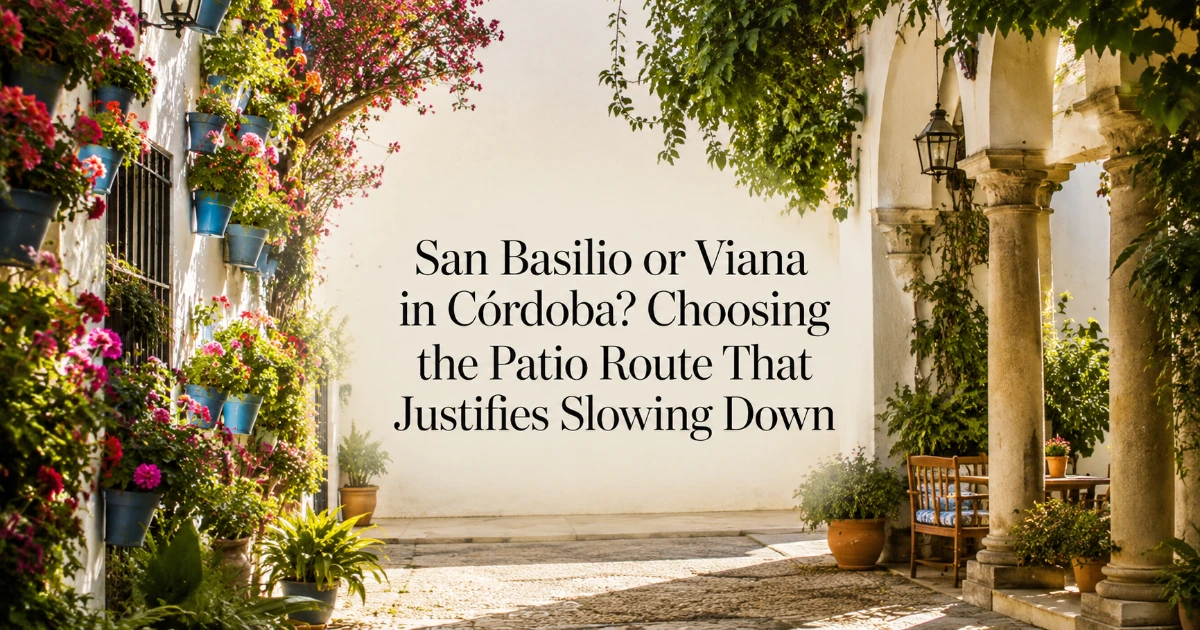
San Basilio wins when the goal is to slow down because it forces a different etiquette. You do not merely arrive at a venue; you enter a residential language. The best moments are often small: a doorway framing blue pots, the change in temperature as you step from a sunlit lane into a planted courtyard, the realization that the patio is both decoration and climate technology. That is not the same experience as walking a palace sequence, however beautiful the palace may be.
Viana wins when your group needs containment. Families with mixed attention spans, older parents who prefer a defined visit, celebration travelers with lunch or dinner commitments, and travelers who want a stronger cultural container often leave Viana happier. The official Palacio de Viana site is the right place to confirm current visitor information before you go: official Palacio de Viana site (https://www.palaciodeviana.com/). For the Mezquita-Catedral, which often shapes the whole day’s order, use the official Mosque-Cathedral site (https://mezquita-catedraldecordoba.es/en/) for current visitor information rather than relying on a generic itinerary.
When San Basilio feels local rather than staged
San Basilio feels most local when you give it a narrow purpose: a resident-scale patio walk, not a citywide flower hunt.
The San Basilio patio district sits close enough to Córdoba’s headline monuments to tempt a quick detour, but it needs a different tempo. It works best when you have already accepted that the patio is the main point of that part of the day. The district’s value is not just in individual courtyards; it is in the way whitewashed lanes, doorways, ironwork, planted walls and domestic thresholds create a social geography. The more you rush, the more San Basilio starts to feel like a checklist of doors.
Choose San Basilio if your group wants Córdoba to feel inhabited. Couples who like small streets and soft transitions usually respond well to it. Food-and-wine travelers who want an unforced pre-lunch walk can use it as a gentle bridge between the Alcázar side and a slower meal. Families can enjoy it, but only when the adults are comfortable keeping the visit short and explaining that these are not playground-like spaces. Celebration travelers should choose it when they want intimacy, not spectacle.
The on-the-ground consequence is behavioral. In San Basilio, a good guide helps your group read what is open, what is appropriate, when to pause, when not to crowd an entrance, and how to keep voices low. Premium service here is less about privilege and more about restraint. A private guide can protect the mood by spacing the group, trimming explanation in tight areas, and choosing a route that does not trap everyone in the same narrow lane with other visitors. That is especially important when the patios are functioning as homes or semi-domestic spaces rather than as a single museum site.
San Basilio also makes more sense when you are staying overnight. A day-tripper often arrives with the Mezquita-Catedral as the dominant target and lunch as the second fixed point. An overnight guest can let San Basilio sit in a softer part of the day: after a hotel check-in, before a relaxed dinner, or on a second morning when the city has stopped feeling like a transfer problem. If you are still deciding whether Córdoba deserves that night, this overnight decision guide helps place the patio question inside the larger trip rhythm.
The best San Basilio route is usually not long. That may sound underwhelming, but it is the point. A focused San Basilio walk can feel richer than a longer patio chase because attention stays fresh. The strongest version allows time for the district edge, the approach, a few carefully chosen interiors when available, and an exit that does not immediately throw you back into the densest Mezquita crowds. If the route starts to become a search for “just one more patio,” it is already losing its strength.
When Palacio de Viana is stronger than the San Basilio patio district
Palacio de Viana is stronger when you want courtyard variety, reliable sequencing and a more formal cultural visit without depending on neighborhood access.
Viana is not a substitute for San Basilio’s resident-scale mood. It is a different answer. The palace setting makes the courtyard tradition legible in a concentrated way: a sequence of spaces, each with its own proportion, planting, sound, light and relationship to the building. That concentration is useful when Córdoba is part of a larger Andalusia itinerary and you cannot afford uncertainty around the patio portion of the day.
Choose Viana when your group includes travelers who need a defined visit. Older parents often appreciate knowing that the experience has a clear site boundary. Families benefit from the sense of progression: one courtyard, then another, then a shift in texture. Culture-focused travelers get more interpretive material from the relationship between architecture, domestic status and garden design. Travelers who have already done the Judería and Mezquita-Catedral may also find Viana’s Santa Marina location helpful because it pulls the day into another side of Córdoba rather than repeating the same old-town lanes.
Viana is especially useful outside peak flower expectations. Many travelers overvalue Córdoba’s patio idea as a flower-photo experience and undervalue it as climate, architecture and household intelligence. A palace courtyard can still read well when blooms are not at their most theatrical because proportion, shade, stone, water, plant structure and room-to-courtyard relationships remain meaningful. That makes Viana a sturdier choice for travelers who do not want the day to depend on a perfect seasonal display.
There is also a mobility argument. The Santa Marina side of Córdoba is not difficult, but it is a real shift from the Mezquita-Catedral zone. If your day begins near the Mosque-Cathedral and then moves north to Viana, the route needs to be treated as a separate movement, not as a casual “nearby” add-on. A private route can absorb that transition by deciding whether to place Viana before lunch, after a hotel pause, or on a second morning. Without that discipline, the visit can feel like you are chasing the city across its compact center.
Viana is the better patio choice when the group wants comfort without performance. You can slow down without worrying as much about whether you are overstepping a residential threshold. You can pause for context without blocking a tight doorway. You can compare courtyard styles without needing every stop to be open at exactly the right moment. For travelers who value calm structure, that is not a lesser experience; it is the reason Viana often beats a rushed San Basilio walk.
How the Mezquita-Catedral shapes the patio day
The Mezquita-Catedral should set the day’s spine, because it consumes more attention than most travelers expect and changes which patio route feels generous afterward.
The Mosque-Cathedral is not simply one attraction before the patios. It is Córdoba’s interpretive center of gravity. After a serious visit, many travelers need contrast, not another dense cultural explanation. That is why San Basilio can be excellent after the Mezquita-Catedral only if the route becomes lighter, quieter and more bodily. It should feel like air after architectural intensity. If it becomes another guided lecture, it flattens the day.
Viana after the Mezquita-Catedral can work, but only with a deliberate reset. The route from the Mosque-Cathedral area toward Plaza de Don Gome is a shift in neighborhood and mood. It asks the group to leave the Judería’s emotional concentration and move into a more northern domestic-palace Córdoba. That is worthwhile when Viana is the second major cultural chapter of the day, not when it is the fifth stop after the Roman Bridge, Alcázar gardens, Judería and lunch.
The body feels this city through heat load, stone reflection, narrow-lane pacing and repeated thresholds. Córdoba’s compact center is a gift, but compact does not mean effortless. A morning around the Mezquita-Catedral can involve slow walking, standing, visual concentration, security or entry logistics, and the mental work of absorbing a building that resists simple explanation. Add sun between shaded streets, a lunch search, and a northward transfer to Viana or a residential pause in San Basilio, and a seemingly elegant plan can become heavy before you notice.
The cut-first rule is firm: if the Mezquita-Catedral is the emotional anchor of the day, do not force both San Basilio and Viana afterward. Choose only one patio mode unless you have an overnight and can separate them into different halves of the stay. The extra access will not make the day feel more premium if it turns the patios into recovery stops you are too tired to receive.
For first-time visitors, the cleanest approach is often Mezquita-Catedral first, then one patio mode chosen by season and energy. If you want deeper Mosque-Cathedral planning before you decide, this guide to Córdoba Mosque-Cathedral tours helps clarify why the building deserves protected attention rather than being squeezed between patio ambitions.
The ranked ladder: which patio route fits your season, energy and overnight rhythm?
The best patio route is the one that leaves enough attention for the evening, not the one with the longest list of courtyards.
1. San Basilio as the slow overnight choice
San Basilio ranks first for travelers staying the night because it gives Córdoba a human scale after the day-tripper rhythm has faded. The district works beautifully when you are not trying to extract everything from the city before a train. It suits couples, garden-minded travelers who like lived-in detail, and small groups who can move gently through residential spaces. The route should be selective, not exhaustive, and it should leave time to exit with calm rather than spill directly into dinner already overstimulated.
The mood consequence is important. San Basilio can make the entire stay feel shorter in the best sense: less like an itinerary, more like a city you briefly joined. The wrong pacing does the opposite. If the group arrives hot, late, hungry or in a hurry, the district’s intimacy can feel fragile. A guide who knows when to stop talking is as valuable as one who knows what to explain.
2. Palacio de Viana as the strongest structured patio answer
Viana ranks second overall but first for short days, mixed-mobility groups and travelers who want the patio theme to carry clear cultural weight. It is easier to plan, easier to contain and easier to pair with a hotel pause or lunch. It also creates a stronger sense of accumulation: courtyard after courtyard, each one adjusting light, water, planting and domestic architecture.
The tradeoff is that Viana is less local in mood. You are visiting a palace, not stepping through a neighborhood’s domestic rhythm. That is not a flaw. It simply means Viana should be chosen when structure is the virtue. If your Córdoba day already includes rail logistics, a fixed Mezquita-Catedral visit, and a lunch or dinner reservation, Viana may preserve more dignity than a San Basilio route that depends on everyone having the right energy at the right moment.
3. A split patio plan across an overnight
A split plan can work when you have two meaningful windows: one for the Mezquita-Catedral and San Basilio, another for Viana. This is the only way to see both patio modes without making them compete. For example, San Basilio can sit in the late afternoon or early evening tone of the arrival day, while Viana can become a second-morning visit before departure. Or Viana can be the arrival-day cultural container, with San Basilio reserved for a gentler walk when the group has stopped watching the clock.
The split plan fails when it is used to justify overpacking. Two patio modes across an overnight are worthwhile only when the rest of the itinerary is restrained. If you add Medina Azahara, the Alcázar, the Roman Bridge, a heavy lunch, shopping and a late dinner, the patios will become decorative rather than meaningful.
4. The short-day single-patio rule
A short Córdoba day should choose one patio mode, and for many groups that means Viana. This is not because San Basilio is less important. It is because short days punish fragility. Viana gives you a clearer plan, a more predictable arc and less dependence on the subtle etiquette of residential visiting. San Basilio can still win for travelers who are specifically seeking lived-in patio culture, but only if they are willing to cut elsewhere.
If the short day starts or ends at Córdoba station, the transfer layer matters. The station is not embedded inside the Mezquita-Catedral lanes, and a luggage-aware day needs a clean plan rather than romantic map logic. In that scenario, Viana can be easier to justify because it is a defined visit that can be placed before or after a transfer. San Basilio can be better only when the route is already leaning toward the Alcázar side and the group is not dragging the day through extra crossings.
Where private routing changes the experience, and where it cannot rescue a crowded plan
Private routing changes the patio experience when it protects respect, heat management and context; it does not change the fact that a crowded day feels crowded.
In San Basilio, the value of expert planning is partly ethical. Residential patio culture needs discretion. A private guide can help your group avoid bunching at thresholds, keep explanations brief where the lane is tight, and understand why the district should not be treated like a public garden. This is where premium service is most meaningful: it improves how you occupy the place, not just what you gain from it.
In Viana, private planning earns its place through interpretation and sequence. The courtyards can be beautiful without explanation, but they become more rewarding when someone helps you compare domestic hierarchy, shade, plant choices, water, axes, room relationships and the difference between a courtyard as display and a courtyard as living technology. The visit becomes less about photographing twelve spaces and more about understanding why Córdoba built inward.
Heat management is the other practical gain. Córdoba’s patio culture is inseparable from climate. Courtyards are not just picturesque; they mediate light, air and temperature. A strong route keeps the most exposed movement out of the hardest part of the day when possible, builds in water and shade, and resists the temptation to turn the old town into an endurance walk. The benefit is especially visible with older parents, children, celebration groups in dressed-up clothing, and travelers arriving after a train segment.
But premium spend does not help when the brief is wrong. It can improve timing, context, comfort and judgment, but it cannot make two patio routes, the Mezquita-Catedral, the Alcázar, the Judería, lunch and a relaxed evening all feel spacious in one short day. If the itinerary is already swollen, the premium decision is to cut, not to add a more expensive layer of coordination.
That is why the best planning handoff is not “show us everything.” It is “help us choose the patio experience that fits this season, this group and this overnight rhythm.” For a custom Córdoba route that protects resident respect in San Basilio, uses Viana when structure is the wiser choice, and keeps the Mezquita-Catedral from swallowing the whole day, Inquire now.
Season changes the winner more than most travelers expect
Season affects the patio choice because it changes what the visit asks from the body and what kind of beauty remains reliable.
In peak bloom expectations, San Basilio can be emotionally powerful, but it also requires more patience and better etiquette. The district’s appeal rises when patios are at their most vivid, yet so does the risk of treating the neighborhood as a flower circuit. The more famous the patio moment feels, the more important it is to keep the route selective and respectful. A private group should not move like a crowd just because it is private.
In hotter months, Viana often becomes the more practical first choice. Not because it is immune to heat, but because its contained structure makes it easier to manage pace, pause and interpretation. San Basilio can still work, especially in a short, carefully timed window, but it should not be placed after too much exposed walking. The city’s heat changes patience. It makes small delays feel larger, turns a charming detour into a drain, and pushes groups toward shorter explanations.
In shoulder seasons, the answer becomes more personal. San Basilio is excellent for travelers who like neighborhood texture and are comfortable with a less museum-like experience. Viana is excellent for travelers who want patio architecture to remain rewarding even when the floral display is not the whole story. Winter light can make both experiences compelling, but the route should lean into architecture, proportion and quiet rather than selling the patio idea as a bloom-dependent spectacle.
The patio decision also changes if Córdoba is a day trip versus an overnight. Day-trippers should be more conservative. They need the Mezquita-Catedral, lunch, transfers and one carefully chosen secondary experience. Overnight travelers can allow the patios to become a reason to slow down rather than a reward for having already rushed. For season-specific pacing beyond this San Basilio-versus-Viana question, this Córdoba patio-season guide gives the broader timing frame without turning this route choice into a festival-planning page.
How to sequence the patio route without flattening Córdoba
The best sequence gives the Mezquita-Catedral its own attention, then uses one patio mode to change the day’s texture.
For a first Córdoba overnight, the most satisfying sequence is often arrival and check-in, a light San Basilio walk if the group has energy, dinner without overcomplication, then the Mezquita-Catedral the next morning with Viana only if the second day has enough air. This version lets San Basilio feel like an evening threshold into Córdoba rather than a post-monument errand. It also means the Mosque-Cathedral is not competing with a long palace visit on the same morning.
For a same-day rail visit, the sequence should usually be Mezquita-Catedral, lunch, and one patio answer. If the group wants the lowest-risk patio experience, choose Viana. If the group has specifically asked for residential patio culture, choose San Basilio and cut Viana. Do not add the Alcázar gardens simply because they are nearby. The Alcázar side can be a useful route hinge, but it becomes a mistake when it turns a focused patio day into a garden-and-monument trawl.
For older parents or mixed-generation groups, place the patio experience before fatigue becomes visible. Viana works well here because the visit has a defined container and can be paced with more predictable pauses. San Basilio can be lovely, but it requires the group to handle narrow lanes, residential etiquette and a less controlled rhythm. If anyone in the group becomes anxious when plans are ambiguous, Viana will feel calmer.
For couples or celebration travelers, the route should protect the evening. A patio walk should not leave everyone returning to the hotel overheated and late. San Basilio can set up a beautiful dinner mood when it is short, quiet and well timed. Viana can set up a more cultural day when dinner is later and the group wants to feel they have understood something substantial beyond the Mezquita-Catedral. The wrong plan is the one that makes everyone change clothes in a hurry because the patio portion ran too long.
For travelers staying near the Judería, remember that beauty can create drag. The lanes around the Mezquita-Catedral invite repeated wandering, but repeated wandering is still movement. A route that loops through the same streets three times will make the day feel longer without adding depth. For travelers staying around Viana or Santa Marina, the opposite is true: do not underestimate the emotional pull of the Mezquita-Catedral zone. Build the day so the transfer between zones feels intentional rather than like a correction.
The patio route to cut when the day is getting too full
Cut the second patio mode first, then cut any add-on that duplicates shade-and-garden pleasure without deepening the day.
If you have chosen San Basilio, do not add Viana simply because it is famous. Let San Basilio be the patio answer and use the saved energy for a meal, a hotel pause, or a quieter walk toward the river edge. If you have chosen Viana, do not add San Basilio as a token residential stop unless you can give the district enough respect and attention. A shallow San Basilio detour can feel less generous than no San Basilio at all.
The Alcázar is the next place to be careful. Its gardens and location near the San Basilio side can make it look like a natural add-on, but in a patio-focused day it often duplicates the outdoor-garden impulse without answering the same cultural question. The Alcázar belongs when its history and riverside context are part of the day’s argument. It does not belong just because you want one more green space after the Mezquita-Catedral.
The Judería also needs discipline. It is essential context for many first visits, but it can blur into a generic old-town weave if used as filler between bigger stops. If the day is about San Basilio versus Viana, keep the Judería as a route connector or a focused context segment, not a second full theme. Córdoba rewards narrow choices more than broad sampling.
Food-and-wine travelers should protect lunch rather than chase one more patio. Córdoba’s midday meal can restore the day if it is placed well; it can also break the day if it is treated as an afterthought. A patio route that ends with everyone hungry, hot and indecisive has failed even if the courtyards were beautiful. The practical luxury is not seeing more; it is arriving at the meal with enough composure to enjoy it.
What each choice does to the mood of the trip
San Basilio makes Córdoba feel intimate; Viana makes Córdoba feel composed.
That mood difference should guide the decision as much as logistics. San Basilio is the better choice when you want the city to feel slower, smaller and more resident-shaped. It is less about mastery and more about permission. The emotional payoff is quietness: the sense that Córdoba’s beauty is not only monumental but domestic, maintained, watered, shaded and lived with.
Viana is the better choice when you want the day to feel rounded. It gives the group a clear cultural chapter after the Mezquita-Catedral or before a more relaxed evening. The palace format can prevent the day from dissolving into wandering. It also gives travelers who like structure a sense of completion: they did not just glimpse patios; they followed a courtyard argument.
The wrong patio choice can flatten the trip. A rushed San Basilio visit can make the group self-conscious and scattered. A forced Viana visit after too much morning intensity can make the palace feel longer than it is. Both routes are vulnerable to the same planning error: using patios as proof that you made the most of Córdoba. They are more rewarding when used as a reason not to overprove the day.
For an overnight, the best patio decision often improves the evening by subtraction. Choose the patio mode that leaves enough appetite, conversation and patience for dinner or a late walk. Córdoba does not need to be conquered after dark. A calm return through the old town, a short riverside movement, or simply not rushing back from the Santa Marina side can do more for the memory of the trip than another scheduled stop.
Final verdict: which patio route should you choose?
Choose San Basilio if your Córdoba stay has room to slow down, and choose Palacio de Viana if your day needs structure, reliable depth and a cleaner fit around the Mezquita-Catedral.
The strongest San Basilio traveler is staying overnight, values domestic culture, and is willing to see fewer places with more attention. The strongest Viana traveler has a tighter schedule, mixed group needs, or a desire for a coherent courtyard sequence that does not depend on residential access. The strongest planner knows that both can be right, but not usually in the same compressed day.
If your real question is “Which patio route justifies slowing down?” the answer is San Basilio, provided you protect it from hurry. If your real question is “Which patio route gives us the best chance of a satisfying day around the Mezquita-Catedral?” the answer is often Viana. The difference is not quality. It is rhythm.
FAQ
Is San Basilio or Palacio de Viana better for a first visit to Córdoba?
Palacio de Viana is usually easier for a first visit with limited time because it gives a structured courtyard experience. San Basilio is better if you are staying overnight and specifically want Córdoba’s patio culture to feel local and residential.
Can you visit San Basilio and Viana on the same day?
You can, but it is only worthwhile if the rest of the day is restrained. If the Mezquita-Catedral is also a major visit, choose one patio mode unless you have an overnight and can split San Basilio and Viana into separate windows.
Which patio route works better after the Mezquita-Catedral?
San Basilio works better after the Mezquita-Catedral when you want a quieter, resident-scale contrast. Viana works better when the group needs a defined cultural site and enough structure to prevent the afternoon from becoming vague.
Is San Basilio suitable for families?
San Basilio can suit families when the route is short, respectful and clearly explained. It is not ideal for children who need open space or constant movement, because the district depends on quiet thresholds and residential etiquette.
Is Palacio de Viana too formal if I want local patios?
Viana is more formal than San Basilio, but it is not a weak choice. It is strongest when you want courtyard variety, architectural context and a contained visit rather than the more delicate rhythm of a residential patio district.
Where does the San Basilio patio district fit in Córdoba?
The San Basilio patio district sits on the Alcázar side of Córdoba’s historic center, near Puerta de Sevilla and close enough to the old town to tempt a quick detour. It feels best when treated as its own slow route rather than a filler stop.
Should I choose only one patio mode in Córdoba?
Yes, choose only one patio mode if you have a short day, a fixed Mezquita-Catedral visit, rail logistics or a group with mixed energy. Choose both only when an overnight lets you separate them without rushing.
Does paying for a private patio tour get better access?
Private planning can improve timing, context, comfort, etiquette and route judgment, but it does not make an overpacked day feel spacious. The best value is in choosing the right patio mode and pacing it well, not in adding more stops.
If you’re interested in any private tours of Cordoba, please reach out to us.



 So if you are looking for the absolute best in Cordoba & surroundings with authentic local fully-licensed native guides whose English you can actually understand and with an exclusive and amazingly fun itinerary













