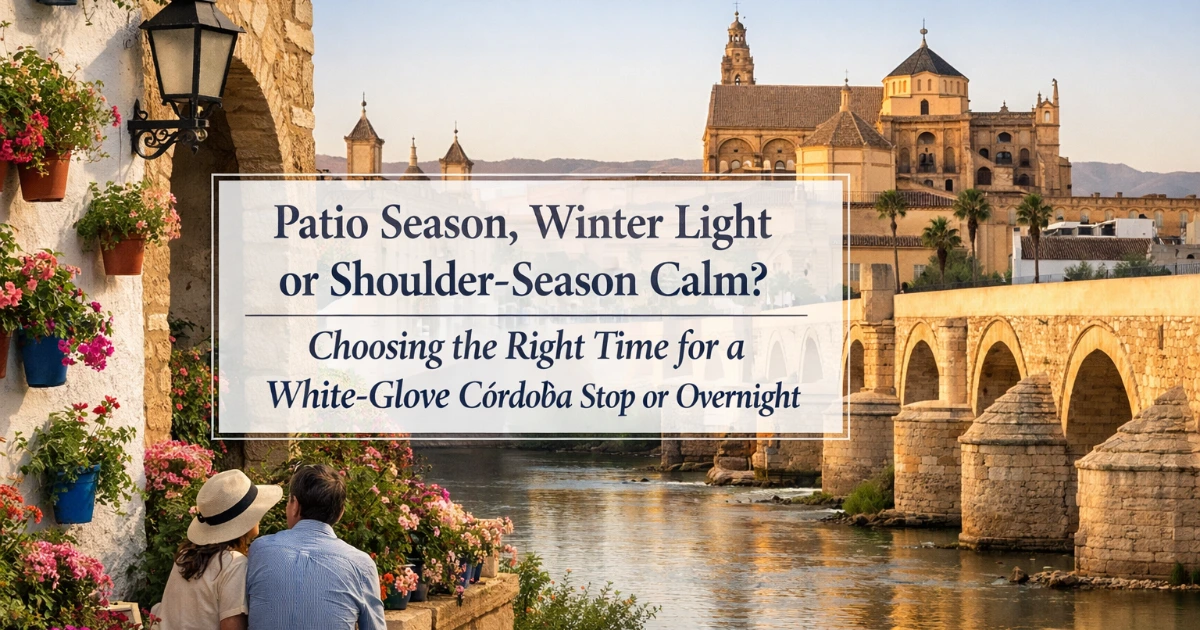
Patio Season, Winter Light or Shoulder-Season Calm? Choosing the Right Time for a White-Glove Córdoba Stop or Overnight
Updated
For a comfort-led Córdoba stop or one-night stay, shoulder-season calm is the best default, winter light is the most underrated runner-up, and patio season is a specialty choice rather than the automatic winner. That ranking works because Córdoba is not difficult in a broad, sprawling-city way; it is difficult in a more deceptive way, where one extra zone changes the whole feel of the day. The Mezquita-Catedral and the Judería sit beautifully together, but the moment you add Palacio de Viana, patio routes, or Medina Azahara, the city stops behaving like a single compact core and starts acting like separate pieces stitched together by timing, walking, and exposure. The clearest exception is a patios-led trip: if the courtyards are the true reason you are coming, patio season can be wonderful, but it usually deserves an overnight rather than a polished same-day stop.
In Córdoba, the right date does not just change the scenery. It changes the honest size of the city. The Judería-to-Viana stretch is the point where a day that looked effortless on a map begins to feel like two old-town visits joined together, and that is why season choice matters so much more here than travelers expect. If your dates are already fixed, seasonal planning for Córdoba is the clearest next step after deciding what the day can truthfully hold.
Before you lock a train or overnight, check the official Mosque-Cathedral site (https://mezquita-catedraldecordoba.es/en/), the city’s official patios page (https://www.turismodecordoba.org/the-patios-of-cordoba), and the Palacio de Viana official site (https://www.palaciodeviana.com/visitas/). In Córdoba, current entry windows and seasonal access patterns do not sit quietly in the background; they determine whether a stop, a full day, or a night in town feels elegant or forced.
The ranked ladder that decides most Córdoba dates
For most planners, the decision becomes clear once you judge each season against four things: how much exposed walking the day asks of you, how rigid the timed elements become, whether the city can still absorb a second zone without feeling stretched, and whether the evening adds something meaningful rather than simply giving you recovery time.
1. Shoulder-season calm is the default winner. Think late March and early April before patio peak, plus late October and November. Choose it when you want the widest range of honest formats: a rail stop, a full day, or a one-night stay. It wins because Mezquita-Catedral, Judería, lunch, and one further decision still fit together without turning the day into damage control.
2. Winter light is the best mood-first overnight. Think of the cooler winter months when clear light and shorter days encourage focus. Choose it when you want Córdoba to feel spacious, low-pressure, and absorbable, especially if the city is meant to soften an Andalusia itinerary rather than compete with it. It does not give you patio peak, but it often gives you the most satisfying evening.
3. Patio season is the selective splurge. Think especially of the festival fortnight in May. Choose it only when patios are a priority in their own right and you are prepared for crowd density, route zigzags, and more fixed visiting windows. Patio season can be superb. It is just not the easiest way to experience Córdoba well.
The wrong fit: patio season is the wrong choice if you are heat-sensitive, loosely interested in patios, and hoping the city will behave like an easy between-trains stop.
Cut first: do not try to keep both Palacio de Viana and Medina Azahara on the same day when the plan is already getting crowded. They pull your route in different directions, and each only pays off when it has room.
Why shoulder-season calm wins the widest range of trips
Shoulder-season dates are the only ones that keep Córdoba honest as both a sophisticated stop and a rewarding overnight.
What makes spring and autumn shoulder dates so useful is not simply milder air. It is that the city’s internal proportions make sense again. You can arrive from the station, settle into the historic center, see the Mezquita-Catedral at a civilized hour, move through the Judería without feeling herded, and still make one more intelligent choice: either remain in the core for a longer lunch and an easy finish, drift north toward Palacio de Viana, or break outward for Medina Azahara if the rest of the trip has room for it. In a city this compact, that may sound ordinary. In reality, it is the difference between Córdoba feeling beautifully composed and oddly over-ambitious.
This is also the season when Córdoba works most cleanly as a rail stop. The station transfer is not dramatic, but a stop only feels polished when the old town still behaves like a single zone after you arrive. In shoulder season, it often does. You can make the city feel concise rather than clipped. That is why these dates do such good work for couples moving between Madrid and Seville, for families who want a cultured pause without an all-day heat test, and for food-and-wine travelers who want lunch in the middle rather than as an emergency recovery break. If that is your format, our rail-stop planning guide is the natural companion to this seasonal decision.
The shoulder-season advantage becomes even clearer once you understand the route hinge. Around the Mezquita-Catedral and Judería, Córdoba feels beautifully manageable. The streets are narrow, the visual density is high, and the city seems to reward strolling. The trap is that this first impression convinces travelers that everything else nearby will feel equally close. It will not. Palacio de Viana sits up at Plaza de Don Gome, and Medina Azahara is not part of the walkable old-town conversation at all. In a mild shoulder season, you can choose one of those expansions without the city turning against you. In hotter, more crowded conditions, the same expansion changes the whole tenor of the day.
Shoulder season is also when a full Córdoba day can be ambitious without becoming rigid. A strong version looks like this: Mezquita-Catedral first, Judería while the center still feels fresh, lunch before fatigue starts speaking for you, and then one clear branch. The northward branch crosses through the Tendillas side of town toward Santa Marina and Plaza de Don Gome for Viana. The outward branch uses the middle of the day for Medina Azahara and returns you to the historic core later. What does not work nearly as well is pretending those two branches belong in the same afternoon. The city may look small on a screen, but the time penalties accumulate in transitions rather than in headline distances.
For comfort-first travelers, shoulder season is also the best moment to stay lighter-touch without being careless. A well-organized self-directed stop can work if your plan is disciplined: Mezquita-Catedral, Judería, lunch, and out. You do not always need the fullest private architecture when the season is doing some of the work for you. That honesty matters. Better travel planning is not about insisting on maximal support at all times; it is about knowing when the city is already cooperating.
The body feels the difference immediately. In calm shoulder dates, Córdoba asks you to walk, but it does not keep punishing each transition. The shaded lanes around the Judería still help, plaza crossings are manageable, queues do not automatically become heat exposure, and lunch can still feel restorative instead of medicinal. That changes what the city does to energy. You are not merely surviving the middle hours so that the evening can begin. You remain curious through the whole day.
Mood matters here as much as mileage. On a well-chosen shoulder date, Córdoba feels coherent. The city gives you enough softness between monumental moments that the stop can still feel like part of a holiday rather than an impressive logistical act. Dinner remains appealing if you stay, and the train onward does not feel like an escape if you leave.
Patio season only wins when patios are the point
Patio season is not the best choice for a comfort-led traveler unless patios are the reason for the visit, not just a beautiful extra.
This is the correction many Córdoba itineraries avoid because patio season is famous, photogenic, and genuinely special. But fame is not the same as best fit. The city’s own official patios material explicitly notes that patios can be visited all year and that outside the festival dates can actually be a better time because the huge crowds and long queues disappear. That is a useful corrective, especially for travelers who like beauty but do not enjoy being routed by it.
The tradeoff begins with the most important planning hinge in the city: the Mezquita opening-slot versus the patio-window day. If you protect the Mezquita-Catedral at opening, you usually get the monument at its most spacious and mentally legible. If you give that up in order to prioritize patio activity first, you spend the best monument hour elsewhere. Neither choice is wrong. The point is that patio season makes the tradeoff real. In calmer seasons, you can often arrange the day so the tension barely registers. In patio season, it is central. This Mezquita opening-slot versus patio-window tradeoff is the reason season choice changes what a premium Córdoba day can honestly hold.
The second tradeoff is route geography. Official tourism material places many of the emblematic festival patios around Alcázar Viejo and San Basilio, while others cluster farther north around Santa Marina, San Lorenzo, la Magdalena, and the Palace of Viana. That matters more than many visitors realize. The glamorous idea of “seeing Córdoba’s patios” sounds like one experience, but physically it can mean moving between distinct micro-zones. Add the Mezquita-Catedral and Judería to that, and the day starts to split apart. This is exactly why the Judería-to-Viana stretch is such a revealing test. On a cool, uncrowded day it can be a graceful extension. During patio season, after lines and lane congestion, it becomes the section that tells you whether the itinerary was honest.
Patio season also changes what counts as overreach. In shoulder season, adding Viana after the Mezquita-Catedral can be a thoughtful way to widen the day northward. In patio season, the same move often feels like layering one courtyard logic on top of another without enough recovery time between them. Travelers tell themselves the city is compact, therefore another patio-related stop must still be simple. That is often where the plan breaks.
If you are determined to come in patio season, the best response is not to abandon the idea. It is to assign the season a more truthful format. Patio season generally makes the strongest case for an overnight or for a very tightly protected full day. Staying the night allows you to separate the core monument from the courtyard focus, soften the midday, and keep the city from becoming a queue exercise. It also lets celebration travelers and couples keep patio season’s atmosphere without demanding that every major sight fall into a single over-planned block.
Here is the firm editorial judgment: patio season is overvalued when patios are only a secondary curiosity. If what you really want is the Mezquita-Catedral, a calm walk through the Judería, a strong lunch, and perhaps one further cultural layer, you will usually enjoy Córdoba more outside the festival peak than during it.
For families and multi-generational groups, patio season can be especially deceptive because the headline imagery suggests a soft, floral day. What the body experiences can be very different: stop-start lines, repeated attention demands, and a lot of time spent deciding whether one more courtyard is still worth it. Celebration travelers can absolutely love the season, but it works best when the public part of the day is balanced by a private evening, a slower dinner, or a hotel nearby. Without that release valve, the city can feel consumed by logistics before sunset even arrives.
And here is the practical cut-first rule for patio season. Cut Medina Azahara before you cut quality. Its historical payoff is real, but it belongs in a day that has room for an excursion logic of its own. On a patio-heavy date, the city already has enough structure imposed on it.
Winter light is the calmest way to sleep in Córdoba
Winter is the season that most often turns Córdoba from an efficient stop into a place you may actually want to linger overnight.
Winter light works so well here because Córdoba’s major pleasures become easier to absorb than to merely complete. The Mezquita-Catedral gains quiet gravity. The Judería becomes less of a tactical passage and more of a place to move through slowly. The Roman Bridge and the Puerta del Puente side of the river stop feeling like exposed extras and start feeling like natural late-day extensions. If your Andalusia trip needs one city to exhale rather than escalate, winter often gives Córdoba that role better than spring.
This is also when the old center looks more generous than the map suggests. The city’s limestone, ochre, and white surfaces hold low light beautifully, and the narrow lanes are more inviting when you are not measuring every shaded patch. For couples, that often means a stronger overnight than expected. For older travelers or anyone carrying some Andalusia fatigue by this stage of the trip, it can be the easiest version of Córdoba to enjoy fully.
Winter does not win every argument. If the emotional core of the trip is flowers, private courtyards, or outdoor sociability, you may find it too subdued. If you are hoping to stack a very long day with late lingering and maximal side content, shorter daylight will force discipline. But that discipline can be a benefit. Winter nudges Córdoba toward focus, and focus tends to flatter this city.
It is also a good season for travelers who value evening as part of the destination rather than as aftermath. A winter overnight can hold a monument-rich morning, a measured lunch, an easier second act, and still leave enough appetite for a proper dinner or a slow stroll. The city feels finished, not merely checked off. That is not a small distinction. In a place as concentrated as Córdoba, the right evening is often the difference between remembering a stop and remembering a city.
The body experiences winter differently too. Queue drag hurts less. A northward walk beyond the Judería remains a walk instead of a test. A return from Medina Azahara, if you include it, is less likely to flatten the rest of the afternoon. Winter does not make bad sequencing good, but it makes good sequencing far more rewarding.
There is another winter advantage that rarely gets advertised because it sounds too practical to be romantic: the city leaves you with decision-making energy. You are less likely to reach late afternoon already negotiated into silence by crowd management and heat. That matters for discerning travelers. It means you can still choose between a riverside walk, Arab baths, or a serious dinner because the day has not already made the decision for you. Winter, in other words, often preserves the part of the trip that feels personal.
If shoulder season is the best all-purpose answer, winter is the best answer for travelers who know they value atmosphere, breathing room, and a calmer hotel return more than they value patio peak. That is why it is the runner-up here, not a niche afterthought.
What changes at the Mezquita-Catedral, Judería, Palacio de Viana, and Medina Azahara
The four big Córdoba pieces do not keep the same value in every season, and this is where many otherwise intelligent itineraries start to flatten into generic advice.
Mezquita-Catedral
The Mezquita-Catedral is the one element that justifies protection in every season, but the reason changes. In shoulder season, opening gives the day structure without dominating it. In winter, opening sharpens the whole mood of the city. In patio season, opening becomes more important because it may be the only moment of the day that still feels spacious. If you only make one time-sensitive decision in Córdoba, make it here. That is why a detailed call on first-entry versus later visit belongs in our Mezquita timing guide.
It also sets the tone for the rest of the day. The Mezquita-Catedral works badly when treated as a box to tick before “the real Córdoba” begins. In reality, it is the anchor that tells you whether the city should remain compact or whether you still have the appetite to widen the plan. In hot or crowded conditions, people misread the aftermath. They exit feeling energized by beauty and overconfident about distance. That is exactly when they add too much.
Judería
The Judería is the part of Córdoba that most easily flatters every itinerary, but it should not be mistaken for the whole city.
In shoulder season, the Judería can carry a rail stop gracefully because its lanes, courtyards, shops, and sightline density make the center feel rich without requiring huge mileage. In winter, it becomes the city’s most satisfying connective tissue: enough texture to wander, not so much crowding that wandering turns to negotiation. In patio season, though, the Judería often becomes a compression point. The old Jewish quarter may still be beautiful, but beauty under traffic is different from beauty under calm.
The planner’s mistake is to use the Judería as proof that all of Córdoba will feel equally manageable. It will not. The Judería is the city’s best-behaved zone. The minute you make it a springboard rather than a complete experience, season begins to matter much more.
Palacio de Viana
Palacio de Viana is at its best when you use it to widen the city thoughtfully, not when you toss it in because the map looked small.
This is where Córdoba’s micro-geography becomes wonderfully concrete. The palace sits at Plaza de Don Gome, and its own visitor information notes restricted vehicle access, no parking, and a distance of about 17 minutes on foot from the Mezquita-Catedral and roughly 20 minutes from the Renfe station. Those numbers are not huge. They are also not trivial once the middle of the day is hot or congested. In other words, Viana is close enough to tempt, far enough to matter.
That makes Viana especially good in two situations. First, outside patio festival dates, it can give travelers a patio-rich experience without requiring them to subject the whole day to festival density. Second, in winter or calm shoulder conditions, it is the cleanest way to expand north from the Judería and turn a core visit into a fuller city day. What it does not do well is behave like a casual add-on after an already loaded patio or monument route.
If you are deciding between Viana and patio-season courtyard hunting, ask a simple question: do you want courtyard culture as a beautiful, legible layer, or as the organizing principle of the day? If the answer is the first, Viana often wins.
If your date is fixed outside the festival peak and you still want patios in the story, Viana is often the wiser choice than chasing scattered courtyard access around town. It gives the theme a defined frame. If your date is fixed during the festival and patios are central, then Viana becomes either a refinement or a substitute, not an obligation. That distinction alone can save a day from becoming repetitive.
Medina Azahara
Medina Azahara pays off most in cooler or calmer conditions and least when it is appended to an already busy patio-oriented day.
The reason is not only heat, though heat matters. It is rhythm. Medina Azahara is not a continuation of the old-town walk; it is an excursion logic. Once you commit to it, you are accepting transport, an archaeological tempo, and a break in the compact-city illusion that makes central Córdoba feel so attractive. That can be absolutely worth it. It simply needs the rest of the day to be shaped around that fact.
For that reason, Medina Azahara shines on a shoulder-season full day or a winter overnight where the city is meant to unfold in layers. It is much harder to justify on patio-heavy dates, and it is usually the wrong thing to tack onto a same-day stop unless history is the trip’s overriding passion and the rest of the plan has been aggressively simplified. If this is the piece you most care about, begin with a private Medina Azahara plan rather than squeezing it into leftover time.
The larger point is this: season does not change whether Medina Azahara is important. It changes whether its importance can still be felt by the time you get there.
What private support can fix, and what it cannot
Private support earns its keep in Córdoba when it removes transitions, protects timing, and stops a mixed-format day from becoming a series of small frictions.
This is the city where expertise matters less for sheer navigation than for judgment. The value is not that you might get lost in the Judería. The value is that someone has already decided whether the day should remain in the core, stretch north to Viana, turn outward to Medina Azahara, or be split over an overnight. The right help protects the morning at the Mezquita-Catedral, builds lunch into the day before fatigue appears, manages luggage or station coordination when you are moving between Andalusian cities, and prevents patio season from becoming a beautiful but exhausting overcommitment.
That said, not every Córdoba date needs the same level of private architecture. On a calm shoulder-season visit with a disciplined one-zone plan, extra spend may not earn its cost beyond deeper interpretation and smoother handling. A thoughtful self-directed stop can work. The city is compact enough for that. The point of white-glove support is not to prove that everything must be private. It is to know when privacy, pacing, and expert sequencing are actually doing real work.
The return on private support rises sharply in three situations: when you are using Córdoba as a stop between major cities and cannot afford a sloppy middle; when patio season forces real time-window choices; and when Medina Azahara is in the mix and you do not want the excursion to swallow the city. In those cases, guidance is not decorative. It protects the shape of the day.
The same logic applies to chauffeur support. Inside the old core, Córdoba is rarely a chauffeur city in the way Madrid or Barcelona can be. Once you are in the Judería, the day becomes pedestrian. The vehicle earns its keep at the edges: station arrival, hotel transfer, Medina Azahara connection, or sparing you an unnecessary reset between a northern add-on and an evening plan. What you are really buying is not distance but continuity.
Extra private support still cannot undo a badly timed hot-season walking plan.
That is the line many travelers need to hear. You can arrange first-class transfers, pre-book entries, and guide the route elegantly, but no level of polish will make a hot patio-season day feel easy if you insist on the Judería-to-Viana stretch, patio queues, and Medina Azahara in a single push. Premium spend can clarify, compress, and cushion. It cannot repeal exposure, daylight limits, or overpacking.
The best commercial judgment here is therefore a restrained one. Spend more when the date makes protection valuable. Spend less when the season itself is already making the city manageable. That is not anti-luxury advice. It is simply accurate Córdoba advice.
So when is Córdoba best as a rail stop, a full day, or an overnight?
The format should follow the season, not the other way around.
In shoulder-season calm, Córdoba is excellent as a rail stop, excellent as a full day, and still worthwhile as a one-night stay if you care about dinner, mood, or adding Medina Azahara without pressure. This is the season with the fewest regrets because it keeps all three formats viable.
In winter light, Córdoba is best as a full day or an overnight. A stop can still work, but winter’s real gift is the way the city feels once you are no longer clock-watching. If you want to know whether one night changes the city enough to justify it, start from winter and work outward, not from patio season and backward.
In patio season, Córdoba is best as an overnight or a very intentionally curated full day. It is weakest as a casual stop unless you are skipping the patio logic and keeping the visit tightly centered on the Mezquita-Catedral and Judería. The more the trip depends on patio culture itself, the less sense it makes to rush through town.
If your priority is one great Córdoba memory, choose winter light for a calm overnight or shoulder season for maximum flexibility. If your priority is one famous Córdoba image, choose patio season and accept that the city now needs more structure. Those are different ambitions, and the best date is the one that matches the real one.
The cleanest summary is this: shoulder season is the best planning answer, winter is the most soothing overnight answer, and patio season is the right answer only when patios are not an ornament but the point. Once you understand that, the city becomes easier to size correctly.
If your dates are immovable, the smartest adjustment is rarely to change cities. It is to change format. A hot patio-season date may convert an intended rail stop into an overnight. A cool winter date may turn a tentative overnight into the most restful city night of the Andalusia sequence. A mild shoulder-season date may let Córdoba stay delightfully concise. The mistake is to keep the same city shape no matter when you land there.
If your travel dates are fixed and you want Córdoba shaped around them rather than forced into the same route every month of the year, Inquire now.
FAQ
Is patio season actually the best time to visit Córdoba?
Only if patios are your real priority. If you mainly want the Mezquita-Catedral, the Judería, a good lunch, and one more thoughtful layer, shoulder season or winter usually gives a calmer and more satisfying day.
When is Córdoba best as a day trip instead of an overnight?
Shoulder season is the best moment for a day trip because the city can still hold a monument-led visit and one further decision without feeling overpacked. Patio season pushes many travelers toward an overnight, and winter often makes the evening valuable enough that staying becomes more appealing.
Is winter a good time to see the Mezquita-Catedral?
Yes. Winter is one of the best times to see it well because the monument feels easier to absorb and the rest of the city usually leaves you with more mental space for it. The main compromise is that winter is not patio peak.
Can I do the Mezquita-Catedral, patios, Palacio de Viana, and Medina Azahara in one day?
You can force that list onto paper more easily than onto the body. For most comfort-led travelers, it is too much, especially in patio season or warm weather. Cut one major north-or-outward extension first, and usually cut Medina Azahara before you cut quality.
Does Palacio de Viana replace patio season if I travel outside May?
Not completely, because festival patios and Viana are different experiences. But Viana is often the smartest substitute if you want courtyard culture without building the whole day around festival crowds and scattered patio routes.
When does a private guide materially improve a Córdoba stop?
A private guide changes the experience most when timing is tight, luggage is involved, patio-season routing matters, or Medina Azahara is part of the day. In a calm shoulder-season core visit, the city can be easier to manage without heavy support.
If my dates are fixed in hotter conditions, what should I cut first?
Cut the second expansion of the day. Keep the Mezquita-Catedral and a disciplined core route, then choose either Viana or Medina Azahara, not both. The city looks small, but the extra zones are where heat starts collecting consequences.
Is Córdoba better before or after Seville or Granada?
Season changes that answer. In hotter or busier periods, Córdoba is easier when it is not carrying the exhaustion of another dense Andalusian day. In calmer seasons, it can slot in more flexibly. The right sequence depends less on prestige and more on how much walking exposure and decision fatigue the rest of your trip already contains.
If you’re interested in any private tours of Cordoba, please reach out to us.



 So if you are looking for the absolute best in Cordoba & surroundings with authentic local fully-licensed native guides whose English you can actually understand and with an exclusive and amazingly fun itinerary













