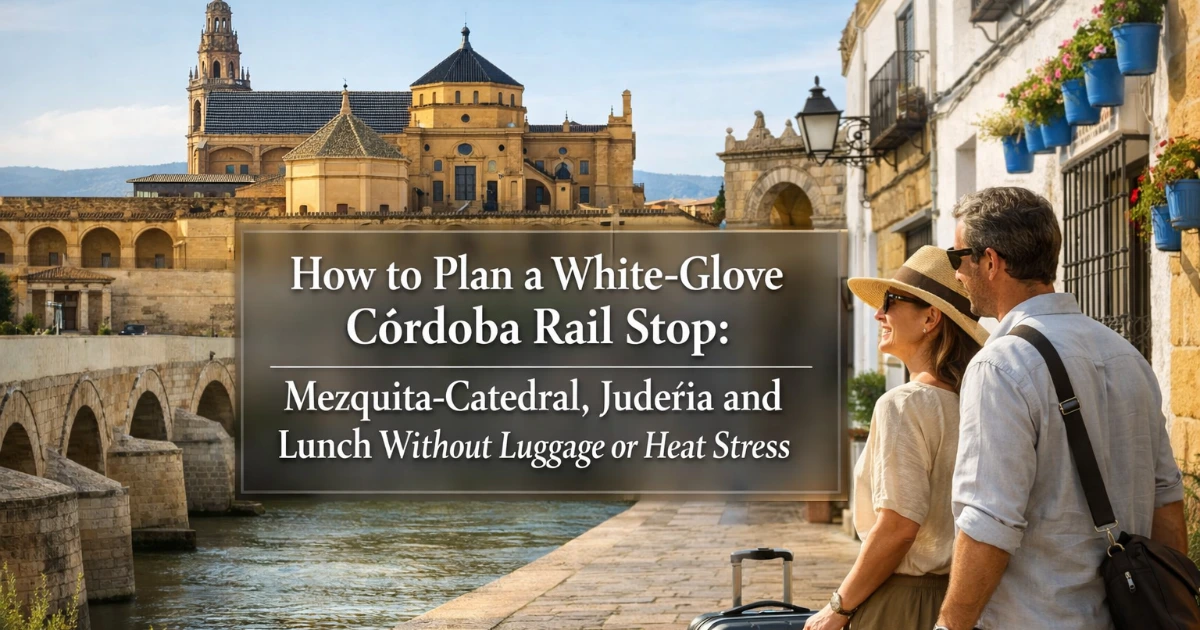
How to Plan a White-Glove Córdoba Rail Stop: Mezquita-Catedral, Judería and Lunch Without Luggage or Heat Stress
Updated
Yes, Córdoba can be an elegant rail stop, but only when you plan it as one old-town corridor rather than a miniature full-day city break. That verdict works in real conditions because the decisive handoff from Córdoba station to Puerta del Puente is short enough to make sense, and because from that hinge the Mezquita-Catedral, the Judería, and a proper seated lunch can sit on one compact line without repeated transfers. The clearest exception is a compressed train window: if your usable time drops below roughly four and a half hours platform to platform, or if you insist on adding Medina Azahara, the stop stops feeling white-glove and starts feeling timed.
Córdoba is one of the rare Spanish rail-stop cities where the most meaningful monument, the most atmospheric quarter, and the right lunch can live in the same few blocks—but only if bags disappear early and the route begins at Puerta del Puente, not at the station curb. The non-obvious local detail is that Puerta del Puente is not just a photogenic gate by the river; it is the exact junction where the Roman Bridge, the Mezquita-Catedral edge, and the south side of the Judería all become one walkable problem instead of three separate errands. If you are still deciding whether the city belongs between larger Andalusia bases at all, start with whether Córdoba works between Madrid and Seville.
One correction belongs early because it saves money as well as frustration: extra hotel spend adds no value if you are not staying the night. The money that changes this day goes into the bag handoff, timed entry, a lunch reservation in the right part of the center, and enough return-train margin that nobody is power-walking through the Judería while checking the time.
The rail-stop ladder: which train window deserves this plan?
The default winner is a 6- to 8-hour platform-to-platform stop built around one continuous old-town loop.
- Default winner: 6 to 8 hours. This is the sweet spot for arrival handoff, Mezquita-Catedral, a shaped walk through the Judería, a real lunch, and a return to the station without sprint energy.
- Runner-up: 5 to 6 hours. This still works if your lunch sits close to the Mezquita-Catedral and you cut the Roman Bridge stroll down to a look rather than a detour.
- Borderline: 4.5 to 5 hours. You can salvage the stop, but it no longer feels generous. One queue, one slow check payment, or one bag complication becomes the story of the day.
- Wrong fit: under 4.5 hours, or any short stop that insists on Medina Azahara. At that point Córdoba is too compressed to feel premium.
The reason this ladder matters is that rail-stop math in Córdoba is less about the train itself than about how much of your day remains once arrival and departure mechanics are subtracted. For comfort-first travelers, it helps to remove roughly half an hour from the front end for getting off the train, finding the right handoff, and moving into the old town, and another half hour from the back end so the return never depends on perfect luck. Once you do that honestly, the difference between a seven-hour stop and a five-hour stop is not two abstract hours; it is the difference between sitting down to lunch when you want to and treating lunch as a timer.
This is also where traveler fit becomes clearer. Couples using Córdoba as a deliberate cultural break between bigger stays tend to love the 6- to 8-hour version because the city gives them one intense monument, one textured neighborhood, and one memorable meal without forcing a full reset of the trip. Families with older children and small groups can also do well in that window because the stop feels legible: there is one arrival point, one big sight, one neighborhood sequence, and one meal. The wrong fit is the traveler who needs a nap, carries multiple large cases without a handoff plan, or wants the emotional pace of an overnight compressed into a transfer day.
A late-morning arrival and a late-afternoon return is the model that makes the most sense, not because those times are magically privileged, but because they let the interior of the Mezquita-Catedral absorb part of the hottest part of the day while keeping lunch in the middle rather than as a rushed afterthought. A very early return, by contrast, turns the whole stop into an extended arrival exercise. You never quite stop calculating your way back to the platform.
The important nuance is that “enough time” in Córdoba is not the same as “enough time to enter the city.” A five-hour stop with confirmed pickup, prebooked entry, and lunch already chosen can feel calmer than a six-hour stop where bags are undecided and the first taxi line goes wrong. In other words, time window and curation work together. Travelers often keep shopping for an extra hour on the rail timetable when the bigger gain would come from deciding the handoff, monument slot, and lunch district before they leave the departure city.
Córdoba station to Puerta del Puente is the make-or-break handoff
The most important choice in this article is not what to see first; it is where your luggage stops being part of the story.
Córdoba station is close enough to the historic core to tempt travelers into under-planning the arrival. That is the trap. Cities that look compact on a map can still waste a good hour when luggage is involved, and Córdoba is especially revealing because once you cross from station logistics into the old town, the day suddenly becomes simple. Puerta del Puente is the correct hinge because it places you at the river edge, the Mezquita-Catedral side, and the southern lip of the Judería all at once. Arrive there bag-free and the city feels composed from the first minute. Arrive there still negotiating where cases go, and the stop feels compromised before the sightseeing has begun.
The weakest version of this day is rolling luggage into pedestrian lanes because you believe the center is “walkable.” It is walkable for people, not for cases. Stone paving, narrow passages, photo bottlenecks, and heat do not make heavy bags dangerous in a dramatic way; they make the stop petty and administrative. One person becomes the bag shepherd. Another starts scanning for lunch sooner than they should. By the time you reach the Mezquita-Catedral, your first impression of Córdoba is not the forest of columns but the relief of finally standing still.
The strongest version uses one clean handoff. That may be a pre-arranged station pickup that leaves you near Puerta del Puente, a through-car solution if you are moving between hotels in different cities, or a confirmed bag-hold plan that has been decided before the train arrives. A storage-based strategy can work, but it builds two extra operations into a short day: drop and retrieve. Those are exactly the sort of minor queues that make a rail stop feel smaller than it really is. This is why historic core private touring can be worth more on a transfer day than on a long stay: the value is not just interpretation, but preserving a linear day from the first curb to the last.
Do not buy a hotel room to solve a luggage problem
Extra hotel spend adds no value if you are not staying the night.
That sentence sounds obvious, yet travelers still burn money on day-use rooms or prestigious addresses because they want somewhere refined to leave bags, freshen up, or “have a base.” In practice, that base often sits in the wrong part of the center for a same-day stop, forces an extra check-in interaction, and adds another backtrack before you have even entered the Mezquita-Catedral. If you are not sleeping in Córdoba, the premium spend that earns its cost is logistical, not real-estate based. Pay for certainty in the handoff, not symbolic ownership of a room you will barely use.
This is also where the city’s shape corrects a common instinct. Travelers often think the smartest lunch or bag solution is somewhere slightly north of the tight old town because it looks calmer on a map. But the farther you drift from Puerta del Puente before seeing the Mezquita-Catedral, the more you start building a Z-shaped day: north for storage, south for the monument, west for the Judería, then back out again. The elegant version is not the one with the fanciest interim stop; it is the one that keeps the line of movement short and legible.
Can you do Mezquita-Catedral, Judería and lunch between trains?
Yes, and this is the version that actually works: timed entry first, a shaped walk through the Judería second, and lunch placed so it feels like the center of the stop rather than its delay.
Start with the timed sight, not the quarter
The Mezquita-Catedral should come first because it is the least flexible part of the day and the place where interpretation pays back fastest. The monument is not hard to admire on your own, but a rail stop is not the right moment for diffuse wandering or improvised reading. If you want the visit to feel rich rather than hurried, either study the route in advance or use something focused like a Mezquita-Catedral private tour. Before you commit to trains, check the official Mosque-Cathedral site (https://mezquita-catedraldecordoba.es/en/) so you are working from the current visitor pattern rather than assumption.
The traveler consequence is simple: when the Mezquita-Catedral is pre-timed, the rest of the stop can breathe. When it is not, every later decision becomes defensive. Lunch gets pushed later. The Judería becomes a compressed stroll instead of a meaningful transition. Return-to-station anxiety starts before the city has had time to land. This is one of those attractions where ten minutes of ticket uncertainty can distort two hours around it.
Inside the monument, the best rail-stop mindset is selective rather than exhaustive. You are here for one of Europe’s most singular interior spaces, for the scale shift between the prayer hall and the inserted cathedral core, and for the emotional reset that comes from stepping out of the heat into somewhere visually immense and physically cooler. You do not need to force every chapel, every angle, or every photograph. On a short city stop, the feeling of spaciousness matters more than checking every corner.
Patio de los Naranjos matters for the same reason. It is not only an atmospheric prelude; it is a useful tempo change. A few purposeful minutes there let the visit settle before you head into the Judería. That matters more than it sounds, because the mistake travelers make after a major sight is assuming the day can continue at the same intensity. Córdoba rewards a brief exhale between the monument and the neighborhood.
Let the Judería be a shaped walk, not a scavenger hunt
The Judería works best after the Mezquita-Catedral because it then feels like an unfolding edge of the same experience rather than a separate item. This is not the part of the day to chase every tiny lane, artisan stop, and photo corner. The quarter is compact, and that compactness is an advantage only if you resist turning it into a scavenger hunt. A few lanes, a few well-chosen pauses, and a clear exit point are more satisfying than trying to “cover” the district.
Calleja de las Flores is the perfect example. It is charming and photographable, but on a rail stop it is better treated as a pass-through than a destination that deserves waiting around. The same is true of the Roman Bridge. Because Puerta del Puente sits right beside it, the bridge is the easiest add-on in the city, but on a shorter window it should be a glance or a five-minute edge walk, not a full cross-river detour toward the Calahorra side. A polished stop protects the main line of the day: monument, quarter, lunch, return.
If you want a mental map, think in one sweep from Puerta del Puente into the Mezquita-Catedral, then outward through the Judería with Puerta de Almodóvar as the useful western edge. That edge matters because it helps you place lunch intelligently. If lunch sits back toward the monument or near the Judería exit, the day remains one loop. If lunch sits somewhere that requires a separate crosstown mission, you have started spending your buffer on geography rather than pleasure.
Most travelers do not need more than roughly 90 minutes for the Mezquita-Catedral, 45 to 60 minutes for a paced Judería walk, and 75 to 90 minutes for lunch. Those are not promises; they are healthy planning ranges. What matters is that you see how snugly those pieces fit once the route is linear. That is the whole case for Córdoba as a rail stop: not that it offers endless variety in a few hours, but that its best short-day pieces sit unusually close together if you choose them well.
What a premium Córdoba rail stop should skip on purpose
On a same-day rail stop, Medina Azahara is usually the first thing to cut.
Include on a polished stop:
- One clean station handoff that removes bags early.
- A timed Mezquita-Catedral visit.
- A deliberate Judería walk instead of monument stacking.
- A seated lunch close to the route.
- Enough margin that the return to the station never depends on luck.
Skip on purpose:
- Medina Azahara on a standard same-day rail stop.
- A prestige lunch that behaves like a destination in itself.
- North-of-center shopping detours before the core sights are done.
- Any bag plan that requires multiple extra queues.
The 10:00 to 16:30 example that works because it excludes Medina Azahara
Imagine a notional 10:00 arrival and a 16:30 departure. That looks generous on paper, and it is generous enough for the right Córdoba day: transfer in, Mezquita-Catedral, Judería, lunch, brief buffer, transfer out. It is not generous enough for Medina Azahara if what you want is a day that still feels controlled and pleasurable. The site is the wrong kind of “close.” It is close enough to tempt you, but separate enough to fracture the day into two different operations with different transport needs, different timing anxieties, and a second round of heat exposure.
This is the correction many articles avoid because it sounds restrictive. In reality, it is liberating. Once you stop forcing Medina Azahara into the rail-stop conversation, Córdoba becomes clear. The city is no longer a stressful checklist of famous names but a specific kind of short luxury: one major interior, one atmospheric quarter, one proper meal, one unhurried return. If Medina Azahara is emotionally non-negotiable for you, read whether Medina Azahara belongs on your trip before you commit to a same-day stop.
The second thing to cut is usually the Alcázar, even though it is geographically plausible. That may sound severe, but it is the right kind of severity. The Alcázar is easiest to overvalue on a rail stop because it sits close enough to feel “free.” It is not free. It takes time, attention, and another decision point. On an overnight, that is a feature. On a train day, it often costs you the relaxed lunch or return buffer that makes the stop feel refined in the first place.
There is a mood consequence here that matters more than most itinerary math acknowledges. Córdoba can either be the cultural high point that enriches the wider trip or the overstuffed stop that flattens the next city. When the plan is trimmed properly, you leave feeling as though you actually visited somewhere. When it is over-packed, you board the next train with the peculiar fatigue of having worked hard in a beautiful place without quite experiencing it.
The clean dividing line is this: once you want Medina Azahara, a long gastronomic lunch, evening atmosphere, or the Alcázar as a real chapter rather than a drive-by idea, you are already in overnight territory. A rail stop is not inferior to an overnight, but it is different. It wins by selectivity.
Lunch without luggage or heat stress is a routing decision, not a foodie side quest
The right lunch on a Córdoba rail stop is close to your walking line, shaded or comfortably interior, and paced to leave you calmer than when you sat down.
This is where travelers with sophisticated dining tastes can accidentally sabotage themselves. In a city with serious culinary credentials, it is tempting to let lunch become the star. On a rail stop, lunch should support the star. That does not mean settling for something forgettable. It means choosing a table whose location and duration fit the physics of the day. In practical terms, that usually means staying on the Mezquita-Catedral, Judería, or Alcázar side of the historic core rather than making a northward excursion that breaks the line of movement.
The sweet spot is a real sit-down meal of about 75 to 90 minutes. That is enough time to cool down, eat well, use proper restrooms, and reset your attention before the return sequence begins. A shorter stop can feel transactional, especially for couples or celebration travelers who wanted Córdoba to feel like a highlight rather than a technical stop. A much longer lunch, on the other hand, starts competing with the one luxury a rail stop most needs: schedule slack. The city is enjoyable when you have room around its transitions; it feels brittle when every stage has to end on command.
Food-and-wine travelers often ask whether this is the moment to aim high. Usually, no. The MICHELIN Guide entry for Noor (https://guide.michelin.com/gb/en/andalucia/cordoba/restaurant/noor) is valuable here for a slightly unexpected reason: it reminds you that Córdoba can absolutely justify a destination meal, but that is the argument for sleeping in the city, not for forcing a prestige lunch into a transfer day. The long, ceremonial version of Córdoba exists. It is simply not the same product as a polished rail stop.
What Córdoba does to the body by midday
Córdoba is not a hill city, which helps, but it is still a heat amplifier. The stone underfoot reflects upward, the river edge around Puerta del Puente and the Roman Bridge has little mercy when the sun is high, and the Judería gives shade irregularly rather than continuously. Add even mild queue drag and the city starts feeling more physically demanding than its distances suggest. Twenty unfocused minutes in midday glare can cost more energy than forty well-directed minutes inside the Mezquita-Catedral.
That is why the body-level planning is so consequential. Bags should already be gone before the old town begins. Water should be bought before you need it, not after the heat has already altered everyone’s patience. Lunch should happen before the group reaches the brittle phase where every small decision starts sounding larger than it is. Families know this instinctively; adult couples and small groups sometimes forget it because the city looks compact and civilized. Compact does not mean effortless in warm weather.
What Córdoba does to the mood of the wider trip
The best version of this stop leaves emotional room for the next city. You board the train having seen one extraordinary interior, walked one textured quarter, and eaten well enough that the day feels complete rather than interrupted. You arrive in Seville, Madrid, or wherever comes next with your evening still intact. The wrong version does the opposite. It uses up the margin that makes onward travel feel glamorous, and the next arrival becomes a recovery exercise.
This is why routing matters more than atmosphere copy. A lunch that sits naturally between the Judería and the return transfer preserves the tone of the whole trip. A lunch that requires a detour, a wait, or a nervous eye on the clock can make a very pretty city feel like a scheduling problem. Córdoba repays decisiveness. It punishes improvization more politely than some cities, but it still punishes it.
When to keep this self-managed, and when to hand the stop off
Self-managing is perfectly reasonable when your bags are simple, your train window is generous, and your ambition is limited to the Mezquita-Catedral, a shaped Judería walk, and lunch. Hand the stop off the moment there are multiple generations, celebration expectations, mobility sensitivity, or a return train you do not want to second-guess.
The reason is not that Córdoba is hard. It is that the difference between a polished stop and an anxious one lies in a cluster of small handoffs that all happen at once: station pickup, bag removal, monument timing, lunch sequencing, and station return. None of those decisions is individually dramatic. Together, they are the whole day. That is especially true for anniversary travelers who care about tone, food-and-wine travelers who want lunch to land properly, and families or small groups where one person otherwise ends up managing logistics instead of sharing the visit.
If you know exactly what you want and you enjoy this kind of choreography, there is nothing wrong with doing it yourself. But there is a clear threshold where delegation stops being an indulgence and becomes good editing. That threshold arrives when the stop matters emotionally, when the bags are more than minimal, or when the train window is closer to the runner-up band than the default winner band. At that point, the day is no longer about seeing more. It is about protecting the quality of what you have already chosen.
That is where tailor-made private touring in Córdoba earns its cost: not by adding more attractions, but by solving the exact handoffs that make a rail stop feel deliberate. When you can already see that the day only works if the transfers, entry time, lunch table, and return margin are curated together, you are looking at a planning problem rather than a sightseeing problem. Inquire now
The spending hierarchy on a train day is blunt. First pay for certainty: the station handoff, the timed Mezquita-Catedral entry, and the lunch booking that keeps the hottest part of the day seated rather than wandering. Second pay for interpretation if the monument is one of the reasons you rerouted your rail journey in the first place. Only after that should you think about polish. A more expensive train seat does not rescue a badly placed lunch, and a glamorous bag-hold workaround does not compensate for beginning the day on the wrong edge of the old town.
FAQ
Is Córdoba worth stopping for just a few hours between trains?
Yes, if those few hours are genuinely usable. The city works well as a rail stop when you have enough time for a clean station handoff, the Mezquita-Catedral, a shaped walk through the Judería, and lunch. It works badly when your window is so short that all you experience is arrival and departure mechanics.
How many hours do I need for Mezquita-Catedral, Judería, and lunch without rushing?
A comfortable target is about 6 to 8 hours platform to platform. That usually gives you enough room for transfer time at both ends, the monument, the quarter, and a proper meal. Around 5 to 6 hours can still work if the route stays very tight. Below about 4.5 hours, the day becomes too compressed to feel premium.
Can I include Medina Azahara on the same-day rail stop?
Usually not if you want the day to feel polished. Medina Azahara is the first thing to cut because it turns one compact old-town loop into a separate transport operation with different timing pressure. It belongs much more naturally on an overnight or a dedicated Córdoba day.
Should I book a hotel just to store luggage or freshen up?
No. Extra hotel spend adds no value if you are not staying the night. A cleaner bag handoff, a better lunch reservation, or a more controlled return transfer is the smarter place to spend. A day-use room usually adds more movement and more check-in friction than it removes.
Is Córdoba manageable with older parents or kids on a rail stop?
It can be, especially because the historic core is more compact and flatter than many famous Spanish old towns. The conditions are that you remove bags early, keep the route linear, and respect the heat. It is easier with older children and adults who handle city walking well than with very young kids who need a real midday reset.
Where should lunch sit in the schedule?
Lunch should come after the Mezquita-Catedral and after at least a short walk in the Judería, not before the monument. That placement lets the timed sight anchor the day, gives you a natural cool-down point, and keeps lunch from becoming the reason the afternoon feels late. The closer the table is to your walking line, the better the stop will feel.
Is a guide worth it if I am only in Córdoba once?
Often, yes. On a rail stop the value of a guide is not only historical context. It is compression without panic. Good guidance helps you begin at the right point, move through the Mezquita-Catedral with purpose, shape the Judería into one intelligible walk, and protect the return margin without constantly checking the time.
When should I stay overnight instead of treating Córdoba as a rail stop?
Stay overnight when you want Medina Azahara, a deeper monument stack, a serious destination meal, or the city’s evening atmosphere as part of the experience. An overnight is also the better call when your train windows are awkward enough that the day would revolve around luggage and timing rather than the visit itself.
If you’re interested in any private tours of Cordoba, please reach out to us.



 So if you are looking for the absolute best in Cordoba & surroundings with authentic local fully-licensed native guides whose English you can actually understand and with an exclusive and amazingly fun itinerary













