Córdoba’s Roman Bridge Evening: Calahorra, Riverside Walks and the Moment an Overnight Pays Off
Updated
Verdict: the Roman Bridge to Calahorra evening route is the most tangible reason to keep a Córdoba overnight, not because it is a sunset photo stop, but because it lets the Mezquita-Catedral, the Guadalquivir, Calahorra Tower and dinner fall into one unforced sequence. In real city conditions, that matters: the old town is compact, the Roman Bridge is pedestrian, and the station-to-old-town transfer has already been absorbed by hotel check-in rather than sitting at the end of a tired day. The clearest exception is a traveler who wants Córdoba only as a fast Mezquita-Catedral visit between trains; the bridge evening alone is not enough to justify a room if you have no appetite for a slower rhythm.
The article-specific thesis is simple: Córdoba’s overnight pays off when the city stops being a monument checklist and becomes a measured walk from the north bank to the Campo de la Verdad side and back, with history still legible after the day-trip clock has loosened. The non-obvious hinge is the southern bridgehead. Treat Calahorra Tower as a far-side photo marker and you merely cross a bridge; treat it as the turning point of the evening and the whole route starts to explain why sleeping in Córdoba can feel different from visiting Córdoba. For the broader stay-length question, see the broader overnight decision guide; this guide solves the narrower question of whether the river evening itself earns its place.
The ranked ladder: when the Roman Bridge evening earns the night
The Roman Bridge evening earns the overnight when it changes your pace, not merely your view. Rank the decision by how much the route improves the trip’s rhythm: first, whether it gives your day a calm second act after the Mezquita-Catedral; second, whether it lets dinner feel chosen rather than rescued; third, whether the river walk gives your group a shared, low-effort memory that a late train would usually erase. That is the ladder. It is not a generic argument for staying everywhere longer.
- 1. Strongest reason to stay: you want the Mezquita-Catedral to have an afterlife in the evening, with Roman, Islamic and Christian context still present as you move toward the bridge rather than disappearing into a taxi or rail platform.
- 2. Very good reason to stay: you are traveling as a couple, family or small celebration group and want a graceful pre-dinner hour that does not require another timed ticket, another interior or another transfer.
- 3. Conditional reason to stay: you want Calahorra Tower context, but only if it is used to frame the river crossing and the old city skyline, not as a museum obligation forced after everyone is already ready for dinner.
- 4. Weak reason to stay: you are staying only because you saw a dramatic bridge photo. A beautiful view does not compensate for a night that otherwise adds luggage friction and an early departure.
- 5. Do not stay for this route alone: you dislike slow evenings, prefer tightly packed sightseeing, or know that your group will retreat to the hotel immediately after the day’s main visit.
The counterintuitive correction is that the most glamorous overnight plan is not necessarily the one closest to the river. A river-adjacent address can still send you into awkward returns if dinner, guiding and next-morning departure are all pointing back toward the Judería, Plaza de las Tendillas or the station side of town. The bridge is powerful because it connects pieces of the city; it becomes overvalued when travelers turn it into a standalone sunset errand. The right question is not “Can we see the Roman Bridge?” but “Will the bridge become the hour that makes the overnight feel calmer than the day trip?”
One local test is whether your evening can move cleanly from Calle Torrijos or the Mezquita-Catedral edge toward the Puerta del Puente without asking the group to re-enter the maze of lanes just to prove they “saw more.” If the plan has you zigzagging between the Judería, the river and a dinner address with no obvious order, the overnight begins to lose its advantage. The bridge route works because it has one line. Protect that line and the city feels composed; break it into errands and Córdoba starts to feel smaller, hotter and more repetitive than it really is.
Why the bridge matters more at evening pace
The Roman Bridge matters more at evening pace because it restores proportion after a monument-heavy day. During a same-day Córdoba visit, the bridge is often added as a quick extension after the Mezquita-Catedral: walk out, photograph the arches, look back at the old city, then start calculating lunch, luggage or train time. That produces a view, but not a change in the trip. With an overnight, the same bridge can be approached without the mental countdown, and that difference is what discerning travelers actually feel.
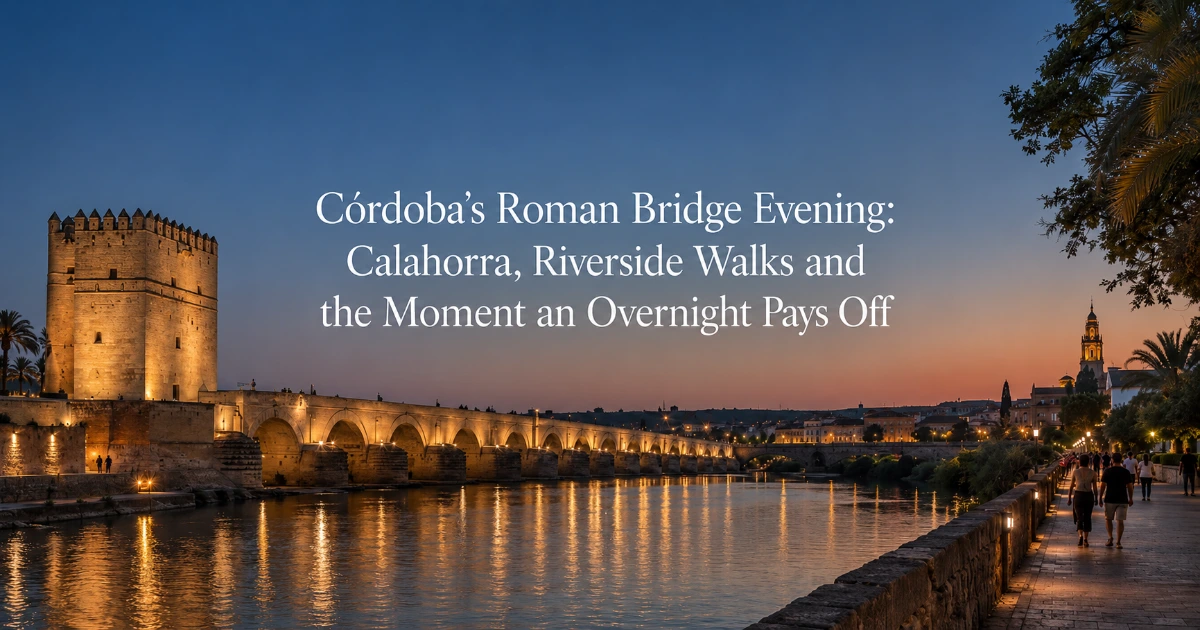
The official Córdoba tourism page for the Roman Bridge (https://www.turismodecordoba.org/puente-romano-roman-bridge) notes the useful historical correction: the bridge was first built in the Roman period, but the structure travelers cross today has been rebuilt many times and is mainly medieval in its present form. That fact matters editorially because it prevents a lazy “ancient bridge at sunset” reading. The bridge is a palimpsest, and an evening walk works best when the guide or planner lets the layers remain visible: Roman river crossing, medieval fabric, the Gate of the Bridge, San Rafael in the parapet, Calahorra guarding the far end, and the Mezquita-Catedral rising behind the north bank.
Evening pace also changes what the body has to do. Córdoba’s historic core is compact, but stone paving, heat stored in walls, and repeated small transitions between narrow Judería lanes and open riverfront space can make a day feel longer than the map suggests. The bridge gives the body a different kind of movement: one clear line across the Guadalquivir, open air, few navigational decisions and a natural pause at the far side. For older parents, children, or guests who dislike being managed from stop to stop, that simplicity can be more valuable than adding another interior.
The best bridge evening therefore starts before the bridge. It might begin near the Mezquita-Catedral or Plaza del Triunfo, pass the Puerta del Puente, and then cross with enough context to make the far side meaningful. If you arrive at the bridge only after dinner, the view can still be beautiful, but the route loses its narrative sequence. If you go too early, the river has not yet done its work of slowing the day. The overnight pays off in the middle band: after the main sightseeing pressure, before the evening becomes only scenic.
Where Calahorra context belongs before the walk turns scenic
Calahorra context belongs before and during the crossing, not as a late add-on after the group has mentally moved to dinner. Calahorra Tower is the route’s interpretive anchor because it sits at the southern end of the Roman Bridge and changes the bridge from a pretty line of arches into a defended threshold. Use it to explain why the river crossing mattered, why the city edge mattered, and why Córdoba’s layers are visible in one short walk.
The official Córdoba tourism page for the Calahorra Tower (https://www.turismodecordoba.org/the-calahorra-tower) identifies it as a medieval defensive fortress at the end of the bridge, today associated with the Living Museum of al-Andalus. That is enough context for most private evening routes. The mistake is to treat the tower as a full cultural module when the traveler’s real need is a lucid bridge-to-river sequence. Unless your group is specifically interested in museum time, Calahorra works best as a context stop: pause near the tower, orient to the Campo de la Verdad side, look back across the Guadalquivir, and let the skyline explain the city’s north-bank power.
This is where a private guide can add value without making the evening feel academic. A good guide can connect the Roman Bridge, the Calahorra Tower, the Guadalquivir and the Mezquita-Catedral in plain language before the light and river take over. That is a different service from reciting dates. It helps travelers see why the southern end of the bridge is not just “the other side” but the point where Córdoba’s defensive, commercial and symbolic geography comes into focus. For travelers who want that sequence shaped around their own energy and dinner timing, the Roman Bridge and Calahorra private tour is the natural route-specific starting point.
The traveler consequence is important: put Calahorra too late and it becomes a burden; put it too early and the river hour has no emotional release. The right placement is a short interpretive pause just before the evening becomes leisurely. That gives couples something richer than a photo, families something concrete to track, and food-and-wine travelers a graceful bridge between monument time and dinner time. Calahorra should open the route, not dominate the night.
The route hinge: Mezquita-Catedral, Puerta del Puente and the river in one sequence
The cleanest evening sequence runs from the Mezquita-Catedral area to Plaza del Triunfo, through the Puerta del Puente, across the Roman Bridge to Calahorra Tower, then back by the riverside with dinner placed after the return. This order works because it avoids the most common Córdoba mistake: finishing the main sight, wandering without a clear line, and letting the evening dissolve into fatigue before dinner has any shape. The route is short, but it has a beginning, crossing, far-side pause and return.
The Mezquita-Catedral is not interchangeable with any other monument in this sequence. Its scale and interior density can absorb the day, especially for first-time visitors, and it deserves timing that respects both attention and physical energy. For direct visitor information, the official Mosque-Cathedral site (https://mezquita-catedraldecordoba.es/en/) is the source to check before you lock a touring day. For a guided visit that sets up the bridge evening rather than exhausting it, a Mezquita-Catedral private tour can be paced so the final context points naturally toward the river rather than ending in a blur of columns, chapels and exit logistics.
Puerta del Puente is the hinge many travelers underuse. It sits between the monument zone and the bridge, so it can either be passed without thought or used to reset the group. A few minutes here can prevent the route from feeling like a postscript. You are no longer inside the Mezquita-Catedral, not yet on the bridge, and not yet committed to dinner. That small pause helps the eye assemble the river, gate, bridge and tower into one composition. It also helps the group decide whether to continue to Calahorra or shorten the evening with a riverside-only walk.
For comfort-first travelers, the sequence has a practical advantage: it limits backtracking. A same-day visitor often has to think about returning to the station or collecting luggage; an overnight guest can walk the route and let dinner sit within the old-town or Ribera orbit. The route asks for attention, not endurance. It also keeps the most exposed section, the bridge itself, in a defined window rather than scattering open-river walking throughout a hot or crowded day. That is why the bridge evening is more than a view. It is a routing tool.
How long the Roman Bridge to Calahorra evening route should take
The Roman Bridge to Calahorra evening route should usually be planned as a generous pre-dinner hour, with extra time only if your group wants deeper context or a slower riverside return. The danger is not that the route is too long; it is that travelers either rush it into ten minutes or inflate it into a full evening program. Neither version gets the best result. The payoff sits in the middle: enough time to cross, pause, understand Calahorra, look back, and return without turning the walk into another obligation.
Think of the route in four movements rather than a strict clock. The first movement is the approach from the Mezquita-Catedral or Plaza del Triunfo. The second is the crossing itself, where the Guadalquivir opens the city and the old-town density gives way to air. The third is the Calahorra pause on the Campo de la Verdad side. The fourth is the return, either back across the bridge or along a riverside line that keeps dinner within easy reach. This mental structure is more useful than promising exact minutes, because season, heat, mobility and group size all change how the walk feels.
Córdoba acts on the body through small accumulations: stone underfoot, sun exposure in open spaces, brief shade in lanes, and the repeated effort of staying oriented in a compact but visually dense old town. By evening, the body is usually asking for fewer decisions, not more attractions. The bridge route helps because it is legible. You can see the tower, the river, the bridge and the old city. There is no need to decode a new neighborhood every five minutes. For travelers who value comfort, that legibility is a form of luxury.
A shorter version can still work. If heat, dress shoes or family patience narrow the window, cross only as far as the middle of the bridge, pause at the San Rafael sculpture, and decide whether Calahorra is still worth the extra stretch. That is not a failure; it is responsive planning. The mistake is pretending that every guest needs the same far-side finish. In a private evening, the best route is the one that preserves the river mood and still delivers the group to dinner with goodwill.
The practical cut is this: do not pair the bridge with a second demanding interior unless that interior is the true purpose of the night. If the day already held the Mezquita-Catedral, Judería lanes and a long lunch, the evening should not become a race through every riverside monument. A short, well-timed bridge route will feel richer than a longer plan that leaves everyone scanning for seats. The goal is to arrive at dinner with appetite and attention intact.
How the riverside walk should connect to dinner
The riverside walk should connect to dinner by delaying the dining decision just long enough to make it feel earned, but not so long that the group becomes hungry, footsore or indecisive. This is the part many travelers misjudge. They treat the Roman Bridge as either a photo before dinner or a stroll after dinner. Both can work, but the strongest overnight rhythm is usually bridge first, riverside return second, dinner third. That sequence lets the evening gather meaning before the table takes over.
Do not turn this into a restaurant list. The useful decision is not which dining room wins; it is where dinner should sit in relation to the walk. If your route ends back near the Puerta del Puente, dinner can belong around the old-town edge, the Ribera corridor or an easy return toward the Judería. If you continue too far along the river without a plan, the pre-dinner walk becomes a drag, especially for families or guests who have dressed for dinner rather than a long promenade. The best dinner location is the one that preserves the walk’s calm rather than making you pay for it with a tired return.
Food-and-wine travelers should be especially careful here. Córdoba can reward a serious meal, but the bridge evening is not improved by forcing a tasting-menu mindset onto the hour before dinner. If dinner is the main event, let the bridge be concise and atmospheric. If the walk is the main emotional reason for the overnight, choose a dinner plan that can receive a slightly fluid arrival. For a wine-led evening after monument time, think in terms of sequence rather than labels: bridge, appetite, then a table that does not force a long return. Córdoba’s local wine context can belong here, but it should support the evening rather than become another tasting itinerary squeezed into the hour before dinner.
Celebration travelers should also resist overdecorating the night. A private toast, a polished dinner, a photographer, a carriage-like transfer fantasy and a bridge walk can quickly compete with one another. The Roman Bridge is at its best when it is allowed to be the quiet hinge. If the occasion needs a formal dinner, make the walk the lead-in. If the occasion needs privacy and conversation, keep dinner close enough that nobody is negotiating routes in dress shoes. The route should lower friction before the meal, not create a new planning problem.
The first cut when the Córdoba day is overloaded
The first thing to cut is the extra attraction that competes with the evening’s energy, not the Roman Bridge itself. This is a firm editorial call: if the overnight was chosen partly for the bridge and Guadalquivir hour, do not spend the late afternoon trying to prove that every Córdoba monument can fit. The bridge route is modest, but it needs the group to arrive with enough attention left to feel the change in mood. Overpacking turns it into a box-tick.
The common culprits are not bad places; they are badly placed places. A late add-on around the Alcázar gardens, an ambitious second museum, a far-flung craft detour or an overlong Judería wander can all be worthwhile in another sequence. But if they steal the unhurried pre-dinner window, they make the overnight less convincing. When the day is getting crowded, cut the optional late-afternoon interior first and keep the bridge-to-Calahorra line intact. If the Alcázar and riverside context are genuinely central to your day, build them into a focused daytime plan rather than stapling everything together at the end.
This cut-first rule is especially important for families and multigenerational groups. Children may still enjoy the bridge because it is simple, visible and open; older parents may appreciate it because it avoids another threshold, ticket or interpretive room. But both groups can turn against it if the walk arrives after a day of “just one more stop.” The bridge is not a rescue device for an exhausted itinerary. It is a reward for having left enough space.
The same logic applies to shoppers and food travelers. Do not let a souvenir errand or a pre-dinner bar crawl consume the bridge hour unless that is the real priority. The Roman Bridge to Calahorra evening route works because the traveler can still sense the city’s shape. If the mind is already on purchases, reservations or logistics, the view becomes decoration. The overnight pays off when you protect the one hour that makes the day feel less transactional.
When a private guide changes the evening and when it does not
A private guide changes the evening when the route needs interpretation, pacing and group management; a guide does not change it much if the group wants only a quiet, self-led walk. This distinction matters because premium travelers are often sold help they do not need. For this specific evening, guidance earns its cost when it connects the Roman Bridge, Calahorra Tower, the Guadalquivir and the Mezquita-Catedral before the scene becomes purely visual.
The best guiding is front-loaded. It should clarify the route, establish the bridge’s layered history, place Calahorra in the story, and give travelers a way to look back at the old city with more precision. After that, the guide should know when to step back. A bridge evening that remains fully narrated from start to finish can feel overmanaged. A well-judged private route gives context while the group still has attention, then lets the river do what it does best: soften the day.
Private planning also helps with uneven groups. One guest may want the historical arc from Roman Corduba to Islamic Córdoba; another may care only about dinner timing; a child may need a visible destination; an older parent may need a shorter return. A guide or planner can use Calahorra as the common point and adjust the depth accordingly. That is where a tailor-made private tour in Cordoba can outperform a fixed evening walk: the route can be shortened, deepened, paired with the Mezquita-Catedral, or used as a pre-dinner bridge rather than a standalone tour.
The value is not exclusivity for its own sake. It is avoiding the small mistakes that flatten a short stay: starting too late, crossing without context, choosing dinner on the wrong side for your hotel, or letting the station transfer dictate the mood. For couples, that might mean a slower interpretive walk and an elegant dinner connection. For families, it might mean fewer facts and a clearer visible route. For celebration travelers, it might mean designing the moment without turning it into a staged production.
When your Córdoba stay is short, the route needs to carry more than scenery: it needs to link the day’s main monument, the river edge, Calahorra context and dinner without making the night feel scheduled to the minute. Inquire now to shape that hour around your group’s pace, interests and onward logistics.
The hotel choice should support the bridge, not dominate it
The best hotel choice for this evening is the one that reduces returns, preserves dinner ease and keeps the next morning sane. It does not have to be the most romantic address on the river. For many travelers, a base near the Judería, the Mezquita-Catedral edge or a practical old-town approach will serve the Roman Bridge evening better than a room chosen only for a view. The point of the overnight is the rhythm outside the room.
A premium hotel night does not matter if the traveler has no appetite for a slower evening rhythm. That sentence is the spend judgment. Paying more can improve comfort, quieter arrival, better rest, easier concierge support and a more graceful morning departure. It cannot manufacture the desire to walk slowly, pause at Calahorra, return along the Guadalquivir and let dinner follow. If your group will use the hotel as a cocoon immediately after the Mezquita-Catedral, a same-day plan or a different overnight reason may be more honest.
Where premium spend does help is in reducing the unglamorous edges around the route. A well-located hotel can spare you a late taxi reset, a long walk back in dinner clothes, or an awkward next-morning luggage decision. It can also make a midday rest realistic, which is often what allows the bridge evening to feel relaxed rather than dutiful. For a deeper base-choice discussion, use the guide to where to stay in Cordoba for the overnight before you commit to a room because it photographs well.
The station matters more than many visitors expect. Córdoba’s rail station is not in the old town itself, so a day visitor often carries a transfer clock in the back of the mind. An overnight visitor can remove that pressure by checking in first, walking later, and leaving the station problem for the next morning. That is why the bridge evening is not simply about proximity to water. It is about when the city stops asking you to calculate the next move.
When the Roman Bridge evening is not enough to justify sleeping in Córdoba
The Roman Bridge evening is not enough to justify sleeping in Córdoba when your trip has no room for the slower mood it creates. If the next morning requires a very early departure, if dinner must be quick, if your group dislikes walking after dark, or if the Mezquita-Catedral is the only Córdoba experience you truly care about, the route may not earn the added hotel change. The honest answer is that the bridge is a powerful proof point, not a universal mandate.
It is also not enough when the overnight causes a worse multi-city sequence. Some Andalusia itineraries are already overloaded with hotel changes between Madrid, Seville, Granada and the coast. Adding Córdoba for one bridge evening can be elegant if it reduces a rushed day trip; it can be inefficient if it creates another pack-and-unpack cycle without improving the trip’s emotional arc. In that case, a carefully designed day visit may be the better luxury choice, because comfort sometimes means fewer beds, not more nights.
The route is a poor fit for travelers who measure value by maximum sightseeing volume. The bridge evening asks you to accept that a one-hour walk can be the point. If that feels too light, you will be tempted to add more until the very quality that justified the overnight disappears. This is the paradox: the Roman Bridge evening proves the night only for travelers willing to let it remain a slow, connected evening. It fails when treated as the final item in a long list.
There is another wrong-fit case: travelers who have chosen a hotel outside the old center for reasons unrelated to Córdoba itself. A resort-style stay, a driver-heavy Andalusia transfer, or a late arrival with limited appetite may make the bridge evening theoretically attractive but practically weak. In those cases, the premium move may be to see the Roman Bridge well during the day, keep the Mezquita-Catedral as the clear anchor, and save the slower evening for a city where the hotel and dinner geography already support it.
Weather and season should also temper the decision without turning the guide into a forecast. In hotter periods, the route is most persuasive when the day has been paced to avoid late fatigue. In cooler or shorter-light periods, it may need to sit earlier and connect more directly to dinner. Do not assume the bridge will rescue a badly sequenced day. It rewards a day that has left space for it.
What changes after day-trippers leave the river edge
After day-trippers leave, the river edge changes from a sightseeing margin into the part of Córdoba that lets the overnight breathe. This is the mood consequence. The same stones, bridge arches and tower are still there, but the traveler’s relationship to them changes because the next decision is not a train, a transfer or a lunch slot. It is simply how slowly to return and where dinner belongs.
The route back matters as much as the crossing out. A riverside return after dusk can make the old city feel less like a dense monument zone and more like a place with a front, a river and a quieter after-hours outline. Looking back from the Campo de la Verdad side, then returning toward the Puerta del Puente, gives travelers a second read on the Mezquita-Catedral and the north bank. That second read is the overnight proof required by this article: the payoff must be physically visible in the route, not argued abstractly.
This is why the bridge evening should not be collapsed into “sunset at the Roman Bridge.” Sunset is a time of day; the overnight payoff is a change in how the city feels. The Guadalquivir gives the group space after the old town’s density. Calahorra gives the walk a far-side purpose. The return gives dinner a calmer arrival. Together, those pieces create a Córdoba evening that a day trip can imitate visually but rarely matches emotionally.
The next morning should not undo that calm. If you have stayed the night, resist the urge to fill every departure-hour gap. A measured breakfast, a short old-town walk, or one focused visit will usually preserve the benefit better than a frantic second-day sampler. For help choosing that final morning, use the guide to next-morning choices after the overnight. The bridge has already done its work; the rest of the stay should protect the feeling it created.
That is also why the route suits celebration travelers more when it is not overproduced. The best moment may be the quiet turn at Calahorra, the slow look back across the arches, or the first few steps of return when the old city gathers itself across the water. A photographer, a private table or a special bottle can all have their place, but they should not interrupt the simple geography that makes the evening convincing. The city has already supplied the stage; good planning keeps it from becoming a set.
FAQ
Is Córdoba’s Roman Bridge evening worth staying overnight for?
Yes, if the bridge evening changes the pace of your trip by connecting the Mezquita-Catedral, Calahorra Tower, the Guadalquivir and dinner in one calm sequence. No, if you only want a quick photo before continuing to another city.
What is the best order for the Roman Bridge to Calahorra evening route?
The best order is Mezquita-Catedral area, Plaza del Triunfo, Puerta del Puente, Roman Bridge, Calahorra Tower, riverside return, then dinner. This keeps the route coherent and avoids treating the bridge as a detached sunset errand.
Should Calahorra Tower be a full visit or just a context stop?
For most evening routes, Calahorra Tower works best as a context stop unless your group specifically wants museum time. Its strongest role is to frame the bridge crossing and the view back toward the old city before dinner.
How long should the Roman Bridge evening take?
Plan it as a generous pre-dinner hour rather than a rushed photo stop or a full evening program. Add time only if your group wants deeper guiding, slower walking or a longer riverside return.
Where should dinner fit after the Roman Bridge walk?
Dinner should sit after the bridge crossing and riverside return, within easy reach of your hotel or old-town route. The goal is to arrive with appetite and attention intact, not to create a long post-walk transfer.
Is the Roman Bridge evening good for families or older parents?
Yes, when the day has been paced carefully. The route is visible, simple and low on navigation decisions, but it should not be added after too many interiors, heat exposure or late-afternoon errands.
When should I skip the overnight and see the Roman Bridge on a day trip?
Skip the overnight if your Córdoba goal is mainly the Mezquita-Catedral, your itinerary cannot absorb another hotel change, or your group will not use the slower evening rhythm that makes the bridge route worthwhile.
Does a private guide make the Roman Bridge evening better?
A private guide helps when you want Roman, Islamic, riverside and Calahorra context connected before the walk becomes scenic. If you want silence, a few photos and an unstructured stroll, self-guided can be enough.
If you’re interested in any private tours of Cordoba, please reach out to us.



 So if you are looking for the absolute best in Cordoba & surroundings with authentic local fully-licensed native guides whose English you can actually understand and with an exclusive and amazingly fun itinerary













