Córdoba After the Overnight: Mezquita, Viana or Riverside Lunch Before the Train
Updated
Palacio de Viana is the best default for the morning after a Córdoba overnight if you gave the Mezquita-Catedral a proper visit on day one; repeat the Mezquita only if that first visit was rushed or under-explained, and choose a riverside lunch when the train window is tighter than your appetite for another monument. This works because the second morning is not a full day in disguise: it is a hotel checkout to station handoff, with luggage, heat, restaurant timing, and old-town lanes all pressing against Córdoba station. The clearest exception is the first-time traveler who only glanced at the Mezquita-Catedral yesterday; then the right move is a focused return, checked against the official Mosque-Cathedral site (https://mezquita-catedraldecordoba.es/en/), before you let lunch or another site compete for attention.
The article-specific thesis is simple: after the overnight, Córdoba rewards the traveler who finishes one idea well, not the traveler who tries to turn checkout morning into a miniature second itinerary. The city’s compact center is an advantage only until you point yourself the wrong way. The Roman Bridge pulls you south across the Guadalquivir, Viana pulls you north-east toward Plaza de Don Gome, and Córdoba station waits outside the old-city mood rather than inside it. That directional tension is why the final morning should be planned as a ranked ladder, not as a list of attractive things still unseen.
The ranked ladder for the morning after a Córdoba overnight
The decision should be ranked by what you saw yesterday, how much time remains before lunch, and how cleanly the plan hands you to Córdoba station. Do not start with the attraction you like most on paper. Start with the consequence: which choice leaves the trip feeling complete rather than clipped?
1. Palacio de Viana before lunch. This is the default winner when the Mezquita-Catedral has already had a full, guided, unhurried visit. Viana gives the second morning a different texture without dragging you into an overbuilt day. Its patios and house interiors also suit travelers who want a final Córdoba memory that is intimate rather than monumental. Pair it with a short lunch plan and a deliberate transfer, not with a second old-town wander.
2. A focused return to the Mezquita-Catedral. This is the runner-up, and it becomes the winner if day one was crowded, too fast, self-guided in a blur, or dominated by logistics. A private, selective revisit can restore the emotional center of the overnight. It should not become a repeat of the whole historic core; if the Mezquita is the reason to return, let the Mezquita be the plan. For a deeper version, consider a guided Mezquita-Catedral visit rather than adding another monument to compensate for a thin first visit.
3. Riverside lunch near the Roman Bridge. This is best when the final morning needs to feel like a graceful close instead of another cultural push. It works for couples, families with mixed energy, celebration travelers, and food-and-wine travelers who already did the essential sightseeing. It is the wrong fit if the train is soon, because the river pulls you away from the station side of the city.
4. Slow breakfast and station transfer. This is not a consolation plan. It is the right move when the overnight already did its job the evening before, when the group is tired, when the weather is heavy, or when the next city needs your full attention. A calm breakfast, checkout, and clean handoff can be more valuable than a half-seen palace or a hurried bridge photo.
The counterintuitive correction is this: the famous Roman Bridge is often overvalued on the last morning because it photographs well and sounds easy. It is easy only if you have enough time to let it be a mood choice. If you are already thinking about luggage, checkout, and Córdoba station, the bridge can send your morning in the wrong direction before you realize the cost. The bridge belongs when it frames lunch or a gentle farewell, not when it becomes one more item squeezed between Viana and the train.
What the overnight unlocks is choice, not permission to overfill the morning
The overnight earns its value by separating the Mezquita-Catedral, dinner, sleep, and departure into humane pieces. It does not automatically mean that the next morning needs Medina Azahara, the Alcázar, Viana, the Roman Bridge, and a late lunch stacked together. That is the planning error this article is designed to prevent.
On a day trip, the Mezquita-Catedral tends to swallow the center of the schedule. The traveler arrives, orients, sees the monument, fits in the Judería, eats where timing allows, and leaves with a pleasant but compressed sense of Córdoba. With an overnight, the first evening can carry the old-town atmosphere, a calmer dinner, or a quiet walk after the day visitors have thinned. The next morning can then become a final act: one more lens on the city, a better revisit, or a composed departure. If you are still deciding whether Córdoba merits that night at all, the broader stay-length question is handled in this overnight decision guide; here, the narrower question is what to do once you have already stayed.
The body consequence is real. Córdoba’s old center is compact, but the surfaces, shade patterns, and direction changes still accumulate. A morning that starts in the Judería, crosses toward Viana, returns toward the Mosque quarter, drops down to the Roman Bridge, and then resets for the station can make a short city feel strangely long. In warm months, the heat load rises before the traveler admits the morning has become work. In a multigenerational group, the person who was fine after breakfast may be dragging by the time the luggage conversation begins. In a celebration trip, the mood can flatten when a beautiful final meal is preceded by too much “just one more stop.”
The mood consequence matters as much as the walking. The overnight should make Córdoba feel more generous than a day trip. If the final morning becomes a scavenger hunt, the city starts to feel smaller, not richer. The train becomes a deadline in the back of every photograph. A single well-chosen priority keeps the morning from feeling like a checkout gap, which is exactly where a tailored private plan can earn its keep: the guide is not there to add more; the guide is there to decide what deserves the last clear hour.
When to repeat the Mezquita-Catedral before the train
Repeat the Mezquita-Catedral when your first visit did not give the building the attention it deserves, not merely because it is the most famous place in Córdoba. This is the morning for correction, not duplication.
The return is justified in four common cases. First, you saw it late in the day when energy was low and the group was already thinking about dinner. Second, you entered without enough context and left remembering columns, light, and scale but not the historical argument of the building. Third, a family or small group split attention between photography, children, mobility, and commentary, so no one fully absorbed the sequence. Fourth, the Mezquita-Catedral is the reason Córdoba is in the itinerary at all, and you would rather leave with one extraordinary site understood than three good sites merely collected.
A focused revisit should be selective. You are not trying to replay yesterday from the doorway. You are using the return to clarify what did not land: the forest of columns, the mihrab, the Christian interventions, the Patio de los Naranjos, and the way the building resists easy summary. Check visitor conditions on the official site before you build the morning around it, and keep the plan anchored to the site rather than drifting into every lane around it. The more the morning depends on a specific entry window or a special condition, the more you should confirm directly rather than rely on inherited assumptions.
This is also where private guiding has the greatest interpretive value. A guide can make the revisit feel like a second reading rather than a repeat ticket. The route can begin with one or two exterior orientation points, enter with a tight interpretive sequence, and exit without turning the Judería into another hour of wandering. Travelers who want to compare opening and later-day conditions should use the more specific Mezquita timing guide before assigning the site to the final morning.
The wrong fit is the traveler who already had a strong, unrushed, guided Mezquita-Catedral visit on day one and now wants to return only out of fear of missing the “main thing.” That fear usually produces a weaker morning. The famous site becomes a defensive choice, while Viana or a calm lunch would have given the overnight a broader shape. If the first visit was excellent, let it stand. The point of an overnight is not to prove devotion by circling the same monument twice.
When Palacio de Viana is better than the Mezquita on checkout morning
Palacio de Viana is better when the first day already carried the Mezquita-Catedral well and the final morning needs a fresh Córdoba register without a hard reset. It is the best choice for travelers who want courtyards, domestic scale, planted shade, and a sense of lived city history before lunch.
Viana’s advantage is not that it is “lighter” in a generic sense. Its advantage is that it changes the kind of attention the morning asks for. The Mezquita-Catedral is vast, layered, and interpretively demanding. Viana is more sequential and tactile: patios, thresholds, rooms, plantings, and the rhythm of a noble house. The official Palacio de Viana visitor information (https://www.palaciodeviana.com/visitas/) is the sensible place to confirm current visit details, but the planning judgment is more important than the raw fact of whether you can enter. Viana only earns the final morning if you protect it from being treated as a quick add-on.
The route consequence is specific. Viana sits away from the Mosque quarter, around Plaza de Don Gome, so it is not something to “pop into” while you are already standing by the Roman Bridge. It asks you to shift the morning north-east through the historic center. That can be an advantage if your hotel and transfer plan are arranged accordingly. It becomes a nuisance if you have breakfast near the river, wander the Judería, decide late to add Viana, and then ask the group to reverse direction before lunch. The palace’s own visitor information notes restricted vehicle access in the historic center, which is a useful reminder that premium planning here is not about pretending a car can solve every corner of Córdoba.
For couples, Viana gives the overnight a gentler final mood: less awe, more intimacy. For families, it can work because the patios create natural resets, though it still needs boundaries. For older parents, it is often more humane than another long interpretive push if the visit is paced and the transfer is planned. For food-and-wine travelers, it can sit before a good lunch without making lunch feel like recovery. A Palacio de Viana private tour is especially valuable when you want the house, patios, and route to feel coherent rather than episodic.
The wrong fit is the traveler who has not truly seen the Mezquita-Catedral yet. Viana should not steal the final morning from the city’s central monument. It also should not be forced when the train window only leaves time for entry, a glance, and a stressful exit. Viana rewards a calm sequence; if you cannot give it that, choose slow breakfast and station transfer instead.
When is a riverside lunch better than Viana before the train?
A riverside lunch is better than Viana when the trip needs a graceful close more than another layer of cultural content. This is not the most complete choice, but it can be the most elegant one when the first day was full and the next city is waiting.
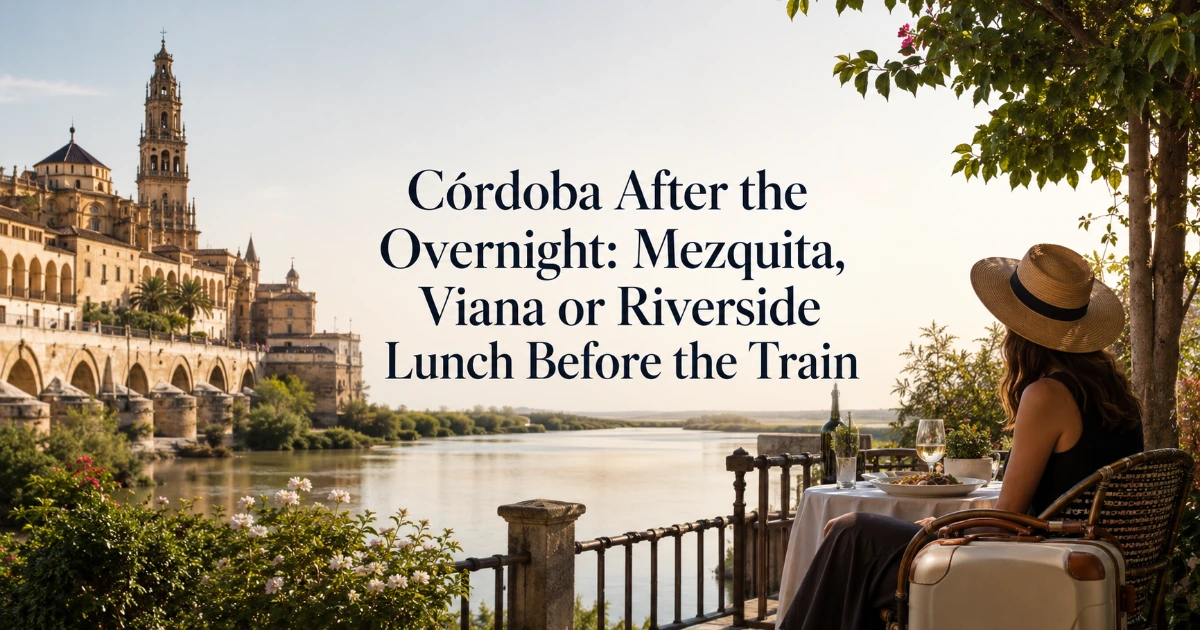
The Roman Bridge, the Guadalquivir, the Puerta del Puente, and the view back toward the Mezquita-Catedral make the river one of Córdoba’s strongest farewell settings. The Tourism of Córdoba page for the Roman Bridge (https://www.turismodecordoba.org/puente-romano-roman-bridge) is useful for basic context, but the planning question is not whether the bridge is historically interesting. The question is whether it belongs in a morning governed by lunch and departure. The answer changes with direction. If you are already near the river, have a lunch reservation that does not run long, and have a clean station transfer after the meal, the bridge can frame the end beautifully. If you are coming from Viana or the station side, it can become a scenic detour that costs more energy than it returns.
This option suits celebration travelers because it lets the final Córdoba memory be conversational rather than instructional. It suits food-and-wine travelers when lunch is meant to be the last experience, not a refueling stop between monuments. It suits families when another ticketed site would produce resistance. It also suits couples who spent the evening well and want the second morning to carry that slower rhythm into departure.
The cut-first rule is firm: if you choose riverside lunch, cut the “quick” extra old-town loop before you cut the calm around the meal. A rushed stroll through the Judería, a bridge photo, and a nervous taxi call is not better than a composed lunch and a punctual transfer. The same applies to the Alcázar gardens if they were not already part of the first day. They can be worthwhile in another plan, but they are often the first thing to remove from this specific checkout morning because they sit too close to the river choice and tempt travelers into overextending.
Riverside lunch is the wrong fit for travelers who still need a meaningful cultural visit before leaving. It is also the wrong fit when the train time leaves no tolerance for a relaxed meal. Córdoba lunch can make a morning feel expansive, but only when the station handoff is protected. If everyone spends dessert checking the clock, the bridge has not done its job.
The hotel checkout to station handoff is the real itinerary
The final morning should be planned backward from the hotel checkout to station handoff, because the handoff is where otherwise elegant Córdoba plans most often lose their composure. Córdoba station is not a romantic extension of the historic center; it is the departure mechanism, and it deserves its own margin.
This does not mean you need train timetable detail in the article or a minute-by-minute public plan. It means the morning should know where luggage is, who is meeting whom, and whether the group must return to the hotel before the station. If the answer is “we will see how we feel,” the plan is already vulnerable. The official ADIF page for Córdoba station (https://www.adif.es/w/c%C3%B3rdoba) is the practical source to confirm station information, but the editorial judgment is simpler: the station reset must be built into the morning, not discovered after lunch.
There are three clean handoff patterns. The first is hotel-based: breakfast, leave luggage, one focused visit, return to the hotel, transfer to the station. This is best when the hotel is well placed and the group values ease over novelty. The second is guide-and-transfer based: luggage is handled, the guide shapes one final visit, and the handoff is coordinated without asking travelers to re-enter the old-town lanes under pressure. This is the most useful pattern for families, older parents, celebration travelers, and small groups with different energy levels. The third is lunch-based: checkout is complete, luggage is settled, the morning ends near the meal, and the transfer follows lunch with no extra sightseeing promise.
The weakest pattern is the floating morning. That is the version where travelers check out, wander, decide late between Viana and the river, keep luggage in mind but not in hand, and then try to compress lunch because the station is suddenly real. Córdoba’s size makes this mistake tempting. The city feels walkable enough to improvise. Yet the final half-hour before a train has a way of making even a compact city feel logistical.
This is why transfer-aware private planning can be more valuable here than a more expensive ticket or a longer route. A guide who knows the morning’s endpoint can edit in real time: keep Viana, drop the bridge; keep the Mezquita return, shorten the exterior walk; keep lunch, remove the second monument. For travelers who want the guide, luggage logic, and departure handoff considered together, transfer-aware private planning is the relevant service lens, even when the departure is by rail rather than air.
How lunch and Córdoba station timing should shape the morning
Lunch should shape the final morning more than travelers expect, because it decides whether the day ends in conversation or in clock management. The train does not need to be early for lunch to matter; it only needs to be close enough that a long meal changes the emotional temperature of the departure.
If the train is soon after lunch
Choose the slowest possible morning before lunch, not the fullest. This is the slot for breakfast, checkout, perhaps a short river view if you are already there, and a direct station transfer. A monument before lunch is only sensible if it is the one thing you came to correct and the visit is genuinely focused. Otherwise, the right move is a slow breakfast and station transfer. That choice may feel conservative while planning, but it often feels generous in the body: no heat spike, no luggage anxiety, no family negotiation in the street, no expensive guide forced to rush.
If the train is mid-afternoon
Choose one priority before lunch and make lunch close the Córdoba stay. The Viana or Mezquita before lunch decision should be settled before you leave the hotel, not negotiated while everyone is already walking. This is Viana’s best lane if the Mezquita-Catedral was strong yesterday. It is also a good lane for a focused Mezquita return if day one was unsatisfying. What does not belong is Viana plus a Mezquita return plus the Roman Bridge plus a proper lunch. The sequence may look plausible in a map window, but it asks the group to keep changing modes: palace attention, sacred-monument attention, scenic attention, dining attention, station attention. That is too many endings for one morning.
If the train is later in the day
You have room to make the morning richer, but still not room to abandon hierarchy. A later train can support Viana and a relaxed lunch, or a Mezquita return with a light old-town thread, or a river lunch with a measured bridge walk. It does not automatically justify Medina Azahara or a full second-day plan. If the day has truly opened up, use the fuller comparison in the full second-day Córdoba guide. This article is for the departure morning, and that narrower frame should keep the choices honest.
The most useful planning test is to ask what the group should still remember at the station. If the answer is “the quiet order of Viana’s patios,” choose Viana and stop there. If the answer is “we finally understood the Mezquita-Catedral,” repeat the Mezquita and do not dilute it. If the answer is “we ended by the river over a good lunch,” protect the meal. If the answer is “we left Córdoba rested,” take breakfast seriously. A good final morning is not the one with the highest attraction count; it is the one whose last hour still feels like part of the trip.
The upgrade that matters is sequencing, not adding access
The worthwhile upgrade on this morning is not more tickets, more sites, or a more ambitious route. It is the ability to turn a small amount of time into a deliberate final chapter. Private guiding changes the morning when it clarifies the hierarchy, handles the interpretive load, and keeps the endpoint in view.
A private guide can help most when the group has competing instincts. One person wants to return to the Mezquita-Catedral because the first visit felt too fast. Another wants patios. Someone else wants a long lunch. A child or older parent is already rationing energy. A guide cannot make the morning longer, but a guide can prevent the loudest preference from becoming the whole plan. In Córdoba, that often means choosing the right first move and then refusing attractive extras.
Premium spend does not help when it simply adds more access to a morning that is already too short; adding more access does not justify the overnight if the final morning becomes rushed. This is especially true with monument-stacking. Paying for help to see Viana, revisit the Mezquita-Catedral, add the Roman Bridge, and still hold lunch before the train may sound polished, but it can turn a premium morning into a pressure system. Paying for a guide to choose, sequence, interpret, and hand off cleanly is different. That spend changes comfort and judgment, not the laws of time.
The private-tour route earns itself when the morning would otherwise become a checkout gap. A guide can meet after breakfast, keep the visit narrow, adjust for weather, pace the group, and coordinate the moment when culture ends and departure begins. For a bespoke Córdoba morning designed around what you already saw the day before, Inquire now.
A practical final-morning blueprint by what happened on day one
The easiest way to decide the second morning is to audit the first day honestly. The best plan is usually visible once you stop asking, “What else can we fit?” and start asking, “What did yesterday leave unfinished?”
- If day one gave you a complete Mezquita-Catedral visit: choose Palacio de Viana before lunch. Keep the route clean, do not add the Roman Bridge unless lunch is genuinely river-based, and avoid returning to the Mosque quarter out of habit.
- If day one made the Mezquita-Catedral feel rushed: return to the Mezquita-Catedral with a narrower interpretive purpose. Cut Viana first, not lunch margin. A corrected main visit is more valuable than a second site layered onto confusion.
- If day one was culturally full and emotionally satisfying: choose riverside lunch or slow breakfast. The overnight has already done its work. The final morning can preserve the mood instead of proving productivity.
- If the group is tired, heat-sensitive, or divided: choose slow breakfast, a short view, and station transfer. This is especially sensible before a longer rail leg, an Alhambra day, a Seville arrival with evening plans, or any next city where you want people arriving composed.
- If you are still tempted by Medina Azahara: save it for a real second day, not a departure morning. The site asks for a different rhythm and a different transfer logic. It is not the corrective answer to a short checkout window.
The stop-forcing move is to remove the option that only exists because it is nearby, famous, or unvisited. On this morning, proximity can be deceptive. The Judería, the river, Viana, and the station all feel close until the group has to move between them under a departure clock. The strongest plan is often the one that looks modest in writing and feels expansive in practice.
Food-and-wine travelers should be especially disciplined. A memorable lunch is not improved by arriving overheated, overexplained, or late. If lunch is the final Córdoba experience, give it space. If the Mezquita-Catedral is the final experience, keep lunch simple. If Viana is the final experience, choose a meal that does not require a cross-town correction. The morning’s value comes from one clear center of gravity.
FAQ
Should I visit the Mezquita-Catedral again on the morning after an overnight?
Yes, if your first visit was rushed, self-guided without enough context, or affected by low energy. No, if you already had a strong, unhurried visit; in that case, Palacio de Viana or a calm lunch usually gives the overnight a better second texture.
Is Palacio de Viana a good choice before a train from Córdoba?
Yes, Palacio de Viana is a strong pre-train choice when the Mezquita-Catedral was properly covered on day one and you have enough time to visit without rushing to lunch. It is weaker if your plan requires crossing back and forth through the old center under station pressure.
Can I do the Mezquita-Catedral, Viana, and lunch before leaving Córdoba?
Usually not in a way that feels premium or calm. It can look possible on paper, but it creates too many attention shifts before a departure. Choose the Mezquita-Catedral if it needs correction, Viana if the main monument is complete, or lunch if the morning should close gently.
Is a riverside lunch near the Roman Bridge worth it before the train?
Yes, when lunch is meant to be the final experience and the transfer to Córdoba station is already protected. It is not worth forcing if the train window is tight or if you still need a meaningful cultural visit before leaving.
What should I cut first from the final morning in Córdoba?
Cut the extra scenic loop first. The Roman Bridge, a second Judería wander, or an added Alcázar stop can all be worthwhile in another context, but they are usually the first things to remove when the morning already has Viana, the Mezquita-Catedral, lunch, or a station handoff.
When is slow breakfast and station transfer the best plan?
Slow breakfast and station transfer is best when the first day and evening already delivered the Córdoba experience, the group is tired, the weather is heavy, or the next city needs everyone arriving fresh. It is a valid premium choice, not a failure to tour.
Does a private guide help on such a short final morning?
Yes, if the guide is used to choose and sequence one priority rather than to add more stops. The best use of a private guide is to make the morning purposeful, paced, and cleanly handed off to the station.
Should I plan Medina Azahara on the morning before leaving Córdoba?
Not unless your departure is late enough to create a true second day. Medina Azahara needs its own transfer logic and attention. For a normal checkout-and-train morning, it is usually the wrong add-on.
If you’re interested in any private tours of Cordoba, please reach out to us.



 So if you are looking for the absolute best in Cordoba & surroundings with authentic local fully-licensed native guides whose English you can actually understand and with an exclusive and amazingly fun itinerary













