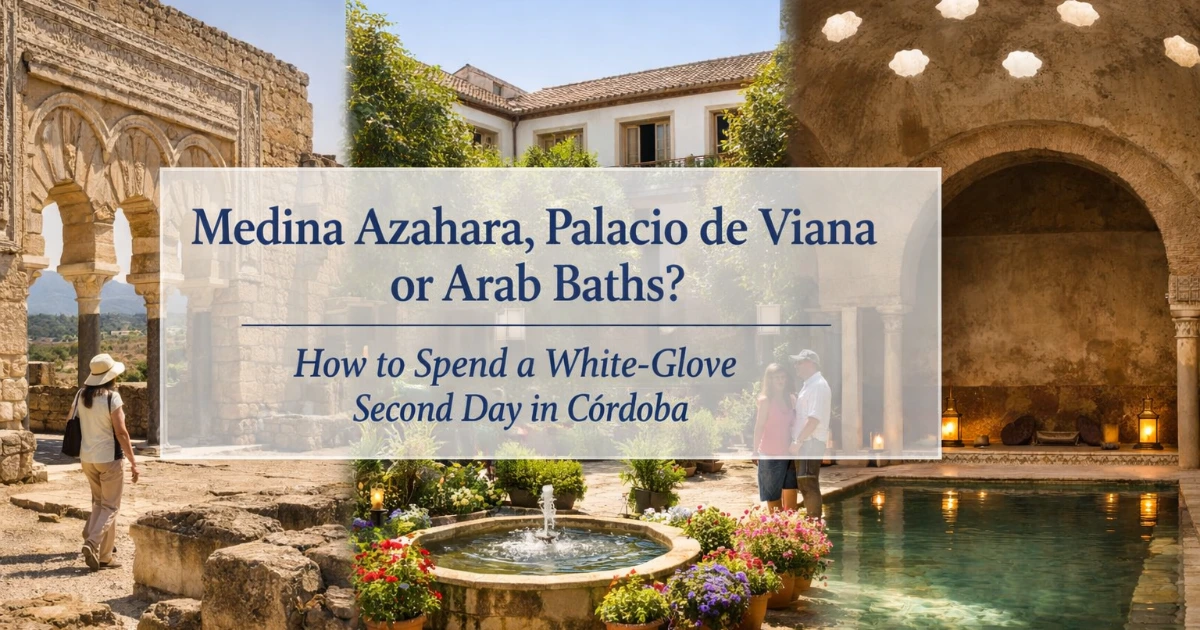
Medina Azahara, Palacio de Viana or Arab Baths? How to Spend a White-Glove Second Day in Córdoba
Updated
The best white-glove second day in Córdoba is usually Palacio de Viana, not because it is the grandest option, but because it changes the scale of the trip exactly when the city asks for that change. After a first day centered on the Mezquita, the Judería, and the emotional weight that gathers around stone, arcades, and layered faith, Viana gives you courtyards, domestic life, quieter storytelling, and a gentler route through the city without turning day two into a second logistics project. The clearest exception is simple: if the Umayyad story is the reason you stayed the extra night, and not merely the reason you bought a ticket for day one, then Medina Azahara is worth leaving town for. The fork becomes visible at Puerta del Puente after the Mezquita exit, where many overnight travelers decide, consciously or not, whether their second day should go deeper, go softer, or stay in motion.
This is the thesis that matters in Córdoba: the second day should change the texture of the stay, not merely enlarge it. That is why Arab Baths can be a smarter luxury than another monument, and why Medina Azahara is the second-day add-on most often chosen for the wrong reason. Travelers frequently pick it because it sounds like the serious answer, the advanced answer, the answer that proves the extra night was justified. In reality, the best second day is the one that complements the first without flattening the evening. If you are still deciding whether that extra night belongs in the trip at all, start with why Córdoba earns the overnight; this guide assumes you already said yes and now need to use that time well.
The ladder this city produces for most second-day planners
- 1. Palacio de Viana: the strongest all-around second day after a Mezquita-heavy first day, especially for couples, families, and travelers who want depth without a transfer block.
- 2. Medina Azahara: the best answer only when archaeological and caliphal context are the real point of staying longer.
- 3. Arab Baths: the most intelligent recovery-led choice, especially in heat, after a dense first day, or on celebration trips that value the evening as much as the morning.
- Wrong fit: trying to stuff all three into one day, or choosing Medina Azahara from guilt rather than curiosity.
The ranked answer in real Córdoba conditions
Palacio de Viana wins for most second days because it gives you a new side of Córdoba without asking your body to start over. The decision is not really about which place is most famous. It is about which option adds something the first day did not already deliver. A Mezquita-first day is heavy on monumentality, sacred scale, and intellectual layering. Viana shifts you into enclosed patios, noble domestic life, and a more intimate city rhythm. That change is why the day feels complete rather than repetitive.
Medina Azahara comes second only because it asks more of the day, not because it lacks value. If your interest is strong, it can be the most rewarding option of all. But it turns the second day into an outbound-and-return shape with a defined transfer block, a different energy curve, and less room for spontaneous old-town drifting. That matters in Córdoba, where staying overnight is valuable precisely because the city center becomes easy once the day-trippers thin and your hotel is already in play.
Arab Baths rank third in the general ladder but first in a very specific kind of trip. If you arrived on an AVE schedule, packed the first day hard, or want the second night to feel elegant instead of earned through exhaustion, the baths can be the best use of your extra time. They simply should be chosen knowingly. They are not a substitute for deeper history. They are a deliberate trade: less seeing, better feeling.
Córdoba’s compact center and easy station access are exactly why over-planning the second day is so easy. Travelers arrive on a fast train, settle into a hotel near the old town, and quickly conclude that day two can absorb almost anything. But the city’s advantage is not that it can hold more. Its advantage is that once you are already checked in, you no longer have to spend energy on arrival mechanics. Viana respects that advantage. Arab Baths preserve it. Medina Azahara uses it only if the extra depth is genuinely wanted.
Why the choice becomes obvious at Puerta del Puente after the Mezquita exit
Córdoba tells you what the second day should be at the exact moment you reach Puerta del Puente after the Mezquita exit. Stand there and the routes separate almost theatrically. One line of thought keeps you close to the Roman Bridge and the river, where a gentler afternoon and Arab Baths feel coherent. Another pulls you north and slightly away from the monument core toward Santa Marina and the streets around Palacio de Viana, where the city opens into a different register. The third is not really a walk at all; it is a decision to leave the old town behind and head west for Medina Azahara.
That is why the second day should never be planned as if all three options lived on the same grid. They do not. The center of Córdoba is compact enough to feel forgiving, but compactness can create a false sense that every add-on is equally easy. It is not the mileage that changes the day; it is the reset. Returning to the hotel, collecting yourselves again, meeting a driver, or finding the right departure rhythm changes how the entire stay feels. Once your first day has already revolved around the official Mosque-Cathedral site (https://mezquita-catedraldecordoba.es/en/) and the old core around it, the second day should answer a different question than “what else can we fit near the same postcard frame?”
This is also the first counterintuitive correction most travelers need. The glamorous-sounding move is not always the better one. In Córdoba, leaving town can be the premium choice, but staying in town can be the better-edited one. Viana in particular benefits from this. It takes you away from the heaviest visitor orbit without exiling you from the city. You still have lunch options, hotel flexibility, and a smoother route back into the evening. That is an enormous advantage for people traveling as couples, with parents, with children, or with anyone whose day one enthusiasm may exceed day two stamina.
The return path matters as much as the outbound one. A Viana morning tends to hand you back to the city near Plaza de las Tendillas or on a manageable line toward your hotel, which keeps lunch and a pause easy. A baths-led day keeps you emotionally close to the river side of the center and makes sunset plans feel natural rather than bolted on. Medina Azahara is different because it does not really return you to the same day; it returns you to a second act. Some travelers love that sensation of having had an excursion. Others discover too late that they preferred the feeling of still being inside Córdoba.
Is Medina Azahara worth leaving town for on your second day in Córdoba?
Yes, Medina Azahara is worth leaving town for on day two only when the caliphal city is one of the reasons you came, not merely one more box you can tick. In that case, it is not an add-on at all; it is the missing half of the story. After the Mezquita, Córdoba’s Islamic past can otherwise remain too architectural and too compressed in the imagination. Medina Azahara expands it into court, power, urban ambition, and the scale of a civilization beyond the prayer hall. For travelers genuinely drawn to that context, staying in the city without going there can leave the trip feeling intellectually unfinished.
The Medina Azahara transfer block is the test that clarifies whether it belongs. As soon as you imagine the practical shape of the outing, the answer usually sharpens. If the idea of an early departure, a westbound ride out of town, a defined visit window, and a return before lunch sounds satisfying rather than taxing, you are probably the right fit. If it already sounds like work, you are not choosing deeper history; you are choosing fatigue with a famous name attached to it. That distinction matters more than traveler ego tends to admit.
When the fit is right, extra spend can make this branch meaningfully better. A private guide and door-to-door car service do not change the site itself, but they change the structure around it: no piecing together transport, no uncertainty about pacing, no clumsy handoffs between city time and excursion time, and much better narrative continuity between what you saw in the Mezquita and what you are seeing beyond the center. This is the one branch where a dedicated vehicle can genuinely buy calm, privacy, and coherence. For travelers ready to commit, a Medina Azahara private tour is the most natural way to turn that half-day into something seamless rather than procedural.
When the fit is wrong, the same premium spend becomes decorative rather than useful. A chauffeur-led Medina Azahara outing does not materially beat a slower in-city morning when your interest in the site is general, your first day was already full, or someone in your party mainly needs recovery. In that situation, the car makes the wrong day smoother, but it does not make it better. Couples sometimes miss this because the chauffeured version sounds polished on paper. It is polished. It is just not always the right answer to the actual state of the trip.
The people who should avoid this option are not anti-history travelers; they are misaligned-history travelers. If what you loved most on day one was not the chronology but the atmosphere of Córdoba itself—the shadowed lanes, the transitions between patios and stone, the intimacy that arrives once the crowds thin—then Medina Azahara may pull you away from the very quality you stayed overnight to enjoy. There is no prize for choosing the most serious-sounding second day. There is only the trip you end up having.
When Palacio de Viana is the best second-day answer
Palacio de Viana is the best second-day answer because it complements the Mezquita-heavy first day instead of competing with it. Day one in Córdoba is usually public, monumental, and interpretive. Day two at Viana becomes private, domestic, and atmospheric in the best sense of the word: you are moving through courtyards, thresholds, and lived spaces rather than through another grand civic statement. For many travelers, that contrast is exactly what turns an overnight into a stay rather than a stop.
The route logic is part of the appeal. Viana sits away from the densest orbit around the Mezquita and the bridge, drawing you toward Santa Marina, San Agustín, and the north-eastern side of the historic fabric that many day-trippers never really see. That matters because it changes the emotional map of Córdoba. Instead of looping back through the same lanes around Calleja de las Flores and Calle Torrijos, you enter a part of the city where the day feels quieter, less performative, and more residential. Even a short taxi from a hotel near the river can feel like a meaningful change of scene.
This is also where paying for interpretation helps more than paying for transport. For Viana, the upgrade that earns its keep is a strong guide, not a chauffeured shell around a compact city. Without context, courtyard culture can blur into a succession of lovely spaces. With the right guide, the patios become a lens on Córdoba’s climate, class, privacy, hospitality, and inward-facing architecture. That is why a Palacio de Viana private tour makes more sense than treating the visit as a logistics problem that requires a car all day.
Viana also handles mixed-energy groups better than the other two branches. Couples with one history-forward partner and one pace-sensitive partner usually land well here. So do families who want something beautiful and legible without a long narrative runway, and small multigenerational groups who benefit from flexible timing. You can visit, have a measured lunch, return to the hotel if needed, and still keep dinner plans intact. That last point is not trivial. In Córdoba, the quality of the evening often determines whether the extra night felt generous or merely expensive.
The true comparison for many second-day planners is not Medina Azahara versus Arab Baths. It is Palacio de Viana courtyards versus a hammam reset. If you want cultural depth, choose Viana. If you want physical recovery, choose the baths. What Viana does unusually well is sit in the middle: enough substance to justify the day, enough softness to keep the trip elegant. That balance is why it becomes the default winner so often once real travel conditions—not brochure hierarchy—take over.
When Arab Baths are the better luxury than another monument
Arab Baths are the best second-day choice when recovery is not a compromise but the point. That is especially true after a first day that was heavy on queues, heat, stone, standing, and concentration. In that circumstance, another historical site can feel admirable in the morning and punishing by late afternoon. The baths break that pattern. They turn the second day into something restorative enough that the overnight feels longer, not shorter.
What makes the baths smart in Córdoba is not indulgence alone; it is sequencing. The old city rewards slower movement once the pressure to “cover” the headline monuments is gone. A baths-led second day lets you wake later, take a quieter walk, pause for lunch without watching the clock, return to the hotel if needed, and move into the afternoon without reassembling everyone for another major visit. Travelers often underestimate how much elegance comes from not having to restart the day. That is why Arab Baths private planning can be more valuable as a pacing choice than as a spa booking alone.
This branch suits celebration travelers, couples, honeymooners, and anyone visiting in heat especially well. It also works for food-and-wine travelers who care about arriving at dinner in good form rather than in tourist collapse. If the first evening was already excellent and the second evening matters too, Arab Baths can protect that part of the trip better than another monument run ever will. On a two-night stay, that can be a decisive quality-of-trip improvement.
The limitation should be stated clearly. Arab Baths are not the best answer if your extra night in Córdoba was purchased for more historical understanding. They are not a replacement for Medina Azahara, and they are not a cultural alternative to Viana. They are a beautiful decision to value calm, body, and mood. If that is not the actual priority, the baths can feel underpowered. Chosen honestly, they are one of the sharpest second-day moves in the city. Chosen apologetically, they can leave a history-minded traveler slightly unconvinced.
The second-day add-on most often chosen for the wrong reason
Medina Azahara is the second-day add-on most often chosen for the wrong reason. The wrong reason is not that travelers misunderstand its importance. They understand it very well. The wrong reason is that they often choose it to prove seriousness, to avoid the suspicion of “wasting” the overnight, or to reassure themselves that their Córdoba stay was not too short. None of those are strong enough motives for a westbound excursion after a monument-heavy first day.
The traveler consequence is immediate and specific. A day that began with the promise of depth turns into a day ruled by departure time, transfer rhythm, and the subtle stress of making the outing “worth it.” By midafternoon, you may have seen something remarkable and still feel that the city itself slipped away. That is the paradox. A second day that sounds fuller can make Córdoba feel thinner if it pulls you out of the in-city ease the overnight was supposed to buy.
There is a gentler version of the same mistake at the other end of the spectrum. Some travelers choose Arab Baths because they are afraid of doing the wrong historical thing, so they hide inside the least demanding option. That can be misaligned too. If your actual wish is one more meaningful cultural layer, then Viana is usually the better compromise. It is softer than Medina Azahara and more substantial than a pure recovery afternoon. In other words, the real mistake is not choosing any one option; it is choosing against your own trip state and pretending taste made the decision.
Small groups notice this mistake faster than solo travelers do. In a couple, one person is usually protecting curiosity while the other is protecting energy. In a family, one person is protecting pace while another is protecting meaning. Medina Azahara chosen from fear of missing out makes those tensions visible by late morning. Viana often eases them because it offers enough substance for the history-minded without making the pace-sensitive member pay for it. Arab Baths ease them in the opposite direction by admitting that comfort is the day’s actual success metric. That honesty is worth more than another name on the itinerary.
How heat and pace change the ranking
Heat is the fastest way this ranking flips. Córdoba can look easy on a map and still feel physically heavy because the stress is not climbing so much as exposure, stop-start movement, and heat reflected off stone in the old core. The gap between one shaded lane and the next is short, but the accumulated load of standing, waiting, walking, and resetting adds up. A second day that asks for another hard launch can feel disproportionately tiring precisely because the center seemed so manageable on day one.
This is what the city does to the body. A first day built around the Mezquita, Judería, and perhaps the Alcázar often leaves travelers with more low-grade fatigue than they expected. Not collapsed, just dulled. The hotel bed feels inviting at the wrong moment. Midday lunch becomes longer. The idea of returning out into full light after a pause becomes strangely expensive. That is why a transfer-heavy Medina Azahara morning can be glorious for one traveler and deadening for another, while Viana often works because it asks less from the day’s first restart.
This is also what the city does to the trip mood. Viana tends to preserve the sense that you are still inhabiting Córdoba. Medina Azahara turns the day outward and makes the stay feel more scholarly, more architectural, more definitive. Arab Baths soften the edges of the whole trip; they can make two nights feel like more because the evening survives with energy still intact. Travelers remember this mood effect long after they forget the tidy logic they used to justify the schedule.
In cooler weather, Medina Azahara rises. In hotter conditions, Viana and the baths gain ground. That does not mean you should reduce the choice to season alone. It means temperature changes the cost of friction. When the day is kind, a transfer block can feel purposeful. When the city is hot, the same block can feel like a tax. If your stay includes one golden evening you do not want to spend half-alert, take that seriously. For some travelers, the best second-day planning is simply refusing to make the afternoon earn the morning.
Where premium spend earns its keep, and where it does not
In Córdoba, premium spend matters when it removes friction or deepens interpretation; it does not matter when it merely upgrades optics. This is a city where the old core is compact, where much of the pleasure comes from not overengineering the day, and where convenience can be bought too broadly. The best spend is specific. Use it to smooth a genuinely transfer-dependent outing, secure strong private interpretation, or protect a day shape that would otherwise become clumsy.
For Medina Azahara, premium spend can earn itself. The combination of guide plus driver creates a meaningful difference because the excursion has a real outbound threshold. You are leaving the city, changing tempo, and asking the day to hold together across movement. In that case, private service buys more than comfort; it buys continuity. The story you started with the Mezquita continues without interruption, and the return to the center can be timed around lunch, rest, or an easy late afternoon rather than whatever a fixed public rhythm would impose.
For Palacio de Viana, premium spend belongs in the guide, not the car. The city is too manageable for an all-day vehicle to be the decisive luxury unless mobility issues or group complexity make it necessary. Storytelling is the richer upgrade. The courtyards, collections, and domestic scale reward someone who can connect what you are seeing to Córdoba’s climate habits and social structure. A car can keep shirts crisp. A guide can keep the visit from blurring.
For Arab Baths, premium spend should stay modest and intentional. The point is calm, not maximalism. If you are using the baths as the day’s anchor, the smartest upgrade is whatever preserves timing, privacy, and a graceful lead-in or return, not an elaborate attempt to wrap them inside too many other commitments. This is also the place to say it plainly: premium spend does not help when the plan itself is wrong. A chauffeur-led Medina Azahara outing does not materially beat a slower in-city morning when the real need is recovery, not range.
Three second-day shapes that actually work
The best second day is a shape, not a stack. What fails in Córdoba is not usually the choice of place. It is the instinct to hedge by adding a little of everything. The city punishes hedging because each branch wants a different rhythm. A successful second day therefore looks surprisingly restrained on paper and noticeably better in memory.
A useful editing question is what the plan looks like at four in the afternoon. If the answer is “we are still in transit,” the day is probably too ambitious for a second day in Córdoba. If the answer is “we are deciding whether to sit down, rest, or dress for dinner,” the shape is usually right. This sounds minor, but it is the difference between a trip that feels curated and one that feels merely completed. Palacio de Viana tends to deliver you into late afternoon with choices still open. Arab Baths do the same by design. Medina Azahara can do it too, but only if the rest of the day stays disciplined. The second you start attaching another major visit, a shopping sprint, or a forced riverside walk because it seems efficient, the elegance disappears and the city starts feeling smaller rather than richer.
The Viana-led shape is the strongest all-purpose design. Start later than you did on day one, head north toward Viana, let the visit breathe, take lunch without urgency, and keep the afternoon flexible. This is the pattern that still leaves room for shopping, a pause at the hotel, or a quiet pre-dinner drink without making the day feel empty. It is also the shape most likely to leave you ready for a serious dinner reservation. Food-and-wine travelers considering Noor should sanity-check tone and approach on the MICHELIN Guide entry for Noor (https://guide.michelin.com/gb/en/andalucia/cordoba/restaurant/noor), then decide whether the second day should support that dinner with culture or with recovery.
The Medina Azahara-led shape works only when you commit to it early. Make it the morning’s reason for being, return to the city for lunch, and keep the rest of the day intentionally loose. Do not come back and try to prove productivity with another full cultural block. The value of this day is that the hard part is concentrated and meaningful. The moment you start padding the return with more obligations, the whole design loses its polish.
The baths-led shape is the one most travelers are relieved they allowed themselves. Give the morning only a light cultural frame, hold the center loosely, and let the baths be the event rather than the afterthought. This is the version that pairs most naturally with a calmer Córdoba evening because it understands that the trip is not measured solely by what happened before lunch. It is measured by how the city feels when the light drops and you still have energy to enjoy it.
Departure timing the next day should influence this choice more than many travelers expect. If you are leaving Córdoba the following morning, Viana and the baths usually keep the stay feeling rounded and gracious. If you are continuing deeper into Andalusia after breakfast, a punishing second day can make the hotel, dinner, and final night feel oddly disposable. By contrast, if Córdoba sits in the middle of a longer slow-travel stretch and the next morning is unhurried, Medina Azahara becomes easier to justify because the outing does not have to protect a last precious evening.
When to hand the day to a guide, a chauffeur, or a slower in-city plan
The moment to ask for help is the moment you realize the day has become a logistics question rather than a taste question. If you are wavering between Medina Azahara and a slower in-city day, you are no longer deciding whether archaeology or courtyards sound nicer. You are deciding whether your second day should involve an outbound threshold at all. That is exactly where private planning earns its place: not by selling more, but by editing better.
Choose a guide-led in-city plan when the goal is texture, context, and controlled pacing. Choose a guide plus chauffeur when the goal is a proper Medina Azahara morning without any procedural drag. Choose Arab Baths when the trip itself is asking for recovery, and build around them rather than around guilt. If you need to compare these branches against the rest of your stay, including transfers, dinner ambitions, or family pace, start with all Córdoba private tours and hand over the routing problem before it starts to distort the day.
The core handoff is simple. If you want the second day to feel like Córdoba became richer, choose Viana. If you want it to feel like Córdoba became deeper, choose Medina Azahara. If you want it to feel like the stay itself became more generous, choose Arab Baths. Once that distinction is clear, the right private plan usually reveals itself quickly. Inquire now
FAQ
Which option best complements a first day centered on the Mezquita?
Palacio de Viana best complements a Mezquita-heavy first day for most travelers because it changes the scale and tone of the experience without repeating the monument circuit. It gives you a more intimate Córdoba and usually keeps the evening in better shape than an out-of-town excursion.
Is Medina Azahara better than Palacio de Viana for a second day in Córdoba?
Medina Azahara is better only when you specifically want caliphal and archaeological depth. Palacio de Viana is better for most second-day planners because it demands less reassembly, stays within the city, and adds cultural contrast rather than another major logistics block.
Are Arab Baths enough for a second day in Córdoba?
They are enough only if recovery, celebration, or preserving the evening is the actual goal of day two. They are not enough for travelers who stayed longer mainly to deepen their historical understanding of the city.
Can you combine Medina Azahara and Arab Baths on the same day?
You can, but it is rarely the most elegant second-day design. Medina Azahara works best as a committed half-day with a light return, while Arab Baths work best when the rest of the day stays intentionally soft. Combining them often creates a day that is efficient on paper and oddly tiring in practice.
When does a private driver for Medina Azahara make sense?
A private driver makes sense when Medina Azahara is a genuine priority, when you value door-to-door calm, or when your group includes travelers who do not want to navigate a transfer-heavy morning. It does not earn its cost when the real need is simply a slower in-city day.
Is Palacio de Viana a good hot-weather option?
Yes. It is usually one of the best hot-weather second-day choices because it keeps you in the city, changes neighborhood texture, and avoids the full transfer reset of leaving town. Starting earlier and using a short taxi rather than a warm midmorning walk can make it feel even better.
What should couples or celebration travelers choose on day two?
Couples and celebration travelers should usually choose between Viana and Arab Baths. Pick Viana if you want culture and a shaped day that still supports dinner well; pick Arab Baths if the emotional success of the stay depends more on calm, intimacy, and arriving at the evening relaxed.
What is the one thing to cut first if the itinerary is getting overpacked?
Cut the urge to combine all three branches or to bolt Medina Azahara onto a day that already feels ambitious. In Córdoba, the first thing to remove is not usually a restaurant or a stroll; it is the extra transfer block that turns a polished second day into a tiring one.
If you’re interested in any private tours of Cordoba, please reach out to us.



 So if you are looking for the absolute best in Cordoba & surroundings with authentic local fully-licensed native guides whose English you can actually understand and with an exclusive and amazingly fun itinerary













