Can Montilla-Moriles Belong in a Discerning Private Córdoba Day? Wine Country, the Mezquita and Old-Town Lunch
Updated
The verdict: yes, but only when the Mezquita still has first claim
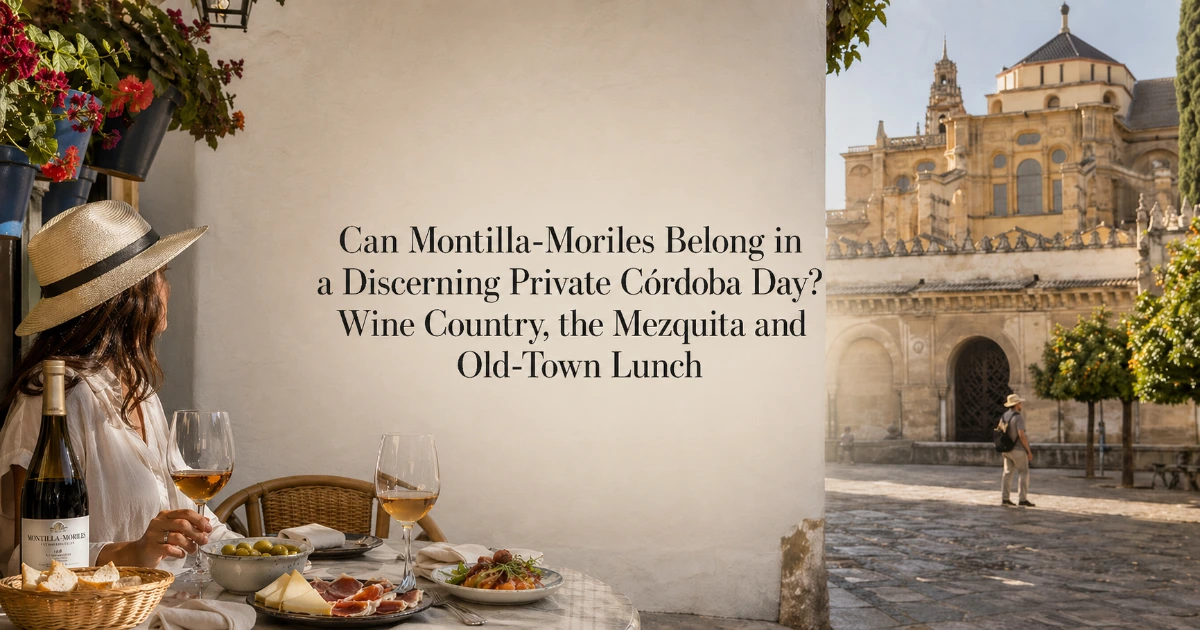
Montilla-Moriles can belong in a discerning private Córdoba day when the day is built around the Mezquita-Catedral first, old-town lunch second, and wine country as a deliberate extension rather than a decorative extra. It works in real city conditions because Córdoba’s historic center is compact, but the move from the Mezquita and Judería to the southern wine towns still changes the rhythm: once you leave the Cardenal Herrero and Patio de los Naranjos edge of the monument, you have to unwind from narrow lanes, meet transport outside the tightest pedestrian core, and accept that the afternoon is no longer an old-town wander. The clearest exception is a short rail stop or a day of punishing heat; in those cases, keep the day in the historic center and let lunch do the wine work.
The thesis is simple but not generic: in Córdoba, Montilla-Moriles earns its place only when it deepens the food-and-wine identity of the province without stealing attention from the Mezquita-to-Montilla-Moriles timing hinge. The Mezquita-Catedral is not just another morning stop; it controls the emotional scale of the day, the body’s energy, and the pace at which a good lunch can unfold. If that core feels rushed, a wine-country add-on will feel like a forced transfer, not a privilege. If the core is protected, Montilla-Moriles can turn a monuments day into a more complete Córdoba day.
The corrective point is worth stating early: Montilla-Moriles is not a casual sherry-style flourish to bolt onto any Córdoba itinerary, and the short rail-stop base is overvalued for this particular pairing. Wine lovers hear “near Córdoba” and imagine a small detour; in practice, the detour asks for a different kind of day. For a first visit, consider a focused private Mezquita-Catedral tour before deciding whether the afternoon should leave the city at all.
A ranked ladder for deciding whether Montilla-Moriles belongs
The most useful way to decide is not “wine country or no wine country,” but how much of Córdoba you can protect before the wine begins. A private day has only so many clean transitions. The best version keeps the monument unrushed, lunch seated and local, and the wine visit focused enough that the return does not flatten the rest of the trip.
- Tier 1: best fit. You are staying overnight in Córdoba or have a full private day with no luggage scramble, and you care enough about wine to let Montilla-Moriles be the day’s second act.
- Tier 2: good fit with restraint. You are visiting from Seville or another Andalusian base with private transport, but you are willing to make the city route narrower: Mezquita-Catedral, Judería context, old-town lunch, one winery or wine-led stop, then return.
- Tier 3: old-town-only wins. You are in Córdoba for a rail stop, traveling with children or older parents in high heat, or trying to include the Roman Bridge, Alcázar, patios, shopping, and a long lunch in the same day.
- Tier 4: do not force it. You want a quick tasting as a badge of completeness rather than a meaningful wine-country encounter. In that case, a guided tapas-and-wine route in the old town is cleaner, calmer, and more honest.
This ladder matters because Montilla-Moriles changes the cost of every other choice. Adding it means you should cut something before the day cuts you. The cut-first rule is the riverside-and-Alcázar expansion after lunch, not the Mezquita. If wine country is in the plan, do not also try to loop across the Roman Bridge, browse slowly around the Judería, linger at Plaza del Potro, and make a winery appointment. That is how a day that should feel curated starts to feel like a sequence of recoveries.
For travelers who are not sure yet, the practical fork is between a city-contained Córdoba tapas and wine private route and a fuller excursion shaped through private day trips outside the city. Both can be premium; the better one is the one that respects the day’s available energy rather than the one with the longer list of inclusions.
Can Montilla-Moriles fit beside the Mezquita and old-town lunch?
Yes, Montilla-Moriles can fit beside the Mezquita and old-town lunch when the wine visit is treated as a targeted afternoon extension, not as a second full destination. The cleanest pattern is a morning anchored by the Mezquita-Catedral, a short contextual walk through the Judería, a seated lunch near the old town rather than a grazing marathon, and then a transfer south toward Montilla-Moriles with one meaningful wine experience. The day should feel like Córdoba expanding outward from its center, not like the center was interrupted.
The official sources are useful here because they remind travelers what is operational and what is identity. Before locking monument timing, check the official Mosque-Cathedral site (https://mezquita-catedraldecordoba.es/en/) for visitor information rather than relying on a remembered schedule. For the wine side, the official Montilla-Moriles wine page (https://www.montillamoriles.es/en/wines/) is a better grounding than generic Andalusian wine language because the region’s personality depends on Pedro Ximénez, finos, amontillados, olorosos, and sweet wines rather than a simple “vineyard lunch” idea. The official site (https://www.turismoyvino.es/en/) of the wine route also makes clear that this is a broader provincial landscape, not a tasting room hidden behind the Mezquita.
The decision therefore hinges on whether the wine country is doing something the old town cannot do. If the point is simply to drink well with lunch, stay in the historic center. If the point is to understand why Córdoba’s food culture is tied to the southern part of the province, to taste wines in their own setting, and to see how vineyards, olive groves, and bodegas change the scale of the day, then Montilla-Moriles has a reason to be there.
The mistake is asking the winery to rescue a thin city plan. It cannot. A hurried Mezquita visit followed by a transfer will make the wine feel like compensation for a compromised morning. A strong morning, by contrast, lets the wine visit feel additive: you have already seen the great civic and sacred hinge of the city, eaten in the old town, and then moved into the agricultural landscape that gives Córdoba’s table another layer.
Why the Mezquita-to-Montilla-Moriles timing hinge controls everything
The Mezquita-to-Montilla-Moriles timing hinge controls the day because it is the moment when Córdoba changes from pedestrian concentration to provincial movement. Inside the historic center, the logic is walking, shade, doorways, courtyards, and interpretive pauses. Once you commit to wine country, the logic becomes pickup point, road time, appointment discipline, tasting duration, and return mood. That hinge should happen after the monument and lunch have done their work, not while everyone is still processing the Mezquita’s layered history.
This is especially true because the Mezquita-Catedral does not reward a skim. The emotional effect is partly spatial: the forest of columns, the mihrab area, the later cathedral insertion, the outer walls, and the Patio de los Naranjos all ask for orientation. A guide can make the building coherent, but even a brilliant guide cannot make it feel spacious if the group is already thinking about the driver, the winery, and the next booking. When the wine appointment starts dictating the monument, the day has the wrong master.
There is also a bodily consequence. Córdoba’s old town is compact, but compact is not the same as effortless. The Judería’s lanes, the uneven surfaces around the monument edge, warm stone, and standing time inside the Mezquita accumulate. A traveler may not feel tired at 11:30, but the body registers every slow shuffle, every pause in a dense passage, every return to a meeting point. Add a midday transfer too early and the day becomes a set of temperature changes: monument coolness, lane heat, restaurant pause, car, winery, car again.
The better sequence respects that accumulation. Give the Mezquita the morning’s cleanest attention, let the Judería provide a short human-scale bridge, and use lunch to settle the group before departure. That is where private design matters: not in making the day sound grander, but in choosing the least damaging moment to leave the center. For travelers comparing monument-first versus later-entry logic, the detailed Mezquita timing question deserves attention before the wine appointment is confirmed, because the monument hour will quietly decide the rest of the day.
When wine country deserves the time
Montilla-Moriles deserves the time when wine is a real priority, the group has enough day length to avoid rushing lunch, and the afternoon can be kept to one strong wine-country encounter. It is especially persuasive for couples who want the day to feel personal rather than checklist-driven, celebration travelers who prefer a distinctive provincial experience over another monument, and food-and-wine travelers who will notice the difference between a glass poured at lunch and a wine explained in its own landscape.
The fit is strongest on an overnight Córdoba stay because an overnight removes the anxiety of the return train and gives the city its evening back. A morning Mezquita visit, lunch in or near the old town, and a measured afternoon in Montilla-Moriles can still leave space for a quieter later walk or a low-pressure dinner. The day feels like two connected chapters. Without the overnight, the same plan can work, but the margin shrinks; every late start, warm hour, slow lunch, or extended tasting has a consequence.
Montilla-Moriles also earns its place when the traveler is curious about Córdoba beyond the postcard frame. The wine region is not a substitute for the Judería, and it should not be sold as a universal upgrade. Its value is that it explains another Córdoba: southern provincial towns, vineyard soils, the Pedro Ximénez grape, the culture of fino and oxidative styles, and the way wine and olive-country landscapes sit just beyond the historic center’s stone intensity. That context can make lunch taste less like a restaurant choice and more like part of a region.
The premium version is therefore not “more wineries.” It is one carefully chosen wine stop, a host or guide who can translate the wines without turning the afternoon into a lecture, and transport timed so the group is not watching the clock through the tasting. Two wineries may sound more substantial, but for a day that also includes the Mezquita-Catedral and lunch, doubling the winery count often reduces pleasure. The first bodega gives texture; the second can turn the return into a chore unless the entire day is a wine-country day.
When an old-town-only food route is the better premium choice
An old-town-only food route is the better premium choice when the traveler has limited time, wants the Mezquita to remain unhurried, or values conversation and atmosphere more than seeing the wine landscape itself. This is not the lesser choice. For many discerning travelers, especially first-time visitors, the strongest Córdoba day is Mezquita-Catedral, Judería, a precise lunch, and a few food-and-wine stops that stay within the center’s walking logic.
The old town offers a different kind of control. You can move from the Mezquita edge into the Judería, use shaded lanes near Puerta de Almodóvar or the streets around Calleja de las Flores carefully rather than aimlessly, and choose lunch without the pressure of an afternoon departure. If the group wants another layer after lunch, it can be a vermouth, a local wine conversation, a small craft stop, or a short walk toward Plaza del Potro or the riverside. None of those require the psychological reset of leaving the city.
This choice is especially strong for families, older parents, and travelers arriving by rail. Children rarely appreciate why a wine-country transfer is worth the interruption after a major monument, and older travelers may feel the fatigue later rather than at the moment of decision. A couple celebrating an anniversary may love the romance of wine country, but if they are also dressed for lunch, managing heat, and planning a formal dinner, the simpler old-town food day may feel more elegant.
The old-town-only route also keeps the trip mood more conversational. Instead of shifting from guide to driver to host to driver again, the day stays in one narrative field: the Mezquita, the Jewish Quarter, the lunch table, and the small choices that make Córdoba feel inhabited rather than consumed. This matters for travelers who dislike feeling processed. A private day should not simply remove strangers from the group; it should remove unnecessary gear changes from the experience.
The firm editorial call is this: if you have less than a full day in Córdoba, skip Montilla-Moriles and choose a focused Mezquita, Judería, and old-town lunch day. That route is not less ambitious; it is better matched to the city’s strongest first impression. Travelers who want more old-town depth beyond the monument should decide whether patios, craft detail, or Mudéjar stops deserve the time instead.
The rail-stop trap: why Montilla-Moriles is not a casual add-on
Montilla-Moriles should not be forced into a rail-stop day because the rail-stop version already spends energy before the city day begins. Córdoba’s station is convenient, but it is not the old town. You still have the station arrival, any luggage handling, transfer into the historic center, monument timing, lunch, and return logistics. Adding wine country asks the day to carry another departure and another return. That is too much for a premium experience unless the stop has been deliberately lengthened and the city route sharply narrowed.
This is the rail-stop day versus overnight wine extension threshold. A rail stop is best when it uses Córdoba’s compact-center advantage: arrive, transfer cleanly, visit the Mezquita-Catedral, walk the Judería with purpose, lunch well, and return without dragging the group through unnecessary edges. An overnight wine extension is different: arrive the day before or stay after, give the city its own center of gravity, and let Montilla-Moriles become a planned half-day arc rather than a squeeze.
The trap is that private transport can disguise the problem without solving it. A car can make the physical transfer smoother, but it cannot create a longer attention span, lower the heat in the Judería, or make a rushed lunch feel leisurely. When a day is tight, the driver becomes a way to move the stress faster. That is useful for some logistics, but it is not the same as a better day.
The station version also changes how the group behaves. People check phones for train times, keep one eye on luggage, and treat lunch as the thing between two deadlines. That mood is the enemy of Montilla-Moriles. Wine country needs a little mental slack: the ability to listen, taste, ask questions, and not calculate the return while the host is explaining a solera or a Pedro Ximénez wine.
Private transport or a premium tasting does not make sense if the traveler has only a short rail stop or is visiting in punishing heat. In that situation, put the spend into a stronger guide, a cleaner pickup, luggage handling if needed, and a better lunch strategy. For a rail-focused plan, this Córdoba rail-stop guide is the more relevant planning companion than a wine-country build.
How to sequence a private day without weakening lunch or the monument
The best sequence is monument, Judería context, lunch, then wine country, with no major add-on between lunch and departure. The morning should begin with the Mezquita-Catedral while attention is fresh. After that, the Judería should be used as interpretation, not as wandering filler: a short route that explains the old city’s texture, religious layering, and lane structure is enough before lunch. Lunch then becomes the hinge, not an afterthought.
A clean version might begin near the Mezquita-Catedral, move through the monument with a private guide, step into the Judería for a compact walk, and settle into lunch before the afternoon heat and transfer rhythm take over. After lunch, the driver should meet at a realistic edge rather than forcing a pickup inside an awkward pedestrian tangle. The value is not theatrical; it is avoiding the slow, mood-killing search for a vehicle while everyone is warm, full, and half-ready for the next chapter.
The old-town lunch itself should be chosen for pacing as much as food. A long tasting menu before wine country is usually the wrong move because it dulls the tasting and stretches the afternoon. A rushed tapas crawl is also the wrong move because it leaves the group standing when they need a seated pause. The ideal lunch is local, seated, not too heavy, and wine-aware without trying to become the entire wine program. It should steady the day.
After lunch, keep Montilla-Moriles to one focused wine-country visit or a compact pairing that has a clear reason. Do not add Medina Azahara, the Alcázar, or a full Roman Bridge walk to the same day unless the wine piece is removed. Córdoba rewards restraint. When the route tries to prove too much, the traveler remembers the transfers rather than the city.
A private plan should also name the recovery points. The group may need a bathroom pause before leaving the old town, a realistic pickup edge after lunch, and enough time at the winery for the host to explain the wines without speaking over coats, bags, and phone calls to the driver. These details sound small, but they are the difference between an afternoon that feels hosted and an afternoon that feels dispatched. In Córdoba, the polished day is usually the one with fewer visible moves.
What Montilla-Moriles adds that the old town cannot
Montilla-Moriles adds a provincial wine identity that the old town can introduce but not fully express. The old town can pour the wines, tell their story, and pair them with lunch; wine country can show why those wines belong to the southern Córdoba landscape. That difference matters for travelers who enjoy terroir, production culture, and the social atmosphere of bodegas as much as they enjoy the glass itself.
The region’s value is not that it is more glamorous than the city. In fact, expecting glamour is one of the easiest ways to misread the experience. Montilla-Moriles is compelling because it is specific: Pedro Ximénez as a central grape, fino styles under flor, amontillado and oloroso profiles, sweet wines that can surprise travelers who only know the category as dessert shorthand, and towns such as Montilla, Moriles, and Aguilar de la Frontera that move the day out of Córdoba’s monument-heavy frame.
That movement changes the trip mood. Done well, the afternoon opens up after the visual density of the Mezquita and the closeness of the Judería. The car becomes a transition from stone and shade to agricultural space. The conversation changes from conquest, worship, and urban memory to soil, grape, barrels, family production, and regional appetite. For wine travelers, that shift can make the day feel fuller without needing another landmark.
Done poorly, the same shift flattens the day. If the group leaves too late, tastes too much, or returns with dinner still ahead, Montilla-Moriles can make Córdoba feel shorter rather than richer. The bodega may be good, the wines may be interesting, and the plan may still be wrong. The test is not whether wine country is worthy in the abstract. The test is whether the visit improves this particular day.
The towns themselves should not be treated as interchangeable scenery. Montilla, Moriles, and Aguilar de la Frontera are not there to provide a postcard after the Mezquita; they are part of the reason the wines make sense. A planner who treats them only as a tasting address misses the point. The better interpretation connects what was poured at lunch with what is being explained in the bodega, so the traveler does not experience the afternoon as a disconnected excursion.
What private planning can fix, and what it cannot justify
Private planning can fix the transitions, the interpretation, the pacing, and the comfort of the day; it cannot make an overfilled itinerary wise. This distinction is important for premium travelers because Córdoba tempts people to spend their way around limits. A guide can turn the Mezquita-Catedral into a coherent experience, a driver can reduce the strain of the wine-country transfer, and a tailored plan can prevent lunch from colliding with heat and fatigue. But none of that means every good thing belongs in one day.
Where spend earns its cost is in coordination. A private guide can adapt the Mezquita explanation to a family, a historian, a wine-focused couple, or a celebration group. A driver can keep the group from spending its warmest, lowest-energy moments negotiating pickup points. A planner can choose whether the day is city-contained or wine-country-forward before restaurant and tasting choices create obligations. These are practical improvements, not decorative ones.
The sharpest private value is often saying no early. If the group wants Montilla-Moriles, the planner should remove the tempting extras before they become promises: a second monument, a full shopping loop, a long dessert stop, or a riverside detour that sounds harmless until it pushes the winery later. This is where expert restraint feels better than abundance. The day becomes legible, and the guide has room to respond to the travelers in front of them.
Where spend does not help is the fantasy of consequence-free expansion. A premium tasting cannot restore attention after a rushed monument. A better vehicle cannot make a short rail stop feel like an overnight. A more expensive lunch cannot compensate for an afternoon that asks the group to move before it has rested. Paying more changes comfort and control when the plan is well-shaped; paying more only makes a poor plan more polished when the day is already too crowded.
This is the natural handoff point for a tailored private route. If you are choosing between a focused Mezquita-and-old-town food day and a fuller Montilla-Moriles extension with transport, Orange Donut Tours can shape the tradeoff around your date, group, lunch style, and tolerance for afternoon travel. Inquire now to design the version that fits the day you actually have, not the longest version that can be written on paper.
Food-and-wine pacing: lunch in the old town versus tasting in the vineyards
Lunch should not compete with the tasting; it should prepare for it or replace it. When Montilla-Moriles is in the afternoon, lunch in the old town needs to be satisfying but not exhaustive. The best lunch leaves room for curiosity. It gives travelers local anchoring, perhaps a wine reference or two, and enough seated calm to make the transfer feel welcome. It does not try to be the culinary climax and then ask the bodega to perform after everyone is already full.
If the day remains old-town-only, lunch can take on more weight. It can be longer, more wine-led, and more conversational. A private food route can move around the Judería and nearby old-town streets without the pressure of a winery departure, using the city’s compactness as an advantage. In that version, the wines are interpreted through the meal rather than through the vineyard landscape. The mood is more intimate, and the group stays inside Córdoba’s historic texture.
The choice also affects dinner. A wine-country afternoon after a long lunch often makes a formal dinner feel like an obligation. A lighter lunch before the bodega can leave the evening open, while a city-only food day may allow for a later walk, baths, or a quieter meal if you are staying overnight. This is where Córdoba’s small scale becomes deceptive: because the distances look manageable, travelers underestimate how much sensory density the day contains.
For an overnight, the evening can absorb more nuance. You can return from Montilla-Moriles, rest, and re-enter the city later with less pressure. For ideas after a wine-country or food-led day, the adjacent evening question is covered in this comfort-first Córdoba evening guide.
A cleaner decision for couples, families, celebrations, and wine travelers
Couples should choose Montilla-Moriles when the wine-country arc feels like the emotional signature of the day, not just an impressive add-on. A morning in the Mezquita, a lunch with room for conversation, and an afternoon bodega visit can be beautifully proportioned for two. It gives the day privacy, subject matter, and a shift in landscape. But if the couple also wants a long romantic lunch, hotel downtime, and a special dinner, the old-town-only route will usually feel more graceful.
Families should be more cautious. The Mezquita-Catedral can work well with children when the explanation is vivid and the route is not too long, but adding a wine-country transfer after lunch asks children to behave through an adult second act. Teenagers with a genuine food or wine interest may enjoy the production side, but younger children often experience the afternoon as car, talking, waiting, car. For family groups, the better premium choice is often a shorter old-town food route after the monument, with shade and flexibility built in.
Celebration travelers need the clearest brief. If the celebration is about a shared wine interest, Montilla-Moriles gives the day a memorable destination without leaving Córdoba province. If the celebration is about ease, beauty, and being together without logistical pressure, the old town wins. A bodega visit can feel special; a rushed bodega visit can also split the group between those who love the detail and those who want to be back at the hotel.
Serious wine travelers are the easiest yes, but even there the day needs discipline. If the wines are the main reason for the excursion, give them a proper arc and reduce city ambitions beyond the Mezquita-Catedral and lunch. If the wines are merely a curiosity, keep the tasting in the city. The strongest private days are not the ones that satisfy every possible interest; they are the ones that know which interest is in charge.
The final planning test before you add wine country
Before adding Montilla-Moriles, ask three questions: will the Mezquita-Catedral still feel unrushed, will lunch still feel like a pleasure rather than a checkpoint, and will the group welcome an afternoon transfer after walking the Judería? If the answer to any one of those is no, keep the day in the old town. This test is more reliable than asking whether wine country is “worth it,” because worth depends on the cost to the rest of the day.
The practical version is even sharper. If you are arriving by train, check whether the transfer from Córdoba station, luggage plan, monument timing, lunch, and return train already consume your best energy. If they do, do not add Montilla-Moriles. If you are staying overnight, decide whether the afternoon after lunch is genuinely available or whether the group would benefit more from rest, patios, baths, or a quiet later walk. If the day is in high heat, treat the heat as a structural fact, not an inconvenience to be overcome by optimism.
Also ask what kind of memory you want from the day. A city-only version leaves a concentrated memory: arches, lanes, a good table, and the sense that Córdoba was understood rather than sampled. A wine-country version leaves a broader memory: the same monument core, followed by the province opening out beyond the city. Both are valid. The mistake is trying to make one day produce both memories at full strength.
When the wine-country version passes the test, brief the plan narrowly. Ask for a Mezquita-first morning, a Judería walk that does not sprawl, lunch chosen for pacing, and one wine-country experience that reflects Montilla-Moriles rather than a generic tasting. Through tailor-made Córdoba private touring, the value is not adding more stops; it is deciding which stops deserve to survive.
When the test fails, the alternative is still excellent: Mezquita-Catedral, Judería, old-town lunch, and a wine-aware city route. That day keeps Córdoba concentrated, gives the guide more room to adapt, and avoids the late-afternoon fatigue that can make even good wine feel like homework. In Córdoba, the most discerning choice is often the one that leaves something out.
FAQ
Is Montilla-Moriles worth visiting on a private Córdoba day?
Montilla-Moriles is worth visiting on a private Córdoba day if wine is a genuine priority and you have enough time to protect the Mezquita-Catedral, the Judería, and a seated old-town lunch first. It is not worth forcing into a short rail stop or a hot, overpacked day.
Should I visit the Mezquita-Catedral before going to Montilla-Moriles?
Yes. The Mezquita-Catedral should usually come before Montilla-Moriles because it is the core Córdoba experience and demands fresh attention. Wine country works best as a second act after the monument, a short Judería walk, and lunch.
Can I combine Montilla-Moriles with the Judería and lunch?
Yes, but keep the Judería portion focused. A compact walk through the Judería after the Mezquita and before lunch works well; a long old-town wander plus lunch plus wine country often makes the afternoon feel rushed.
Is Montilla-Moriles a good idea for a Córdoba rail stop?
Usually no. A rail stop is better used for the Mezquita-Catedral, Judería, and lunch because the station transfer, luggage plan, monument visit, and return timing already create enough structure. Montilla-Moriles is better for a full private day or an overnight extension.
What should I skip if I add Montilla-Moriles to the day?
Skip the extra post-lunch city expansion first. Do not add the Alcázar, a full Roman Bridge walk, Medina Azahara, patios, and a winery to the same day. If Montilla-Moriles is in the plan, let the Mezquita, Judería, lunch, and one wine-country visit carry the day.
Is an old-town-only food and wine route a lesser choice?
No. An old-town-only food and wine route can be the better premium choice when time is short, heat is heavy, or the group values a calmer lunch and guided city context over an afternoon transfer. It keeps Córdoba’s best first-visit rhythm intact.
Does private transport make Montilla-Moriles easy to add?
Private transport makes the transfer smoother, but it does not remove the time, heat, attention, or mood costs of leaving the old town. It is valuable when the day is already well-shaped and insufficient when the itinerary is too crowded.
Who is the best fit for a Mezquita, lunch, and Montilla-Moriles day?
The best fit is a couple, small group, celebration party, or serious food-and-wine traveler with a full private day or overnight in Córdoba. The weaker fit is a short-stop visitor, a heat-sensitive family, or anyone who mainly wants the city’s old-town atmosphere.
If you’re interested in any private tours of Cordoba, please reach out to us.



 So if you are looking for the absolute best in Cordoba & surroundings with authentic local fully-licensed native guides whose English you can actually understand and with an exclusive and amazingly fun itinerary













