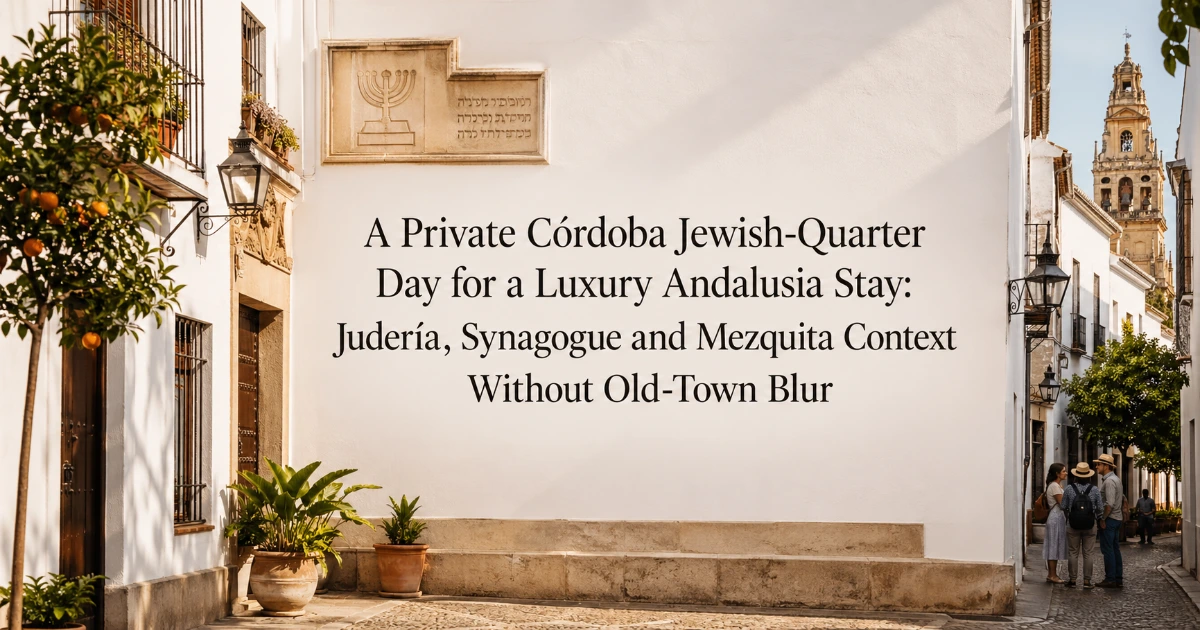
A Private Córdoba Jewish-Quarter Day for a Luxury Andalusia Stay: Judería, Synagogue and Mezquita Context Without Old-Town Blur
Updated
Verdict: For heritage-focused travelers, a private Córdoba Jewish-quarter day should begin with the Judería and the Synagogue before the Mezquita-Catedral context bridge, not treat them as decoration after the main monument. This works in real city conditions because Córdoba’s old center is compact but mentally dense: Calle Judíos, the Synagogue, the lane texture toward the Chapel of San Bartolomé, and the Mezquita-Catedral sit close enough to form one guided argument, while heat and narrow-street crowding make unguided wandering feel flatter than it should. The clearest exception is a very short rail stop or a family visit with limited attention; then make the Mezquita-Catedral the priority and keep the Judería as a short orientation rather than pretending to do heritage depth.
The thesis is simple: in Córdoba, the best Jewish-quarter day is not a bigger route; it is a better order. A luxury Andalusia stay earns more from sequence, shade, and interpretation than from adding more monuments. The non-obvious hinge is the western edge of the Judería near Avenida del Conde de Vallellano and Puerta de Almodóvar: enter too quickly from that side, photograph the lanes, and hurry to the mosque-cathedral, and the quarter becomes a picturesque corridor. Enter with purpose, let the Synagogue and San Bartolomé set the question, and the Mezquita-Catedral changes from a single astonishment into the final chapter of a layered civic story.
That is why the Judería should not be treated as a quick add-on after the Mezquita for heritage-focused travelers. The Synagogue is small enough to be dismissed by visitors who measure value by square footage; the Chapel of San Bartolomé is easy to underplay if it is reduced to “another pretty Mudéjar stop”; and the Mezquita-Catedral is so visually commanding that, once seen first without context, it can swallow everything around it. A better private day gives each place a role before the old-town blur begins.
Is the Córdoba Jewish Quarter worth a private guided day?
Yes, the Córdoba Jewish Quarter is worth a private guided day when your goal is heritage depth rather than a checklist walk. The Judería rewards a guide because its meaning is dispersed: in street widths, in proximity to religious power, in small interiors, in what survives, and in what no longer does. Without interpretation, the quarter can seem charming but slight; with the right sequence, it becomes the framework that helps the Mezquita-Catedral make fuller sense.
The first planning mistake is assuming that “close together” means “easy to understand together.” Córdoba’s compact center is a gift for logistics, but not a substitute for judgment. The Synagogue, Chapel of San Bartolomé, and Mezquita-Catedral are not far apart, yet they ask for different tempos. The Synagogue needs a quiet read before it fills with passing visitors. San Bartolomé needs enough attention for its Christian, civic, and Mudéjar textures to register. The Mezquita-Catedral needs a guide who can keep the building from becoming a sequence of visual surprises with no governing thread.
The best-fit traveler is someone who cares about medieval Spain, religious coexistence and rupture, architecture as a record of power, or family history that makes Jewish heritage emotionally important. Couples on a celebration trip often like this day because it feels intimate rather than performative. Small groups with different knowledge levels benefit because a private guide can calibrate: enough context for the history lover, enough pace control for the traveler who tires of dense explanations, and enough stillness for the person who wants to feel the space rather than be lectured through it.
The wrong fit is just as important. If you mainly want patios, shopping, broad old-town atmosphere, and a leisurely lunch, this is not the frame to force. Córdoba has other ways to build a crafted day beyond the Mezquita, and those can be more satisfying when heritage interpretation is not the central desire. A broader old-town plan can sit beside this article in the Orange Donut Tours journey, but this piece is narrower: it is about when the Judería deserves a heritage-led day rather than being background scenery. For a wider heat-conscious city plan that includes other major choices, see how to plan a curated Córdoba day without heat fatigue.
The counterintuitive correction is this: the famous monument is not always the best first interpretive stop. The Mezquita-Catedral may still be the emotional high point, and it may need ticket and entry planning, but heritage-focused visitors often understand it better after the Judería has posed the questions. Where did religious communities live in relation to power? How did later Christian institutions reuse, reframe, or neighbor older forms? Why does Mudéjar detail matter in a city where Islamic, Christian, and Jewish memory sit so tightly together? Those questions should be active before you step into the vastness of the mosque-cathedral.
The ranked ladder: what earns its place in a private Jewish Quarter day
The most rewarding plan is a ranked ladder, not a pile of nearby sights. Each element should earn its place by changing how the next one is read. If a stop does not clarify the Synagogue, San Bartolomé, or the Mezquita-Catedral, it should be shortened or cut.
1. The Judería as a guided frame, not a scenic preamble. The day begins in the Judería because the neighborhood is the question-setter. Calle Judíos is not merely a photogenic lane; it is the place where the visitor starts to feel how compressed the historical center is. A guide can use the walk to distinguish memory from reconstruction, explain why surviving fragments matter, and prevent the quarter from being flattened into souvenir-shop scenery. This is the natural place to start a focused Jewish Quarter Walking Private Tour if the aim is depth rather than “we passed through it.”
2. The Synagogue before the larger religious spaces. The Synagogue deserves early attention because its small scale is part of its interpretive force. Córdoba tourism’s official page describes the Synagogue as situated in the heart of the Jewish Quarter and built between 1314 and 1315; it also notes its importance among Spain’s preserved medieval synagogues. Use the official Córdoba Synagogue page (https://www.turismodecordoba.org/synagogue) for narrow fact-checking and current visitor basics, but do not let the practical note become the story. The traveler consequence is this: if the Synagogue is visited after the Mezquita-Catedral, it can feel tiny and anticlimactic; if visited before, its intimacy sharpens the contrast that follows.
3. Calle Judíos to the Chapel of San Bartolomé as the essential transition. The route from Calle Judíos to the Chapel of San Bartolomé is where the day becomes more than Jewish-quarter sightseeing. The short walk toward the chapel area near Plaza del Cardenal Salazar makes the quarter feel less like an isolated ethnic enclave and more like a layered urban fabric. The official city page places the chapel in the former Cardinal Salazar hospital, now tied to the Faculty of Philosophy and Arts, and describes it as a splendid example of Mudéjar architecture; use the official Chapel of San Bartolomé page (https://www.turismodecordoba.org/chapel-of-san-bartolome2) for the factual frame. The planning point is that San Bartolomé should not be a drive-by mention. It is the pivot that helps travelers read continuity, appropriation, craft, and Christian patronage in a neighborhood too often described only through absence.
4. The Mezquita-Catedral after the context bridge. The Mezquita-Catedral still anchors the day, but it should arrive after the Jewish-quarter frame has done its work. This is where a guide can connect urban memory, religious authority, architectural transformation, and the physical sensation of scale. The official Mosque-Cathedral site is the right place to confirm visitor information before you go; start with the official Mosque-Cathedral site (https://mezquita-catedraldecordoba.es/en/), then let your guide shape the human sequence. A focused Mezquita-Catedral Skip-the-line Private Tour has more value when it is not isolated from the streets that brought you there.
5. The wider historic core only if it clarifies the main thread. Córdoba’s historic core can tempt travelers into adding the Alcázar, the Roman Bridge, patios, craft stops, a market pause, and extra churches. Some are excellent choices on a different day. In this day, however, the wider core should serve the Jewish-quarter-to-Mezquita argument. If the route starts drifting toward a generic “best of Córdoba” walk, cut the extra stops first and keep the Synagogue, San Bartolomé, and Mezquita-Catedral coherent.
This ladder is deliberately strict. It does not deny that Córdoba has more to offer; it protects the one question this day is meant to answer. The result feels calmer not because it is thin, but because each stop prepares the next one.
Why the Synagogue and San Bartolomé need sequencing rather than drive-by mentions
The Synagogue and Chapel of San Bartolomé need sequencing because their value is interpretive, not theatrical. Neither should be judged by the instant impact expected from the Mezquita-Catedral. Their importance appears when the visitor is guided through scale, survival, decoration, patronage, and neighborhood position in the right order.
The Synagogue should come early enough for the group’s attention to be fresh. It is small, and that is exactly why it needs care. A private guide can make the room legible without overloading it: why inscriptions and ornament matter, why the building’s survival is significant, why the surrounding streets create a sense of historical compression, and why Jewish Córdoba is not adequately represented by one room alone. The guide’s task is not to inflate the stop into something it is not; it is to prevent travelers from missing the meaning because they were trained by larger monuments to expect drama.
San Bartolomé belongs after the Synagogue because it complicates the story. The chapel’s Mudéjar language sits inside a Christian setting, and that is precisely the point. Visitors who see it only as “pretty tile and plaster” lose the intellectual value of the stop. Placed between the Synagogue and the Mezquita-Catedral, it becomes a hinge: a way to talk about craft traditions, changing authority, neighborhood reuse, and the difference between style and community. This is where a Mudejar Chapel of San Bartolomé Private Tour can make a small interior carry more weight than a rushed visitor expects.
The consequence of bad sequencing is not merely academic. It changes the mood of the day. When the Synagogue and San Bartolomé are squeezed between a hotel pickup, a Mezquita entry, lunch pressure, and a river photo, the group begins to feel that the Jewish Quarter is filler. Conversations become thinner, questions stop, and the old town becomes a stream of façades. When these sites are given a deliberate order, the group slows down and the day feels shorter in the best sense: fewer transitions, fewer mental resets, more continuity.
Premium spend helps when it buys interpretive control: a guide who knows when to pause, when to compress, when to let the family member with a special interest ask a longer question, and when to move before the lane becomes crowded. Premium spend does not help if the route compresses the Synagogue, San Bartolomé, and Mezquita into superficial stops. Paying more for a private day does not rescue a route that has been designed like a race.
How Jewish-quarter context changes the Mezquita-Catedral visit
Jewish-quarter context changes the Mezquita-Catedral by turning the monument from an isolated masterpiece into the final, concentrated expression of Córdoba’s layered religious and civic history. The building is already powerful without preparation; the question is whether the visitor understands what kind of power they are seeing.
Arriving from the Judería changes the first minutes inside the Mezquita-Catedral. The group has already moved through a neighborhood where survival is fragmentary, where memory is partial, and where small interiors ask to be read carefully. Then the mosque-cathedral’s scale does something different to the body: the sudden expansion of space feels less like a visual trick and more like a shift in authority. The columns, the internal rhythm, the Christian interventions, the chapels, and the cathedral core are no longer competing facts. They become a sequence of claims made in stone, light, and ritual use.
This matters for first-time visitors because Córdoba is often reduced to a single famous photograph: arches, stripes, and astonishment. A guide should certainly allow astonishment. But if that is all the visit delivers, the traveler leaves with beauty and very little structure. With the Judería already in mind, the Mezquita-Catedral can be read through relationships: minority memory beside monumental authority, Islamic architectural legacy within a Christian cathedral, civic identity shaped by proximity rather than neat separation.
The Jewish-quarter frame also prevents an overly simple coexistence story. Córdoba invites romantic shorthand, but a serious private day should be more careful. The point is not to turn the city into a sentimental tale of harmony or a bleak tale of rupture. It is to let travelers see how communities, laws, patrons, religious institutions, and later tourism narratives all leave traces with different degrees of visibility. The Synagogue’s smallness, San Bartolomé’s hybrid artistic vocabulary, and the Mezquita-Catedral’s overwhelming scale all belong in the same conversation, but only if the guide resists turning them into slogans.
The cut-first rule follows from this. If the day is getting overpacked, do not cut the interpretive bridge and keep a random extra photo stop. Cut the optional old-town add-ons first. A quick view of the Roman Bridge, an Alcázar exterior, or a patio detour may be pleasant, but none of them should displace the sequence that makes the Mezquita-Catedral more intelligible for this specific heritage day.
The city friction: heat, lane density and the station-to-old-town reset
Córdoba’s main friction is that the historic center is compact enough to invite overconfidence and hot enough to punish it. The old town does not need long distances to tire a traveler. It uses heat, dense lanes, uneven attention, and repeated micro-pauses to drain comprehension.
For the body, the issue is cumulative exposure. A traveler may start from a hotel in the Judería, from a riverside property, or from the railway station after arriving from Seville, Madrid, or Granada. The station-to-old-town transfer is not the intellectual problem; the transfer is simple enough with a car or taxi. The problem is what happens after arrival, when the day asks the visitor to switch from luggage brain or train brain into dense historical listening. If the first hour is spent wandering without a thesis, the body is already warm, the group has already spent patience on orientation, and the Synagogue’s subtlety has less chance of landing.
A shaded Judería loop before the midday heat wall is not a decorative comfort choice; it is a comprehension strategy. In the cooler part of the day, a guide can slow near Calle Judíos, keep the group out of the most exposed pauses, and decide when to step into interiors. By midday, the same route can feel shorter on a map and longer in the body. Narrow streets hold movement, small doorways create bottlenecks, and a group that was curious at 10:00 can become transaction-minded by 13:00.
The old-town density also affects how people hear. In compact historic centers, visitors often think they want more facts because they are surrounded by history. In practice, they need fewer, better-timed facts. Too much explanation in a lane with passing groups, shopfronts, and heat glare becomes noise. A private guide earns their role by choosing the right corner, the right threshold, and the right moment to speak. That may sound modest, but it is the difference between a day that feels lucid and a day that dissolves into “we saw the Jewish Quarter somewhere before lunch.”
Córdoba also affects the mood of the trip. A blurred old-town morning can make the whole day feel strangely short: travelers remember the Mezquita-Catedral, but the rest becomes a warm prelude with names attached. A controlled sequence creates the opposite mood. The day feels calmer, not slower; the evening feels less like recovery from sightseeing and more like an earned continuation of the stay. This matters for celebration travelers and couples who do not want a heritage day to leave them too depleted for dinner, conversation, or a riverside walk.
The practical answer is not to demand a chauffeur for every step. Much of the value here comes from walking the right small area in the right order. A car can improve arrival and departure, especially from the station or from hotels beyond the immediate old-town edge, but it cannot interpret Calle Judíos or make San Bartolomé meaningful from the curb. Use transport to remove dead time; do not let it replace the intimate logic of the quarter.
What to stop forcing into this particular day
The first thing to stop forcing is Medina Azahara. It is a major historical site, but it belongs to a different planning question. Adding it to a heritage-focused Judería, Synagogue, San Bartolomé, and Mezquita-Catedral day can look efficient on paper and feel fragmented in practice. The transfer out of the center changes the rhythm, the interpretive scale changes, and the old-town thread is broken. If Medina Azahara is a priority, build the whole day around caliphal Córdoba and accept a different structure.
The second thing to stop forcing is a full old-town sampler. The Alcázar, patios, craft stops, riverside views, and food pauses can all be worthwhile, but not all in the same heritage-depth route. The moment the day becomes “one more nearby thing,” the Synagogue and San Bartolomé start losing their role. Córdoba is compact, but the traveler’s attention is not infinite. A private day should choose what the mind will carry home, not just what the feet can reach.
The third thing to stop forcing is a hotel-location debate into this article. Staying overnight in the Judería, near the riverside, or closer to another district can change the feel of a Córdoba stay, but this day can work from several bases if the route is ordered well. If you need a base-choice piece, use a neighborhood guide. For this specific planning problem, the deciding factor is not whether the hotel is a few minutes closer to the Synagogue; it is whether your first serious heritage hour happens before heat, crowding, and monument fatigue begin to dull the group.
The fourth thing to stop forcing is the idea that more exclusive automatically means more meaningful. Private access, a beautiful lunch, a polished transfer, and a well-briefed guide can all improve the day. But the highest-value upgrade is not always the most visible one. The real upgrade is editorial: a route that says no to padding, gives the small sites their due, and keeps the Mezquita-Catedral from becoming disconnected spectacle.
There is one exception to this strictness. If the group includes travelers who are not deeply heritage-focused, a small mood-setting detour can be useful. A short pause near Puerta de Almodóvar, a carefully placed coffee, or a brief riverside breath after the Mezquita-Catedral may help the group stay receptive. The difference is that these pauses support the sequence; they do not hijack it.
How a private guide earns the day without turning it into a lecture
A private guide earns this Córdoba day by connecting layered religious and civic history while controlling old-town fatigue. The goal is not more talking. It is better judgment: when to frame, when to let the space work, when to move, and when to cut a tempting addition.
The right guide will build a route around the group’s reason for caring. A Jewish-heritage traveler may want more time with the Synagogue’s survival and the historical absence around it. An architecture-focused traveler may want San Bartolomé and the Mezquita-Catedral tied through Mudéjar vocabulary, craft continuities, and Christian patronage. A first-time couple may want enough history to feel the city’s seriousness without losing the pleasure of being there together. A multi-generational family may need shorter interpretive bursts and a stronger rhythm of shade, interiors, and pauses.
This is where Orange Donut Tours’ private planning fits naturally. The guide is not there to make the Judería sound important; the neighborhood is important when read properly. The guide is there to keep the day from collapsing into either a generic old-town walk or a monument-only sprint. A route can combine the Judería, a focused Mezquita-Catedral visit, and the San Bartolomé pivot without pretending that every nearby site belongs in the same morning; the broader Historic Center of Cordoba Private Tours frame only belongs when it supports that story.
The planning handoff is especially useful when travelers are arriving from another Andalusian city, celebrating a milestone, or coordinating different levels of stamina and interest within one small group. A private guide can hold the intellectual line of the day while adjusting the human tempo. If you want the Synagogue, Chapel of San Bartolomé, and Mezquita-Catedral to feel connected rather than merely adjacent, Inquire now.
The best private version does not need theatrical exclusivity to feel premium. It needs pre-visit choices made before the group is hot, hungry, and standing in a lane deciding what matters. It needs a guide who can say, “We are not adding that because it weakens the story,” and a route that can still breathe. For travelers who want a broader custom brief across several Córdoba interests, Tailor-Made Private Tours of Cordoba is the better doorway than trying to stretch this Jewish-quarter day beyond its natural shape.
A practical one-day order for Judería, Synagogue, San Bartolomé and Mezquita context
The cleanest order is Judería orientation, Synagogue, Calle Judíos to the Chapel of San Bartolomé, a brief controlled pause, then the Mezquita-Catedral. The exact timing should be adjusted around official opening information, ticketing, season, and the group’s start point, but the sequence should remain stable unless a site-specific constraint requires a swap.
Stage 1: Enter the Judería with a thesis. Start at a point that allows the guide to frame the quarter before the group is surrounded by visual clutter. Puerta de Almodóvar can work as an edge cue; a hotel inside the Judería can work if the guide prevents the start from becoming a casual stroll. The first minutes should explain why the day is not a generic old-town walk.
Stage 2: Give the Synagogue fresh attention. Visit the Synagogue before the largest monument has reset everyone’s scale. Keep the explanation concise but serious. The stop should leave travelers with sharper questions, not with the false sense that one surviving building “covers” Jewish Córdoba.
Stage 3: Walk Calle Judíos to the Chapel of San Bartolomé deliberately. This is the route hinge. The guide should use the walk to connect neighborhood texture with institutional change, not simply move the group from one door to another. The phrase Calle Judíos to the Chapel of San Bartolomé should mean an interpretive transition, not just a line on the map.
Stage 4: Let San Bartolomé complicate the story. Inside or around the chapel, the guide should explain why Mudéjar detail in a Christian setting matters here. This is not an optional decorative aside. It is the place where the visitor begins to see how artistic language can outlive, migrate, and be repurposed by power.
Stage 5: Pause before the Mezquita-Catedral. The pause should be short and intentional. Water, shade, a restroom, or a quiet corner can restore attention before the day’s largest interpretive demand. Do not use this pause to add another major sight unless the group is unusually fresh and the guide believes it strengthens the thread.
Stage 6: Enter the Mezquita-Catedral with the earlier questions alive. Once inside, the guide should connect scale, architecture, ritual transformation, and civic identity to what the group has already seen. The visit should feel like culmination, not a separate ticketed episode.
After the Mezquita-Catedral, choose restraint. Lunch, a hotel pause, or a short atmospheric walk may be enough. If the group still wants more, the added piece should be chosen for mood rather than encyclopedic coverage. A riverside view toward the Roman Bridge can provide air after dense interpretation; a long second monument may turn a strong day into a crowded one.
This order also works for an overnight stay because it leaves space for the rest of Córdoba to unfold later. A traveler staying in the Judería can return to the lanes after dinner with less pressure to “use” them as sightseeing. A traveler staying closer to the river can let the evening feel separate from the morning’s intellectual work. A rail-stop traveler can still use the sequence in compressed form, but should be honest about the limits and avoid adding Medina Azahara or an old-town sampler.
FAQ
Should I visit the Córdoba Synagogue before or after the Mezquita-Catedral?
Heritage-focused travelers should usually visit the Synagogue before the Mezquita-Catedral. The Synagogue’s small scale is easier to read with fresh attention, and it gives the later mosque-cathedral visit a stronger frame.
Is the Judería enough for a full private day in Córdoba?
The Judería alone is usually not a full day, but the Judería, Synagogue, Chapel of San Bartolomé, and Mezquita-Catedral can form a substantial heritage-focused private day when they are sequenced carefully.
Why include the Chapel of San Bartolomé in a Jewish Quarter day?
The Chapel of San Bartolomé belongs because it complicates the neighborhood story. Its Mudéjar character in a Christian setting helps travelers understand continuity, reuse, craft, and power between the Synagogue and the Mezquita-Catedral.
Can I do the Jewish Quarter as a quick add-on after the Mezquita?
You can, but it is not the best choice for heritage-focused travelers. After the Mezquita-Catedral, the Synagogue and San Bartolomé can feel too small unless a guide has already prepared the interpretive frame.
Does a private guide matter in Córdoba’s Jewish Quarter?
A private guide matters when you want the Judería to be more than attractive lanes. The guide connects small sites, street texture, religious history, and the Mezquita-Catedral while adjusting the pace around heat and attention.
What should I cut first if the Córdoba day is getting too full?
Cut optional old-town add-ons first, especially stops that do not strengthen the Synagogue, San Bartolomé, and Mezquita-Catedral sequence. Do not cut the interpretive bridge and keep a random extra photo stop.
Is Medina Azahara part of this Jewish-quarter day?
Medina Azahara is better treated as a separate planning question. It can be excellent, but adding it to a Judería and Mezquita-Catedral heritage day often breaks the rhythm and shifts the focus away from the old-town sequence.
Is this route suitable for families or older travelers?
Yes, if the route is paced with shade, concise explanations, and sensible pauses. Families and older travelers should avoid overloading the day with extra monuments and should keep the core sequence clear.
If you’re interested in any private tours of Cordoba, please reach out to us.



 So if you are looking for the absolute best in Cordoba & surroundings with authentic local fully-licensed native guides whose English you can actually understand and with an exclusive and amazingly fun itinerary













