Shuttle, Taxi or Private Vehicle to Medina Azahara? Córdoba Logistics Around a Fixed Mezquita Slot
Updated
Choose by the return deadline, not by the outbound ride
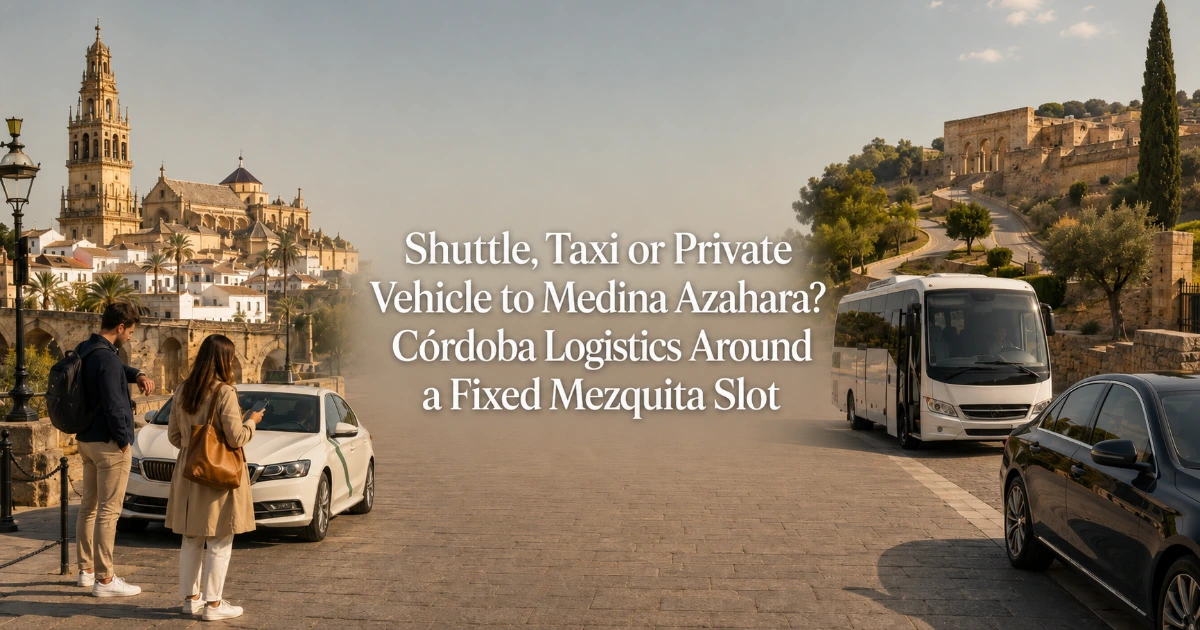
For a day that pairs Medina Azahara with a fixed Mezquita-Catedral entry, the transport decision is mainly a return-risk decision. The official city bus is the cleanest choice when its full round trip sits comfortably outside the monument deadline. A taxi is useful when you need a different departure time, but it does not remove the internal shuttle between the interpretation center and the archaeological site, and it does not by itself guarantee a precisely timed ride back. A dedicated private vehicle is the most controllable option when luggage, limited mobility, heat exposure, a rail connection or a non-negotiable Mezquita slot leaves little room for a missed handoff. Even then, the vehicle reaches the visitor hub rather than bypassing Medina Azahara’s access procedure.
The practical test is simple to apply. First, write down the time at which you must be on foot near the Mezquita entrance, not merely back inside Córdoba. Second, reserve enough time for the internal shuttle, the return from the site to the museum and parking area, the road into the city, the final drop-off, luggage handling and the walk to the correct access point. Third, compare that deadline with the transport option’s least convenient plausible return, not its advertised driving time. A twenty-minute city transfer can still sit inside a much longer chain of boarding, waiting and walking. The municipal tourism page describes the official service as a two-stage movement: coach from Córdoba to the Medina Azahara Interpretation Centre, then shuttle from the center’s parking area to the archaeological site and back. It also gives an approximate twenty-minute city transfer, but that is only one segment of the visit. The official Córdoba tourism description of the service is the correct starting point for the current arrangement.
For most time-constrained visitors, the decision falls into three bands. Use the city shuttle when its published return puts you in the old town with a generous margin. Use a taxi when you need departure flexibility and can secure the return rather than improvising it. Use a dedicated vehicle when the entire day depends on coordinated pickup, protected luggage and a pre-agreed city re-entry plan. None of these choices should turn Medina Azahara into a hurried photograph stop. If the fixed entry makes a serious visit impossible, change the order, choose a different day or let one monument go.
Map the journey as a chain of handoffs
Medina Azahara is often described as a short excursion west of Córdoba, which is geographically true and operationally incomplete. A useful plan sees at least six handoffs: leaving the hotel or old town; reaching the city bus stop or vehicle; arriving at the interpretation center and parking hub; transferring to the internal shuttle; returning from the ruins to the hub; and re-entering Córdoba before approaching the Mezquita on foot. A visitor who thinks only in terms of road distance tends to undercount four things: the wait before the city departure, the wait for the internal shuttle, the transition between museum and ruins, and the last pedestrian segment in the historic center.
The hub matters because the museum, parking area and shuttle connection sit in the same operational system, while the excavated palatine city is reached separately. The city coach does not deposit you among the ruins. A taxi does not deposit you among the ruins. A private vehicle does not deposit you among the ruins. The operator’s current guidance distinguishes the Córdoba bus from the internal shuttle and states that visitors arriving by car continue from the parking area by shuttle. The service operator’s planning page also warns that schedules can vary by date, season and availability, which is why a saved timetable from another month is not enough.
Think of the route in two directions. Outbound, the main question is whether you reach the site early enough to visit without rushing. Inbound, the main question is whether you can leave the site early enough to clear every remaining handoff before the Mezquita commitment. Those are not mirror images. Outbound delay can sometimes be absorbed by reducing unstructured time. Inbound delay presses directly against a fixed entry. That asymmetry is why the return should govern the transport choice.
For the wider historical logic of placing the palatine city beside Córdoba’s congregational mosque, use this caliphal Córdoba route as the interpretive companion. This guide is narrower: it treats the bus stop, museum, shuttle, road return and old-town arrival as one linked system.
What the official city shuttle solves, and what it fixes in place
The official city shuttle solves the most obvious problem: it provides a booked outward and return movement between central Córdoba and the Medina Azahara visitor hub, with the internal shuttle forming the second stage toward the site. For a traveler staying centrally, that can be simpler than arranging two separate rides. The boarding points published by the municipal tourism site are on Paseo de la Victoria, including the Glorieta Hospital Cruz Roja area and the stop opposite Mercado Victoria. That geography is convenient for many central hotels, but it is not the Mezquita itself. A guest based deep in the Judería still needs time to reach the correct stop and should distinguish between the stops when checking the booking.
The same structure that makes the service orderly also fixes the day. Your museum time, site time and return are contained inside a predefined window. The official tourism page explicitly asks passengers to be punctual and warns that missing the return bus does not provide another return alternative through that service. This is not a reason to avoid the bus; it is a reason to stop treating its return as approximate. If your Mezquita entry follows soon after the scheduled arrival, a five-minute delay at one handoff can consume a large share of the margin you thought you had.
The bus is strongest when three conditions are present. Your hotel-to-stop movement is easy. The published return leaves an unhurried interval before the Mezquita. And your group can follow the shared pace without needing special handling for luggage, mobility or an urgent onward connection. It is weaker when you have to cross the old town to reach the stop, when the return lands near the entry time, or when someone in the group may need a slower museum-to-shuttle transition.
Do not assume that a booked city bus means every internal movement is synchronized without waiting. The coach and the site shuttle are separate parts of the system, and visitor flow can create pauses. Nor should you assume that choosing the earliest possible city departure automatically produces the best historical sequence. A very early arrival may favor the ruins before the museum; a later one may make the museum primer more valuable. The transport booking establishes the outer frame, not the intellectual order inside it.
Taxi: flexible departure, but the return must be designed
A taxi can remove the fixed city-bus departure and take you directly from a hotel, station or agreed central pickup to the Medina Azahara visitor hub. That is meaningful when the group is starting outside the Paseo de la Victoria corridor, when breakfast or a train arrival makes the city bus awkward, or when a later Mezquita slot allows a custom morning. The municipal transport directory lists taxis as an option for Medina Azahara and publishes local dispatch contacts. Córdoba’s official transport directory, however, does not promise a site-side taxi queue, a waiting arrangement or an immediate return car at the minute you finish.
That absence should shape the plan. A taxi is flexible outbound only if the return is treated as a separate operational question. Ask whether the same driver will return, whether a pickup can be booked for a defined time, where that pickup will occur, how changes will be communicated and what happens if the internal shuttle reaches the hub later than expected. Without those answers, a taxi transfers uncertainty from the city timetable to the return dispatch. With those answers, it can be a strong middle option for a couple or small party.
A taxi still cannot carry you from the parking and museum area straight into the archaeological site. The internal shuttle remains part of the visit. This matters because some travelers choose a taxi believing they have eliminated all waiting. They have eliminated the shared coach from Córdoba, not the visitor-management procedure at Medina Azahara. The sensible taxi itinerary therefore includes a pickup window rather than an exact minute and tells the driver that the final departure depends on the shuttle returning from the site.
For a fixed Mezquita entry, avoid a plan that says only, “We will call a taxi when we are done.” That may work on an unconstrained afternoon; it is not a robust design when late arrival would undermine the principal city monument. Pre-arrangement is more important than vehicle category. A standard taxi with a confirmed return can be more reliable than a nominally higher-end transfer booked for the outward leg only.
A dedicated private vehicle buys control, not privileged access
A dedicated vehicle is most useful when the group needs continuity across the entire chain: hotel pickup, luggage custody, Medina Azahara return, a lawful old-town drop-off and possibly a later station or intercity departure. Its value is not speed on the archaeological site. It is the removal of several uncertain handoffs outside the site’s own procedure. The driver can be briefed on the fixed Mezquita time, can hold non-permitted luggage away from the monument and can work backward from the required city arrival rather than waiting for an on-demand dispatch.
The boundary is important. Private transport does not confer a right to bypass the interpretation center, parking arrangements or internal shuttle. It should not be sold or understood as door-to-ruins access. The operating question is where the vehicle may drop and wait on the date, what pickup point the driver and passengers will use, and how much slack is allowed for the internal shuttle. Because no official source in the supplied planning record publishes a universal taxi or private-car waiting protocol at the site, the responsible instruction is to confirm the arrangement rather than invent one.
In the city, the vehicle also needs a realistic endpoint. The historic core is not a place to promise effortless door-side access without checking the exact property, traffic restrictions and time of day. A well-coordinated plan names a lawful drop point, keeps the final walk short and separates luggage from the monument visit. The official Mezquita page identifies a taxi stop at Calle Torrijos 6 and the Puerta del Puente bus stop nearby, but a private vehicle’s precise access should still be agreed with the operator rather than inferred from a taxi rank.
This is where route coordination becomes materially different from simply hiring a car. The useful brief includes the Mezquita ticket time, the intended museum-site order, the latest acceptable departure from the visitor hub, the group’s walking speed, luggage dimensions and the fallback if the ruins shuttle runs late. For travelers whose day fails if one transfer slips, a coordinated Medina Azahara private visit can connect interpretation with the vehicle plan rather than leaving the cultural visit and transport schedule to operate independently.
Museum first or ruins first is a logistics decision as well as an interpretive one
The museum and interpretation center explain the political, ceremonial and urban logic of Madinat al-Zahra; the ruins let you read that logic across terraces, gates, halls and changing levels. Museum first usually improves comprehension because names, functions and reconstructions are in mind before the exposed remains ask you to reconstruct a city from foundations and fragments. For first-time visitors who have not studied the Umayyad caliphate of Córdoba, that sequence often produces the strongest intellectual return.
Ruins first can still be the better operational choice. It may protect the outdoor component before midday heat builds, reduce anxiety about the last internal shuttle compatible with the city return, or use an early arrival when the museum visit can be placed afterward at the hub. The important distinction is that this is an editorial route judgment, not a claim that the site always requires one order. Current visitor instructions, opening times and shuttle flow must be checked for the date.
The fixed Mezquita slot changes the weight of the choice. If the city return is tight, ruins first can prevent the most irreplaceable part of Medina Azahara from being squeezed at the end. The museum then becomes the adjustable component, though it should not be reduced to a token pass-through. If the return is generous, museum first gives the site greater meaning and usually supports a calmer visit. The wrong approach is to spend so long in the museum that the archaeological city becomes a rushed circuit undertaken while watching the clock.
A practical sequence uses a “latest departure from the ruins” time. Before entering, decide when you must board the internal shuttle back to the hub. Work backward from the city departure or vehicle pickup, adding time for the shuttle queue and the walk from the excavated area to its boarding point. Once that time arrives, leave. This protects the return without turning the final half-hour into a negotiation among companions.
Build backward from the Mezquita entry, then add a city-arrival margin
A fixed monument entry is not the same as a suggested arrival. The day should be built around the moment when the group must be near the correct entrance with tickets ready, luggage resolved and enough composure to enter a sacred and heavily visited building. The official Mosque-Cathedral site states that last admission to the Monumental Site is half an hour before closing, that the Monday-to-Saturday free morning access is stopped at 09:20, and that opening times can change exceptionally for special events. The official ticket and opening-hours page should therefore be checked for the actual date, even when tickets are already in hand.
For planning rather than official policy, a useful target is to reach the old-town drop-off area about sixty to seventy-five minutes before a fixed Mezquita entry. That margin is editorial, not a published requirement. It covers ordinary variation in the road return, unloading, finding the correct approach, using facilities, resolving a ticket problem and walking at a normal pace. Increase it toward seventy-five to ninety minutes when the group has luggage, reduced mobility, children, high heat, an unfamiliar guide meeting point or a vehicle drop that cannot be close to the monument.
Now work backward. Subtract the city-arrival margin from the ticket time. Subtract the road transfer from the visitor hub to the old-town drop. Add a contingency for city traffic rather than using only the fastest map estimate. Subtract the time needed to regroup at the museum and parking area after the internal shuttle. Subtract the shuttle ride and plausible waiting. The result is the latest sensible time to leave the archaeological site. That time, not the ticket time itself, should be visible to every adult in the party.
This backward calculation exposes plans that look feasible on a map but are fragile in practice. A nominally short drive is irrelevant if the bus departs later than your safe threshold. A taxi is not flexible if its pickup is unconfirmed. A dedicated vehicle is not protective if the party stays at the ruins past the agreed last shuttle. The margin must exist in the itinerary, not merely in the driver’s intentions.
Two timing models show how the transport choice changes
Consider an afternoon Mezquita entry with Medina Azahara in the morning. The city shuttle can be an excellent fit when its published return leaves more than an hour before the required old-town arrival. In that version, reach the correct Paseo de la Victoria stop early, use the outbound coach, decide the museum-site order in advance, board the return punctually and treat any extra city time as a buffer rather than filling it with another monument. If the scheduled return lands inside the sixty-to-seventy-five-minute planning margin, the shuttle may still be technically possible, but the day becomes dependent on every handoff performing cleanly.
Now consider a late-morning Mezquita entry followed by Medina Azahara. The official city shuttle may or may not fit, depending on that date’s departures, because a fixed outbound time can force an awkward gap or a rushed transfer from the old town to Paseo de la Victoria. A pre-arranged taxi or dedicated vehicle often performs better here: meet outside the pedestrian core after the Mezquita, travel to the visitor hub, complete the museum and ruins without an immediate city deadline, and return when the visit is complete. The key is that the afternoon site opening, shuttle and seasonal heat conditions must still be checked.
A third case is the day-trip visitor arriving by rail with luggage and holding a fixed Mezquita ticket later the same day. The official bus might match the clock, but luggage changes the risk. The Mezquita’s rules do not permit general-visit access with large objects or packages, so the plan needs secure storage or a vehicle that retains the bags. A taxi used only to reach Medina Azahara does not solve that later problem unless luggage handling is arranged separately. A dedicated vehicle may justify itself because it joins the station, site and old town in one controlled sequence.
When route coordination and a dedicated vehicle are the difference between a coherent double visit and two compromised monuments, Inquire now. The useful request is specific: provide the Mezquita ticket time, starting address, passenger count, luggage, mobility considerations and any onward train or road deadline. That information permits a route to be built around the actual failure point rather than around a generic excursion duration.
Heat, mobility and luggage alter the minimum safe margin
Medina Azahara is not only a transfer problem. It is an outdoor archaeological visit with walking, changes of level and time spent moving between transport and interpretation. Heat can slow the group before anyone consciously decides to slow down. It lengthens the walk back to the shuttle, increases the need for water and shade, and makes a tight city return feel tighter. The operator advises water, comfortable footwear and sun protection in hotter periods and notes that summer or night services can be adapted. Because those arrangements are seasonal, recheck the actual date rather than relying on a general summer assumption.
Mobility needs should be translated into minutes and handoff design. “Walks slowly” is not enough. Ask whether the traveler can board a shuttle without rushing, manage uneven archaeological surfaces, stand while waiting, and complete the final old-town approach after the road transfer. A private vehicle can shorten some city-side walking and provide a place to rest between legs, but it cannot change the terrain of the ruins or eliminate the internal shuttle. The appropriate plan may require a longer visit window, a shorter but still meaningful route through the site, or placing the Mezquita on a separate day.
Luggage is more binary. The official Mezquita rules state that access with large objects or packages is not allowed. The official visitor rules also identify Deanes Gate for accessible entry and list adapted toilets, available wheelchairs, guide-dog access and information material for blind visitors. Those provisions are useful, but they do not turn the monument into a baggage-storage solution. Travelers arriving from the station need a confirmed place for suitcases before the fixed entry.
These factors compound rather than add neatly. Heat plus luggage plus a slow walker does not call for three small adjustments; it may change the transport category. A city shuttle that is comfortable for two unencumbered adults can become poor risk management for a multigenerational group. For a broader heat-aware route that balances the Mezquita, Judería and Medina Azahara, compare this heat-conscious Córdoba day plan before deciding how much outdoor archaeology belongs on the same date.
The handoffs most likely to break the plan
The city departure. Confusing the Paseo de la Victoria stops, leaving a deep-old-town hotel too late or assuming the coach waits for delayed passengers can end the plan before it begins. The prevention is mundane: confirm the exact stop shown on the reservation, map the walk from the hotel, and arrive early enough that a wrong corner can be corrected. A fixed Mezquita entry later in the day is not a reason to cut the outbound arrival margin.
The museum-to-shuttle transition. The museum can absorb attention, which is precisely why it is valuable. It can also obscure the last sensible shuttle to the ruins. Set a time to move, not only a time to leave Córdoba. When ruins first are preferable, make that decision before arrival rather than debating it in the lobby. When museum first is preferable, identify the essential interpretive themes and avoid treating every display as equally necessary under a fixed deadline.
The return from the ruins. This is the most consequential handoff because it is upstream of every remaining deadline. A traveler who misses the intended internal shuttle may still reach the hub, but the margin for the city coach, taxi pickup or private vehicle departs with it. Do not schedule the last possible site shuttle as though it were the desired one. Choose an earlier departure that leaves a recovery interval.
The city re-entry. Reaching Córdoba is not the same as reaching the Mezquita. A bus may finish near Paseo de la Victoria, while the monument lies deeper toward the historic core. A taxi or private vehicle may need to use a lawful drop point rather than the doorway imagined during planning. Add the walking leg explicitly. For visitors already weighing a same-day visit without an overnight, use this no-overnight guide to decide what else should be removed instead of stealing time from either major site.
Recovery plans should be chosen before the failure occurs
If the city shuttle outbound is missed, the fastest recovery may be a taxi to the visitor hub, but only after confirming that enough time remains for the museum, internal shuttle, ruins and return. Do not spend heavily to preserve an itinerary that is already intellectually broken. When the delay would reduce Medina Azahara to a hurried circuit, move the site to another day or use the museum as a limited contextual visit if its current access allows. That is a better outcome than paying for speed and still arriving too late for a serious site visit.
If the planned internal shuttle to the ruins is missed, use the next available movement only if the pre-set latest return from the site remains intact. The variable to cut is optional dwell time, not the city-arrival margin. A museum-first plan can be shortened at the edges; the ruins should still receive enough time to read their urban structure. If that threshold cannot be met, abandon the site leg rather than turning it into a photograph stop.
If the return city bus is missed, the municipal page warns that the service does not provide another return alternative. The practical fallback is to seek a taxi or use a pre-arranged contact, but availability and timing should not be assumed. This is why the city bus works best when the Mezquita is not immediately afterward. A traveler who has deliberately left a large buffer may recover; one whose ticket follows closely may not.
If a taxi does not appear at the agreed time, contact dispatch promptly, tell the Mezquita-side coordinator that the group may be delayed, and avoid consuming the buffer with repeated optimistic estimates. A dedicated vehicle reduces this specific risk, but only if the pickup protocol is clear. If the internal shuttle is late, the driver should know that the party cannot control the exact hub return and should wait within the confirmed site arrangement.
If heat or fatigue changes the group’s pace, remove the least consequential old-town addition. Do not respond by rushing the Mezquita or forcing a long Judería walk. A late Mezquita slot can absorb a shaded pause only when the transport return has protected it. This late-entry guide offers city-side holding patterns once Medina Azahara is safely complete.
The minimum viable Medina Azahara visit is not a photo stop
The operator’s planning guidance currently suggests allowing at least two and a half hours for a basic visit that includes the museum, internal movement and archaeological site, and longer for a calmer experience. Treat that as a planning reference, not a guarantee that every traveler can complete the visit in the minimum. Group size, heat, mobility, interpretive depth and shuttle waiting can all extend the sequence. A minimum viable visit should still let the traveler understand why the caliph Abd al-Rahman III built a palatine city outside Córdoba, how courtly power was staged across terraces, and how the remains relate to the urban and religious authority seen later at the Mezquita.
What can be compressed is the breadth of detail. In the museum, prioritize the city model, construction and decorative language, and the relationship between residence, administration and ceremonial reception. On the site, prioritize the spatial descent or ascent, the logic of controlled access, the main residential and ceremonial zones, and the view back toward the landscape that supplied the city’s setting. What should not be compressed is the transition between explanation and place. Without that connection, Medina Azahara becomes a collection of low walls rather than evidence of a political project.
A rushed visit also creates transport errors. People take longer photographs because they know time is short, split up because different companions prioritize different rooms, or delay the return because no one agreed on the essential route. A minimum viable plan is therefore curated before arrival. It states what the group will understand, which spaces matter most and when the return begins.
If the available window falls below that threshold, the honest alternatives are better. Visit the Mezquita properly and move Medina Azahara to another morning. Choose the museum only as contextual preparation for a later return. Or stay overnight so the archaeological city is no longer subordinate to a same-day deadline. The decision is not about collecting two UNESCO-associated places in one day; it is about allowing each to explain a different scale of caliphal Córdoba.
How to choose among shuttle, taxi and private vehicle
Choose the official city shuttle when its booked schedule fits your day without using the last hour before the Mezquita as contingency, your group can reach the correct central stop easily, and you do not need vehicle-held luggage. It offers a clear public transport structure and removes the need to arrange separate outward and return rides. Its weakness is the fixed return and the consequence of missing it.
Choose a pre-arranged taxi when the city bus times do not fit but your group is small, luggage is already stored, and you can confirm the return pickup. It is particularly useful for a custom departure from the station area, a hotel outside the bus-stop corridor or an afternoon visit after the Mezquita. Its weakness is that flexibility can be illusory if only the outward ride is secured.
Choose a dedicated private vehicle when the Mezquita slot, station transfer, luggage and group pace need one person to hold the entire route. It is also the most defensible choice when a missed return would affect a train, intercity transfer or another non-refundable commitment. Its weakness is conceptual rather than operational: travelers may assume the vehicle buys direct access to the ruins. It does not. The internal shuttle and visitor procedures still govern the archaeological site.
Choose a different day when none of the three options leaves a real visit plus a credible return margin. This is not a failure of planning. It is the correct response to incompatible fixed constraints. Medina Azahara deserves enough time to move between museum and landscape; the Mezquita deserves arrival without a sprint. A day that can technically contain both may still be a poor day to experience both.
Special cases that push the answer toward more coordination
A same-day rail stop is the clearest luggage case. The traveler arrives at Córdoba station, needs to reach Medina Azahara, has a fixed Mezquita entry and departs again. Every independent transfer adds a point where bags, timing or meeting instructions can fail. Secure storage near the station or hotel can make a taxi plan viable, but a dedicated vehicle may be more coherent when it holds the luggage and connects all three points. For the broader station-to-monument question, this Córdoba luggage guide explains the city-side constraints.
A multigenerational group is the pace case. The city shuttle can still work, but only if everyone can reach the stop, board comfortably, manage the internal shuttle and complete the final old-town walk within the margin. A vehicle shortens some transfers and offers continuity, yet the archaeological terrain remains. The visit may need a selective route and a larger buffer rather than merely a different car.
A family with young children is the synchronization case. The problem is not only walking speed; it is the unpredictability of facilities, snacks, heat and regrouping. The city shuttle’s fixed return can be reassuring when the family is punctual and the window is generous. It becomes stressful when the Mezquita entry follows closely. A private vehicle can absorb a slower transition, but the adults still need an explicit latest departure from the ruins.
An executive or celebration itinerary is the consequence case. The traveler may value a specific Mezquita entry because it anchors a guide, photographer, onward transfer or carefully paced evening. Here, private transport is relevant not as an ornament but as risk containment. The vehicle should be coordinated with the cultural route and instructed to preserve the monument deadline. A polished car without a backward-planned schedule adds little.
A final verification sequence for the week of travel
Recheck the volatile parts shortly before the visit and again when a substantive page update or source correction appears. The evidence record for this guide was verified on July 24, 2026, but shuttle calendars, seasonal operations, heat-related adjustments and monument access can change. Use the exact date in every check. “Summer schedule” is not precise enough, and neither is a screenshot saved from another week.
- Confirm the official Córdoba-to-Medina Azahara departure, the exact Paseo de la Victoria stop and the return shown on the booking.
- Confirm the internal shuttle arrangement from the museum and parking hub to the archaeological site, including the last movement compatible with your return.
- Check whether the museum-first or ruins-first sequence is operationally possible on that date.
- For taxi or private vehicle travel, confirm the site-side drop-off, waiting or return-pickup arrangement rather than assuming one.
- Check the Mezquita ticket, opening-hours tool and any notice of exceptional changes or religious celebrations.
- Resolve luggage before the monument visit and confirm the appropriate entrance for any accessibility need.
- Review the heat forecast, water plan, footwear and the group’s realistic walking pace.
Then write one time at the top of the itinerary: the latest moment the group should leave the archaeological site. Beneath it, write the old-town arrival target and the Mezquita entry. Those three times should be shared with the guide, driver and every adult traveler. The plan is ready only when the return still works after a modest delay at one handoff.
The final reminder is deliberately conservative. Verify the shuttle, access, heat and ticket rules on the official pages for your date; confirm any taxi or private-vehicle waiting arrangement directly; and preserve more margin than the map appears to require. Medina Azahara and the Mezquita form a powerful historical pair, but they remain two distinct visitor systems. The best transport choice is the one that lets both places retain their scale, context and calm.
If you’re interested in any private tours of Cordoba, please reach out to us.




 So if you are looking for the absolute best in Cordoba & surroundings with authentic local fully-licensed native guides whose English you can actually understand and with an exclusive and amazingly fun itinerary













