Córdoba in a Madrid-to-Granada Transfer: When a Driver Beats the Train
Updated
A Madrid-to-Granada transfer via Córdoba is a strong private-driver day when the real goal is not “faster than the train,” but fewer resets: luggage stays controlled, the Mezquita-Catedral gets a properly guided slot, and the move from one hotel city to the next does not consume the whole mood of the day. The clearest exception is simple: if Granada arrival quality matters more than seeing Córdoba, take the cleaner rail plan or turn Córdoba into an overnight.
The article-specific thesis is this: Córdoba works between Madrid and Granada only when the day is built around one sacred center and one clean handoff, not around proving that a chauffeured transfer can swallow every famous stop in Andalusia. The non-obvious hinge is not the highway; it is the old-town edge. A driver can solve the Madrid departure, the bags, and the Granada arrival, but the Mezquita-Catedral still sits inside a compact historic core where drop-off logic, walking heat, Judería lanes, and the river edge decide whether the day feels graceful or overstuffed.
This is why the decision belongs less to generic train advice and more to transfer design. Rail can be excellent for city-to-city movement; driver support wins only when the itinerary needs luggage custody, a private guide, lunch placement, and a single accountable plan. For a broader Córdoba planning handoff, Orange Donut Tours can shape the day through tailor-made Córdoba touring, but the verdict below stays narrow: use Córdoba as a Madrid-to-Granada transfer stop only if you are willing to cut hard.
The ranked ladder: driver stop, overnight, or rail-only
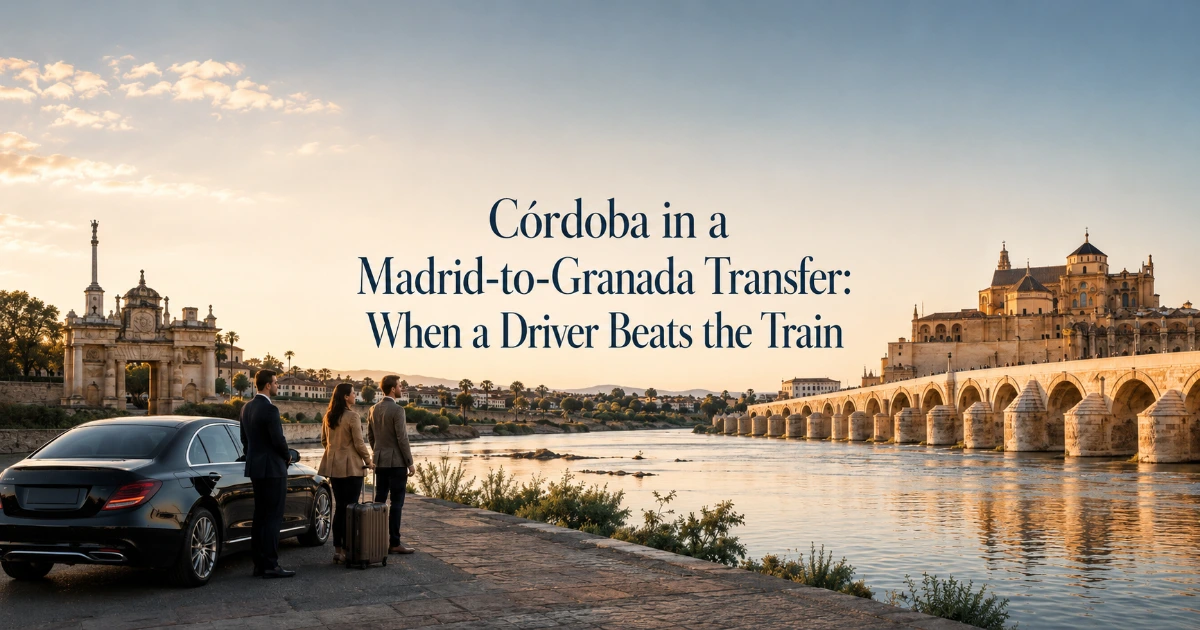
The best choice is a private driver with a focused Córdoba stop, but only for travelers who accept that the day has one centerpiece. The driver beats the train when the plan is Madrid hotel departure, bags handled without discussion, a guided Mezquita-Catedral visit, a short Judería or river-edge walk, lunch placed without a second cross-town transfer, and a calm onward drive to Granada. That is the elegant version of the day.
The second-best choice is not a longer stop; it is an overnight in Córdoba. If the travelers want the Mezquita-Catedral, patios, Viana, Medina Azahara, dinner, and a relaxed old-town evening, the transfer day should stop pretending to be a transfer. Córdoba’s center rewards slower hours after the day-trip wave loosens, and that is a different travel product from a Madrid-to-Granada move.
- 1. Best base case: Madrid to Córdoba by private driver, bags remain with the vehicle or are handled as part of the plan, guided Mezquita-Catedral first, lunch, brief Judería or Roman Bridge context, then Granada.
- 2. Best upgrade: turn Córdoba into one night when dinner, patios, Viana, or Medina Azahara matter as more than add-ons.
- 3. Best restraint: use rail and save Córdoba when the Granada arrival is the emotional priority, especially before a demanding Alhambra day.
The counterintuitive correction is that Medina Azahara, not the Roman Bridge, is usually the first famous thing to resist on this particular transfer. The archaeological site can be rewarding on a Córdoba stay, but it pulls the day away from the old-town core and adds a second logistical axis. On a Madrid-to-Granada transfer, that often converts a polished stop into a long historical errand.
The route geometry favors one clean pause
The route geometry favors one clean Córdoba pause, not a chain of small stops. The Madrid-to-Granada line of travel can absorb Córdoba when the city functions as a deliberate hinge: leave Madrid, enter Córdoba with a plan, step into the historic core, then continue toward Granada. It becomes clumsy when travelers try to treat Córdoba as a miniature version of a two-day stay.
The reason is local rather than theoretical. Córdoba’s railway station and modern traffic approaches sit outside the tightest old-town fabric, while the Mezquita-Catedral sits deep enough in the historic center that the last movement is a pedestrian decision. A driver can make that edge easier, especially around the Judería, Puerta de Almodóvar, Avenida del Alcázar, or the river side near Puerta del Puente, but the driver does not remove the need to walk the final meaningful piece.
That is why the best transfer stop has one inward movement and one outward movement. Once travelers begin adding a second monument axis, a shopping detour, or an archaeological excursion beyond the core, the day starts multiplying thresholds: vehicle to guide, guide to ticket, ticket to lunch, lunch to vehicle, vehicle to Granada. The premium move is to reduce those thresholds before they appear.
When driver support beats rail on the Madrid-to-Granada route
Driver support beats rail when the traveler problem is baggage, timing, and continuity rather than pure speed. Trains can be clean and civilized, and travelers should check the Renfe official site (https://www.renfe.com/es/en) for current schedules when comparing routes. But once the plan includes Córdoba sightseeing between Madrid and Granada, rail introduces extra handling: station arrival, luggage decisions, old-town transfer, guide meet-up, return to station or onward train timing, then a second arrival in Granada.
A private driver changes that sequence by turning Córdoba into a held pause rather than a separate travel problem. The vehicle is not valuable because it drives into every medieval lane; it is valuable because travelers do not have to keep reassembling themselves. Families do not need to count bags at each platform. Celebration travelers do not have to carry garment bags or shopping pieces through station choreography. Older parents do not have to debate whether the next taxi is worth it for a short hop.
The driver is strongest when paired with a private guide at the right point, not when used as a luxury shell around an oversized day. The most useful version is a planned handoff near the historic center, a guided visit through the Mezquita-Catedral, and a route that never asks travelers to cross Córdoba simply because a map made the stops look close. For similar day-trip design logic, the adjacent planning page for private day trips outside Córdoba is useful, but the Madrid-to-Granada version needs sharper limits because the day ends in another city.
Rail remains the stronger choice when travelers are light, energetic, and happy to keep Córdoba for another date. It is also stronger when Granada arrival must be predictable for a dinner, a family reunion, or an early Alhambra entry the next morning. The driver is not a badge of superiority; it is a tool that earns its cost only when it removes enough coordination to justify a longer road day.
Mezquita timing with luggage: the real hinge of the day
Mezquita timing with luggage should control the day, because the Mezquita-Catedral is the only Córdoba stop that can justify bending a Madrid-to-Granada transfer around the city. Travelers should use the official Mosque-Cathedral site (https://mezquita-catedraldecordoba.es/en/) for current visitor information before finalizing the plan, then let the rest of the transfer day serve that appointment rather than compete with it.
The practical issue is not simply “skip the line” or “go early.” The site sits beside the Patio de los Naranjos and close to the Judería, the Puerta del Puente, and the Roman Bridge, but that compactness can mislead planners. With luggage in the background and Granada still ahead, every extra loop matters. A stop that looks like ten more minutes on foot may become a slow shuffle through shade gaps, photo clusters, narrow lanes, and a second decision about where the vehicle will be waiting.
The strongest order is usually guide first, wandering second. Enter the Mezquita-Catedral while attention is fresh, then use the surrounding streets for context rather than as a prelude that steals energy from the monument. A private guide can make the layered mosque-cathedral story legible without turning the visit into an academic marathon; that matters on a transfer day because the travelers still need enough concentration for Granada arrival. For travelers who want the centerpiece handled with care, a private Mezquita-Catedral tour is the natural anchor, not a decorative add-on.
Do not overvalue a late scenic bridge moment if the group is already warm, hungry, or saturated. The Roman Bridge is useful when it gives travelers an easy spatial read of the river edge and the old city wall, but it should not force a loop that makes lunch late and Granada feel distant. In this plan, the bridge is a punctuation mark, not the thesis.
The Córdoba stop that should become an overnight
The Córdoba stop should become an overnight when the wish list contains more than one emotional centerpiece. If travelers want the Mezquita-Catedral plus patios, Viana, the Alcázar gardens, a dinner worth dressing for, and unhurried old-town wandering, the transfer framework is too narrow. At that point, paying for a driver does not solve the deeper issue: the city is asking for an evening.
An overnight changes Córdoba because the day no longer has to defend every minute against the road to Granada. The Mezquita-Catedral can sit in a better slot, lunch can be slower, and the Judería can be experienced as streets rather than connective tissue. The city’s compactness becomes an advantage instead of a trap. You can pause near Calleja de las Flores without calculating how that pause affects a mountain-city arrival later.
This is especially true for couples and celebration travelers. Córdoba after the day-trip peak can feel more personal, and dinner becomes part of the reason to stop rather than a meal squeezed between monument and motorway. It is also true for families with mixed stamina: one night lets grandparents, children, and faster walkers split expectations without making anyone the problem.
The editorial call is firm: if Medina Azahara is essential, or if a special dinner is part of the trip’s identity, sleep in Córdoba or save it for another journey. A transfer stop can honor the Mezquita-Catedral beautifully; it cannot make every Córdoba layer feel considered. For the broader sleep-versus-stop decision, the companion guide on whether Córdoba deserves an overnight is the more appropriate next read.
What to cut first when the transfer day gets long
Cut Medina Azahara first when the Madrid-to-Granada transfer day starts to stretch. That may sound severe, because the site is historically important, but importance is not the same as fit. The detour changes the geometry of the day: instead of Madrid, Córdoba old town, and Granada, you now have Madrid, an out-of-core archaeological visit, the Mezquita-Catedral, lunch, and Granada. The day becomes a chain of resets.
Cut the Alcázar second unless gardens are the group’s main comfort valve. The Alcázar can make sense after the Mezquita-Catedral when travelers are staying in Córdoba or spending a full day there, but on this transfer it often competes with the very energy needed for Granada. A brief river-edge read near the Puerta del Puente can provide enough orientation without turning the afternoon into another ticketed commitment.
Cut shopping, craft browsing, and “just one more lane” before cutting lunch. This is a comfort-first transfer, not an endurance test. A well-placed lunch gives the group a physical and mental reset before the onward drive. Removing lunch to preserve another stop is usually false economy: it makes the vehicle quieter in the wrong way and leaves travelers arriving in Granada depleted rather than satisfied.
The last thing to cut is guided context inside the Mezquita-Catedral. Without a guide, many first-time visitors see beauty but miss the layered logic that makes Córdoba worth the interruption between Madrid and Granada. If the day is too tight to guide the centerpiece properly, the stop should be saved for another trip or turned into an overnight.
The lunch slot should calm the transfer, not become a second agenda
Lunch should be planned as the transfer’s reset, not as another competitive sightseeing block. In Córdoba this usually means staying close enough to the old-town route that the meal supports the Mezquita-Catedral visit rather than forcing a new city crossing. A well-chosen lunch gives the group shade, seating, bathrooms, and time to absorb the morning before the road to Granada resumes.
The mistake is treating lunch as a destination equal to the monument on a day that already has two city moves. Food-and-wine travelers may be tempted to use Córdoba for a serious culinary detour, and that can be a beautiful reason to stay overnight. On a transfer, though, the meal should steady the day. If the restaurant plan requires a long detour, a late departure, or a second round of vehicle choreography, it belongs to a Córdoba stay rather than a Madrid-to-Granada transfer.
This is also where group mood is often saved. Travelers may remember the Mezquita-Catedral as the reason they stopped, but they will judge the day by whether they were asked to keep pushing when they needed to sit. A private plan that leaves lunch unglamorous but perfectly placed can feel more refined than a famous table that bends the whole afternoon out of shape.
What Córdoba does to the body between station, stone, and river
Córdoba asks more of the body than the map admits. The historic core is compact, but compact does not mean effortless when the day includes luggage anxiety, a road departure from Madrid, old paving underfoot, possible heat, slow corners in the Judería, and the mental load of knowing Granada is still ahead. The body feels every small transition more sharply on a transfer day.
The most important physical consequence is accumulation. A short vehicle drop near the old-town edge, a walk to the Mezquita-Catedral, time standing inside, a Judería loop, a lunch transfer, perhaps the Puerta del Puente or Roman Bridge, and then the onward drive can be perfectly manageable. Add Medina Azahara, the Alcázar, shopping, or a second museum, and the day stops feeling curated. It starts feeling like a city visit taped to a transfer.
Heat makes this more pronounced, but it is not only a summer issue. Even in milder months, the combination of stone surfaces, bright courtyards, and slow-moving clusters near the monument can tire travelers faster than they expect. Older parents may not complain until the onward drive. Children may be cheerful through the Mezquita-Catedral and then collapse at lunch. Couples may discover that the afternoon has become logistics rather than romance.
This is where driver support has real value. It cannot erase walking inside the historic center, but it can remove the unnecessary walking around it. It can spare the group from station-to-taxi improvisation, give the luggage a silent home, and let the guide choose a route that respects shade, attention span, and the need to leave Córdoba before the day turns heavy.
What Córdoba does to the mood before Granada
Córdoba can make the Madrid-to-Granada day feel richer, but it can also flatten the arrival if the stop is treated as a conquest. The best version gives travelers the feeling that Andalusia has opened gradually: Madrid behind them, Córdoba as the layered pause, Granada waiting with its hills and Alhambra logic. The worst version makes Granada feel like the place everyone reaches after they have already spent the day’s patience.
The mood consequence matters because Granada is not a neutral arrival city. Many hotels and first evening plans involve tight streets, slopes, or decisions about whether to walk, taxi, or simply rest. Arriving with unused attention changes the first night. Arriving after too many Córdoba add-ons makes the group more likely to skip the very first Granada moment that would have made the city feel welcoming.
A driver can help preserve the mood when the plan is honest. The luggage is not part of the conversation. The guide is not trying to race. The lunch is not a negotiation. The onward departure is not a vague hope. Those small absences make the day feel shorter because travelers are not repeatedly asked to manage the trip themselves.
But mood is also where the hard exception lives. If the travelers care deeply about a polished Granada check-in, an unhurried dinner, or being rested before the Alhambra, Córdoba should not be forced into the same day. Saving Córdoba can be the more luxurious decision because it protects the city that is actually next.
The Granada arrival buffer is the hidden vote
The Córdoba decision should be made backward from Granada, not forward from Madrid. If the arrival in Granada is meant to be quiet, polished, and unhurried, the Córdoba stop needs a firm leaving time and a modest scope. If the first Granada evening is expendable, Córdoba can carry more weight. Many itinerary mistakes happen because travelers ask, “Can we stop in Córdoba?” before asking what kind of arrival Granada deserves.
This matters because Granada often asks for decisions immediately. A hotel near the Cathedral quarter, Realejo, or the lower Alhambra approach can be easy enough with the right arrival, but the city is less forgiving when travelers arrive tired and hungry. A beautiful Córdoba afternoon can become a poor choice if it leaves the group impatient with Granada’s first taxi, first slope, or first dinner decision.
The buffer should also reflect the next morning. If the Alhambra is early, travelers need more than sleep; they need a first evening that does not feel administratively heavy. That may mean using Córdoba as a shorter Mezquita-Catedral stop, or it may mean skipping Córdoba entirely. The point is not to make the transfer heroic. The point is to arrive in Granada with enough attention left for the city that follows.
How to sequence the day without pretending it is a city stay
The sequence should make Córdoba a contained chapter between two hotel cities. Begin with a Madrid departure that does not require a sightseeing prelude. This is not the morning to add a final museum, a shopping errand, or a farewell lunch in Madrid. The earlier part of the day should be calm enough that Córdoba receives attention rather than leftover energy.
In Córdoba, place the Mezquita-Catedral before discretionary wandering. A short orientation through the Judería can work if it supports the monument, but the guide should not spend the group’s best attention outside the building and then ask them to absorb the interior when hunger is approaching. After the visit, a modest old-town walk can connect the Patio de los Naranjos, the Judería edge, and the river context without pretending the group is there for a full city survey.
- Phase one: Madrid departure, luggage settled, no extra capital-city errands.
- Phase two: Córdoba old-town edge, guided Mezquita-Catedral, compact context, lunch.
- Phase three: leave before the stop becomes sluggish, arrive in Granada with enough patience for hotel logistics.
The strongest transfer itinerary feels almost underbuilt on paper. That restraint is intentional. A plan that leaves room for a bathroom pause, a slower walker, a child’s snack, or an extra ten minutes of explanation inside the Mezquita-Catedral is more premium than a plan that lists every nearby site and quietly assumes nobody will tire.
The rail-only plan is sometimes the more polished choice
The train-only plan is the right choice when certainty matters more than the Córdoba pause. This is not a downgrade. For some travelers, the most elegant version of the day is simply to leave Madrid, travel cleanly, arrive in Granada, and keep the first evening intact. That is especially true when the trip has already included several guided days and the group is beginning to value empty space.
Rail is also sensible when travelers are moving with small bags, when everyone is comfortable managing platforms, and when the Córdoba interest is shallow. If the plan is “we should probably see it because it is famous,” that is not enough reason to complicate a transfer. Córdoba is too strong a city to be reduced to guilt-driven sightseeing. It should be chosen deliberately or saved deliberately.
The driver wins only when the stop has a clear purpose and the logistics would otherwise become the day’s dominant story. If there is no private guide, no real lunch plan, no thought about old-town access, and no protected Granada arrival, the car becomes a more expensive container for the same uncertainty. Paying more for a vague day is not premium planning.
Travelers who choose rail can still make a stronger overall itinerary by giving Córdoba a proper night elsewhere in the trip. That is often the cleaner editorial solution: do Madrid to Granada directly, enjoy Granada fully, and let Córdoba appear later as a focused stay rather than a squeezed interruption.
Five decisions to make before booking the driver
The driver should be booked after the day’s limits are clear, not before. A chauffeured transfer can create confidence too early: once a car is secured, travelers may assume the rest of the day can expand. In practice, the best Córdoba transfer is planned by answering five questions before anyone starts adding stops.
- What is the one reason to stop? For this route, the answer should usually be the Mezquita-Catedral, not a general wish to “see Córdoba.”
- How important is Granada tonight? If the first evening in Granada matters, the Córdoba scope should be lighter and the onward departure firmer.
- Who is the slowest traveler in the group? The itinerary should be designed for that person’s comfort, because transfer days expose stamina gaps quickly.
- Where will lunch restore the day? A meal that requires a detour may be impressive, but a meal that steadies the group is usually more valuable.
- What is the first cut? Name the cut before the day begins, so the guide and driver are not forced into diplomacy when the afternoon is already tight.
These decisions keep the day from becoming a negotiation in motion. They also make the private guide’s role more effective. Instead of rescuing an overbuilt plan, the guide can deepen the one part of Córdoba that deserves depth and then release the group toward Granada before the stop loses its elegance.
The most confident travelers are often the ones who accept an intentionally incomplete Córdoba day. They understand that leaving out a site is not the same as missing the city. On this route, leaving something out is what allows the Mezquita-Catedral to register properly and Granada to begin well.
Spend for the handoff, not for more monuments
Premium spend earns its cost when it buys coordination: the right vehicle, a driver who understands the day’s timing, luggage custody, a guide who meets the route at the correct point, and a plan that knows when to stop adding. It also helps when travelers have mixed mobility, valuable luggage, a celebration wardrobe, children, older parents, or a Granada arrival that should not begin with platform arithmetic.
Premium spend does not earn its cost when it is used to make an overlong plan sound refined. A private driver cannot make a too-long transfer day feel restful if Granada arrival matters. That sentence should sit at the center of the decision. More comfort in the vehicle does not change the fact that attention, heat, walking, lunch, and arrival patience are finite.
The best use of Orange Donut Tours in this scenario is not simply “book a car.” It is to coordinate the car, the luggage assumptions, the guide timing, the Mezquita-Catedral focus, and the onward departure into one realistic cross-city day. When that handoff is the difference between a polished pause and a self-managed scramble, Inquire now.
For travelers comparing this with other Córdoba-in-transit problems, the luggage-specific guide on station, Mezquita, and hotel timing with luggage gives a narrower rail-stop perspective. The Madrid-to-Granada version is more demanding because there is no Córdoba hotel waiting at the end of the day.
Who should save Córdoba for another trip
Save Córdoba for another trip if the day before or after is already heavy. A late Madrid evening, an early Granada Alhambra plan, a multigenerational group with uneven stamina, or a celebration dinner in Granada can all flip the answer. The right question is not whether Córdoba is “worth it.” It is whether this particular transfer day gives Córdoba enough space without stealing the first night in Granada.
Travelers should also save it when they want Córdoba for food, patios, craft, or Islamic art depth rather than one focused monument. Those are excellent reasons to visit, but they are weak reasons to overload a transfer. A traveler who wants to understand the old town beyond the Mezquita-Catedral will have a better trip with one night than with a chauffeured marathon.
The clearest wrong-fit traveler is the person who dislikes any feeling of being scheduled on a travel day. A private driver reduces friction, but it does not remove the structure required to make the stop work. If a group wants to wake slowly in Madrid and decide at lunch whether Córdoba still sounds appealing, rail or an overnight plan is safer than a predesigned road day.
There is no failure in leaving Córdoba out. In a tailor-made Andalusia itinerary, restraint can be the mark of a stronger plan. Córdoba belongs when it gives the day shape; it should be saved when it becomes a trophy stop between two more important hotel moments.
Traveler-fit filters for couples, families, and food-and-wine trips
Couples should choose the driver stop when Córdoba adds intimacy rather than obligation. A guided Mezquita-Catedral visit, a slow lunch, and one short old-town walk can make the transfer feel like a meaningful shared chapter. But if the couple is traveling for a celebration and Granada has the important dinner, Córdoba should not steal the evening’s composure.
Families should choose the driver stop when the vehicle removes arguments. The value is not only comfort; it is the absence of repeated bag counts, station decisions, and snack-timing negotiations. Children often do well with one unforgettable interior and a concise outdoor context. They do less well with a transfer day that becomes a disguised full-day march.
Older parents and mixed-generation groups need the strongest cut discipline. The Mezquita-Catedral can be a superb shared experience because it concentrates meaning in one place, but Córdoba’s compact center still requires standing, walking, waiting, and heat judgment. For these groups, the best private plan is not the one with the longest list. It is the one that keeps everyone dignified through arrival in Granada.
Food-and-wine travelers should be particularly alert to the overnight threshold. If the Córdoba fantasy includes a serious dinner, Montilla-Moriles context, or a lunch that should not be rushed, the city may deserve its own night. A transfer lunch can be excellent, but it should serve the route. Once the meal becomes the reason for the stop, the stop is no longer a simple transfer strategy.
How Orange Donut Tours holds the transfer together
A good Madrid-to-Granada transfer through Córdoba needs one planner thinking across city boundaries. The driver’s timing, the guide’s meeting point, the Mezquita-Catedral slot, lunch placement, luggage assumptions, and Granada arrival all affect one another. If each piece is booked separately, the traveler becomes the dispatcher, and that is exactly what a private transfer should prevent.
Orange Donut Tours is most useful when the brief is honest: one centerpiece, limited old-town context, no Medina Azahara unless the day is being redesigned, and a Granada arrival that still feels like a beginning. That is different from building a full Córdoba day and attaching it to a transfer. The narrower plan is often the more polished one.
Groups with older parents, children, or a celebration schedule should be especially clear about the desired ending. If the goal is to arrive in Granada dressed and ready for dinner, Córdoba must be lighter. If the goal is to make Córdoba the emotional high point of the day, Granada’s first evening should be left loose. Private planning is not about removing choices; it is about making the right tradeoff before the road exposes the wrong one.
For travelers whose route is still fluid, arrival and transfer-style planning in Córdoba can help frame the handoff discipline, while route-specific touring can be shaped around the exact Madrid departure and Granada arrival. The key is to make the transfer feel designed, not merely chauffeured.
FAQ
Is Córdoba worth stopping in between Madrid and Granada?
Yes, Córdoba is worth stopping in between Madrid and Granada when the day is built around the Mezquita-Catedral, a concise old-town context, and a controlled luggage handoff. It is not worth forcing if Granada arrival quality or next-day Alhambra energy matters more.
When does a private driver beat the train for a Córdoba stop?
A private driver beats the train when travelers need luggage custody, hotel-to-hotel continuity, a guide timed to the Mezquita-Catedral, and fewer station resets. Rail is better when travelers are light, schedule-sensitive, and happy to save Córdoba for a fuller visit.
Should Córdoba be a day stop or an overnight on a Madrid-to-Granada route?
Córdoba should be a day stop if the plan is the Mezquita-Catedral, lunch, and a short Judería or river-edge walk. It should become an overnight if the wish list includes Medina Azahara, patios, Viana, a special dinner, or slow evening wandering.
What should be cut first if the transfer day is too long?
Cut Medina Azahara first, then the Alcázar or extra shopping loops, before cutting lunch or guided time inside the Mezquita-Catedral. The centerpiece should stay strong; the optional layers should shrink.
Can a driver make a long Madrid-to-Córdoba-to-Granada day feel easy?
A driver can make the day smoother, but not effortless if the itinerary is too full. The vehicle solves luggage, continuity, and timing friction; it does not remove walking load, heat, monument fatigue, or the need to arrive well in Granada.
Is the Mezquita-Catedral enough for a Córdoba transfer stop?
Yes, the Mezquita-Catedral is enough for a Córdoba transfer stop when guided well and paired with a short old-town context. Trying to add every nearby monument can make the stop less memorable, not more.
Who should avoid stopping in Córdoba on the way to Granada?
Travelers should avoid the stop if they have a late Madrid start, a firm Granada evening plan, an early Alhambra visit the next morning, or a group that dislikes structured travel days. In those cases, Córdoba deserves a separate overnight or another trip.
The final editorial verdict
A private driver beats the train for Córdoba between Madrid and Granada when the day is treated as a designed transfer with one great stop, not as a compressed Córdoba itinerary. The route can work beautifully for couples, families, small groups, and celebration travelers who value luggage control, guided context, and a smoother handoff between hotel cities. It works less well for travelers who measure success by the number of places touched.
The best version is disciplined: Madrid departure, Córdoba old-town edge, Mezquita-Catedral, lunch, a small amount of context, then Granada. The worst version is expensive but unfocused: too many monuments, no real rest, and an arrival that makes Granada feel like the final task of the day. Choose the driver when it protects the experience. Choose the train, an overnight, or another trip when restraint would make both Córdoba and Granada better.
If you’re interested in any private tours of Cordoba, please reach out to us.




 So if you are looking for the absolute best in Cordoba & surroundings with authentic local fully-licensed native guides whose English you can actually understand and with an exclusive and amazingly fun itinerary













