Córdoba from Madrid for the Mezquita: When a Same-Day Rail Plan Works and When It Does Not
Updated
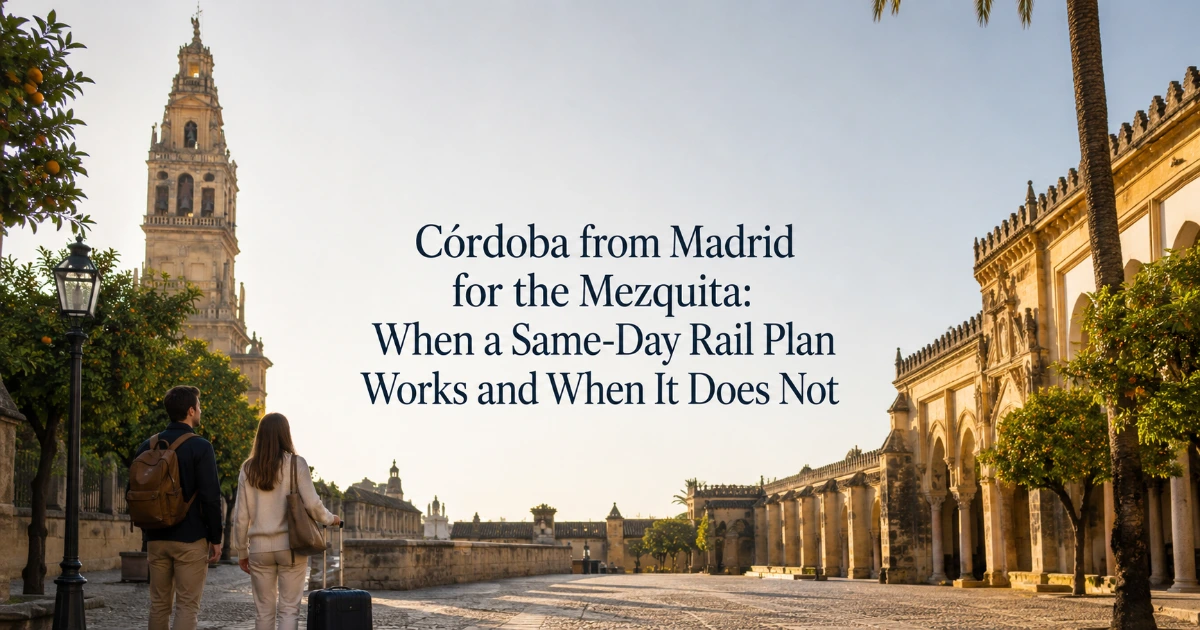
A same-day Córdoba trip from Madrid works when the Mezquita-Catedral is the clear reason for going, you can protect a generous city window after the train, and you resist turning the day into a miniature Andalusia survey. It works because Córdoba’s old center is compact: once you are past the station transfer and inside the Judería edge near the Mezquita, the day can become a focused cultural arc rather than a transport endurance test. The exception is simple: if your available hours in Córdoba are so thin that the rail-window-to-Mezquita threshold collapses into a rushed entrance, a hurried lunch, and a late train back to Madrid, add Córdoba as an overnight instead.
The article-specific thesis is this: Madrid gives Córdoba enough rail access to make the Mezquita feasible in one day, but Córdoba itself rewards restraint, not ambition. The travelers who leave happiest are the ones who treat the Mezquita-Catedral as the main event, let the Judería and a measured lunch support it, and cut anything that drags the day beyond the city’s natural walking radius. For a deeper monument-first option, see Orange Donut Tours’ Mezquita-Catedral private tour.
The Madrid-to-Córdoba same-day ladder
The best way to decide is not to ask whether Córdoba is “possible” from Madrid, because technically it often is. The better question is how much Córdoba you can experience before the return journey starts shaping your mood. Use this ranked ladder as the decision framework.
1. Strong same-day plan: You have enough time in Córdoba for the Mezquita-Catedral, the Judería immediately around it, a calm lunch or restorative pause, and a return to the station without watching the clock every few minutes. This is the cleanest version for couples, small groups, and culture-first travelers who want one profound day without moving hotels.
2. Acceptable but narrow plan: You have enough time for the Mezquita-Catedral and a short Judería walk, but lunch becomes functional and you should not add the Alcázar, Palacio de Viana, Medina Azahara, craft shopping, or a long riverside loop. This can work, but only if expectations are tightly set.
3. Poor value plan: You are trying to combine long rail travel, a late arrival, a return train that cuts off the afternoon, and a broad checklist. This is where the day feels expensive in energy, not just money. Private guiding can concentrate meaning in a compact window, but private guiding cannot compensate for too little time on the ground.
4. Overnight plan: You care about patios, evening light, a serious food-and-wine pause, Palacio de Viana, Medina Azahara, or a slower family rhythm. In that case, Córdoba should become a one-night stop, not a heroic day trip.
The mildly counterintuitive correction is that the famous Roman Bridge is not the automatic second priority on a Madrid day trip. It is close enough to tempt you, and the view back toward the old city is memorable, but the bridge can pull you across the Guadalquivir just when the day needs shade, context, and a controlled return path. If time is tight, the first cut is not the Mezquita; it is the add-on that forces a river crossing, a photo loop, and a mental reset before lunch.
For official monument planning, the official Mosque-Cathedral site (https://mezquita-catedraldecordoba.es/en/) is the primary reference to check before you go. For rail operations, confirm your chosen services directly with the train operator or booking channel rather than building the day around generic sample timings. This article uses planning thresholds, not promised departures.
How much time do you need in Córdoba from Madrid?
You need enough time in Córdoba for the station transfer, the Mezquita-Catedral visit, a short old-town sequence, a pause, and a return buffer; anything less turns the day into transport with a monument in the middle. For discerning travelers, the practical minimum is not the number of hours between trains. It is the number of usable, unpanicked hours between stepping out near the old town and needing to start back toward Córdoba station.
The rail-window-to-Mezquita threshold is the hinge. Córdoba’s station is not at the Mezquita’s door. The old town is close by city standards, but the day still requires a taxi or a purposeful transfer into the historic core, then a walk through streets that become narrower and more pedestrian as you approach the Mezquita-Catedral and the Judería. That short displacement matters because it happens twice: once when you arrive with anticipation, and once when you leave with tired feet, heat, shopping bags, or a lunch that ran longer than planned.
A well-shaped day should allow the Mezquita-Catedral to breathe. The building is not best understood as a quick interior stop. Its power comes from transitions: the Court of the Orange Trees, the forest of columns, the shift from Islamic space into the later Christian insertion, the way the Cathedral core changes the sightline, and the tension between continuity and interruption. A private guide can make those layers legible quickly, especially for travelers who do not want to read every panel or chase every date. But the visit still needs mental room.
The narrowest version of a good Madrid day is Mezquita-Catedral first, Judería second, lunch third, and station return last. The stronger version adds one carefully chosen extra: either a more textured Jewish Quarter walk, a short approach to the Roman Bridge without crossing far beyond your energy, or a focused food-and-wine pause that gives the day an Andalusian register without turning it into a tapas crawl.
The weak version is the one that tries to make Córdoba behave like a checklist city. Mezquita-Catedral, Alcázar, synagogue, Roman Bridge, patios, shopping, and a long lunch can all belong in Córdoba, but not all in a same-day plan from Madrid. The city’s compactness is a gift only if you respect it. If you treat every nearby sight as “just a few minutes more,” the day becomes a chain of small frictions.
What makes the Córdoba day trip from Madrid work in real city conditions?
The day works because Córdoba’s cultural center compresses high-value meaning into a walkable zone near the Mezquita-Catedral. Once you are inside the old center, the route can be almost elegantly simple: arrive, transfer, enter the monument, step into the Judería, eat close by, and return without crossing the city repeatedly.
The station-to-old-town transfer is the first real test. Córdoba railway station sits in the newer city, while the Mezquita-Catedral sits in the historic core near the Guadalquivir. This is not a dramatic distance, but it is a meaningful planning seam. A casual traveler might dismiss it; a comfort-first planner accounts for it. You do not want the first fifteen to twenty minutes after arrival spent debating whether to walk, where the taxi stand is, or whether the old-town street you chose allows easy drop-off. The day feels markedly calmer when that first move is predetermined.
The second advantage is Córdoba’s scale. The Mezquita-Catedral, the Judería, Calleja de las Flores, the area around the old synagogue, and the river edge sit close enough to form a coherent cultural hourglass. You can move from the monument to narrow lanes, from historic context to lunch, without the cross-city hops that make some day trips feel like logistics dressed as sightseeing. That is why a private Córdoba guide has unusually high value in a compact window: the guide is not merely adding commentary, but sequencing the day so that each step explains the next.
The third advantage is thematic clarity. Córdoba from Madrid should not try to compete with Madrid’s museums or Seville’s evening life. Its reason for existing is the Mezquita-Catedral and the layered city immediately around it. When you accept that hierarchy, the day becomes stronger. If the Mezquita is the anchor, the Judería is not a separate attraction; it is the human-scale setting that helps you understand how the old city folds around the monument. For a broader view of how first-time visitors should approach the site, see this guide to Córdoba Mosque-Cathedral tours for first-time visitors.
The fourth advantage is that the return to Madrid can still leave the evening intact if the plan is disciplined. That does not mean the day is effortless. It means the fatigue is purposeful. You return having seen the thing you came for, not having spent the afternoon bargaining with add-ons. This distinction matters for celebration travelers, families, and food-and-wine travelers who care not only about what they saw, but how the day felt by dinner.
The plan that usually wins: Mezquita first, Judería next, then one controlled pause
The strongest same-day structure is to place the Mezquita-Catedral first, follow it with the Judería, and then choose one controlled pause rather than one more monument. This order protects attention at the moment when the building deserves it and uses the old town to deepen, not dilute, the visit.
Starting with the Mezquita-Catedral gives the day a spine. The building asks for orientation: where the mosque begins, why the column rhythm matters, how the mihrab and the Christian nave alter the visitor’s sense of direction, and why Córdoba’s history cannot be reduced to a single period. If you enter after a long lunch, a hot walk, or a string of small stops, the building still impresses, but your concentration is already divided. For a Madrid day trip, that is a poor trade.
The Judería should come next because it keeps the route compact and the story continuous. The mistake is to think of the Jewish Quarter as a pretty wander that can be inserted anywhere. On a short day, it works best as a transition from monument scale to street scale. Its lanes help travelers absorb what they just saw: how religious, civic, and domestic Córdoba sit close together; how narrow streets compress movement; and how the old city’s charm can also slow the group down if everyone stops for photographs, water, or shade at different times.
After that, choose the pause that matches your travelers. Couples may want a longer lunch near the old center rather than a second ticketed site. Families may need shade, bathrooms, and a reset more than another interpretive stop. Small groups may benefit from a reserved table or a guide-managed handoff so the day does not dissolve into group negotiation. Food-and-wine travelers can use the pause to place Córdoba within Andalusia’s culinary rhythm, but should resist turning lunch into an extended tasting if the return train is already dictating the afternoon.
The one controlled pause is not a downgrade. It is what makes the day feel composed. Córdoba’s compact old town can trick ambitious travelers into over-layering the plan, because several meaningful places look close on a map. But distance is not the only cost. Heat, stone paving, narrow sidewalks, small decisions, and the need to reassemble a group all add drag. A thoughtful pause converts the day from extraction to experience.
What to prioritize after the Mezquita-Catedral
After the Mezquita-Catedral, prioritize the Judería and one mood-setting pause; add the Roman Bridge or Alcázar only when the rail window and the group’s energy clearly support it. Córdoba rewards sequence more than quantity on a Madrid day trip.
First priority: the Judería close to the Mezquita
The Judería is the most natural second move because it adds context without requiring a new logistical chapter. The lanes around the Mezquita, the old synagogue area, Calleja de las Flores, and the small-scale shifts between whitewashed walls, courtyards, and shaded corners make the city legible after the monument. This is especially useful for travelers who want Córdoba to feel like a place, not just a building reached by train.
A guide matters here because the Judería can blur quickly. Without context, it becomes a series of photogenic lanes and shopfronts. With context, it explains proximity: how communities, memory, architecture, and later tourism occupy the same small radius. On a short day, that interpretive compression is valuable. It prevents the “old town blur” that happens when travelers have seen a beautiful lane but cannot later explain why it mattered.
Second priority: lunch or a restorative pause near the old center
Lunch belongs near the old center unless the day is deliberately designed around a particular restaurant elsewhere. A long transfer for a marginally better table rarely earns its cost on a Madrid day trip. The restaurant choice should support the day’s rhythm: close enough to avoid backtracking, comfortable enough for a true pause, and timed so the return to the station is not tense.
This is where premium planning helps. A reserved lunch, an understood walking route, and a guide who knows when to stop explaining can change the day’s texture. Premium spend does not help when it is used to add more stops than the rail window can hold. It does help when it removes decision drag, protects shade and pacing, and keeps the group from scattering at exactly the moment the day needs composure.
Conditional priority: the Roman Bridge and river edge
The Roman Bridge works when you have enough time for it to be a calm visual coda, not a forced proof that you “saw Córdoba.” The approach to the river can be rewarding, especially for the view back toward the Mezquita-Catedral and the old city. But crossing the bridge and continuing toward the Calahorra side adds exposure, time, and a return step. On a hot or narrow day, it can flatten the mood just before departure.
For many Madrid day-trippers, the better move is a short river-edge look rather than a full bridge episode. That gives the group spatial orientation without turning the afternoon into a photo march. If the group includes older parents, younger children, or travelers with limited walking tolerance, the bridge is often the first scenic item to cut.
Conditional priority: the Alcázar
The Alcázar belongs only when the day has a generous Córdoba window and the group is genuinely interested in gardens, Christian-monarch context, and a second ticketed site. It is not the automatic “next major monument” on a Madrid-based Mezquita day. The Alcázar can be a strong addition on an overnight or full Córdoba stay, but it competes with lunch, shade, and the return buffer in a same-day plan.
Choose it when the group prefers structured sightseeing over lingering. Skip it when the Mezquita-Catedral already satisfies the day’s cultural appetite. The practical judgment is firm: do not add the Alcázar just because it is nearby. Nearby is not the same as effortless.
Usually cut: Medina Azahara
Medina Azahara is usually the wrong add-on for a same-day Córdoba trip from Madrid. Its historical payoff can be high, especially for Islamic-art travelers, but it sits outside the compact old-town logic that makes the Madrid day workable. Adding it changes the day from a rail-to-old-town cultural visit into a multi-transfer excursion with less margin.
If Medina Azahara matters to you, stay overnight or place Córdoba differently in the wider Andalusia itinerary. For a focused private site visit, see Orange Donut Tours’ Medina Azahara private tour; for a same-day Madrid plan, save it unless your entire day is built around it.
When the same-day plan does not work
A same-day rail plan does not work when the Mezquita-Catedral becomes one stop among many, when your Córdoba hours are too compressed, or when the return to Madrid leaves no emotional margin. The warning sign is not just tiredness. It is when every decision starts being made against the train clock.
The first bad-fit case is the late-arrival, early-return day. If you arrive in Córdoba close to lunch and need to leave before the afternoon has settled, you will spend too much of the day transferring, orienting, queuing, eating quickly, and checking the time. The Mezquita-Catedral will still be powerful, but the trip may feel oddly thin for the effort. For travelers used to premium pacing, this is the category to avoid.
The second bad-fit case is the “while we are there” itinerary. While we are there, can we do the Alcázar? While we are there, can we cross the Roman Bridge? While we are there, can we shop for leather, see patios, add a wine stop, and return for dinner in Madrid? This is how Córdoba becomes smaller on paper and harder in the body. The old center is compact, but it is not frictionless.
The third bad-fit case is a group with uneven walking pace. Córdoba’s historic core is not mountainous, but its narrow lanes, stone surfaces, shade gaps, and stop-start rhythm can magnify small differences in mobility. One traveler wants to photograph every corner; another wants to sit; a child wants water; an older parent prefers a taxi; a guide is trying to hold the narrative together. A private guide can manage this better than a public tour, but the schedule still needs breathing room.
The fourth bad-fit case is travelers who want Córdoba after dark. The city’s evening is a separate pleasure: patios cooling, the river edge softening, dinner stretching later, and the Judería feeling less like a day-visitor corridor. If that is the Córdoba you want, do not pretend a same-day rail plan will deliver it. Choose the overnight and build the day around arrival, Mezquita depth, evening, and an easier departure. For the broader overnight decision, see this guide to choosing between a Córdoba day trip and one night.
What Córdoba does to the body during a Madrid day trip
Córdoba feels compact, but the body still registers the day as a rail transfer plus a stone-built old-town walk. The fatigue comes less from distance than from accumulated exposure: station movement, old-town paving, narrow lanes, standing inside the Mezquita-Catedral, heat reflecting off walls, and the return transfer when attention has already dipped.
Midday heat matters even when you are not visiting in the most extreme part of the year. Córdoba’s old center has shade, but not always where a group needs it at the exact moment. The Judería’s narrowness can protect you in places and slow you in others. The open approach toward the river or bridge can feel more exposed than expected. A plan that looks elegant in the morning can become brittle after lunch if it requires another open-air loop before the station.
The Mezquita-Catedral itself also asks the body to stand, look up, turn, reorient, and absorb. This is not a seated museum experience. Travelers who care deeply about architecture may underestimate how tiring visual intensity can be. Families may find that children stay engaged inside the monument but fade during the “small extra” afterward. Older travelers may do beautifully with a private guide and a controlled route, but not with a second half of the day built around momentum alone.
The cut-first rule is therefore physical, not merely aesthetic: cut the open-ended wander before you cut the guided Mezquita depth. If the group is tiring, shorten the Judería loop, keep the lunch close, and skip the bridge crossing. Do not preserve every minor stop while reducing the one experience that justified the rail day in the first place.
What Córdoba does to the trip mood
Córdoba can make a Madrid-based itinerary feel richer, but only if the day returns with a sense of completion rather than depletion. The emotional success of the trip depends on whether Córdoba feels like a focused cultural privilege or a compressed errand.
The composed version has a distinct mood: early movement, arrival in a smaller Andalusian city, a guided encounter with the Mezquita-Catedral, a human-scale walk through the Judería, a meal or pause that lets the day settle, and a return to Madrid with the sense that the excursion had a beginning, middle, and end. That mood is especially good for couples and small groups because the day becomes shared interpretation, not shared logistics.
The flattened version feels different. The group arrives already thinking about the return. The Mezquita is shortened because lunch is late. The Judería becomes a corridor to somewhere else. The bridge is added for a photograph, but nobody has the energy to enjoy the view. By the time the group returns to Madrid, the memory is not the red-and-white arches or the city’s layered history; it is the sensation of moving through a plan that was always slightly too full.
This is why a same-day rail plan should not be judged only by feasibility. The question is whether the day preserves enough calm for Córdoba to change the trip’s texture. A good Córdoba day from Madrid gives an Andalusian counterpoint to the capital. A poor one makes Madrid feel far away twice.
Where private guiding changes the day, and where it cannot
Private guiding changes a Córdoba day by concentrating meaning, reducing route drift, and matching the pace to the group; it cannot create time that the train plan has already removed. That distinction is central to spending well.
The Mezquita-Catedral is one of the clearest cases in Spain where a private guide can transform a short visit. The building’s visual drama is immediate, but the deeper value is interpretive: understanding what you are seeing without turning the visit into a lecture. A strong guide can decide when to pause, when to move, when to explain the mihrab, when to let the column forest work silently, and how to connect the monument to the Judería outside. For visitors arriving from Madrid, that editorial control is worth more than another hour of unguided wandering.
Private guiding also helps with group psychology. Couples often want depth without stiffness. Families need a route that keeps children engaged without lowering the intellectual level for adults. Celebration travelers need the day to feel special without being overloaded. Small groups need someone to prevent every intersection from becoming a committee decision. A guide can do that because Córdoba’s compact core allows interpretation and movement to happen together.
Where premium spend does not help is a too-short Córdoba window. Paying more for a guide, car support, or elaborate lunch does not earn its cost if the plan leaves no proper time for the Mezquita-Catedral and a grounded old-town sequence. Spend should remove friction, not disguise an unrealistic schedule. If the day is too tight, the premium answer is not a faster tour; it is a different structure, usually an overnight or a stop placed between cities.
For tailor-made pacing, including family needs, food pauses, and a compact monument-first design, see Orange Donut Tours’ tailor-made Córdoba private tours. When the rail window is strong, this is where a private guide can make the day feel richer than its hours. When the rail window is weak, the more honest advice is to change the plan.
When to sleep in Córdoba or stop elsewhere instead
Sleep in Córdoba when you want more than the Mezquita-Catedral and a short old-town arc; stop elsewhere when Córdoba is being forced into a Madrid itinerary for the wrong reason. The overnight is not a luxury flourish. It is the correct structure when the city’s second layer matters.
Choose an overnight if you want Palacio de Viana, patios, craft stops, a slower Judería walk, Arab baths, a serious dinner, or Medina Azahara. Each of those can be excellent, but each competes with the tight logic of a same-day Madrid rail plan. The overnight lets Córdoba’s rhythm change. You can arrive, visit the Mezquita-Catedral without rushing, let the late afternoon soften, eat without reverse-engineering the meal around a train, and use the next morning for Viana, the riverside, or a lighter departure. That is a different trip, not simply a longer day.
Choose an overnight if your group includes travelers who need a midday reset. This includes older parents, young children, jet-lagged travelers, and anyone who dislikes being hurried after a major monument. Córdoba’s hotels and old-town bases can turn the city from a rail project into a stay. The difference is not only comfort; it is interpretive. You stop measuring the city by what can be extracted before departure.
Consider stopping elsewhere if the real goal is not Córdoba but “one cultural day outside Madrid.” Toledo, Segovia, or El Escorial may fit some Madrid-based itineraries more naturally depending on interests and available time. Córdoba is the stronger choice when the Mezquita-Catedral specifically matters. If you are indifferent to the Mezquita and simply want a convenient excursion, Córdoba’s travel investment may be harder to justify.
Consider placing Córdoba between cities if you are already moving through Andalusia. A Madrid-to-Seville or Seville-to-Granada journey can sometimes make Córdoba a more natural stop than a round trip from Madrid, especially when luggage, hotel timing, and onward travel are planned correctly. But that is a different planning problem from this article’s Madrid same-day question. For this guide, the point remains: do Córdoba from Madrid when the Mezquita is the reason and the city window is genuinely usable.
How to keep the same-day plan focused without making it feel thin
A focused Córdoba day does not feel thin when the hierarchy is clear: Mezquita-Catedral for depth, Judería for context, lunch or a pause for rhythm, and one optional visual coda only if the day has room. The fear of “coming all that way for one building” is understandable but misplaced. In Córdoba, one building can legitimately carry the day.
The Mezquita-Catedral is not a standalone object in the way a museum room might be. It is the old city’s organizing force. The streets around it, the movement from the Court of the Orange Trees into the interior, the way the Judería presses close, and the river beyond all help explain why Córdoba mattered. A good same-day plan uses those relationships rather than collecting separate sights.
To avoid a thin day, make the transitions intentional. Do not simply exit the Mezquita and wander. Step into the Judería with one or two interpretive points in mind. Choose lunch because it supports the route, not because it appeared on a generic list. Decide in advance whether the river edge belongs. Keep the return to the station clean. The day feels premium when decisions have been edited before the traveler has to make them.
To avoid an overstuffed day, stop forcing Medina Azahara, a full bridge crossing, craft shopping, and multiple ticketed sites into the same plan. Those are not failures to see Córdoba. They are reasons to return or stay. If the same-day trip succeeds, it should leave you with one or two things you deliberately saved, not a string of things you technically reached but barely absorbed.
For travelers who want the broadest private design across Córdoba, including monument depth, old-town pacing, food interests, and comfort constraints, the main Orange Donut Tours Córdoba hub is here: private tours in Córdoba. The better question is not how much can be added; it is what will make the day feel complete.
A practical same-day sequence from Madrid
The best Madrid-to-Córdoba day follows a simple sequence: rail arrival, direct old-town transfer, Mezquita-Catedral, Judería, pause, optional short coda, station return. The elegance is in resisting the detours.
- Arrival and transfer: On arrival at Córdoba station, move directly toward the old center. Do not spend the first part of the day improvising. The station is your logistical edge; the Mezquita-Catedral is your cultural center.
- Mezquita-Catedral first: Place the main visit before lunch and before optional sights whenever possible. Confirm operational details close to travel on the official Mosque-Cathedral site (https://mezquita-catedraldecordoba.es/en/), especially if your date involves services, closures, or special conditions.
- Judería context walk: Keep this close and purposeful. The Jewish Quarter should deepen the monument visit, not become an unbounded wander.
- Lunch or pause: Choose proximity and pacing over novelty. A beautiful meal that causes return anxiety is not a better meal.
- Optional coda: Add a short river-edge view, a limited bridge moment, or a small craft stop only if the group has genuine margin.
- Return buffer: Start back before the day feels tight. A calm departure is part of the experience, not wasted time.
This sequence is intentionally conservative. It is built for travelers who care about the quality of attention. If you are traveling with a high-energy adult group in mild weather and a generous rail window, you may add the Alcázar or a fuller river walk. If you are traveling with older parents, children, or a celebration group dressed for a polished day rather than a walking marathon, keep the plan closer to the core.
Food-and-wine travelers should also be careful. Córdoba has excellent reasons to linger over the table, and Montilla-Moriles wines can add local identity to a meal. But on a Madrid day trip, lunch should enrich the day without taking it hostage. If wine is the main purpose, design a different Córdoba plan rather than squeezing it after the Mezquita.
The final verdict
Córdoba from Madrid works as a same-day rail plan when the Mezquita-Catedral is the priority, the usable Córdoba window is generous, and the day is edited around the old center. It does not work when the city is treated as a checklist, when the return train controls every hour, or when travelers actually want Córdoba’s evening, patios, Medina Azahara, or second-day texture.
The best plan is not the most ambitious one. It is the one that crosses the rail-window-to-Mezquita threshold with enough time left for meaning. Put the Mezquita-Catedral first, use the Judería as context, choose one controlled pause, and cut the open-ended extras before they turn a beautiful day into a tired one. If you want Orange Donut Tours to shape the private guide, pacing, and rail-aware Córdoba plan around your Madrid itinerary, Inquire now.
FAQ
Can you visit Córdoba from Madrid in one day?
Yes, Córdoba can work as a same-day trip from Madrid when the rail window leaves enough usable time for the Mezquita-Catedral, a Judería walk, a pause, and a calm station return. It is a poor fit when the day leaves only a rushed monument visit and a tense return.
What is the minimum time needed in Córdoba for the Mezquita?
The minimum should be judged by usable time in the city, not simply hours between trains. You need enough time for the station transfer, a properly paced Mezquita-Catedral visit, a short old-town sequence, and a return buffer; otherwise the day feels more like transport than travel.
Should the Mezquita-Catedral be first on a Madrid day trip?
Yes. The Mezquita-Catedral should usually come first because it is the reason to make the trip and demands the clearest attention. Place the Judería, lunch, and any optional add-on after it.
What should you see after the Mezquita in Córdoba?
After the Mezquita, prioritize the Judería and a calm pause near the old center. Add the Roman Bridge or Alcázar only when your return timing, weather, and group energy clearly support another step.
Is the Roman Bridge worth adding on a same-day Córdoba trip?
The Roman Bridge is worth adding only as a controlled visual coda when the day has margin. If time is tight, a short river-edge view is often better than a full crossing that adds exposure and return effort.
Can you add Medina Azahara to a Córdoba day trip from Madrid?
Medina Azahara is usually too much for a same-day Córdoba trip from Madrid. It sits outside the compact old-town route that makes the day work, so it is better suited to an overnight or a differently structured Córdoba stay.
When should you stay overnight in Córdoba instead?
Stay overnight if you want patios, Palacio de Viana, Medina Azahara, Arab baths, a slower meal, or Córdoba after dark. Those experiences are worthwhile, but they do not fit naturally into a tight Madrid round trip.
Does a private guide make Córdoba from Madrid worth it?
A private guide can make a strong same-day plan much better by concentrating the Mezquita-Catedral’s meaning, shaping the Judería walk, and keeping the day paced. A guide cannot make an unrealistically short Córdoba window feel relaxed.
If you’re interested in any private tours of Cordoba, please reach out to us.


 So if you are looking for the absolute best in Cordoba & surroundings with authentic local fully-licensed native guides whose English you can actually understand and with an exclusive and amazingly fun itinerary