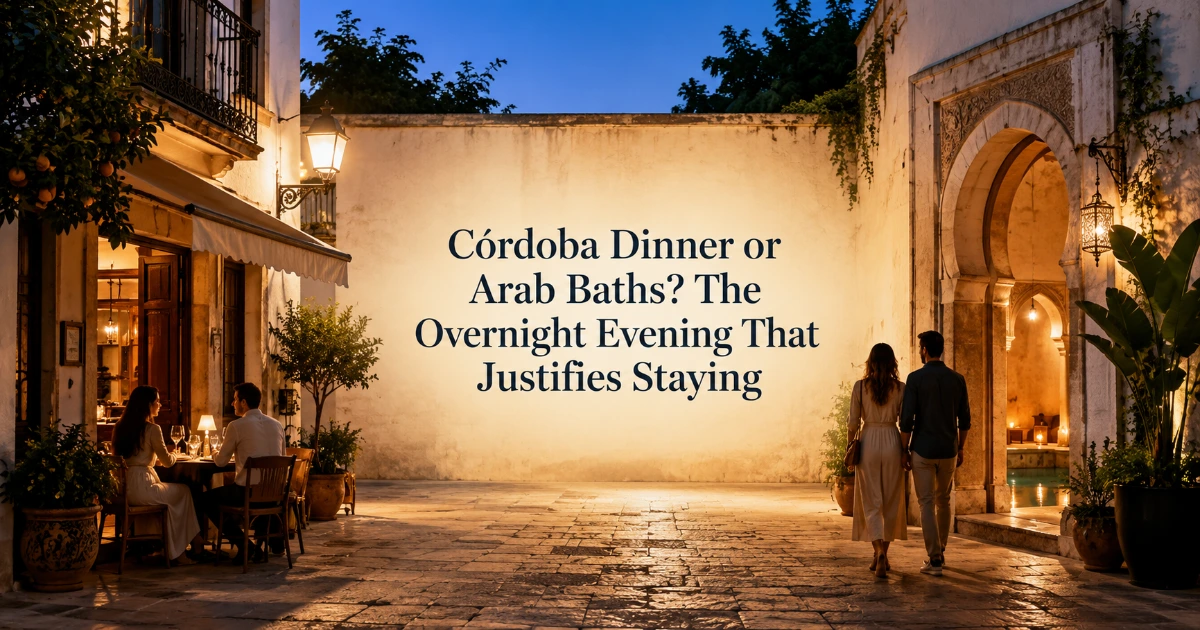
Córdoba Dinner or Arab Baths? The Overnight Evening That Justifies Staying
Updated
Verdict: stay overnight only if the evening becomes the point
Córdoba earns the overnight when your evening is not merely a late meal, but a slower old-town experience: Judería after-daytrippers leave, an unforced dinner, or an Arab Baths reset after a concentrated sightseeing day. That works in real city conditions because the station sits outside the old walls, the historic center tightens around the Mosque-Cathedral and Judería, and the mood changes once train-led day visitors thin out. The clearest exception is simple: if you will spend the night recovering from an overpacked day and leave early, keep Córdoba as a day stop.
The article-specific thesis is this: Córdoba’s one-night value is not its ability to add another attraction after dark; it is the rare chance to let the Judería, the Roman Bridge, and a restorative evening absorb the day instead of making the day bigger. For many couples and comfort-led travelers, that is more persuasive than another ambitious dinner reservation. For food-and-wine travelers, dinner can still win, but only when the meal is the chosen anchor rather than a consolation prize after too much walking.
The first planning correction is counterintuitive. A more expensive hotel night is not automatically the premium move here. An expensive hotel night is not justified if the evening is just recovery from an overpacked day. Pay for the overnight when it buys a different rhythm: a calmer late afternoon, fewer station-to-old-town resets, an evening that lets you walk without watching the clock, and a morning that does not start with luggage anxiety.
That distinction matters because Córdoba is often planned between larger bases. A night here has to compete with the ease of staying put in Seville, Granada, Madrid, or a coastal hotel. The overnight wins when it makes the trip calmer or more memorable; it loses when it merely interrupts the larger route with another check-in.
The ranked ladder for choosing dinner, Arab Baths, or a quiet old-town night
The cleanest way to decide is to rank the evening by what it does to your energy, not by which option sounds most impressive. This ladder is built for travelers deciding whether Córdoba deserves a hotel night, not for travelers who have already committed to several days in town. It also keeps the comparison narrow: dinner, Arab Baths, or the quiet Judería walk that often makes both feel better.
Use three criteria: first, whether the option reduces or increases physical load; second, whether it gives the night a distinct Córdoba identity; third, whether it makes the next morning easier or harder. The winner is not the most luxurious-sounding option. It is the option that prevents the overnight from feeling like a logistical detour.
1. Default winner: quiet Judería walk plus an easy dinner. Choose this when you want the overnight to feel different from a day trip. The gain is atmosphere and pacing: lanes around the Judería, the edge of the Mosque-Cathedral, and a soft return to the hotel rather than a train departure.
2. Runner-up: Arab Baths before or after a simple meal. Choose this when heat, standing, transfers, or family fatigue have made the day feel physically dense. The Arab Baths evening reset can justify the stay better than more sightseeing because it changes the body’s experience of Córdoba.
3. Narrow winner for food-first travelers: a destination dinner. Choose dinner as the anchor only when the meal itself is the reason you are sleeping in town. If you are just adding a formal dinner because a night feels incomplete without one, it can become the least distinctive use of the overnight.
Wrong fit: a maximalist evening after a maximalist day. A late monument, a river walk, a tasting-menu-style dinner, and a dawn departure will flatten the night into logistics. That is the version of Córdoba that looks elegant on paper and feels shorter in practice.
The same logic applies to restaurant ambition. A destination meal can be a beautiful reason to stay, but an impressive reservation is not the same as a well-paced night. The meal should simplify the evening by giving it a clear center. If it forces a rushed change, a long debate over transport, or a late walk no one wants, the name on the booking is doing too much symbolic work.
For the broader stay-or-day-trip question, see whether Córdoba is worth an overnight. This guide assumes the more specific dilemma: if you do sleep in town, what evening choice actually earns that decision?
Notice what is not at the top of the ladder: a maximalist restaurant-first evening with no buffer. Córdoba can support a special meal, but the city’s strongest one-night advantage is the way its old core changes tempo. If your plan skips that tempo entirely, you may be paying for a room without using the city’s best overnight asset.
Why Judería after-daytrippers leave is the real overnight asset
The Judería is the main reason the overnight can feel justified even when you do not book an elaborate dinner. During the day, the narrow lanes near the Mosque-Cathedral can feel like part of the visitor circuit; by evening, the same streets can become a pacing device. You are no longer trying to “cover” the Jewish Quarter. You are letting the old town slow the trip after the formal sightseeing has done its work.
A practical clue is how differently the same route feels once you are not pushing toward an exit. Near Puerta de Almodóvar, the old wall edge can act as a clear starting point instead of a checkpoint. Around the lanes that feed toward the Mosque-Cathedral, a short pause becomes more valuable than a longer loop. The overnight lets you stop before the streets blur.
The non-obvious local hinge is the station transfer. Córdoba’s rail station is convenient, but it is not in the medieval center; reaching the Judería usually means a taxi or transfer across the modern city before you are dropped near a historic edge such as Puerta de Almodóvar, the Mosque-Cathedral side, or another old-town access point. On a day trip, that transfer becomes part of the clock pressure. On an overnight, it becomes a boundary: once you are inside the old town, you can stop converting every lane into minutes.
That boundary is easy to miss when planning from a map. The distance between rail station, hotel, monument, dinner, baths, and bridge may look modest, yet each change of setting asks travelers to reorient. The overnight works when those changes are reduced. It weakens when the night repeats the same stop-start pattern a day trip already requires.
This is also why the evening walk has more value than it seems. A quiet turn through the Judería, a look back toward the Mosque-Cathedral walls, and a possible stretch toward the Roman Bridge do not need to be dramatic to justify the night. They let the day’s historical density settle. If your morning included the Mezquita-Catedral, confirm the current visitor basics on the official Mosque-Cathedral site (https://mezquita-catedraldecordoba.es/en/), then resist building the whole evening around another major ticketed plan.
For couples, the mood-preserving decision is to leave a genuine gap between touring and dinner. The mood-killing mistake is to treat the evening like a second itinerary: photos at every famous corner, a forced bridge crossing, a tightly timed reservation, and a late return through lanes that should have felt calm. Córdoba is compact enough to tempt over-planning, but the overnight earns its place when the compactness becomes ease rather than compression.
Córdoba dinner or Arab Baths: the choice is really about energy
The dinner-or-Arab-Baths decision should start with how the day has used your body. Córdoba’s historic core is compact, but a compact city can still be tiring: stone paving, shade that comes and goes, standing time inside monuments, and the thermal load of an Andalusian day all accumulate. Add a station transfer, a hotel check-in, and the mental weight of choosing where to go next, and a “simple” evening can become another demand.
This is what the city does to the body: it rarely exhausts you through distance alone, but it can tire you through standing, heat reflection, tight lanes, and the repeated attention required by dense historic detail. Travelers often underestimate that because the map looks manageable. By evening, the issue is not whether you can walk farther; it is whether walking farther still gives pleasure.
If the day has been intellectually rich but physically moderate, dinner may be the better anchor. You can keep the late afternoon light, return to your hotel, change without hurry, and let the meal become the social center of the overnight. That is especially true for travelers who came to Córdoba with a food-and-wine lens, who want local conversation, regional flavors, and a slower dinner instead of one more heritage explanation.
If the day has been hot, crowded, or too vertical in energy even without actual hills, Arab Baths often beat another dinner-focused evening. The choice is not about choosing wellness over culture; it is about making the one-night stay feel restorative enough to deserve the hotel shift. A bath circuit or guided bath-focused plan can turn the evening from “we survived the day” into “we are glad we slept here.” For a more specific service path, see Arab Baths private planning.
The clearest sign that the Arab Baths should win is when a formal dinner would require you to perform enthusiasm. If no one wants to dress, debate menus, or extend conversation after a full monument day, the bath reset is the more honest premium choice. Follow it with something simple rather than turning the night back into a production.
When dinner is still the better use of the night
Dinner wins when the meal is the planned highlight, not when it is being asked to justify a weak overnight. Córdoba can be a strong food-and-wine stop, but this article is not a restaurant list and the decision should not start with a ranking of dining rooms. It should start with the traveler: do you want the evening to be social, sensory, and local, or do you want it to take pressure off the body?
For a couple celebrating something, dinner can be the better answer because it gives the night a shared center. The Judería walk beforehand keeps the evening from feeling like a transfer from hotel to table. A guide-led or privately shaped late afternoon can set up the meal with context, then step back so the dinner feels like yours. The most elegant version is not necessarily the most formal; it is the one that lets the conversation deepen instead of turning the restaurant into another scheduled site.
Dinner also works when it is placed after a deliberate hotel pause. A quick return to the room, a change of shoes, and a short walk back into the historic core can make the meal feel like a continuation rather than a duty. Without that pause, even a good dinner risks inheriting the day’s fatigue.
For food-and-wine travelers, a Córdoba tapas or wine-focused route can also make more sense than the Arab Baths, especially when the itinerary has already included spa or hammam experiences elsewhere in Andalusia. In that case, the meal does the work the bath would otherwise do: it slows the night, localizes the stay, and gives the overnight a reason beyond sleep. See Córdoba tapas and wine private tour when the food route is the anchor rather than an add-on.
Where dinner loses is in symbolism. Do not choose a grander meal just because an overnight feels too small without a “big” event. Premium spend does not help when it buys a richer menu but leaves you too tired to enjoy the room, the walk, or the person across the table. If the day has already demanded attention, the better dinner may be shorter, better timed, and closer to the hotel.
When a quiet Judería walk is the value, not the filler
A quiet Judería walk is the value when the overnight is about mood rather than volume. It is easy to underestimate this because a walk looks less substantial than a dinner booking or Arab Baths reservation. But the walk changes what Córdoba feels like after the official sightseeing day ends: less like a celebrated monument stop, more like a city you briefly get to inhabit.
The best version is not a vague wander. Start with a known edge, such as the area around Puerta de Almodóvar or the Mosque-Cathedral side of the Judería, and keep the route short enough that it never becomes a hunt for more. A small loop through old lanes, a pause near the walls, and a gradual turn toward dinner can be enough. If the Roman Bridge is included, treat it as an optional exhale rather than a compulsory crossing to the Calahorra side and back.
This is where the overnight differs most from a day stop. Day visitors often leave Córdoba with the sensation of having seen the essential sites but not having felt the city loosen. Sleeping in town lets the evening walk become a hinge between sightseeing and rest. The result is not more content; it is a calmer memory of the same content.
This is what the city does to the trip mood. During the day, Córdoba can feel concentrated: the Mosque-Cathedral asks for attention, the Judería asks for orientation, and every narrow lane seems to promise another detail. After the pressure drops, the same concentration becomes intimate. The night feels shorter in the best sense, because it is not chopped into errands.
It also helps families and small groups. A quiet Judería walk gives everyone a reset without splitting the party into separate preferences. Older parents are not asked to sit through another long interpretation session. Teenagers are not trapped in a formal dinner before they have decompressed. Couples are not forced into performative romance. The mood stays intact because the plan has room to breathe.
The sequence that makes one night feel intentional
The strongest one-night Córdoba sequence is usually afternoon context, hotel pause, evening choice, and a short old-town close. That order matters more than the exact dinner table or bath slot. If you keep touring until everyone is depleted, the evening can only repair damage. If you stop before depletion, dinner, Arab Baths, or the Judería walk can become the reason the overnight feels chosen.
A good late afternoon does not need to be long. It might be a focused historic-core walk that explains why the Judería reads differently beside the Mosque-Cathedral, a short private orientation that keeps you from doubling back through the same lanes, or a light food-and-wine introduction that does not spoil dinner. The point is to shape the hours before evening so the night has a coherent arc.
Two sample rhythms usually outperform a packed one. In the first, you finish the guided portion near the Judería, pause at the hotel, then walk to dinner with no sightseeing agenda. In the second, you end the afternoon near the bath plan, keep the meal simple, and allow the Roman Bridge or old-town lanes to remain optional. Both rhythms make the overnight feel designed without making it feel controlled.
Orange Donut Tours is useful here because the value is in calibration, not in adding more. A tailor-made plan can decide whether you should finish near the hotel, near the baths, near the dinner area, or near the Roman Bridge, then leave enough unscheduled space that the overnight does not feel managed to the minute. For a privately shaped late afternoon and evening, explore a tailor-made Córdoba private tour or Inquire now.
The practical advantage is that the night stops being a loose afterthought. Couples can keep the pre-dinner walk short and atmospheric. Families can return to the hotel before anyone crosses into fatigue. Small groups can agree on one evening priority instead of negotiating three. Celebration travelers can place the special moment where it belongs, rather than asking a late dinner to rescue a day that has run too long.
What to cut first when the Córdoba day is getting too full
Cut the late extra attraction before you cut the evening pause. This is the rule that protects the overnight from becoming an expensive day trip with sleep attached. Palacio de Viana, the Alcázar, the Roman Bridge, patios, craft stops, and the Judería can all belong in different Córdoba plans, but they do not all belong before a dinner-or-Arab-Baths evening.
The cut-first rule is especially important in warm months and on multi-city itineraries. When heat or transfer fatigue is present, the late add-on usually takes more from the evening than it gives to the day. If you want a richer cultural plan, place it earlier, route it cleanly, or give it its own morning instead of squeezing it into the softest part of the overnight.
Palacio de Viana is a good example because it is worthwhile in the right route and wrong in the wrong rhythm. It sits away from the tight Mosque-Cathedral and Judería core, around the city’s northern historic neighborhoods rather than directly on the standard old-town loop. If you add it late without planning the route, you create a second center of gravity and make the evening feel like a return from somewhere rather than a gentle continuation.
The Roman Bridge also needs discipline. It is easy to say, “We will just cross for the view,” then discover that the round trip, photos, and return to dinner have swallowed the softest part of the evening. Use the bridge when it gives the night a graceful river edge. Cut it when it turns into a task between the hotel and the table.
The same caution applies to a second deep heritage stop. If you have already spent the morning with the Mosque-Cathedral and the Judería, a late interpretive add-on may create detail fatigue rather than depth. The better upgrade is often a cleaner end point: finish the guided portion before the group is tired, return to the hotel, and let the night do fewer things well. The adjacent comfort-first Córdoba evening guide is useful if you have already decided to stay and want a broader menu of evening options.
Who should still keep Córdoba as a day stop
Córdoba should remain a day stop when the overnight does not change the trip’s rhythm. If your plan is to arrive, see the Mosque-Cathedral, walk part of the Judería, eat lunch, and continue to Seville or Granada, that can be a clean and satisfying day. Adding a hotel night only earns its cost when the evening creates a different experience, not when it postpones the same departure.
Keep it as a day stop if your next morning is already committed to an early train, a long transfer, or a high-attention monument elsewhere. In that situation, the Córdoba night becomes a logistical pause rather than a travel pleasure. It may still be comfortable, but comfort alone is not the same as value. A private day can handle luggage, timing, heat, and the main monuments without asking you to split the itinerary unnecessarily.
This is also true for families with a strong next-day priority. If children, older parents, or a mixed-age group will be better served by waking in the next base, do not force the Córdoba night for prestige. A clean day stop may protect the wider trip better than a beautiful hotel used at the wrong point.
Also keep it as a day stop if your group is indifferent to the old-town mood after dark. Some travelers want the Mezquita-Catedral, a concise Judería walk, and a clean return to their main base. That is not a lesser trip; it is a different priority. The mistake is pretending that an overnight is automatically more refined when the traveler would rather have continuity in Seville, Granada, Madrid, or the coast.
A useful test is regret. Would you regret missing the old town after dark, the Arab Baths, or a specific dinner? If yes, the overnight has a reason. If the only regret is theoretical, a day stop may give you Córdoba’s essentials while preserving the comfort of a settled base elsewhere.
The day-stop answer is especially sensible when the evening would be only a recovery buffer. If everyone will order room service, avoid walking back out, and leave after breakfast, the hotel night is doing administrative work. A well-shaped day with a smooth departure can feel more polished than a nominally luxurious overnight with no memorable evening.
The splurge test: pay for timing, privacy, and route clarity, not symbolism
Premium spend changes the Córdoba evening when it buys better timing, privacy, and route clarity. A private guide can help you understand the historic core without exhausting it. A well-placed hotel can reduce backtracking. A carefully chosen dinner or bath plan can put the evening priority within a manageable walk or transfer. Those are real improvements because they change the way the night feels.
Hotel location is part of the test. A room that keeps you close to the Judería or a sensible old-town edge can make the evening easier, but a supposedly grander base that creates awkward transfers may work against the purpose of staying. The glamorous choice is not always the one with the smoothest night.
Premium spend does not help when it simply makes an already crowded plan more expensive. A fancier room will not repair a day that has no pause. A more ambitious meal will not make tired travelers attentive. A private service cannot make every site belong in one short stay if the order is wrong. Spend should remove drag, not hide it.
This matters in Córdoba because the city can appear deceptively easy. The historic core is compact, so travelers assume they can add one more patio, one more bridge view, one more late dinner, and one more early departure. But compactness is not infinite capacity. The best premium choice is often restraint: a better route, fewer transitions, and one evening priority chosen early.
For celebrations, that restraint is not austerity. It is taste. A birthday or anniversary can feel more intimate with a short Judería walk and a dinner that begins before fatigue takes over than with a grander plan that everyone reaches late. The private value is not spectacle; it is the removal of awkward timing, unnecessary negotiation, and the small moments of uncertainty that flatten a special night.
How the overnight changes the next morning
The best reason to sleep in Córdoba may be what it does to the following morning. If the night has been calm, the next day can start without the same station-to-old-town conversion that day visitors face. That can be useful if you want a second look at the historic center, a quieter breakfast, or a short route before leaving for Seville, Granada, Madrid, or another Andalusian stop.
But the morning only helps if it is protected from overreach. Do not use the overnight as an excuse to build a second full Córdoba day unless you genuinely have the appetite for it. A light morning can be excellent: a return glance at the Mosque-Cathedral exterior, a small shopping or craft stop, a short look toward the river, or a calmer departure. A heavy morning can undo the evening’s value.
Think of the morning as a release, not a second attempt to justify the hotel. If the previous night gave you dinner, baths, or the Judería at the right tempo, the morning can be modest and still feel complete. A calm departure often proves the overnight was well used; a frantic extra circuit suggests the stay was trying to prove itself too late.
If Palacio de Viana is important, the morning may be a better place for it than the previous evening, provided it fits your departure route. If the Roman Bridge was skipped at night, a morning look may be more practical. If the Arab Baths gave you the reset you needed, resist adding too much simply because you feel refreshed. The point of the overnight is not to make Córdoba expandable without limit; it is to give one compact city a humane rhythm.
How to place Córdoba between Seville, Granada, Madrid, or the coast
Córdoba’s overnight decision often lives inside a multi-city Andalusia plan. Between Seville and Granada, the city can act as a pause with cultural weight; between Madrid and Seville, it can be a rail-smart stop; from the coast, it can be a more deliberate inland day. The evening question matters because the overnight has to compete with the simplicity of keeping one main base.
From Málaga or the coast, the threshold is higher because the transfer can turn Córdoba into a more demanding inland commitment. From Seville, the day-stop version is easier, so the overnight must offer a true evening gain. From Granada, the question is often attention: will Córdoba calm the trip before or after the Alhambra, or will it add another dense chapter too close to it?
If you are already changing hotels often, Córdoba must earn its night through the evening. Otherwise, the extra check-in, unpacking, and morning departure can make the trip feel more segmented. If you have a longer Andalusia stay, the overnight can be the opposite: a quiet middle chapter that prevents the region from becoming a sequence of large monuments and transfers.
The right answer depends on what comes before and after. After a dense Seville stay, Arab Baths and a quiet Judería evening may be more valuable than a formal dinner. Before Granada, a lighter Córdoba night may preserve attention for the Alhambra. After Madrid, dinner can feel like the social release after rail logistics. For route-level thinking, compare this with Córdoba between Seville and Granada planning.
The final decision rule for a one-night Córdoba stay
Choose the overnight if you can name the evening’s purpose in one sentence. “We want Judería after-daytrippers leave.” “We want Arab Baths after a hot monument day.” “We want dinner to be the celebration, not the afterthought.” Any of those can justify sleeping in town because each changes the shape of the trip.
Do not choose the overnight if the sentence is vague. “It might be nice to stay.” “We should probably not rush.” “There may be a good restaurant.” Those reasons can be true and still weak. The stronger test is whether the night gives you something a day stop cannot: unhurried old-town mood, physical restoration, or a meal that deserves the center of the itinerary.
My firm editorial call is this: the quiet Judería walk plus an easy dinner is the most reliable overnight justification, while Arab Baths are the smartest alternative when the day has been physically heavy. A dinner-led evening is best only when food is the actual purpose of staying. The overvalued choice is the expensive night that adds nothing except a later checkout from the same rushed plan.
If you are undecided, choose the lighter version of the overnight or keep Córdoba as a day stop. A restrained plan can still become memorable if the city opens up after the day-trip rhythm passes. An overloaded plan rarely becomes more graceful through expense, and it can leave travelers wondering why they changed hotels for a night they barely inhabited.
FAQ
Is Córdoba worth staying overnight for dinner alone?
Córdoba is worth staying overnight for dinner alone only if the meal is the clear anchor of the trip. If dinner is simply being added because you feel a night should include something special, the overnight is weaker than a calm day stop or a quieter Judería evening.
Are the Arab Baths better than dinner in Córdoba?
Arab Baths are better than dinner when the day has been hot, crowded, or physically draining. Dinner is better when you still have social energy and the meal is a chosen highlight rather than a late obligation.
What is the best evening plan for one night in Córdoba?
The most reliable plan is a short Judería walk after the day-trip rush has thinned, followed by an easy dinner or Arab Baths depending on energy. It should feel deliberately light, not like a second sightseeing itinerary.
Should couples choose dinner or Arab Baths in Córdoba?
Couples should choose dinner when conversation and celebration are the point, and Arab Baths when the day has made a formal evening feel like work. The mood-preserving move is leaving a pause between touring and the evening choice.
Can a quiet Judería walk justify the overnight?
Yes. A quiet Judería walk can justify the overnight when the goal is to experience Córdoba’s old-town mood after day visitors leave. Its value is not distance covered; it is the change from sightseeing pace to settled evening rhythm.
Who should keep Córdoba as a day trip?
Keep Córdoba as a day trip if you only want the Mosque-Cathedral, a concise Judería walk, lunch, and onward travel. Also keep it as a day stop if your overnight would be only recovery from a crowded schedule.
Where should the Roman Bridge fit in the evening?
The Roman Bridge belongs in the evening only if it serves as a short river-edge pause. Skip the full crossing when it would create backtracking, delay dinner, or turn a calm night into another item on a checklist.
Does a luxury hotel make the Córdoba overnight worth it?
A luxury hotel helps when its location, quiet, or service reduces backtracking and protects the evening. It does not make the overnight worth it by itself if the plan remains overfilled and the evening has no clear purpose.
If you’re interested in any private tours of Cordoba, please reach out to us.



 So if you are looking for the absolute best in Cordoba & surroundings with authentic local fully-licensed native guides whose English you can actually understand and with an exclusive and amazingly fun itinerary