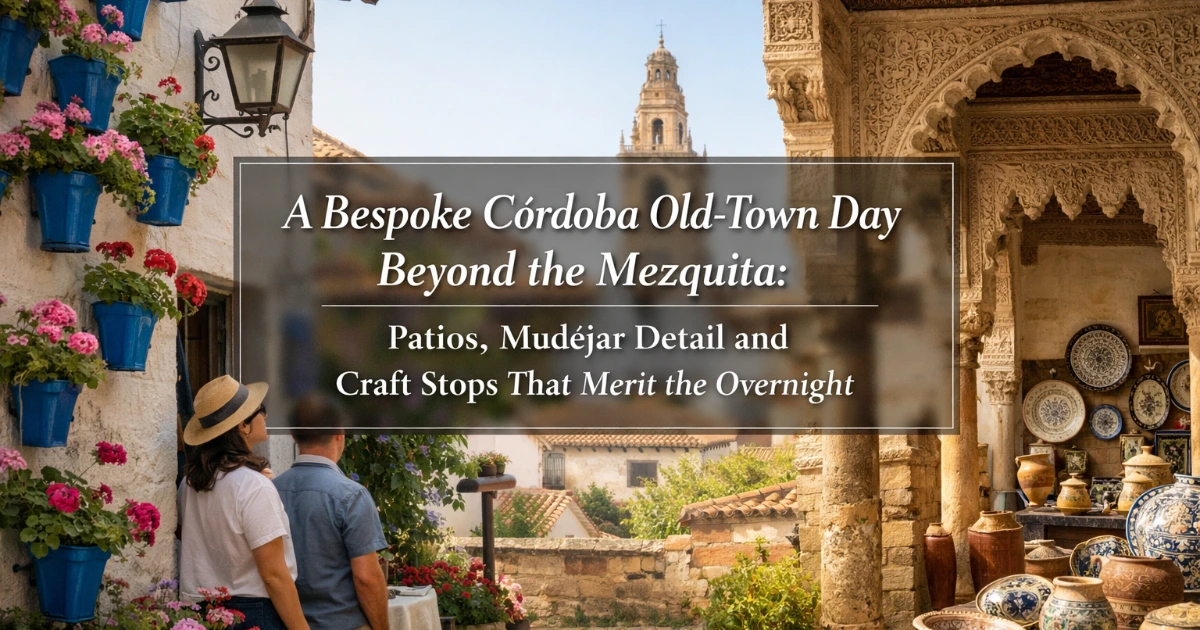
A Bespoke Córdoba Old-Town Day Beyond the Mezquita: Patios, Mudéjar Detail and Craft Stops That Merit the Overnight
Updated
Córdoba’s extra day earns its keep when you spend it inside the old town, not when you immediately leave it again. After the Mezquita-Catedral, the highest-return second window for discerning travelers is usually a slow loop of San Bartolomé, selected Patios de Córdoba, and a few craft stops whose doors and rhythms make more sense once you are already sleeping in the Judería or just beside it. The non-obvious proof is that San Bartolomé is folded into the former Hospital del Cardenal Salazar complex, now the University faculty in the Judería, so one of the city’s most rewarding Mudéjar interiors is not an isolated “major sight” at all; it is hidden in the grain of ordinary old-town life.
The clearest exception is also simple. If your extra window is really for archaeology, you do not mind another departure-and-return cycle, and you actively want a broader caliphal story outside the center, give the time to Medina Azahara instead. But if the real purpose of the overnight is to make Córdoba feel deeper rather than merely longer, the San Bartolomé chapel-and-patio pairing within one shaded old-town loop is the stronger answer.
This guide assumes you have already decided that the city deserves the sleepover and now need to make that one added day feel more intelligent than a default detour. If you are still deciding the bigger question, start with whether Córdoba really deserves the overnight; what follows is the narrower answer for travelers who want the extra night to buy depth, privacy, and calmer old-town pacing.
Is Córdoba worth an overnight beyond the Mezquita-Catedral?
Yes, but only if you treat the second window as an inward old-town day rather than a second headline-sight chase. Córdoba is unusually good at rewarding subtle attention: a tiny chapel with dense plasterwork, a courtyard entered through an ordinary door, a craft stop that is easy to miss if you move only by checklist, and an evening that still feels intact because you never spent the afternoon reassembling yourself after another out-of-center run.
That is the article-specific thesis here: Córdoba is one of the few Andalusian overnights where an extra day can be justified not by adding miles but by learning to read thresholds, courtyards, materials, and workshop rhythms at the pace the old town actually rewards. In practical terms, that means using the Mezquita-Catedral as the reason you came, but not letting it monopolize the value of the stay.
The priority ladder for a high-value old-town second day
- First: stay inside the historic core unless you are genuinely committed to an archaeological outing.
- Second: build around the San Bartolomé-to-patio loop inside the old town, because that is where the overnight proves it bought access to subtle spaces, not just more hours.
- Third: let patio access, small interiors, and independent craft hours set the tempo; do not improvise this as a loose wander and expect the same payoff.
- Fourth: hand the day into lunch, a pause, and dinner while you still have energy, rather than trying to wring out one more monument after four in the afternoon.
The mistake to avoid is assuming that every overnight needs another monument marathon. It does not. In Córdoba, the rushed traveler sees one giant icon and then tells themselves the remainder is a pleasant but generic tangle of lanes. The traveler who stays and sequences the next day properly discovers the opposite: the surrounding old town is strongest when you stop demanding another blockbuster from it and start using it as a network of intimate, cumulative experiences.
The practical corollary is that you should lock the Mezquita-Catedral timing first and then let the rest breathe. If you want to check visitor planning or confirm the first-day visit pattern, use the official Mosque-Cathedral site (https://mezquita-catedraldecordoba.es/en/). Once that anchor is placed, the second day can be designed on a different principle entirely: not maximum monuments, but maximum texture per step.
The threshold call: the Medina Azahara detour versus staying in the old town for craft and courtyard access
For most travelers fitting Córdoba into a polished Andalusia trip, staying in the old town wins only when you care more about depth and ease than about one more major-ticket site. That is the threshold. The Medina Azahara detour versus staying in the old town for craft and courtyard access is not an abstract comparison between “big history” and “small charm”; it is a real decision about what kind of day you want your second day to feel like.
Choose Medina Azahara when the following are true at the same time: you have not yet had your fill of Umayyad or caliphal history, you are comfortable devoting a meaningful part of the day to leaving and re-entering town, and the travelers involved still have appetite for a site that is conceptually richer when read expansively rather than skimmed. That profile is common among history-led couples, repeat Spain visitors building an Andalusian arc around political and religious centers, and travelers who already know that a quiet chapel and a courtyard sequence will feel too understated for the time available.
Do not choose Medina Azahara by reflex just because you slept in Córdoba. That is the counterintuitive correction many premium itineraries need. The overnight does not automatically create enough spare value to justify another transfer-heavy outing. In fact, a single extra night often makes the old town more compelling precisely because you no longer have to treat the center as a rail-stop sprint. Once you are already checked in near the Judería, the best use of the next day is often to remain where the city is most legible on foot.
The on-the-ground consequences are what matter. A Medina Azahara day asks you to leave the compact walking grid that makes central Córdoba so easy, commit to outbound logistics, then re-enter the city later and decide whether you still have enough attention left for its intimate spaces. An old-town day, by contrast, lets you move from hotel to chapel to patio to lunch to craft stop without the repeated reset of waiting, loading, driving, orienting, and starting again. Travelers often underestimate how much those resets flatten a day that was supposed to feel more gracious than the arrival day.
This is where comfort-first planning stops being a slogan and becomes a filter. If you are traveling with older parents, children who fade after lunch, or a celebration trip group that wants the day to feel relaxed rather than “achieved,” staying local preserves options. You can lengthen lunch, step back to the hotel, detour through a quieter lane, or trim the final stop without feeling the whole plan collapse. Once you have committed to an out-of-town archaeological block, the schedule is less forgiving.
There is also a mood consequence that matters more than many travelers admit. An old-town day keeps Córdoba feeling like a place you are inhabiting. A detour day can make the city feel like a base camp: you wake there, leave it, return to it tired, and then attempt to enjoy it again in the evening. For some trips that is perfectly worthwhile. For many one-night or two-night Andalusia itineraries, it is exactly what the overnight was meant to avoid.
Here is the firm editorial judgment. If you only have one full second window after the Mezquita-Catedral and your goal is a richer, smoother city stay, staying inside the old town is the better use of time than forcing Medina Azahara. The detour becomes the winner only when the historical payoff itself is the reason for the extra day.
And here is the honest limit. Staying overnight still does not justify an extra old-town day if you are arriving late, want only one unstructured stroll after breakfast, and have no interest in patios, small interiors, or craft culture. In that scenario, the extra sleep may still be pleasant, but the second day does not become distinct enough to earn its place on a tightly packed Andalusia itinerary.
If you already know you are the kind of traveler for whom Medina Azahara might still be the right call, decide that before you emotionally commit to the intimate old-town day; trying to do both usually creates the most disappointing version of each. The private-touring version of this decision works best when it is explicit rather than hedged.
The San Bartolomé-to-patio loop inside the old town is the part most rushed visitors miss
The best old-town second day in Córdoba is not a generic wander; it is the San Bartolomé-to-patio loop inside the old town. That exact micro-location matters because it converts the overnight into depth you can feel step by step. Instead of treating the historic center as a backdrop, you move through one of its most revealing sequences: the Mezquita-Catedral orbit, the Judería’s finer grain, San Bartolomé’s compressed Mudéjar richness, and then the courtyard culture that explains how Córdoba is lived from the inside.
Start from the assumption that you do not need another large-scale monument first thing. If the Mezquita-Catedral dominated the previous day, begin this one with what it could not give you: intimacy. San Bartolomé is perfect for that, because its scale forces attention. The reward is not mass or grandeur, but density—tile, plaster, geometry, proportion, the sense that Córdoba’s artistic intelligence can operate at close range as convincingly as it does in the forest of columns next door.
The local proof cue that makes this route so convincing is its setting. San Bartolomé is tucked into the former Hospital del Cardenal Salazar, today part of the University faculty complex in the Judería. That means the approach already strips away the false divide between “monument” and “ordinary city.” You are not marching from one ticketed blockbuster to another. You are moving through a living old town where layers of academic, civic, and sacred life overlap within a few minutes.
That changes traveler behavior. People walk more slowly here. They look harder. They stop confusing “small” with “minor.” They also realize why a guide can matter in a place that many visitors underestimate: not because the route is impossible to follow, but because subtle spaces like San Bartolomé are easier to rush through than to read well. A knowledgeable guide can explain why certain plaster patterns matter, why Mudéjar detail in Córdoba lands differently after the Mezquita-Catedral, and why this chapel belongs in the itinerary precisely because it resists spectacle.
From there, the most satisfying continuation is not random lane collection. It is a deliberate shift toward Patios de Córdoba. The best second-day rhythm is rarely “more lanes, more plazas, more churches.” It is “one intimate interior, then one or two courtyard experiences that show how the city turns inward.” That is why the pairing works. San Bartolomé prepares your eye; patios reward it.
And patios are not interchangeable. Some feel cloistered and stately, tied to palaces or institutional buildings; others retain the popular, neighborly character that made Córdoba’s courtyard culture distinctive enough to carry its own heritage weight. If you try to “do patios” as a checklist, all of them blur. If you choose carefully, the contrasts become the point: noble versus popular, ornamental versus domestic, curated versus inhabited.
The route hinge that helps the day stay coherent is the move out from the Judería toward the patio districts rather than back toward the same postcard lanes around the Mezquita-Catedral. That usually means thinking through the Puerta de Almodóvar or Puerta de Sevilla side of the old town and then deciding how far into San Basilio you want to go. The names matter because they help you understand the city’s edge conditions. Córdoba’s center is compact, but its emotional rhythm changes subtly as you move from the denser tourist orbit into the quieter patio streets.
San Basilio is especially useful because it turns courtyard culture into a neighborhood experience rather than a single entrance. The tourism material points repeatedly to streets such as Postrera, Martín de Roa, and San Basilio as classic patio territory, and that matters less as a trivia fact than as a route cue. It tells you where the old town starts feeling residential in the right way for this second-day problem. You are no longer circling the icon; you are moving toward the side of Córdoba that justifies slowing down.
For many travelers, this is the point at which a private route becomes much more persuasive than a self-guided drift. A good guide will not simply talk you from door to door. They will keep the sequence disciplined: enough Judería texture to contextualize San Bartolomé, enough patio time to show real differences, and no pointless backtracking. That is exactly the logic behind a focused San Bartolomé private visit paired with a well-chosen Patios de Córdoba route instead of a broad “best of” sweep.
What should you cut first if the day starts to bloat? Cut the repeatables. Cut the second panoramic bridge walk. Cut the urge to re-tour the most photographed lane simply because it is nearby. Cut any “while we are here” monument that asks for another formal entry but does not deepen the specific thesis of the day. In Córdoba, repeated views are easy to recover at dawn or dusk; small interiors and courtyards are the fragile part of the plan.
Why patios, small interiors, and craft hours should control the clock
The second day works best when doors, not landmarks, determine the order. That sounds obvious, but it is the planning move that most often separates a refined Córdoba day from a loose old-town stroll that never quite coheres. Patios, small interiors, and craft-oriented stops each obey rhythms that are narrower and more fragile than the obvious monuments, so they should control the clock while the easy open-air wandering fills the spaces between them.
The first implication is seasonal. Patios are not one single attraction with one stable year-round pattern. Some are tied to the city’s famous spring competition and festival structure; some are attached to institutions; some are better understood as occasional or context-specific visits rather than guaranteed everyday sightseeing. That is why it helps to check the Patios de Córdoba official site (https://patios.cordoba.es/en/general-information/) rather than assuming that “patios” functions like a single museum. The overnight is valuable here because it gives you enough slack to respond to what is actually visitable instead of forcing the day to behave like a standard monument crawl.
The second implication is typological. Popular patios and formal courtyards do different work in a route. The popular patios, especially around San Basilio or the edges of the Judería, are often the ones that make the emotional case for staying overnight: they feel intimate, inward, and city-specific. Formal courtyards in palatial or institutional settings can be beautiful, but if you stack too many of those you risk turning the day into a sequence of refined but similar spaces. The best route mixes one or two distinct modes rather than chasing volume.
The third implication is temporal. Independent craft stops often keep shorter, split-day, or owner-dependent hours, and that changes where shopping belongs. Craft should not be the first thing in the morning if you are traveling for architecture and old-town texture; it works better as a late-morning or post-lunch bridge, when you can shift from looking to touching, asking, and comparing. In Córdoba, that is particularly true if you care about objects with local continuity rather than generic souvenir retail.
The craft lens that belongs in this article is narrow and specific. Córdoba has long-standing traditions in leatherwork and in silver filigree, and that matters because it gives shopping a cultural role, not just a commercial one. A well-chosen craft stop can extend the morning’s reading of the city: ornament, domestic display, hand skill, patience, and material finish. That is much more interesting than “time for shops,” and it is why craft belongs in this itinerary at all.
There is also a practical planner’s advantage. Craft stops create useful compression. On a hot or crowded day, they offer short, controlled indoor interludes between walking segments. On a celebration trip, they give families or small groups something participatory that is neither another ticket queue nor a forced museum block. For travelers who care about bringing home something local, they turn buying time into city-reading time.
What they are not good for is volume shopping. If the real aim is a major retail day, Córdoba is not the right city to inflate that ambition. The value here lies in a few thoughtful craft-minded stops that belong to the old-town story, not in maximizing bags. That is why a focused craft and shopping route can earn its place in this specific itinerary, while a generalized “shopping afternoon” often cannot.
The timing consequence of all this is clear. Build the day around one high-attention interior, one or two meaningful patio experiences, a lunch with enough time to reset, then a craft stop or two before the late-afternoon handoff. Do not reverse that order unless opening constraints force you to. If you shop first, you blunt the architecture. If you leave patios too late, you risk finding the day has lost its momentum or that the best part of the route is being squeezed into the least attentive hour.
This is also where many mass visitors miss what a guide adds. Group patterns in Córdoba tend to reward speed: a famous lane, a photo pocket, a major icon, perhaps one more well-known stop. A guide working to this narrower brief does something different. They show why San Bartolomé matters after the Mezquita-Catedral, why a popular patio can carry more second-day value than a larger but less personal site, and which craft stop is worth the detour because the objects still feel rooted in the city rather than merely sold in it.
If the trip starts overpacking itself, stop forcing completeness. You do not need every patio subtype, every lane, every craft tradition, and every old-town monument in one day. The rule to keep in view is simple: if a stop does not sharpen the argument that Córdoba merits the overnight through intimacy and local texture, it should probably go.
What deserves private guidance, and what is just paying to walk slower
A private guide earns the fee in Córdoba when the day depends on interpretation, selective access logic, and sequencing, not when the route is so simple that all you need is a map. This distinction matters because the city is compact enough to tempt travelers into assuming that anything walkable is automatically easy to curate well. It is easy to walk. It is much harder to make the walk add up to a coherent premium day.
San Bartolomé is a prime example. Without context, many travelers will see a small chapel and conclude they have “got it” in a few minutes. With the right guide, it becomes a key to reading Mudéjar craft at human scale after the overwhelming spatial drama of the Mezquita-Catedral. The value is not access magic; it is attention management. The guide helps you see why this interior belongs in the itinerary and why it hits differently here than a similarly sized stop might in another Andalusian city.
Patios are another place where guidance becomes practical rather than decorative. Because access patterns vary, because not every patio fits every traveler, and because the difference between a memorable courtyard stop and a disappointing one can be smaller than it appears online, local judgment has real value. A good guide knows when a patio experience should be short and luminous, when it should open into a broader neighborhood explanation, and when the better move is to pivot to another door instead of wasting good energy in the wrong place.
Craft stops may be the most underrated use of a private guide on this kind of day. The point is not to be escorted into shops for the sake of commission-like theater. The point is to avoid wasting time in places that do not match your interest, to connect material traditions to what you have already seen in the built fabric of the city, and to keep the route graceful when hours or availability shift. That can matter for couples buying one meaningful piece, families who need low-friction engagement, and celebration travelers who want something bespoke without devoting half a day to retail wandering.
There is a group-size consequence too. Small groups with mixed interests benefit disproportionately from a guide in Córdoba’s subtle spaces because the city’s pleasures fragment easily: one person wants more history, another wants patio atmosphere, another wants a craft object, another is watching energy levels. A guide can turn those into one continuous narrative instead of four tiny negotiations at every corner.
Here is the plain spend judgment that many travelers need to hear. Paying for a private guide does not earn its cost if your old-town plan is only one simple stop after the Mezquita-Catedral and the rest is a casual self-guided wander back to lunch. In that situation, you are often better off walking on your own and spending the money on a better table, a better room, or simply more time.
The same goes for cars inside this particular plan. Once you are already staying in or beside the Judería, extra vehicle spend usually adds very little to a day built around San Bartolomé, patios, and craft stops. The streets are compact, many of the best moments are within a short walking grid, and a chauffeur will mostly be solving a problem you have chosen to avoid by basing yourself correctly.
Where the spend does change the day is in design. A thoughtful private planner can combine the right amount of architectural reading, the right patio mix for the season, and the right craft stop for your taste, then protect lunch, rest, and dinner from the usual drift. That is why the conversion-adjacent next step in this article is not “book a generic tour,” but “build a day that respects the city’s fine grain.” If that is what you want, a tailor-made Córdoba plan is the relevant escalation, not more breadth for its own sake.
The city is compact, but this is what Córdoba still does to the body and to the mood
Córdoba’s center is compact, but compact does not mean effortless. The old town works on the body through repetition rather than scale: hard paving underfoot, heat reflecting off pale walls, narrow lanes that feel cool until they suddenly do not, and frequent stop-start patterns whenever crowds thicken around obvious photo points. Add one extra transfer-heavy detour to that and the day can feel more tiring than a supposedly bigger city day built around a car.
This is exactly why the old-town second day can be so effective for comfort-first travelers. You cut out the most draining form of fatigue, which is not walking itself but reset fatigue: getting yourself out, back, reoriented, watered, cooled, and motivated again. In Córdoba, an overnight only becomes truly restorative when you stop spending its second day on resets. The San Bartolomé-to-patio approach works because it lets the walking be continuous and meaningful rather than interrupted and administrative.
There is a body consequence to route choice within the center as well. The Judería side of the day tends to offer denser shade and more frequent options to pause; the move toward San Basilio and its patio streets can feel more open and residential, which is lovely, but it should usually be approached after attention is already focused rather than as a long, aimless midday drift. That is one reason the route works best when the intimate chapel comes first and the more atmospheric courtyard segment follows.
Families and multigenerational groups feel this quickly. Children do better with variation than with duration. Older parents do better with continuity than with repeated departures. Celebration groups do better when the day leaves some energy in reserve for dressing, dining, and enjoying the evening. The old-town version of a second day serves all three better than a plan that spends goodwill on transport before the softer pleasures even begin.
The mood consequence is just as important. A well-shaped old-town day preserves the evening because it lets Córdoba remain emotionally coherent. You are never far from the hotel. You are never far from a good pause. You are not returning to the center as if it were a second destination. Instead, the city feels shorter, calmer, and more intimate as the day goes on.
That is one reason not to over-prioritize the Roman Bridge or another long scenic walk in the body of this itinerary. Those views are lovely, but they are best used as light edges to the stay—early, late, or incidental—not as the spine of the second day. The same is true of repeating the Alcázar or other major exterior landmarks unless they specifically belong to your interests. The overnight earns itself through concentration, not through extra mileage.
If you need a benchmark for whether the day is working, ask a simple question around four in the afternoon: do you still feel like Córdoba is opening, or do you feel like you are finishing? The right old-town second day should leave you in the first mood. If it leaves you in the second, the route has probably taken on too much monument logic and not enough threshold logic.
How to hand the day into dinner without turning it back into a checklist
The right ending for this day is dinner, not one more attraction. That may sound obvious, but many travelers sabotage the value of the overnight by using late afternoon to chase a final “worth it while we’re here” stop, then arriving at dinner tired, over-walked, and slightly detached from the place they meant to savor. Córdoba rewards a cleaner handoff.
For most travelers, that means one of two finishes. Either you keep the evening close to the old town and let the day fade naturally into aperitifs and dinner within easy reach of the hotel, or you make one deliberate transfer for a meal that is the evening’s main event and trim the afternoon accordingly. What you should not do is combine a full old-town subtle-space day with a restless pre-dinner push for more sightseeing.
This is where food-and-wine travelers need one bit of restraint. Noor can absolutely belong to a high-end Córdoba overnight, but it is not an argument for packing more into the hours before it. If Noor is the evening’s destination, treat it as the finale and let the afternoon breathe. The MICHELIN Guide entry for Noor (https://guide.michelin.com/gb/en/andalucia/cordoba/restaurant/noor) is the right place to understand its significance and confirm whether it fits the tone of your night; the planner’s task is to make sure the day that precedes it does not feel like a separate city entirely.
For many travelers, the more elegant answer is actually simpler: keep the second day deeply local, finish the craft and patio logic by late afternoon, return to the hotel without hurry, and let dinner be the reward for having used Córdoba properly rather than the compensation for overextending it. The old-town overnight is at its best when the evening feels like a continuation of the same city, not the recovery period after a hard march.
If that is the shape you want, the planning problem is no longer whether to stay; it is how to make the extra night buy the right kind of day. That is the moment this guide is meant to solve. And if you want that day built around your walking tolerance, family mix, celebration goals, patio interest, or dinner ambitions, the next step is straightforward: Inquire now.
For travelers who prefer to compare the broader service options first, the full starting point is Private Tours in Córdoba. If you already know the heart of the day should be patios rather than broad monument coverage, the specialist route is the Patios of Córdoba Private Tour.
FAQ
Is this old-town plan better than visiting Medina Azahara on a second day in Córdoba?
It is better when your priority is to make one overnight feel richer, calmer, and more city-specific rather than more expansive. Medina Azahara wins for travelers who are explicitly history-led and willing to spend part of the day leaving and re-entering town. The old-town plan wins for travelers who want the extra night to reduce friction and deepen the feel of Córdoba itself.
Who should stay in the old town instead of heading out of town?
Couples, families, celebration travelers, and comfort-first visitors usually benefit most from staying inside the old town on the second day, especially if they value lunch, rest, craft stops, and an intact evening. Travelers with strong archaeological priorities or a broader caliphal-history agenda are the clearest exception.
Why is San Bartolomé so important if I have already seen the Mezquita-Catedral?
Because it changes the scale of your attention. After the Mezquita-Catedral’s vastness, San Bartolomé shows Córdoba’s Mudéjar intelligence at close range, in a compressed setting where detail matters more than size. It proves that the overnight can buy depth rather than just extra hours.
Are Patios de Córdoba only worth planning around in May?
No, but May is when the city’s courtyard culture is most publicly legible and easiest to structure through official information. Outside festival periods, patio access becomes more selective and less uniform, which is exactly why the overnight should be planned with restraint rather than assumed to work like a fixed museum route.
Where does a private guide add real value on this kind of day?
A guide adds the most value in San Bartolomé, in selective patio sequencing, and in matching craft stops to your actual taste and timing. The value is interpretation and route discipline. It is much less valuable if the plan is only one simple stop followed by an otherwise casual wander.
What should I cut first if my second day in Córdoba starts feeling overpacked?
Cut the repeatables first: another panoramic walk, another broad exterior monument, or another famous lane you can easily absorb at another hour. Keep the fragile pieces instead—small interiors, patio access, and craft stops with limited or variable opening patterns.
Can this plan work for food-and-wine travelers or celebration trips?
Yes, it works especially well for them because it preserves the evening. The best version is an old-town day that ends with enough energy left for a strong dinner, whether that means a polished local meal nearby or a more destination-driven table such as Noor. The key is not to treat dinner as compensation for a tired day, but as the natural continuation of a well-paced one.
If you’re interested in any private tours of Cordoba, please reach out to us.



 So if you are looking for the absolute best in Cordoba & surroundings with authentic local fully-licensed native guides whose English you can actually understand and with an exclusive and amazingly fun itinerary













