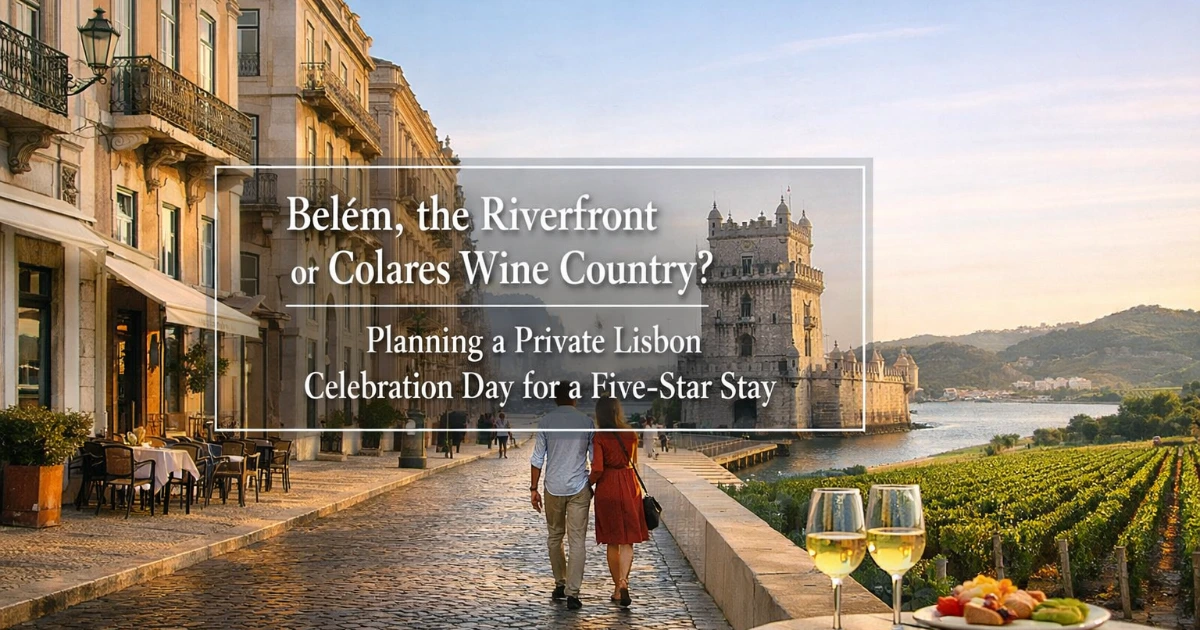
Belém, the Riverfront or Colares Wine Country? Planning a Private Lisbon Celebration Day for a Five-Star Stay
Updated
The regret risk in Lisbon is simple: spending your celebration day on too much geography and arriving at dinner already flattened. For most couples and small groups on a five-star city stay, the best answer is a central riverfront day built around the Ribeira das Naus / Praça do Comércio riverfront loop, not a western monument sweep and not a wine-country detour.
That verdict works because Lisbon rewards contained movement. The Belém riverfront between Jerónimos and the waterfront is one of the city’s easiest ceremonial walks, but it only stays easy when you let Belém be Belém. Colares is even more distinctive, thanks to its sand-grown ramisco landscape and Atlantic mood, yet it asks you to hand the city day over to the coast rather than treating it as an add-on.
The clearest exception is a wine-led celebration or a return visit that no longer needs central Lisbon icons. In that case, Colares can beat the city outright. In Lisbon, the best celebration day is the one that sends the most energy into the evening, not the one that squeezes the most famous names between breakfast and sunset.
Three questions decide it. Is dinner or lunch the day’s anchor moment? How much transfer time can you absorb before changing for the evening? And do you want your standout memory to be river light, a ceremonial monument district, or an Atlantic wine-country escape? One counterintuitive correction belongs near the start: when a Belém day begins to sprawl, Torre de Belém is the first thing I cut, not lunch. Jerónimos, Praça do Império and the waterfront already deliver the sense of occasion; the tower often adds more drift than delight on a celebration schedule.
The celebration ladder, from safest win to biggest swing
The ranking is clear once you judge Lisbon by dinner energy, transfer load, and whether the headline belongs to the city or the coast.
1. Default winner: the central riverfront loop. Best for anniversaries, birthdays, proposals, and anyone who wants a serious dinner without sacrificing the calm hours beforehand. This is the strongest answer when you are staying near Chiado, Avenida da Liberdade, or another central base that can slip toward the river without turning the return into work.
2. Runner-up: a Belém monument-and-lunch day. Best for travelers who want one ceremonial Lisbon chapter, flatter walking, strong history, and a west-side lunch that feels occasion-worthy without committing the whole day to leaving town.
3. Biggest swing: Colares wine country. Best for wine-led celebrations, return visitors, and small groups who would rather remember Atlantic vineyards than central landmarks. It wins only when the drive itself is part of the pleasure.
What falls to the bottom. The version that tries to do Belém, Colares, and a central tasting-menu dinner in one Lisbon day is beautiful on paper and overpacked in practice.
Why the Ribeira das Naus / Praça do Comércio riverfront loop wins most Lisbon celebration days
The city-day branch wins because it gives you Lisbon’s best ratio of atmosphere to effort.
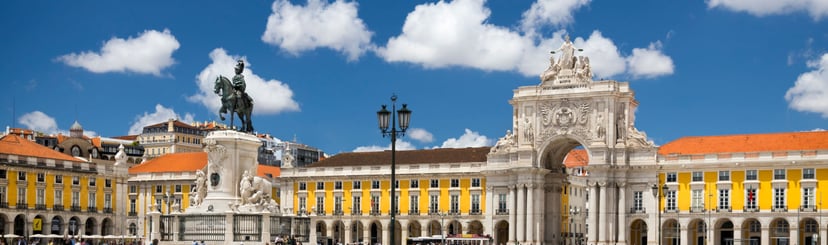
The Ribeira das Naus / Praça do Comércio riverfront loop is not just scenic; it is one of the few central stretches where Lisbon lets you move for a meaningful amount of time without paying the hill tax every few minutes. From Cais do Sodré you can step onto the broad river edge, follow the light along Ribeira das Naus, drift under the arcades of Praça do Comércio, and decide later whether to rise into Baixa or Chiado. That optionality matters. A celebration day should be expandable when the weather is perfect and compressible when lunch runs long, shoes start talking, or the room is not ready on the clock you imagined.
This is why the riverfront is the safest winner for a hotel-based celebration. It does not require you to commit early to a westbound or coastal arc. It lets you keep the day porous. You can stop for a drink, retreat to the hotel, change for dinner, or add a short museum or shopping interval without feeling that you have broken the structure of the day. For couples, that flexibility keeps the mood intact. For families and mixed-generation groups, it avoids the subtle tension that appears when one person wants “just one more stop” and another person is already conserving energy for the evening.
The riverfront also gives couples the easiest chance to keep one private pocket inside the day. Because the route can thin out between fixed moments, there is room for an extra glass, a bench by the water, or a short hotel pause without the feeling that you are abandoning paid-for momentum. Small groups benefit in the same way. It is far easier to let two people browse while two others linger over coffee when the entire day is not pinned to vehicle departures, tower entries, or timed tastings.
Lisbon’s central riverfront also behaves well physically. The city is famous for hills and cobbles, but this branch lets you decide how much of that you actually buy into. You can stay low by the water, add only one uphill section into Chiado, and save the steeper neighborhoods for another day. That matters more than many travelers expect. The body rarely complains during the first pretty walk; it complains after the second transfer, the third staircase, the standing line you did not count, and the final uphill approach to a dinner table you were meant to enjoy. The riverfront day strips out most of those accumulations.
The other reason it wins is emotional, not physical. Celebration travelers usually say they want a “full day,” but what they actually remember is whether the day held its shape. On the central loop, the hours connect. A late breakfast, a river walk, an unhurried lunch, a short rest, and dinner feel like one continuous occasion. A Belém day has more ceremonial architecture, and a Colares day has more escape value, but the riverfront is the branch least likely to feel chopped into separate episodes by cars, queues, or recovery stops.
This branch is particularly strong if your hotel sits in a part of the center that can tilt gracefully toward the river and back again; this Lisbon stay guide explains why Chiado and nearby central bases make that geometry easiest. If you are celebrating soon after arrival, it is also the branch least likely to expose jet lag, because you can keep the walking low-pressure and still feel that you had a real Lisbon day.
A strong version of the riverfront day
A strong version starts late enough to feel indulgent, not athletic. Begin with a relaxed breakfast or coffee close to the hotel, move down to the river once the city is properly awake, and let the first long stretch be the promenade rather than an interior sight with fixed timing. Put the longest seated moment at lunch, not mid-afternoon. After lunch, keep only one more purposeful element: perhaps a short drift into Chiado for browsing or a return to the hotel to dress for the evening. That single choice is enough. The mistake is believing you need a second “headline” after lunch to validate the day.
If food matters more than monuments, this is also the branch that pairs most naturally with a private Lisbon food-and-wine experience, because the daytime and the evening are telling the same story rather than competing for attention. A riverfront day that feeds into a central dinner feels coherent in hindsight. That coherence is worth more than one extra landmark.
Who should not choose this as the default? Travelers for whom the monument district is the point, wine lovers who already know central Lisbon well, and guests who will feel they missed something if the day does not include a major historical interior. But for most first celebratory days in Lisbon, the riverfront wins precisely because it resists overstatement. It gives you beauty, pace control, and a clean runway into dinner.
Belém is the better answer when the day should feel ceremonial, not wide-ranging
Belém becomes the right answer when you want one grand Lisbon chapter and are willing to let the rest of the city wait.
The Belém riverfront between Jerónimos and the waterfront gives you something the center cannot: concentrated monumentality without constant climbing. Jerónimos, the gardens around Praça do Império, the broad riverfront, and the west-side light create a day that feels stately from the beginning. For older parents, history-forward couples, and families who do better with fewer changes of terrain, that matters. Belém is one of the rare parts of Lisbon where the city can feel ceremonious and comparatively forgiving at the same time.
But Belém only works as a celebration day when you respect its boundaries. It is a west-side chapter, not a small errand from the center. The area feels compact once you are in it, yet the psychological mistake is assuming that because it is still Lisbon it can be attached casually to other ambitions. Once you go west, you need to think west for several hours: one major interior, one waterside walk, one lunch, perhaps one pastry stop, then back to the hotel core. When you plan it that way, Belém feels gracious. When you bolt it to a second major branch, it starts to feel like commuting between pretty backdrops.
This is the branch for travelers who want the day to build toward lunch rather than dinner. Jerónimos gives the morning weight, the walk toward the waterfront opens the day outward, and lunch can land as the emotional center of the celebration. After that, you do not need much. A promenade, a pause, maybe a slow look at the water or the museum strip, and then you return to the hotel before the day becomes blunt. Belém is at its best when the plan accepts that the district itself is the occasion.
The first cut-first rule belongs here. On a celebratory Belém day, Torre de Belém is usually the first element I remove when time or patience starts thinning. That is not because it lacks importance; it is because the day already has its symbolic charge without it. Jerónimos and the Praça do Império zone do the heavy lifting. By contrast, adding the tower often means extra shuttling of attention, more standing, and more schedule awareness in a day that should feel composed. The same logic applies to the obvious pastry stop. It can be a pleasure, but at the wrong hour it can also become the least elegant line of the day. If you want it, place it deliberately instead of assuming it will slide in harmlessly.
Belém is especially persuasive for travelers whose celebration wants photographs and symbolism without requiring intimacy every minute. The setting does some of the work for you. That can be a virtue on milestone birthdays, family celebrations with older parents, or trips where one person wants history and another simply wants the day to feel important. What Belém does less well is late-day spontaneity. Once you are west, you either stay committed to the district or you start feeling the return tugging at you.
Belém also rewards travelers who like a guide but do not necessarily need a car for every minute. Once you arrive, the district makes sense on foot. That is why a focused west-side route, rather than an all-city mash-up, is usually the cleaner way to enjoy it. If Belém is clearly your winning branch, a focused private Belém and Jerónimos route is a more convincing use of the day than trying to turn the district into a warm-up for somewhere else.
A strong version of the Belém day
A strong version of Belém starts with the major interior while your attention is still fresh, then moves outward. After Jerónimos, use the transition through Praça do Império as part of the day rather than dead space. That garden-and-waterfront interval is one of the reasons Belém suits celebration travelers: the monument density sits beside calmer walking. Then give lunch room to matter. After lunch, keep the afternoon selective. Either add a short riverfront continuation or stop early enough to get back to the hotel without hurrying into the evening. The day weakens the moment you start trying to prove you “covered Belém.”
Who tends to be happiest here? Couples who want grandeur without a demanding city climb, families marking a birthday with grandparents in tow, and travelers who like the idea of Lisbon’s imperial and maritime chapter being the day’s visual center. Who tends to be less happy? Guests who have fixed central dinner plans and want the whole day to feel progressively more intimate, not more formal. Belém gives you ceremony early. It does not naturally taper into the city-center evening as smoothly as the riverfront loop does.
Colares earns the drive only when wine country is the headline
Colares is worth choosing only when you genuinely want to give the city day away to wine country.
This is where many otherwise smart Lisbon plans wobble. Colares sounds temptingly close on paper, especially compared with a full-scale rural detour. But proximity is not the point. The value of the branch is that it stops feeling like Lisbon. The air changes, the scale softens, and the day becomes appointment-led rather than promenade-led. Most importantly, the landscape has real authority of its own. Colares is not just “vineyards near the city.” Its reputation rests on the sand-grown ramisco landscape and Atlantic conditions that make the region unlike the more generic wine add-ons travelers sometimes fold into a city trip. The Adega Regional de Colares (https://arcolares.com/en/the-region/) is a useful primary reference if you want to understand why the place matters before you go.
That distinctiveness is exactly why Colares can beat Belém and the riverfront for the right traveler. If you are celebrating a return trip, marking a serious wine milestone, or traveling with friends who care more about a tasting room conversation and a slow coastal lunch than about central Lisbon landmarks, Colares offers the most singular memory of the three branches. It feels more private, more separate, and more transportive. You are not just looking at the Tagus from another angle; you are stepping into a different rhythm.
The cost is equally clear. A Colares day needs a start, a middle, and a return. It does not absorb improvisation in the same easy way as the center. Tastings often work best with pre-arranged timing. Lunch matters more because you are out there for real, not simply west of the hotel core. The return to Lisbon can still lead to dinner, but it is usually a second act, not the continuation of the same mood. By the time you come back, you are re-entering the city rather than gliding through it.
This is why Colares suits some celebration styles beautifully and frustrates others. It suits wine-led anniversaries, milestone birthdays for small groups, and couples who already know they want one day of Atlantic separation. It frustrates travelers on a short first stay who still want to feel immersed in Lisbon itself, and it is a poor fit for anyone with a rigid central dinner reservation that same evening. The wrong expectation is “we’ll do a tasting, maybe a coastal lunch, and still come back for a full Lisbon night as if nothing happened.” Something has happened: you have spent the day outside the city’s cadence, and the evening should respect that.
Another correction matters here: do not let Colares get swallowed by a standard Sintra-and-Cascais mindset. Those are different day types. The more you turn Colares into a side note between palace traffic and coast-hopping, the more you lose the reason to go: a slower wine-country identity with Atlantic edges and real tasting time. Celebration travelers tend to be happiest in Colares when they accept fewer stops, longer conversations, and the possibility that the best memory of the day may be the lunch table rather than the most photographed viewpoint.
That is also why chauffeur support matters here in a way it does not on the riverfront loop. Colares is the branch where the journey is part of the celebration, and that means the transitions have to feel easy. You do not want the day organized around parking, navigation, or who is abstaining at the table. If Colares is your answer, a dedicated Colares wine-country route makes more sense than trying to append the region to a generic Lisbon day.
A strong version of the Colares day
A strong version starts with a calm city departure, not an early scramble. Let the hotel breakfast happen, or take a slow first coffee, then leave knowing the day’s headline is already decided. Build around one meaningful tasting and one long lunch rather than a scatter of small stops. If there is a second tasting or coastal pause, it should deepen the atmosphere, not chase volume. Return to Lisbon with enough margin that dinner is either intentionally simple or close to the hotel. Colares does not need an oversized evening to justify itself. If the day was right, the drive, the tasting, and the Atlantic lunch already carried the celebration.
Who should actively avoid this branch? First-time visitors trying to “fit wine country in somewhere,” travelers with children who still need a city sight as the day’s insurance policy, and anyone whose ideal celebration depends on a polished central-city evening with a wardrobe reset, cocktails, and late momentum. Colares is a rewarding day, but it is not a half-day ornament.
The plan that looks luxurious and lands tired
The overpacked version is easy to describe: Belém in the morning, Colares after lunch, then back to central Lisbon for a destination dinner and perhaps one more scenic stop along the river. It sounds abundant. It is usually exhausting.
The reason has less to do with distance alone than with reset costs. Lisbon is not enormous, but it penalizes repeated changes of mode. A west-side monument morning has its own pace: tickets, interiors, gardens, photos, a walk to the water, lunch. A wine-country branch has another pace: departure, tasting, a rural or coastal table, a second appointment, the return. A central celebration dinner has a third pace: shower, clothes, anticipation, arrival. The fantasy plan asks all three rhythms to share one day, and they almost never do. Something starts bleeding: lunch runs later, the tasting becomes a checkbox, the drive turns functional, the hotel return gets rushed, and dinner begins with apology instead of appetite.
There is a bodily penalty too. Travelers often imagine Lisbon’s fatigue as a hill problem confined to Alfama or Bairro Alto. In practice, fatigue comes from accumulation. It comes from stone underfoot, queue drag, heat off pale paving, the time spent standing when you thought you would be sitting, and the mental tax of watching the clock so you do not miss the next reservation. Even a chauffeured day cannot erase that buildup if the design itself is wrong. A car can remove some friction; it cannot make three incompatible moods feel like one coherent celebration.
The mood penalty is just as important. Celebration days usually have one anchor moment that carries the memory: a long lunch, a tasting, a riverfront golden hour, or dinner. What kills the mood is not always something dramatic. More often it is the sense that the day has turned managerial. One person starts checking the time. Another asks whether the pastry stop is still happening. Someone wonders if there will be time to change. The conversation shifts from enjoying Lisbon to defending the structure of the plan. Once that happens, the day starts feeling shorter and harsher than the clock says.
This is the reason I would rather see travelers choose clearly than optimize endlessly. If the point is Lisbon itself, choose the riverfront and let the evening grow. If the point is ceremony and history with lower walking stress, choose Belém and let the city center wait. If the point is Atlantic wine country, choose Colares and stop apologizing to the center for it. The worst celebration design is the one that keeps trying to reassure you that you did not miss anything. The best one lets one branch become enough.
There is another paper-beautiful mistake worth naming. Some couples build the whole day around “sunset somewhere” without deciding whether sunset is scenery or sequencing. On Lisbon’s riverfront, sunset can be a natural phase of a central day. On a Belém day, chasing a precise sunset moment can keep you west longer than is comfortable before dinner. On a Colares day, trying to force both Atlantic golden hour and a full central evening usually means giving up the calm return that made the escape worthwhile. Sunset is not an itinerary. It is a bonus when your routing was already correct.
Spend on the transitions, not on status signals that do nothing for the day
The money that changes this decision is transport, pacing control, and reservation protection, not extra prestige markers.
Paying for a chauffeur adds little on a compact Chiado-to-riverfront celebration evening, but can transform a Belém-plus-Colares day.
That sentence is the cleanest spending rule in this article. If your plan lives mostly between the hotel, Chiado, and the riverfront, a car can be more symbolic than useful. You will still walk the best stretches, and the interruptions of pickups and drop-offs may add ceremony without adding ease. The right central-city splurge is usually not another vehicle; it is better lunch timing, a room for a proper pause, or dinner that genuinely deserves the day built around it.
Once the plan swings west or outward, the equation changes. Belém on its own can be reached in several ways, but Belém plus a second commitment, or any day that reaches Colares and returns to the city, benefits sharply from door-to-door control. The upgrade is not about looking grand. It is about protecting mood, not thinking about routes, and making sure the person organizing the day is not also acting as dispatcher. For travelers weighing that tradeoff, chauffeur support in Lisbon earns its keep when the geography stops being compact.
The second worthwhile spend is reservations. Celebration travelers frequently design daylight first and dining second, which is backwards. If dinner is the anchor moment, lock the table before you decide how far west to roam or whether Colares belongs in the day at all. A central dinner and a skyline dinner ask for different geometries. Fifty Seconds is the kind of room where you should confirm booking conditions, timing, and the shape of the evening on the official site (https://www.fiftysecondsexperience.com/en/reservations/) before assuming you can drift in from a western or coastal plan. A place like Belcanto is the kind of room where reading the official PDF (https://belcanto.pt/uploads/Belcanto_FAQ_EN_Abr25.pdf) first can keep you from building a day around assumptions that do not match how you actually want to dine. Reservation details can change, so confirm when booking.
A guide can help differently in each branch. In Belém, guidance earns its keep through interpretation and selective focus: one monument understood well is better than three sites skimmed thinly. In Colares, the value is more operational: winery coordination, lunch sequencing, and a day that still feels calm if one appointment shifts. In the center, by contrast, the most elegant choice may be fewer booked elements and more intentional empty space.
The third rule is where premium spend does not help. More money does not make a popular pastry line feel celebratory at the obvious hour. More money does not change the fact that Belém Tower can become the least graceful use of a tightly structured day. More money does not turn a triple-branch plan into an elegant one. Spend can improve privacy, ease, and punctuality. It cannot rescue a day whose real problem is that it wants three identities at once.
If your actual choice is between a compact city celebration loop and a chauffeur-led Belém or Colares branch, make the decision backward from the evening you want to protect, then Inquire now.
My firm editorial view is this: for most five-star stays in Lisbon, the riverfront is the low-regret winner; Belém is the correct ceremonial alternative when you want one grand district and lower walking strain; Colares is the high-payoff exception when wine country is the purpose, not the accessory. If you remove the pressure to “have it all,” Lisbon becomes much better at celebration.
FAQ
Is Belém or the Lisbon riverfront better for an anniversary day?
For most anniversary days, the central riverfront is better because it leaves more energy for the evening and makes it easier to return to the hotel, dress, and dine well. Belém is better when you want the day to feel ceremonial from the start and are happy for lunch, not dinner, to carry more of the emotional weight.
Can you combine Belém and Colares in one private celebration day?
You can combine them mechanically, but it is rarely the best celebration design. The west-side monument rhythm and the wine-country rhythm compete with each other, and the return to central Lisbon usually feels hurried. If you want both, separate them across different days.
Is Colares worth it on a first high-end stay in Lisbon?
Usually not on the first celebratory day. Colares is strongest for return visitors, serious wine travelers, and guests who are happy to give the city day away to the coast. If you only have a short Lisbon stay, this guide on how many days to spend in Lisbon helps you judge whether wine country belongs on this trip at all.
Does a chauffeur make sense if we are staying in Chiado or Avenida da Liberdade?
It makes limited sense for a compact city celebration built around the riverfront, because much of the pleasure lies in walking and pausing. It makes far more sense once the day reaches Belém with additional commitments, or especially when the plan extends to Colares and back.
Which branch works best for food-and-wine travelers?
If the celebration revolves around dinner in Lisbon, choose the riverfront and keep the day central. If the celebration revolves around tasting, vineyards, and Atlantic lunch rather than a central-city evening, choose Colares. Belém sits in the middle: better for a long lunch with ceremonial context than for a wine-led day.
Which branch is easiest for older parents or mixed-energy groups?
Belém is often the easiest because the district gives you gravitas with less climbing, and the day can stay geographically contained once you arrive. The central riverfront is the next easiest. Colares works only if everyone is happy to spend a real day in the vehicle-to-table rhythm of an outward excursion.
Should the tasting-menu dinner be on the same day as Colares?
Usually only if you keep the evening deliberately simple and geographically sensible. The stronger pattern is to let Colares carry the celebration through tasting and lunch, then return for a relaxed dinner near the hotel rather than trying to stage a second major performance that night.
Should the celebration dinner stay in central Lisbon?
Usually yes. A central dinner pairs best with the riverfront winner and also makes a Belém day easier to finish well. If you choose a destination dinner outside the center, design the whole day around that geometry instead of pretending it is a small late adjustment.
If you’re interested in any private tours of Lisbon, please reach out to us.


 So if you are looking for the absolute best in Lisbon & surroundings with authentic local fully-licensed native guides whose English you can actually understand and with an exclusive and amazingly fun itinerary