A Comfort-First Lisbon Stay by Season: Jacarandas, Atlantic Breezes and When Sintra Belongs in the Plan
Updated
Choose late spring first and early autumn second if your aim is a smooth Lisbon stay with room for one hill district, one riverfront stretch, and evenings that still feel like part of the holiday rather than recovery time. That answer works because Lisbon’s real friction is not the headline weather on a chart. It is the combination of steep grade changes, polished calçada, exposed miradouros, and how quickly a short map distance can turn into a tiring sequence of climbs.
The clearest exception is a winter trip built around Sintra as the headline rather than an add-on. Winter can be excellent for dining, shorter city walks, museum-led days, and a calmer urban rhythm, but it becomes the wrong fit when travelers try to combine a full uphill Lisbon day with a palace-heavy Sintra day and no backup plan for wet stone, fog, or slower mountain logistics. The same dates that feel easy in Chiado can feel much more demanding on a mountain slope once humidity, wind, and mist enter the picture.
In Lisbon, season is not background scenery; it decides whether the city feels like one flowing day or a series of small recoveries between slopes. The most useful local clue is the Baixa-to-Alfama summer-climb hinge. A day that starts easily in Chiado, glides through flat Baixa, and then rises past Sé into Alfama can feel beautifully sequenced on a cool shoulder-season morning and surprisingly draining on a hot afternoon. Chasing a “perfect season” matters less than choosing the right base and pacing; if the hotel question is still open, start with where to stay in Lisbon.
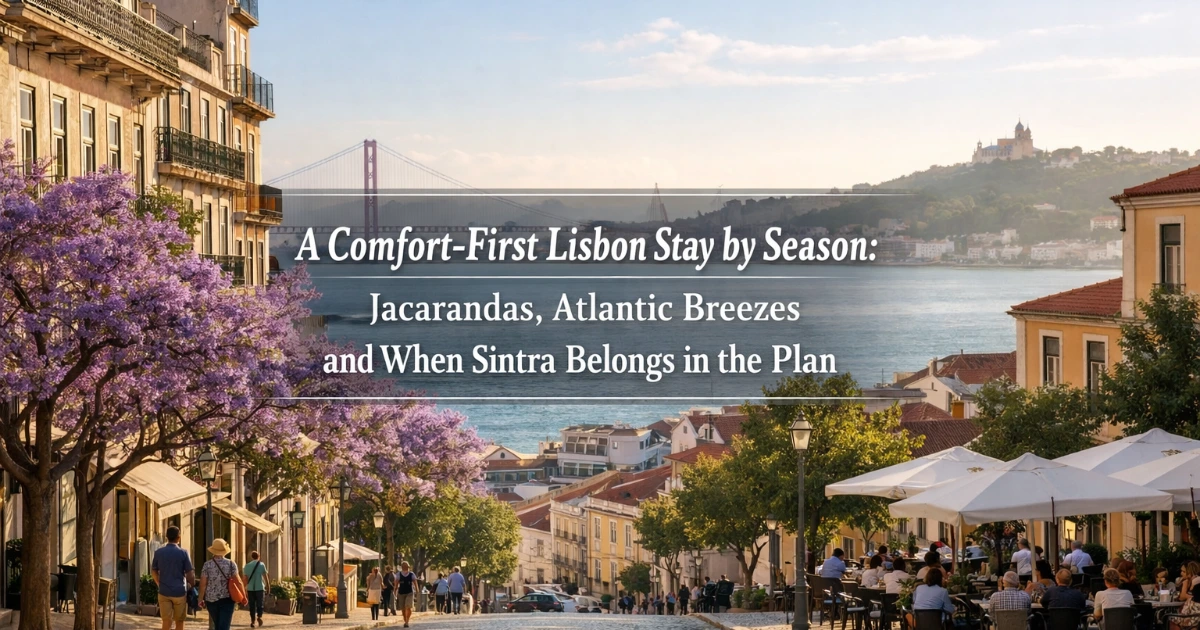
That is why jacarandas are a lovely signal of season, not the decision itself. They genuinely make the city feel special. But the overvalued move is choosing dates for purple bloom on Avenida da Liberdade and then overpacking the stay. Flowers do not rescue a two-night plan that also tries to force Sintra, a hard dinner reservation, and a full Alfama climb.
Best time to visit Lisbon for first-time, comfort-first travelers: a ranked ladder
The ranking is clear: late spring wins, early autumn comes a very close second, winter is more useful than many travelers expect, and midsummer comes last unless school calendars, beach time, or very long daylight matter more to you than route comfort. That ranking is not about romance or atmosphere. It is about how the city behaves when you actually have to move through it.
- 1. Late spring is the best overall choice. This is the season when Lisbon gives you the most range. You can do Chiado in the morning, cross Baixa without feeling rushed, decide whether Alfama is worth the climb, and still have enough appetite and patience for a long evening. The jacarandas are part of the pleasure, but the bigger win is that the city’s best-looking days and its best-moving days often overlap. Riverfront walks are pleasant, viewpoint time is still rewarding, and you are less likely to feel that every decision has to be organized around shade, air-conditioning, or how to avoid the steepest return. For first-time visitors who want classic Lisbon without battling the city’s hardest version of itself, late spring is the season that most often delivers.
- 2. Early autumn is the strongest runner-up, and for some travelers it is the better answer. Early autumn loses only because it does not give you jacarandas. In almost every other practical sense, it can be just as good and sometimes better. The city still feels open to the river, evenings remain attractive, and many travelers arrive with slightly calmer expectations than they do in spring. That matters in Lisbon, because a city often feels easier when you are not trying to squeeze every outdoor icon into the same day. If your trip is about well-paced sightseeing, good lunches, a celebratory dinner, and one or two thoughtful hilltop moments rather than a checklist, early autumn is often the most elegant fit.
- 3. Winter is better than high summer for a surprising number of city stays. This is the most counterintuitive call in the article, and it is the one many experienced travelers eventually make for themselves. Winter is not the best season for uninterrupted postcard light or for a viewpoint-heavy schedule, but it can be a superb season for travelers who care more about good food, museums, a beautiful hotel, and a city that does not punish every uphill hour. Without summer heat, Lisbon’s climbs are less physically wearing. The tradeoff is that the city asks for flexibility: more indoor fallback options, more acceptance that a river evening may not happen, and more honesty about whether Sintra’s mountain weather is helping or hurting the stay. Winter is a good Lisbon season for urban pleasure, but not for travelers who have pinned the whole trip on blue-sky miradouros.
- 4. Midsummer is last for city comfort, even though it can still work. Lisbon’s Atlantic position does moderate the heat, but that help is uneven. A breezy riverfront moment can mislead you into underestimating what happens later on exposed stone and uphill streets. If your stay is hotel-forward, if you plan to add Cascais, or if school holidays dictate timing, midsummer is still absolutely viable. But it is the season that punishes bad sequencing fastest. In midsummer, Belém plus Chiado plus Alfama is not ambitious but doable; it is the kind of plan that tends to erase the evening. The city is still beautiful. It is just less forgiving.
The practical takeaway is simple. If you can choose dates freely, late spring or early autumn are the safest bets. If your dates are fixed outside those windows, do not obsess over finding a miracle week. Chasing a “perfect season” matters less than choosing the right base and pacing. When the season itself is the main design variable, seasonal Lisbon private touring is the most natural next step because the city either simplifies beautifully or starts demanding route control.
How season should change the shape of your Lisbon day
The smartest way to use this guide is to let season change your route, not just your suitcase. Lisbon rewards travelers who redesign the day-flow for the conditions in front of them. The city does not punish everyone equally. It punishes the traveler who keeps the same plan in every season and assumes that shade, breeze, and slopes will somehow sort themselves out.
In late spring, you can be more generous with vertical movement. This is the season when a morning can start in Chiado, drift toward Praça do Comércio, and then make a measured rise toward Sé and Alfama without feeling like a physical negotiation by eleven-thirty. That does not mean everything belongs in one day. It means the city still gives you enough margin to add one meaningful climb and preserve lunch, appetite, and patience. If you want classic first-trip Lisbon, this is when Portas do Sol or Santa Luzia can feel like a reward rather than a demand.
In early autumn, the best day often has a slightly cleaner split. Keep one district for the morning, then shift mood rather than chasing volume. Chiado and Baixa work beautifully as a paired urban core, while the riverfront can carry the afternoon without forcing a second hard ascent. This is a particularly good season for travelers who value the city after dark. The light softens, the temperature usually becomes more agreeable, and the trip often feels calmer simply because you are not defending yourself against the hottest part of the day. If late spring is the season of breadth, early autumn is the season of polish.
In winter, be stricter. Winter rewards a compact center of gravity: Chiado, Baixa, one indoor anchor, one short climb if the day is cooperating, and then a protected return before the light goes flat or the pavements turn slick. The mistake is assuming winter’s lack of heat means unlimited walking. It does not. The city can still tire you through damp stone, wind exposure, and stop-start pacing. Winter Lisbon works best when the day is edited. A shorter, better-shaped route nearly always beats a longer heroic one.
In midsummer, separate the river and the hills. That is the most useful sentence in this article for July and August travelers. Belém, the waterfront, and long lunch territory belong in one mood. Alfama belongs in another, ideally early and limited. Trying to braid them together in one sun-heavy day usually creates dead time: slow uphill returns, overlong cooling-off breaks, and the kind of hotel reset that steals the evening. The Baixa-to-Alfama summer-climb hinge is exactly where many ambitious summer plans unravel, because the climb happens after the easy part has already spent more energy than people realize.
This is also the right place to stop forcing famous transport simply because it photographs well. The nostalgic tram fantasy is not a comfort strategy when the day is hot, crowded, or time-sensitive. If the goal is smoother movement, then smoother movement should win. A comfort-first Lisbon stay is not improved by pretending that every charming mode of transport is automatically the best one for your particular weather, energy, and schedule.
The Baixa-to-Alfama summer-climb hinge is the real comfort test
If you want to know how Lisbon will actually feel, think less about average weather and more about how many times your day asks your body to move from flat to steep on hard stone. The Baixa-to-Alfama summer-climb hinge matters because it catches people at exactly the wrong point: after they have already walked enough to believe the city is easier than its reputation, but before they understand how quickly effort compounds on the climb toward Sé, Santa Luzia, and deeper Alfama.
What Lisbon does to the body
Lisbon loads the calves, ankles, and attention before lunch. Chiado can feel pleasantly urban. Baixa can feel orderly and almost level. Then the transition toward Alfama changes the equation. The climb is not alpine, but it is irregular. The surface changes. The pace breaks. You stop more often than the map suggests, sometimes because of the grade, sometimes because of the stone, sometimes because the city is visually seductive and keeps tempting you to pause at the wrong moment. In mild weather, that creates the happy illusion of discovery. In hot weather, it quietly turns into cumulative fatigue.
The consequence is practical. A summer plan that treats Alfama as just another district after lunch is usually misdesigned. The better version is Alfama first thing, or one hill district only, or a car-assisted day that uses the city’s slopes selectively instead of repeatedly. Travelers who do not make that adjustment often mistake Lisbon for a city that became tiring for no clear reason. In reality, the reason is usually sequencing.
Cobbles change by season, too. In dry shoulder-season light, calçada is mostly an aesthetic and comfort consideration: choose the right shoes, slow your pace, and the day stays pleasant. In wet weather, the same surfaces ask for shorter strides, more concentration, and different route choices. That does not mean Lisbon becomes impossible. It means the city starts charging an attention tax. You can still have an excellent day, but you should spend it in fewer districts.
What Lisbon does to the trip mood
Lisbon’s mood is unusually sensitive to whether the evening survives. A city day that ends with appetite, patience, and enough energy to dress for dinner feels generous. A city day that ends with everyone showering in a rush, ankles talking back, and one person saying they would rather cancel the reservation feels much shorter than it actually was. In shoulder season, the same Chiado-to-Baixa-to-Alfama sequence can still leave space for sunset or a leisurely aperitif. In midsummer, that sequence often spends the evening before you get to it.
This is why the famous all-the-hilltops idea is often the wrong Lisbon day for first-timers, even fit ones. One well-chosen hill district is usually richer than two. Portas do Sol or Santa Luzia may be worth it. Forcing both plus additional climbs is often not. The city rewards restraint more than bravado.
The firm editorial judgment here is that a first-time visitor does not need to conquer Lisbon’s hills to feel they have seen the city properly. In summer especially, the better day is the one that leaves one climb unspent. That is the difference between a city that feels elegant and a city that feels like you worked for it.
When does Sintra belong in a Lisbon stay?
Sintra belongs in a Lisbon stay when you have enough nights to let it stand on its own, or when the palaces and mountain atmosphere matter more to you than maximizing city time. It does not belong automatically just because it is famous, close, or blessed with good weather on paper. This is where many Lisbon plans go wrong: travelers treat Sintra as an easy bolt-on, when operationally it behaves like a separate day with its own rules. Central Rossio station, timed palace entries, mountain transfers, and the final approach to the monuments all matter more than the simple map distance.
Those rules matter because they change what close to Lisbon really means. A day can start centrally and still become brittle if you miss a timed palace slot, if you underestimate transfer time from the station, or if you assume a private vehicle will remove all friction. It will not. Premium logistics help. They do not suspend mountain rules. That is also why Sintra is best understood as a day with a commitment cost. Once it is in the plan, other pieces of the stay usually need to become simpler.
The Sintra day on a short spring stay
On a short spring stay, Sintra is the first thing to cut unless Sintra is the emotional reason for the trip. This is the hard call, and it is the one most travelers need. Spring is when Lisbon itself is at its most generous: jacarandas, usable mornings, lovely riverfront hours, and the best odds that Chiado, Baixa, and a measured Alfama outing will all still feel rewarding. Leaving the city for Sintra on a two-night or tight three-night spring break often means sacrificing Lisbon precisely when Lisbon is easiest to enjoy.
The threshold is simple. If you have only enough time for one long city day and one partial day, keep Sintra out. If you have enough time for a genuine city day plus a separate excursion day, it can belong. If your larger question is still about overall stay length rather than timing, read how many days in Lisbon.
In practical terms, a short spring stay overloaded by Sintra usually fails in the evening. You return later than planned, still have an uphill hotel approach or a dinner booking to make, and suddenly the city part of the trip feels rushed even though the calendar was full. The better spring use of Sintra is on a longer Lisbon stay, or when the whole outside-the-city day is designed around it rather than squeezed beside a maximal city plan. When Sintra clearly belongs, a dedicated Sintra and Cascais private day earns its place because the mountain day stops competing with Lisbon and starts complementing it.
The Sintra day on a windy winter stay
On a windy winter stay, Sintra can still be the right call, but only if you accept what kind of day it becomes. Winter Sintra can feel atmospheric, wooded, and memorable for the right traveler. It can also feel administratively fragile for the wrong one. If the appeal is mist, interiors, forested drama, and one serious excursion balanced by lighter city hours, it can be excellent. If the appeal is postcard certainty, winter is the wrong season to force it.
This is the condition that flips the answer: in winter, Sintra belongs when it is the point of the day and Lisbon is deliberately simplified before or after. It overloads the stay when travelers treat it like a small add-on between neighborhoods. A winter city break can absorb Sintra if Lisbon is doing Chiado, Baixa, one museum, one dinner, and perhaps a short look at Alfama. It struggles when the plan also expects long miradouro time, extensive outdoor wandering, and a late uphill hotel return.
The trust-building correction here is that good weather alone does not determine whether Sintra belongs. The real issue is whether the day has space to breathe. A short spring stay can be more overloaded by Sintra than a longer winter stay, because the spring stay tempts people to do everything while the winter stay naturally encourages them to choose.
For couples and celebration travelers, that difference is especially important. Honest winter Sintra can feel cinematic. Overpromised winter Sintra feels administratively fragile. Honest spring Sintra can feel like the highlight of a wider trip. Overloaded spring Sintra often feels like the day that stole Lisbon from you.
When Cascais adds value, and when it is the smarter substitute
Cascais is the better pressure valve when Lisbon has already given you enough hills or enough heat. It adds value when what you want is sea air, gentler walking, a civilized lunch, and a day that feels easier rather than grander. That is why Cascais is often the more successful outside-the-city choice on high-summer stays, on family trips, on celebratory weekends with dinner plans, and on itineraries where Alfama is already doing the heavy lifting for atmosphere.
In hot weather, Cascais often beats Sintra for overall trip comfort. The Atlantic edge helps, the walking is generally kinder, and the day is usually more compatible with a proper evening back in Lisbon. For travelers managing knees, strollers, older parents, slippery footwear, or simple heat sensitivity, that difference is not cosmetic. It is the difference between arriving back ready for a drink and arriving back ready for a lie-down.
Cascais also works well when the city stay already includes one meaningful hill district. Lisbon has already provided texture, vertical drama, historic lanes, and lookout moments. The smartest add-on may be contrast, not more complexity. A hot-weather pattern of Chiado one day, Alfama one morning, and Cascais as the outside-the-city day is often more enjoyable than trying to prove you can do every famous name on the map.
Sintra still wins when the trip is emotionally about palaces, Romantic architecture, wooded atmosphere, or a classic first-time Portugal image. Cascais is not a heritage replacement for Sintra. It is the smoother answer when the body is already negotiating Lisbon’s slopes and the mood of the trip needs one easy-breathing day instead of one more operationally dense one.
That is why a comfort-first Lisbon stay does not need both Sintra and Cascais unless you have enough nights to let them breathe. On shorter stays, one outside-the-city day is usually plenty, and the right choice depends less on fame than on whether the rest of the trip already has enough climbing in it.
Where a private car changes the answer, and where it does not
A private car changes the answer when the day spans disconnected districts, when the weather is punishing, or when someone in the party is managing mobility, energy, or outfit constraints. It changes much less when the day is basically one coherent walking neighborhood with pleasant weather and no time pressure.
Summer heat
In summer, the car pays back not through glamour but through fewer exposed resets. It matters most on days that would otherwise stack Belém, Chiado, a viewpoint, and Alfama into one chain of hot transfers. In those cases, the vehicle is not replacing all walking. It is stripping out the least rewarding walking: the repeat climbs, the awkward returns to the hotel, the moment when a riverfront lunch is followed by an uphill district at the hottest point of the day. Lisbon’s sea-modified climate helps, but it does not cancel the fatigue created by repeated grade changes on stone.
Wet weather
In wet weather, the value is continuity. You stay warm, you avoid waiting on slippery curbs, and you reduce the number of cautious descents on calçada. This is when Lisbon starts feeling longer than it looks. Distances do not change, but every transition gets slower. A car does not make the city dry. It simply stops the weather from owning the entire day.
Sintra is the place to be especially honest. A driver simplifies the Lisbon-to-mountain transfer, helps with timing, and reduces uncertainty, but it does not override access rules. Premium spend helps the day; it does not buy your way out of the mountain’s structure. That matters for expectations as much as comfort. A good driver can remove dead time, but cannot remove the final logic of the site itself.
Mobility-sensitive travel
For older parents, travelers with knees or balance concerns, families with young children, and celebration travelers who do not want to dress for dinner after a punishing uphill return, the value of a car is obvious. Lisbon is manageable for many people, but it is not a neutral city. Stairs, slopes, cambered stone, and uneven energy demands make a real difference once you are no longer designing for the average fit adult in sneakers.
A chauffeured Lisbon day does not materially improve a mild-weather, one-district plan in Chiado, Baixa, and one short riverfront stretch; there, you are paying for a vehicle you will keep leaving behind.
Where extra spend really earns its cost is when the plan would otherwise ask for repeated uphill re-entries, hotel resets between districts, unpredictable weather hedging, or multi-generational compromise. That is when a chauffeured Lisbon day stops feeling ornamental and starts feeling like the cleanest way to protect the day’s shape.
Protect the evening before you protect the checklist
When the stay starts feeling crowded, cut the second hill district first, then cut Sintra from the short stay before you cut the evening. That is the most useful planning rule in this article. Lisbon is a city where a preserved evening makes the whole trip feel longer. Lose the evening, and the city suddenly feels effortful even when the hotel is lovely and the meals are good.
The common mistake is to protect the checklist and sacrifice the mood: Belém because it is famous, Alfama because it is iconic, Sintra because it is nearby, and dinner because it was hard to book. The wiser sequence is to protect what makes the stay feel generous. One hill district, one outside-the-city day at most, and one evening that still belongs to you will usually outperform a fuller itinerary.
If you are trying to return from Sintra and still make a meaningful dinner without stress, use the Pena official site (https://www.parquesdesintra.pt/en/plan-your-visit/tickets-palace-of-pena/) and the CP official PDF (https://www.cp.pt/info/documents/d/cp/completo-comboios-urbanos-lisboa) before you promise yourself that the day will run tightly enough to protect the night. Timed palace admission and real train timing are what decide whether the evening survives, not the fact that Sintra looks close on the map.
Some seasons let Lisbon stay wonderfully simple. Other seasons are exactly when a driver-led day or a cleaner day-trip design pays back your evening, your dinner, and your patience. Inquire now
FAQ
What is the best season for Lisbon if I dislike steep walking and heat?
Late spring is the strongest overall answer, with early autumn a very close second. Those are the periods when Lisbon’s hills, riverfront, and viewpoint hours are easiest to combine without sacrificing the evening. Winter can also work well if your trip leans toward dining, museums, and shorter outdoor stretches rather than long miradouro circuits.
Is spring always the best time to visit Lisbon?
No. Spring is the best-looking and most forgiving season for many travelers, but it is not automatically the best plan. If you only have two nights, or if you tend to overpack city stays, spring can tempt you into doing too much because everything feels possible. That is why base choice and pacing matter more than chasing a perfect season. Jacarandas are a bonus, not a planning system.
Should I do Sintra on a two-night Lisbon stay?
Usually no, unless Sintra is the main emotional reason for the trip. On a short stay, Lisbon itself needs the time more than most travelers expect, especially if you want Chiado, Baixa, and a proper Alfama outing without rushing back uphill late in the day. Sintra becomes much more sensible when you have enough nights to give it a full day of its own.
Can Sintra still work in winter?
Yes, but only when you accept that winter Sintra is about atmosphere, interiors, and mood rather than guaranteed postcard conditions. The day needs flexibility and a lighter city schedule around it. Winter Sintra works best when it is the point of the day, not a quick add-on between Lisbon neighborhoods.
Is Cascais or Sintra better in summer?
Cascais is usually better for pure comfort in summer because it gives you easier walking, sea air, and a day that sits more gently beside a Lisbon stay. Sintra is still the stronger choice if palaces and mountain atmosphere are the point. The question is not which place is more famous. The question is whether your trip needs contrast and breathing room or one more operationally dense day.
Do I need a private car for Lisbon itself?
Not for every day. If the weather is mild and your plan is basically one district with coherent walking, you can do wonderfully without it. It becomes much more valuable when the day crosses several districts, when the heat is high, when rain makes cobbles slow and tentative, or when someone in the party is mobility-sensitive. The gain is in smoother transitions, not in replacing all walking.
Does a driver solve Sintra logistics completely?
No. A driver simplifies the city-to-mountain transfer and lowers stress, but it does not override the structure of the day. Even premium logistics still have to respect the mountain’s operating rules and the timing logic of the sites themselves.
When do jacarandas actually matter to the decision?
They matter as a tie-breaker, not as the whole answer. If you are already leaning toward late spring, jacarandas make the city feel especially rewarding. But they do not justify overloading a short itinerary, and they do not matter more than choosing the right base, limiting the number of hard climbs, and deciding honestly whether Sintra belongs inside the stay.
If you’re interested in any private tours of Lisbon, please reach out to us.



 So if you are looking for the absolute best in Lisbon & surroundings with authentic local fully-licensed native guides whose English you can actually understand and with an exclusive and amazingly fun itinerary













