Granada With an Alhambra-Hill Hotel: Dinner Returns, Driver Timing and When the View Costs Energy

Updated
Stay on the Alhambra hill when the view is part of your room-time, your Alhambra visit is central, and your dinners are either close to the hotel or deliberately driver-timed. It works because Granada compresses the palace, the wooded slopes, Realejo, the Darro edge and the lower city into a small map that is not physically small after dark: the Alhambra-hill hotel return decides whether the view feels romantic or burdensome. The clearest exception is a traveler who wants a serious dinner night, tapas drift, or a late Realejo-to-Centro stroll without negotiating an uphill finish. In Granada, an Alhambra-hill hotel is not a status decision; it is an evening-return decision.
The non-obvious hinge is Cuesta de Gomérez. In daylight, the climb through Puerta de las Granadas can feel like a graceful approach to the Alhambra woods. After dinner, in dress shoes, after wine, or with a family member who is done walking, that same route becomes a test of whether the hotel choice was genuinely considerate. That is why this guide is narrower than a general where-to-stay article. For the broader neighborhood comparison, start with Centro, Realejo or Albayzín for a comfort-led Granada base; here, the question is only whether sleeping near the Alhambra improves the trip enough to justify the return mechanics.
The verdict: stay high only if the return route is designed
An Alhambra-hill hotel is a strong choice when you want Granada to revolve around the Alhambra, quiet room time and one or two carefully placed evenings, not spontaneous lower-city grazing every night. The hill gives you atmosphere, a slower morning, and the feeling that the palace is not a commute. It also gives you an unavoidable fact: every lower-city dinner, every Realejo drink, every Cathedral-quarter detour and every late Albayzín viewpoint plan has to end somewhere uphill.
The best version of this stay is not “book the room with the view and improvise.” It is “book the room with the view, then decide which evenings deserve a driver, which walks should descend rather than climb, and which meals belong near the hotel.” When that design is in place, the hill feels like a reward. When it is missing, the same view can start charging energy at the exact moment the day should be loosening.
The firm editorial call is this: an Alhambra-hill hotel wins for a palace-centered, low-sprawl stay, but it is not the automatic best Granada base for a premium trip. A lower-city base is better than an Alhambra-hill hotel when your strongest evenings are Realejo dinners, Cathedral-quarter tapas, or a restaurant you found through the MICHELIN Guide selection (https://guide.michelin.com/us/en/andalucia/granada/restaurants) that ends below the hill. Paying for a better view does not compensate for hard dinner returns.
Use the hill when the trip looks like this:
- Your Alhambra visit is the emotional center of the stay, and you want the palace setting to shape breakfast, quiet hours and the first look from the room.
- You are happy to choose one planned dinner rather than drifting through three or four lower-city stops after dark.
- You value a calmer hotel arrival after the Alhambra more than you value stepping out into a flat restaurant grid.
- You are traveling as a couple or small group that can agree on walking load, shoe choice and whether the night ends by foot or by car.
Keep the base lower when the trip looks like this:
- Dinner is the anchor of the day, especially in Realejo, around Plaza Nueva, near the Cathedral, or deeper in the lower city.
- You want tapas without a finish line, where one bar can become two and a quick after-dinner walk does not require a climb.
- You have older parents, children, heat sensitivity, or anyone who may be cheerful at 7 p.m. and finished at 10 p.m.
- You expect a driver to solve everything, even though some of Granada’s charm and many of its old-street constraints still require walking at the edges.
When the view is worth the hill
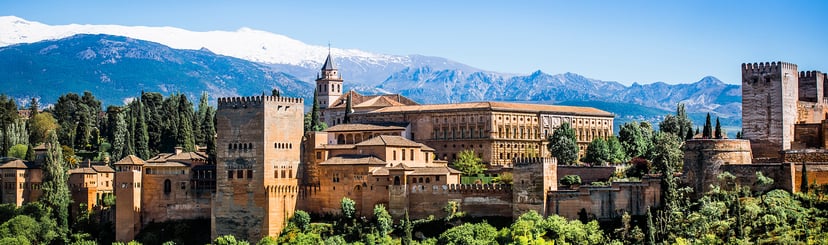
The view is worth the hill when you will actually use it, not simply photograph it once. A room or terrace facing the Alhambra woods, the city bowl or the Sierra Nevada backdrop changes the trip when it gives you a reason to pause between the monument and dinner, wake slowly before a timed visit, or end the evening without needing one more viewpoint. The value is not only scenic. It is the permission to stop.
This matters in Granada because the Alhambra is not a single compact interior. A good visit can involve palaces, gardens, exterior walks, thresholds, security checks, timed-entry awareness and a great deal of stone underfoot. Even with a private guide, the day asks for attention. Staying high can reduce the mental distance between “we have to get to the Alhambra” and “we are already in its orbit.” For travelers who dislike morning transfer anxiety, that is a real gain.
The Alhambra hill also gives a couple a mood advantage when the hotel itself becomes part of the itinerary. The mood-preserving decision is to let the hotel absorb one evening: arrive back from the palaces, clean up, sit with the view, then go to a dinner that does not require a long descent-and-climb cycle. The mood-killing mistake is to spend for the view and then schedule every night below the hill, turning the hotel into a beautiful place you keep leaving and returning to when you are tired.
This is also where a private Alhambra plan earns its keep. A guided visit through the palace and Generalife can be arranged around the way your day should feel after the visit, not only around the entry itself. The relevant question is not “Can we see the Alhambra?” but “Can we see it without using all of the energy we meant to spend on dinner, conversation and the next morning?” For a more site-specific next step, see Orange Donut Tours’ Alhambra and Generalife private visit.
Scenario markers that make a hill hotel work
Choose the hill when your Granada stay has one dominant center of gravity. The more the trip is about the Alhambra itself, a quiet celebration, or a low-switching room-and-view rhythm, the more the hill earns its cost. The more the trip is about spontaneous food, shopping, late walks or neighborhood hopping, the more the view has to fight your actual behavior.
- A two-night couple stay built around the Alhambra: stay high if night one is a gentle arrival and night two is a planned dinner with the return already solved. Do not add a late Albayzín viewpoint on top of the Alhambra day just because the map makes it look close.
- A celebration trip: stay high if the view is part of the celebration ritual: a terrace pause, a slower breakfast, a private guide meeting you at the right moment, and a dinner that does not end with a morale-testing climb.
- A chauffeur-led Andalusia sequence: stay high if you are arriving by driver, your luggage is handled cleanly, and the Alhambra is placed before or after a calm hotel hour rather than squeezed between transfers.
- A food-and-wine stay: think twice. If the best dinner is below the hill, solve the return before booking the room. The restaurant may be worth it; the uphill afterthought rarely is.
The point at which the hill starts charging interest
The hill becomes expensive in energy when you treat every descent as effortless and every return as someone else’s problem. Granada’s map is compact enough to tempt overconfidence. Plaza Nueva, Carrera del Darro, Realejo, Campo del Príncipe, the Cathedral quarter and the Alhambra woods sit close together on screen. The body does not experience them as a flat cluster.
What the city does to the body is cumulative. The Alhambra adds stone surfaces, standing time and attention fatigue. Cuesta de Gomérez adds incline. Realejo adds small grade changes that feel charming early and heavier late. Albayzín adds cobbles, stairs, uneven turns and the temptation of one more mirador. The lower city adds pedestrian density around the Cathedral, Alcaicería and Bib-Rambla. None of this is dramatic in isolation. Combined into one day, it changes the way dinner feels.
The counterintuitive correction is that a glamorous high base can be less comfortable than a simpler lower-city base if your evenings are ambitious. A traveler who books the hill because it sounds more special, then reserves two lower-city dinners and a late Albayzín walk, has not upgraded the stay. They have bought a view and added a nightly logistics bill. In that case, Realejo or the Cathedral edge can produce a calmer trip because the last mile is less theatrical.
There is also a social consequence for couples and small groups. One person may love the idea of walking down through the Alhambra woods; another may be thinking about heels, heat, knees, or whether the return will feel exposed and uphill after dinner. If the plan requires everyone to pretend the climb is romantic, the hill has already started to damage the evening. A thoughtful plan lets the descent be optional and the return settled.
Cut first from a hill-hotel stay: the extra viewpoint. Not the Alhambra, not the hotel pause, not the dinner you came for. Cut the “while we are here” viewpoint that stacks Albayzín or Sacromonte after a palace day and before an uphill hotel return. Granada rewards selectivity. One excellent view used at the right moment beats three views that leave the group quiet in the wrong way.
How should dinner returns work from an Alhambra-hill hotel?
Dinner returns should be decided before you leave the hotel, not negotiated at the end of the meal. This is the central rule for an Alhambra-hill hotel stay. A good evening plan answers three questions in advance: are we descending on foot, how are we getting back, and is the meal worth the return it creates?
A Realejo dinner descent is often the most revealing test. Realejo sits close enough to the Alhambra slope to look simple, and it can be a beautiful neighborhood for a meal or a pre-dinner walk. But the return changes depending on where you end: Campo del Príncipe is not the same as a table tucked higher toward Calle Molinos, and a post-dinner wander toward Plaza Nueva changes the geometry again. Dinner geography reveals the real cost of the hill.
For a lower-city or Realejo dinner, the best rhythm is usually to enjoy the descent as part of the evening and remove uncertainty from the return. Walk down while the group is fresh, especially if the route through Cuesta de Gomérez or the Realejo edge is part of the pleasure. Then use a driver or taxi return if the dinner is late, the group is dressed up, or the day already included a full Alhambra visit. This keeps the walk from becoming a test of pride.
For a serious tasting-menu or MICHELIN-researched dinner, the return deserves even more attention. A long meal changes posture, pace and patience. Confirm the meal structure through the restaurant’s own page when relevant; for example, Faralá – Carta & Menús (https://restaurantefarala.com/carta/) is the kind of direct source travelers should check before deciding whether dinner is a light evening or the main event. Then plan the return as part of the booking, not as an afterthought. The better the meal, the less you want the final memory to be a tired climb.
If dinner is casual tapas, the hill can be either charming or limiting. Granada’s tapas culture invites movement, but hill-hotel guests need a boundary. Choose a zone before you start: Realejo for a more contained evening, Plaza Nueva and the Darro edge for atmosphere, or the Cathedral quarter when you want lower-city ease. Do not start in Realejo, drift to the Cathedral, add a Darro walk, and then expect the hotel return to feel light. That is how a small city becomes a long night.
The lower-city base wins when dinner is the trip’s main pleasure. A traveler who wants to compare bars, linger after dessert, or decide late whether to add one more drink will be happier sleeping closer to the Cathedral, Plaza Nueva, or lower Realejo than above the Alhambra woods. This is not a downgrade. It is an honest match between the hotel door and the evening you actually want.
For dining planning beyond this hill-specific question, use Orange Donut Tours’ Granada fine-dining guide as a restaurant-layer companion, then return here to decide whether your hotel geography makes that dinner feel easy or expensive in energy.
Driver timing: when the chauffeur changes the day and when walking wins
A driver helps when the pickup is timed around the hill; a driver does not help when it is used as decoration. In Granada, a chauffeured day is valuable at the transitions that would otherwise drain the group: arrival with luggage, movement to or from the Alhambra after a timed visit, a dressed-up dinner return, or a day that combines the palace with lower-city context. It is less valuable when the best part of the route is a short downhill walk and the car would interrupt the city rather than ease it.
The most useful driver moments are not always the longest transfers. A well-timed pickup after dinner can be worth more than a full evening of vehicle availability. A drop near the Alhambra access can be worth more than circling the city in comfort. A car waiting after a lower-city lunch can save the mood of a hot day, while a car between Plaza Nueva and a nearby Realejo stop may only add delay. The value is in knowing which edges of the plan are tiring and which are meant to be walked.
Walking wins when the route is downhill, scenic and short enough to be part of the experience. Descending through Puerta de las Granadas toward Plaza Nueva, or easing from the Alhambra side toward Realejo before dinner, can make the city feel intimate. A driver wins when the route is uphill, late, hot, dressed-up, or attached to a non-negotiable time. Driver pickup timing is the difference between a chauffeur changing the day’s movement and a chauffeur merely looking luxurious on paper.
The Alhambra itself sharpens this distinction. A private guide can pace interpretation, choose where to slow down, and help the visit feel coherent. A driver can reduce transfer strain before and after that visit. Neither one abolishes the city’s slopes. The strongest plan combines guided depth with selective vehicle use: guide the monument and the meaningful streets; drive the returns that would flatten the group.
This is where a tailor-made plan becomes commercially relevant without being ornamental. If the day involves a hill hotel, Alhambra timing, Realejo dinner and a lower-city stop, the issue is not whether a chauffeur is “luxury.” The issue is whether the route has too many climbs, late decisions and exposed seams. Orange Donut Tours can pair the Alhambra visit, neighborhood context and driver windows so the car appears where it changes the day rather than where it photographs well. For that kind of routing, see a luxury chauffeured Granada private tour or Inquire now.
What to keep in the lower city when you sleep on the hill
Keep lower-city sights and errands grouped into one clean block when your hotel is on the hill. The mistake is not visiting the Cathedral quarter, Royal Chapel, Alcaicería, Plaza Bib-Rambla, Plaza Nueva or Realejo. The mistake is sprinkling them across the day so the hotel becomes a repeated climb rather than a refuge.
A hill-hotel stay works best when the lower city is treated as a single descent with a clear purpose. That might mean late morning Cathedral and Royal Chapel context, a light lunch near the center, then a return uphill before the evening. Or it might mean a late afternoon Realejo walk that slides into dinner, followed by a planned ride back. What rarely works is morning Alhambra, hotel, Cathedral, hotel, Realejo dinner, hotel, then “maybe Albayzín if we still have energy.” That is not curation; it is stair-step fatigue.
Granada’s lower city is where practical life belongs. Shopping in the Alcaicería, meeting a guide near Plaza Nueva, reading the Royal Chapel in context, pausing around Bib-Rambla, or moving toward the train station on Avenida de Andaluces all make more sense when grouped. If you sleep on the hill, keep errands, casual browsing and lower-city logistics away from the hotel’s romantic hours. Let the hill be the place you return to deliberately, not the place you keep interrupting.
Realejo deserves special treatment because it can serve either the hill or the lower city depending on how you use it. It is often the best compromise neighborhood for dinner when you want character without committing to the full Albayzín climb. Yet Realejo is not flat, and its charm depends on not rushing the edges. If your dinner plan is centered there, read the more focused Realejo strategy in Granada’s Realejo strategy before assuming the Alhambra hill is still the superior base.
The lower-city block is also the place to protect shopping and food curiosity from the Alhambra’s gravity. The Alhambra is demanding enough that it can make every other stop feel secondary if you attach them casually afterward. Put lower-city texture on its own footing. A short Cathedral-quarter morning or a Realejo dinner with breathing room is stronger than a scattered list of “nearby” additions that leave no one sure what the day was about.
The Albayzín question: do not stack two hills into one evening
The Albayzín should usually be separated from an Alhambra-hill dinner return unless the evening is intentionally built around it. This is the planning point many travelers miss. The Alhambra hill and the Albayzín face one another beautifully, but that visual relationship does not make them effortless companions after a full palace day.
From an Alhambra-hill hotel, the temptation is obvious: see the Alhambra, rest at the hotel, cross toward Carrera del Darro or Paseo de los Tristes, climb into the Albayzín, take in a mirador, eat, and return. The problem is not any one piece. The problem is the sequence. The Darro edge is atmospheric, the Albayzín lanes are textured, and views toward the Alhambra can be memorable. But by the time you add the return to the hotel, you have stacked slopes, cobbles, dinner timing and navigation into the part of the day least suited to negotiation.
For many couples, the Albayzín works better as a guided half-day or early evening with a defined finish, not as a spontaneous add-on after dinner below the hill. A private route can start high enough to avoid needless climbing, include the right mirador, explain the neighborhood without turning it into a maze, and end near a practical dinner or driver point. If that is the version you want, use a private Albayzín route rather than trying to absorb the neighborhood through leftover energy.
When should you combine Albayzín and an Alhambra-hill hotel? Combine them when the Albayzín is the evening, not a bonus. Keep dinner simple or nearby, agree that the viewpoint is the purpose, and arrange the finish. Do not add Sacromonte unless the night is built for it. Do not make Mirador de San Nicolás the automatic goal if the group would be happier with a gentler Darro-edge walk and a clean return. The famous view is not a moral obligation.
This is also the section where premium spend has to be judged honestly. A higher room category can make mornings and pauses feel wonderful. It cannot make two hill neighborhoods feel flat. Spend on the view when you will use it at restful moments. Spend on a guide or driver when the movement itself needs shaping. Do not spend on a high hotel and then force the most tiring version of the evening because the room was expensive.
A high-comfort rhythm for a hill-hotel stay
The best rhythm for an Alhambra-hill hotel is a one-descent day, not a repeated shuttle between romance and obligation. Think of the hill as a place to begin and end intentionally. The day should have fewer switches than a lower-city stay, because each switch has a vertical cost.
On arrival day, do not rush to prove you are in Granada by adding every nearby neighborhood. Arrive, settle, take the view seriously, and use the lower city only if the evening return is simple. A short descent to Plaza Nueva or Realejo can be enough. If you are arriving from Córdoba, Seville or Málaga, remember that luggage, check-in timing and first-day fatigue can make the hill feel heavier than it is. A driver-assisted arrival can help here because the issue is not distance; it is the handoff between transfer, bags, hotel access and first impression.
On Alhambra day, give the palace the cleanest part of your attention. If your entry is in the morning, avoid loading the afternoon with Albayzín climbs. Use the hotel for a real pause, then choose either a contained dinner or a driver-timed lower-city meal. If your entry is later, keep the morning low and gentle: Cathedral quarter, Royal Chapel context, or Realejo lunch can work, but only if you leave enough energy for the palace and do not climb before you need to.
On the second day, let the lower city or Albayzín have its own identity. A hill hotel can still support a strong neighborhood day, but the sequence should be deliberate: descend once, stay in the chosen zone, and return once. This is where travelers often need editorial restraint. Granada offers enough nearby texture to make overplanning look reasonable. The better trip usually cuts one “nearby” stop and deepens the one that remains.
For a celebration, the calmest version is often the simplest: Alhambra or gardens, hotel pause, dressed dinner, driver return. The extra flourish is not another hill. It may be a guide who connects the palace to the city before dinner, a reserved return that keeps the end graceful, or a room hour that lets the view do what you paid for. In a small city with steep edges, elegance often comes from subtraction.
How to decide before booking the hotel
Decide by mapping the last movement of each night, not by comparing hotel photos. The final movement is what guests remember when they are tired. Ask where dinner is likely to be, how late it may end, whether anyone will dress for it, and whether the group will still enjoy a climb afterward.
Use four filters. First, the Alhambra filter: will being high reduce timing pressure around the palace, or will it only duplicate a visit you already have well arranged? Second, the dinner filter: are your best meals on or near the hill, or below it? Third, the body filter: does anyone in the group dislike slopes, uneven paving, heat load or late-night walking? Fourth, the mood filter: will the hill make the stay feel more secluded, or will it make every evening feel like a negotiation?
The body filter is especially important for families and multigenerational groups. Children may handle the downhill with excitement and resist the uphill with precision. Older parents may enjoy the Alhambra deeply and still find the return one climb too many. Couples may discover that the person who loves views is not the person who wants to walk back after a long dinner. These are not minor preferences. They decide whether the hill feels like a gift or a recurring bill.
The mood filter is just as real. A hill hotel can make Granada feel slower, more private and more connected to the Alhambra. It can also make the day feel shorter because every evening has a known finish line. Lower-city hotels are not automatically less atmospheric; they often give a better evening rhythm because wandering does not require a return strategy. Choose the hill when seclusion is the mood. Choose lower when conversation, food and street life are the mood.
Before booking, write one sentence for each night: “We return by walking,” “We return by driver,” or “We stay near the hotel.” If you cannot write that sentence without hedging, the hill may be the wrong base. If the answer is clear and pleasant, the view is more likely to earn its cost.
Granada rewards travelers who choose the hill for the right reason and refuse to make it solve the wrong problem. Driver pickup timing is the closing test: if the car appears after the descent, dinner or Albayzín finish, it supports the stay; if it is vague, the hill will collect energy at night. Let the Alhambra-hill hotel return shape the booking before the room view does. When the final climb is designed, the hill can feel like part of the stay’s grace. When it is ignored, the same view costs energy exactly when the trip should feel most at ease.
FAQ
Is it worth staying near the Alhambra in Granada?
It is worth staying near the Alhambra when the palace visit, room view and quiet hotel time are central to the trip. It is not worth it when most dinners, tapas walks and late evenings are planned below the hill without a return plan.
Is an Alhambra-hill hotel better than Realejo for dinner?
No. Realejo is usually better for dinner movement because it sits closer to lower-city restaurants and makes the end of the night easier. An Alhambra-hill hotel is better when dinner is contained, driver-timed, or secondary to the hotel view.
Can we walk back to an Alhambra-hill hotel after dinner?
Yes, but it depends on the route, shoes, heat, timing and group energy. A downhill walk before dinner can be lovely; the uphill return after dinner is the part to judge honestly before you book the hotel.
When does a driver help with an Alhambra-hill hotel?
A driver helps most for luggage arrivals, post-Alhambra transfers, dressed-up dinner returns and late uphill finishes. Walking still wins for short downhill routes that are part of the pleasure of being in Granada.
Should we stay on the hill if we have a MICHELIN Guide selection dinner?
Only if the return is planned before dinner. A MICHELIN Guide selection dinner may justify a lower-city evening, but the hotel should not turn the final movement into the hardest part of the night.
Should we combine Albayzín with an Alhambra-hill hotel evening?
Combine them only when Albayzín is the main evening plan. Do not add Albayzín as a casual extra after the Alhambra and dinner unless you have built the route around the extra hill and the return.
What should stay in the lower city if our hotel is on the hill?
Keep Cathedral-quarter sights, Royal Chapel context, Alcaicería browsing, casual tapas and Realejo dinners grouped into one lower-city block. Avoid repeated hotel returns that turn the hill into a daily obstacle.
What is the simplest rule for booking an Alhambra-hill hotel?
Book it if you can name a pleasant return plan for every night. Choose a lower-city base if the view is attractive but the dinners, walks and late decisions you actually want all happen below the hill.
If you’re interested in any private tours of Granada, please reach out to us.



 So if you are looking for the absolute best in Granada & surroundings with authentic local fully-licensed native guides whose English you can actually understand and with an exclusive and amazingly fun itinerary













