Retiro, Campo del Moro or El Capricho? Choosing a Madrid Garden Study by Design, Court History and Travel Time

Updated
Which Madrid garden fits the question you actually want to answer?
Choose Retiro when you want to study how a royal estate became a large civic landscape, and when the day already contains the Prado, Thyssen-Bornemisza, Reina Sofía or another commitment along Madrid’s museum axis. Its value lies in layers: seventeenth-century court origins, surviving traces of the Buen Retiro complex, later promenades, monuments, exhibition buildings and everyday public use. It is the easiest of the three to shorten, extend or enter from a direction dictated by another reservation.
Choose Campo del Moro when the Royal Palace is the central object and the garden should explain how architecture, slope, fountains, wooded ground and long views stage royal presence. It is geographically central, but it is not simply the palace’s flat back garden. The drop toward the Manzanares and the position of its entrances determine how much effort and time the visit requires. Its opening regime is also more controlled than Retiro’s, so a palace-area day needs sequencing rather than assumption.
Choose El Capricho when landscape design itself is the principal subject: the patronage of the IX Duchess of Osuna, the coexistence of French, English and Italian garden idioms, the use of small buildings and classical references, and the intellectual world of a late-eighteenth- and early-nineteenth-century suburban villa. El Capricho asks for the largest commitment because it sits in Alameda de Osuna, away from the central museum and palace districts, and because its public opening is limited to weekends and public holidays under the current municipal schedule.
The decision is therefore not a beauty contest. Retiro, Campo del Moro and El Capricho preserve different kinds of evidence. Retiro is strongest as a palimpsest of court and city. Campo del Moro is strongest as a royal setting organized by topography and the palace façade. El Capricho is strongest as an aristocratic design project composed through contrasting garden languages and episodic architecture. Mobility, season and the day’s fixed cultural appointment can reverse the choice that looks most attractive on historical grounds alone.
Use five criteria before choosing
- The historical question: Do you want to understand a royal site absorbed into the modern city, a palace garden that frames monarchy through space, or an aristocratic estate shaped by an individual patron’s cultural ambitions?
- The kind of surviving evidence: Retiro rewards comparison between fragments and later additions. Campo del Moro rewards reading an axial relationship and a steep site. El Capricho rewards close attention to designed episodes, stylistic contrasts and restored architectural features.
- The fixed appointment: A Prado, Thyssen or Reina Sofía reservation naturally favors Retiro. A Royal Palace or Royal Collections Gallery reservation favors Campo del Moro. El Capricho generally deserves a separate half-day rather than being squeezed between central admissions.
- The mobility profile: Total distance is only one measure. Retiro is extensive but easy to edit; Campo del Moro is more bounded but its grades and entrance choice matter; El Capricho has many principal routes described by the city as accessible, yet the outward journey and the desire to see dispersed features can make the whole undertaking longer.
- The calendar: Retiro has the broadest daily opening window. Campo del Moro follows seasonal hours and may change access for weather or official activity. El Capricho’s weekend-and-holiday schedule can decide the matter before design preference enters the discussion.
For repeat visitors, the most productive sequence is to choose the intellectual purpose first, then test it against the day’s geography. Reversing that order often produces an attractive but shallow walk: the garden nearest a museum gets added because it is convenient, yet the route never reaches the evidence that made the garden worth choosing.
Three landscapes, three systems of patronage
The distinction among royal, civic and aristocratic patronage is not a label to attach after the visit. It changes what the landscape was expected to do, who was meant to see it, and which elements now carry historical meaning.
Retiro began in 1630 as a Real Sitio for Felipe IV, according to the Madrid City Council’s official Retiro listing. The site later opened to public use and passed into municipal management. That transition is central to its meaning. The modern park is neither an intact court garden nor merely a municipal green space; it is a royal landscape repeatedly reinterpreted by a growing capital. The broad public life visible today is part of the historical argument rather than a distraction from it.
Campo del Moro remains inseparable from the Royal Palace and from national royal heritage. The garden seen today is substantially a nineteenth-century composition, even though the palace above it and the site’s royal associations belong to a longer chronology. Its strongest evidence is spatial: a dramatic elevation change, a long view toward the palace, formal water features and wooded areas that moderate the rigid axis. The patronage question here is how the crown made the palace legible in relation to the land below, not how a city later democratized a former royal enclosure.
El Capricho began as an aristocratic suburban villa shaped through the initiative of María Josefa Pimentel, IX Duchess of Osuna. A scholarly study in the University of Salamanca’s journal describes the estate’s development from the late eighteenth into the early nineteenth century and relates its classical iconography to the cultural program of its patron: the full academic article is available here. El Capricho therefore supports questions that neither royal site answers as clearly: how an elite woman used landscape, architecture, mythology and sociability to construct an intellectual environment beyond the formal court.
The later public histories of all three gardens matter, but they do not erase the original asymmetry of resources and audiences. Retiro was made for a king and court before becoming a civic institution. Campo del Moro is a royal frame whose modern access remains administered around the palace estate. El Capricho was a private aristocratic experiment before municipal stewardship turned it into public heritage. Those trajectories explain why the same feature can mean different things: a long axis may organize sovereign display, a winding path may choreograph invitation and discovery, and a later monument may announce that a former court ground now belongs to the city.
Retiro: choose the landscape of transformation
Retiro is the most useful option when the subject is historical change rather than stylistic purity. The former Buen Retiro palace complex occupied a larger political and ceremonial world than today’s visitor can recover from the park alone. The surviving Salón de Reinos and Casón del Buen Retiro, the Parterre, the Estanque Grande and the park’s western relationship to the Prado district provide fragments of that earlier court geography. Later layers, including nineteenth-century exhibition architecture, monuments, fountains and new circulation patterns, make the park read as a sequence of changing public ambitions.
This is why a productive Retiro study should resist treating every picturesque element as part of one original plan. The Palacio de Velázquez and Palacio de Cristal belong to a different chapter from the seventeenth-century royal site. The monument to Alfonso XII at the lake reshaped an already historic focal point. The Parterre’s formal geometry presents another mode of control from the looser wooded areas. A guide or well-prepared visitor should keep asking two questions: which period produced this element, and what did that intervention do to the memory of the former palace landscape?
The most concentrated court-history route begins outside the park, with the surviving palace buildings and the urban edge that once connected royal residence, performance, ceremony and garden. Read the surviving Buen Retiro palace landscape before entering the park provides the necessary architectural frame. From there, the Parterre and the lake can be read not as isolated attractions but as parts of a site whose palace has largely disappeared while its spatial memory remains distributed across streets, institutions and planting.
Retiro also offers the richest study of civic appropriation. Its crowds, promenades and recreational uses are evidence of a public landscape, not merely noise around historic objects. The park’s municipal life shows how Madrid converted a space associated with royal privilege into one of the capital’s shared interiors. That conversion is visible in the multiplication of entrances, the coexistence of formal and informal movement, and the way monuments from different periods compete for attention. For travelers interested in the politics of heritage, Retiro asks a sharper question than “what survives?”: who has been allowed to define the site after the court ceased to control it?
Verified operational position: the municipal page lists seasonal opening, with 06:00–24:00 from April through September and 06:00–22:00 from October through March, and describes most principal routes as at least partly accessible. Those details were verified for this brief on 5 November 2026, but opening and safety restrictions can change. Check the same official page close to the visit, especially during severe weather or when individual areas are undergoing works.
Mobility consequence: Retiro’s advantage is editability, not small scale. A visitor with limited standing tolerance can use one entrance, one historical theme and one exit rather than attempting a park-wide circuit. A palace-history study can remain around the western edge. A nineteenth-century architecture study can focus on the exhibition buildings and nearby paths. A low-energy finish after the Prado can be confined to the Parterre or lake area. The risk is that a map makes every feature appear equally attainable, encouraging a route whose accumulated distance is much greater than expected.
Best nearby commitments: Retiro is the natural garden for the Prado and Thyssen because the historical argument continues across the Paseo del Prado: royal collecting, scientific and cultural institutions, urban improvement and the gradual creation of a public museum district. It also pairs with the Reina Sofía when the route is designed from the park’s southern side rather than from its northern gates. For a deeper urban reading, follow Madrid’s Enlightenment axis from garden science to museum architecture rather than using Retiro as an unstructured interval between galleries.
Retiro is less convincing when the principal aim is to understand a coherent aristocratic villa or a tightly controlled palace vista. Too many transformations are visible, and much of the original Buen Retiro environment must be reconstructed intellectually. That is precisely its strength for urban history, but it can disappoint a visitor seeking a single, legible design authorship.
Campo del Moro: choose the palace in the landscape
Campo del Moro should be chosen when the Royal Palace is not merely a nearby attraction but the center of the interpretation. From the lower garden, the palace acquires a monumental presence that is difficult to grasp from the dense streets of the Austrias or from Plaza de la Armería. The west façade rises above the slope, and the garden’s long lines, fountains and wooded margins turn the building into the terminating object of a landscape composition.
The site’s topography is the first piece of evidence. Madrid’s palace quarter sits on high ground above the Manzanares basin. Campo del Moro occupies the drop below, so the garden translates the city’s natural edge into royal representation. This makes it especially valuable for visitors who already know the palace interiors: rooms explain dynasty, ceremony and collecting; the garden explains how the palace claimed distance, horizon and approach.
The second piece of evidence is the tension between formality and picturesque movement. The principal axis and fountains establish order, but the surrounding tree cover and curving routes soften it. The garden is therefore more than a single formal view, yet the palace remains the organizing reference. Retiro disperses attention among many episodes; Campo del Moro repeatedly returns attention to one building.
Chronology requires care. The garden’s current form is largely associated with nineteenth-century intervention rather than a perfectly preserved garden from the Royal Palace’s initial eighteenth-century construction. That gap is useful. It reveals how later royal and national administrations continued to stage monarchy through landscape, adapting older sites to newer tastes. Visitors should avoid reading the entire composition as if it were laid out once and left unchanged.
Verified operational position: Patrimonio Nacional’s official Campo del Moro page lists free daily access except 25 December and 1 January. It gives 10:00–20:00 for the San Vicente and Cuesta de la Vega entrances from April through September and 10:00–18:00 from October through March. It also warns that restricted areas and changes may apply because of weather or official events. These details were verified for this brief on 5 November 2026; the official page should remain the final check before the day is fixed.
Those hours create a different planning pattern from Retiro. Campo del Moro cannot absorb an early start in the same way, and a palace ticket before the garden opens may produce an awkward gap unless the route includes the cathedral, Plaza de Oriente or another nearby site. In winter, the 18:00 close reduces the margin after a late palace admission. The garden may also be affected by the official life of the palace district, so a route should contain a nearby substitute rather than depend on entry as an unconditional right.
Mobility consequence: “next to the Royal Palace” is a misleading shorthand. The garden is vertically separated from the palace platform. Entrance selection determines whether a visitor meets the most demanding grade at the beginning, end or not at all. A group with a wheelchair, rollator or limited walking tolerance should confirm the currently available gate and route rather than assuming that the shortest line on a map is the easiest. The garden can be more containable than Retiro, but the effort is concentrated in slope and access rather than total area alone.
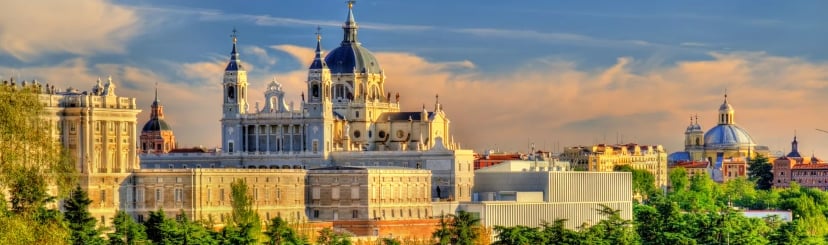
Best nearby commitments: Campo del Moro pairs with the Royal Palace, Almudena Cathedral and the Royal Collections Gallery because all four can answer one question: how the Spanish monarchy represented itself through architecture, objects, ritual and urban position. Use the Royal Palace and Royal Collections Gallery as the object-based counterpart to the garden if the day is intended to connect interior display with exterior setting. The pairing is intellectually coherent even when the final route must be shortened.
Campo del Moro is weaker when the visitor wants a broad survey of garden styles or a long, self-contained landscape day. Its central idea can be understood relatively quickly: palace, slope, axis, water and wooded enclosure. The depth comes from tying those elements to court history and Madrid’s western geography, not from accumulating numerous independent garden episodes.
El Capricho: choose aristocratic authorship and design variety
El Capricho offers the most concentrated landscape-design study of the three. The City Council attributes the garden to the IX Duchess of Osuna and identifies a French parterre, an English landscape garden, an Italian garden and a laurel labyrinth in the surviving composition. The official listing is here: El Capricho de la Alameda de Osuna. The significance of that list is not simply that several styles are present. It is that the garden was designed as an intellectual and sensory sequence in which different ideas about order, nature, leisure and antiquity could be compared within one estate.
The French mode emphasizes geometry and control. The English landscape mode uses irregularity, views and apparent naturalness to produce a different emotional register. The Italian component and classical references connect the estate to a longer culture of villa design. The labyrinth and small architectural incidents turn movement into a series of discoveries rather than a single axial statement. A serious visit should therefore observe transitions: where symmetry gives way to curving paths, where a building arrests the view, where planting conceals and then reveals, and where an apparently playful feature carries an argument about taste or learning.
Patronage is unusually important here because María Josefa Pimentel was not a passive owner attached to a generic country estate. The scholarly source in the evidence plan treats El Capricho as a product of her initiative and cultural world. That gives the garden particular relevance to visitors interested in women’s patronage, Enlightenment sociability and the relationship between aristocratic identity and artistic commissioning. The estate’s design can be read alongside the duchess’s wider role in elite cultural life, while still avoiding the romantic fiction that every surviving detail expresses a single unchanged personal intention.
El Capricho’s small buildings and follies make that interpretive caution necessary. The hermitage, fort, dance casino and other episodes should not be treated as decorative curiosities detached from the route. They create shifts of mood, reference and social use. At the same time, surviving fabric has undergone loss and restoration. A visitor is seeing both historical design and the modern conservation decisions that make parts of it legible.
An April 2026 municipal report records the completion of conservation work on the fort and dance casino, using heritage criteria and traditional techniques and materials compatible with the originals: the city’s restoration report. That recent work is evidence of stewardship, not proof that the garden is frozen in an original state. For a design-minded visitor, restoration itself becomes a question: which surfaces, structures and missing elements have been reconstructed, and how does that intervention guide present-day understanding?
Verified operational position: the municipal listing currently restricts ordinary public opening to Saturdays, Sundays and public holidays. It lists 09:00–21:00 from April through September and 09:00–18:30 from October through March, and describes most principal routes as accessible. These details were verified for this brief on 5 November 2026. Because the schedule is the most restrictive of the three and because individual areas can be affected by conservation or management needs, checking the official page before building the day is essential.
Travel-time consequence: El Capricho sits in Alameda de Osuna, in Madrid’s northeast rather than on the central museum or palace axis. The practical cost is not only the outward journey. A central hotel departure, the garden visit, the return and a fixed museum admission can fragment the day into four timed pieces. That structure is tolerable when El Capricho is the main subject; it is poor value when the garden is treated as an optional add-on that must be abandoned at the first delay.
Mobility consequence: the city’s accessibility description is encouraging but should not be confused with a promise that every feature can be reached by every visitor with equal ease. The estate’s interpretive value is dispersed across routes and architectural episodes. A group that needs a short, step-minimized circuit should decide in advance which design evidence matters most. The correct comparison is not simply “accessible or inaccessible,” but whether the chosen route reaches enough of the parterre, landscape garden and architectural features to answer the study question.
El Capricho is the strongest choice for visitors who want authorship, stylistic contrast and aristocratic cultural history. It is less suitable when the day is already anchored by two central museum admissions, when the visit falls on a weekday, or when the group needs the freedom to enter for only thirty minutes and leave from whichever side best suits the next commitment.
When expert route coordination materially changes the result
El Capricho’s distance and restricted calendar, or Campo del Moro’s palace-area access conditions, can turn a historically coherent idea into a day of missed openings and rushed interpretation. This is the point at which private planning has a concrete purpose: selecting the right entrance, protecting the fixed museum or palace admission, limiting the garden to the evidence that matters, and keeping a nearby substitute ready if access changes. Explore private Madrid touring designed around fixed cultural commitments or Inquire now when the garden must fit a larger art or palace day without reducing either component to a hurried walk.
Mobility and season can change the historical answer
A design preference should survive contact with the visitor’s actual energy, balance, standing tolerance and sensitivity to heat. The most historically compelling garden is not automatically the most legible under every condition.
For limited walking or standing tolerance
Retiro is usually the most adjustable. Its total scale is large, but a route can be bounded around the western palace remnants, the Parterre, the lake or the exhibition buildings. The key is to abandon the idea of “seeing Retiro” as a complete task. A sixty- to ninety-minute thematic circuit can be substantive if it answers one question and uses the nearest practical entrance and exit.
Campo del Moro can be shorter in distance, yet the slope may make it harder. It becomes a good choice when the active entrance and desired palace view can be reached without an avoidable climb. It becomes a poor choice when a group arrives at the wrong level and must use energy simply to correct the approach.
El Capricho requires the most deliberate selection. The outward geography, limited opening and dispersed features reward a visitor who can give the estate time. For a mobility-limited group, the visit should focus on a few connected pieces of evidence rather than on collecting every folly. A design specialist can add value by explaining unseen or inaccessible elements in relation to those that the group can reach, but no amount of commentary compensates for a route that ignores surface and distance.
For hot weather
Summer changes more than comfort. Retiro opens early, allowing a historical route before the busiest and hottest part of the day. Campo del Moro’s 10:00 opening removes that early-morning advantage. El Capricho’s long summer hours create choice, but the return to central Madrid and any later fixed reservation still need margin. Tree cover matters, yet shade should not be the sole criterion: the study depends on whether light, heat and fatigue still allow the visitor to read axes, transitions and architectural details rather than merely seek the nearest bench.
For winter
Shorter opening windows make sequence more important. Campo del Moro closes at 18:00 under the listed winter schedule, and El Capricho closes at 18:30. Lower foliage may reveal structure, sightlines and the relationship between building and ground more clearly, while reducing the lushness that many visitors expect from a garden. Retiro’s flexibility and central location make it the easiest winter fallback when a museum day overruns.
For spring and autumn
These seasons often provide the most balanced conditions for close looking, but they also encourage overplanning because a garden visit feels effortless on paper. El Capricho still needs a weekend or public holiday. Campo del Moro still depends on its controlled entrances. Retiro still covers more ground than most visitors estimate. Seasonal color can sharpen the experience, but the design question should remain primary: formal geometry, palace framing, or stylistic and symbolic variety.
For uncertain weather or official activity
Campo del Moro’s official page explicitly allows for changes because of weather and official events. Municipal parks can also restrict areas during hazardous conditions or works. A resilient plan keeps the substitute geographically close: palace-quarter interiors for Campo del Moro, museum-axis institutions for Retiro, and a completely different northeast or indoor plan for El Capricho rather than an urgent return across the city for a timed admission.
Pair each garden with the site that completes its argument
The best pairing is not always the nearest attraction. It is the place that supplies the evidence the garden lacks.
Retiro with the Prado, Thyssen or the former palace remains
The Prado complements Retiro because the museum preserves court collections while the park preserves the altered ground of a royal site. The pairing makes a large historical transition visible: objects once formed under monarchy now belong to a public museum, while a former royal estate functions as civic space. A focused visit can connect court representation inside the museum to the missing architecture and later public monuments outside.
The Thyssen works well when the day starts around Cibeles or the northwestern edge of Retiro. The Reina Sofía works when the route uses the southern side and does not require an unnecessary return north. In each case, the entrance and exit should be chosen around the museum rather than around an abstract “main gate.” Retiro’s flexibility is most valuable when it serves this broader geographic logic.
A three-day stay can place Retiro on the museum day rather than giving it an isolated half-day. See how Retiro can sit within a wider three-day Madrid sequence while still giving the garden a defined interpretive purpose.
Campo del Moro with the Royal Palace and Royal Collections Gallery
This is the most direct pairing because the garden and buildings share a royal subject. The palace interiors explain ceremony, dynastic continuity and decorative programs. The Royal Collections Gallery adds objects, patronage and the institutional afterlife of the crown’s holdings. Campo del Moro then shifts the question outward: how did the palace occupy the city’s western edge, and how did the landscape magnify its authority?
Sequence matters. Beginning below in the garden can make the palace’s scale intelligible before an interior visit. Beginning inside the palace can make the garden feel like an architectural epilogue. Neither order is universally superior. The first favors spatial understanding; the second favors recognition of royal symbols already encountered indoors. Opening hours, ticket times and mobility decide which interpretation is feasible.
Almudena Cathedral can be included because it explains the religious and ceremonial platform around the palace, but it should not displace the garden’s central question. Plaza Mayor and the Austrias are historically connected to monarchy, yet adding them creates a broader urban-history day rather than a focused garden study.
El Capricho with a house-museum or women’s-patronage study
El Capricho has fewer obvious central neighbors, so its best pairings are often thematic rather than adjacent. A separate visit to Liria Palace, the Museo Cerralbo or the Museo Lázaro Galdiano can extend the question of aristocratic collecting and domestic display. The comparison should be made across the stay, not forced into the same tightly timed day. Choose a Madrid house museum by collection, interior and access to complement the garden’s outdoor evidence.
For women’s patronage, El Capricho can be placed in conversation with convent foundations, palace collections and works commissioned or collected by elite women. The point is not to manufacture a single seamless narrative, but to compare the different mechanisms through which women could shape spaces and objects within courtly and aristocratic systems.
Geographically, the wisest same-day companion is usually a modest nearby commitment or an evening plan with generous margin. The estate is too important to be reduced to a transit stop, and the central museum district is too important to be approached with an optimistic return time.
When none of the three is the right royal-garden answer
A visitor seeking irrigation systems, long dynastic continuity, hunting landscapes or a more expansive court retreat may need to leave central Madrid. Aranjuez, La Granja and El Pardo answer different royal questions with greater scale and stronger links to court function beyond the capital’s urban park system. Compare El Pardo, Aranjuez and La Granja by court function, gardens and road time before assuming that a central garden must carry every aspect of Spanish royal landscape history.
What the available time actually buys
Under ninety minutes: choose a bounded Retiro study or Campo del Moro if the relevant entrance is open and the palace quarter is already part of the day. Do not choose El Capricho unless you are already nearby and the visit is the main purpose; the outward geography would consume too much of the intellectual value.
Two to three hours: Retiro can support a clear theme plus a nearby museum edge, while Campo del Moro can be paired with one palace-quarter institution. El Capricho can work only when this window refers to time on site rather than the entire round trip from central Madrid.
A half-day: El Capricho becomes a strong candidate, particularly for landscape-design specialists, repeat visitors and those studying women’s patronage. Retiro also supports a half-day when the route includes the lost palace remains, nineteenth-century exhibition architecture and the Enlightenment axis. Campo del Moro rarely needs the whole half-day by itself; its depth usually comes from the palace or collections pairing.
A day with one fixed museum admission: choose the garden in the same cultural geography. Prado, Thyssen and Reina Sofía point toward Retiro. Royal Palace and Royal Collections Gallery point toward Campo del Moro. El Capricho is appropriate only when the museum time leaves a large, protected block and the garden’s weekend opening is confirmed.
A weekday: Retiro or Campo del Moro. Under the currently verified public schedule, El Capricho is not an ordinary weekday option.
A weekend with no central reservation: El Capricho deserves priority if design history is the point. Retiro remains preferable when flexibility matters more than concentration, and Campo del Moro when the palace landscape is the central thesis.
Conditions that should reverse your initial choice
- You chose El Capricho for design depth, but the date is a weekday. Move it to a weekend or public holiday rather than substituting a hurried central park and pretending the subject is unchanged.
- You chose Campo del Moro because it appears closest to the palace, but the group cannot manage sustained grades. Confirm the entrance and accessible line first. If that route is unavailable, use the palace platform and Royal Collections Gallery for the day’s royal argument and reschedule the garden.
- You chose Retiro after the Prado, but the museum visit is already long. Cut the park to one meaningful episode: former palace evidence, the Parterre, or one nineteenth-century exhibition building. A short, coherent route is better than a fatigued circuit.
- You chose El Capricho and also booked a central museum at a tight time. Protect one subject. Either give El Capricho the half-day it merits or keep the museum and choose a central garden. The apparent efficiency of combining both can erase the interpretive value of each.
- You chose Campo del Moro for an early start. Its listed 10:00 opening makes it unsuitable as a dawn or very early morning anchor. Retiro is the garden with the broad early window.
- You chose by season alone. Recheck the historical purpose. Blossoms, foliage or shade can enrich a visit, but they do not determine whether the site answers a question about royal transformation, palace representation or aristocratic design.
- You want a complete, unchanged historic garden. None of the three should be presented that way. Retiro is heavily layered, Campo del Moro reflects later intervention, and El Capricho includes restoration and altered fabric. Their value lies in reading survival, change and stewardship honestly.
A concise decision path for repeat visitors
Start with the object of study. For court-to-city transformation, choose Retiro. For the palace as a landscape image, choose Campo del Moro. For stylistic comparison and an individual aristocratic patron, choose El Capricho.
Then test the calendar. If the date is a weekday, remove El Capricho under the current public-opening regime. If the visit is early morning, Retiro has the useful window. If weather or official activity may affect the palace estate, keep a nearby indoor alternative for Campo del Moro.
Then test mobility. Retiro offers the most ways to shorten, but not the least total distance. Campo del Moro offers a bounded subject, but not a level one. El Capricho offers many accessible principal routes, but its full intellectual payoff is distributed across a destination visit.
Finally, test the fixed commitment. Let museum and palace geography decide the sequence. The Prado side of the city supports Retiro. The Royal Palace platform supports Campo del Moro. El Capricho should usually stand on its own rather than being subordinated to a central admission.
The final choice
Retiro is the right garden for the broadest range of Madrid days, but not because it is automatically “best.” It wins when flexibility, museum-axis geography and the history of a royal site becoming civic space are the central concerns. Its challenge is intellectual: the visitor must distinguish seventeenth-century origins from later architecture, monuments and public uses.
Campo del Moro is the right garden when the Royal Palace must be understood from the land below. Its palace view, slope and controlled access make it a precise study of royal representation. Its challenge is practical: proximity on a map conceals vertical separation, seasonal hours and the possibility of access changes.
El Capricho is the right garden for the most focused design study. The IX Duchess of Osuna’s patronage, the coexistence of French, English and Italian modes, the sequence of follies and the evidence of modern conservation create the richest conversation about aristocratic landscape culture. Its challenge is geographic and calendrical: it needs a weekend or public holiday and enough protected time to justify the journey.
Choose the garden that preserves the question, not merely the one that fills an empty hour. Madrid’s three landscapes become more legible when they are treated as evidence of different political and social worlds: a royal estate remade as civic ground, a palace framed by its western terrain, and an aristocratic villa built as an environment of taste, learning and discovery.
If you’re interested in any private tours of Madrid, please reach out to us.



 So if you are looking for the absolute best in Madrid & surroundings with authentic local fully-licensed native guides whose English you can actually understand and with an exclusive and amazingly fun itinerary













